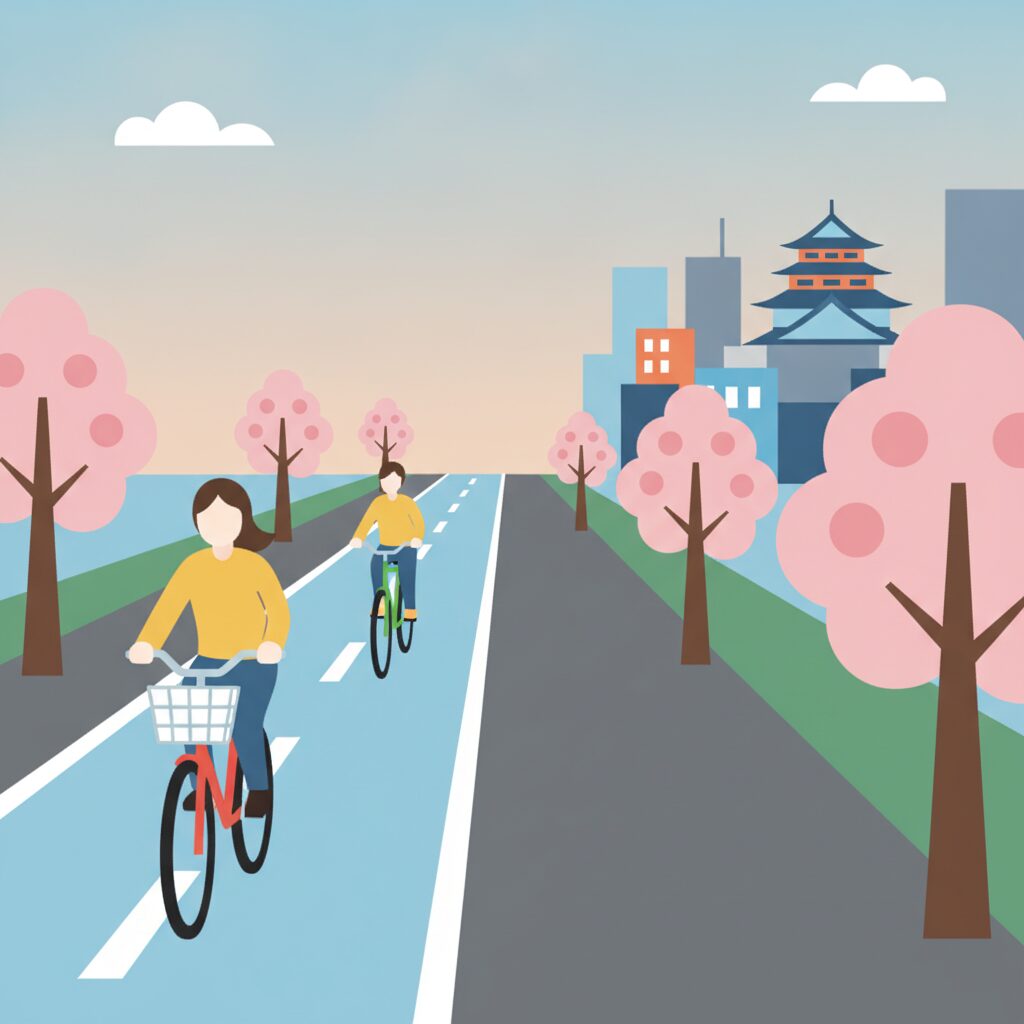
Welcome to Osaka. You’ve probably noticed them by now. They are a constant, a silent river flowing through the city’s arteries, a metallic flock that glides, swerves, and occasionally careens through the urban landscape. I’m talking about bicycles. Not the sleek, carbon-fiber frames of weekend warriors, but the heavy, workhorse machines of daily life: the mamachari with its wicker basket, the rusty single-speed leaning against a vending machine, the electric-assist bike carrying two kids and a bag of groceries. In many cities, cycling is a choice—a hobby, a workout, a green alternative. In Osaka, it is the default. It’s the city’s circulatory system, and if you plan on living here, you will inevitably become part of the flow. But here’s the reality check you won’t find in any official guide: the rules of the road are not the rules of the street. What is written in law and what is practiced in life are two entirely different universes. You see a sign depicting a bicycle in a neat, orderly lane on the street, but you witness a grandmother in a sun visor weaving through pedestrians on a crowded sidewalk with the grace of a seasoned bullfighter. This isn’t lawlessness. It’s a different kind of law. It’s a complex, unspoken, and deeply pragmatic system of etiquette born from the city’s geography, its history, and the very character of its people. To understand the chaos of Osaka cycling is to understand the soul of Osaka itself—a place that values efficiency over formality, intuition over rigid instruction, and a shared, unspoken understanding over everything else. This is your guide to navigating that beautiful, terrifying, and utterly Osakan ballet.
In the midst of Osaka’s unspoken cycling etiquette, regional changes such as the luxury accommodation boom reflect the broader economic transformation shaping Kansai’s urban identity.
The Holy Trinity of Osaka Cycling: Sidewalk, Bell, and the Weave
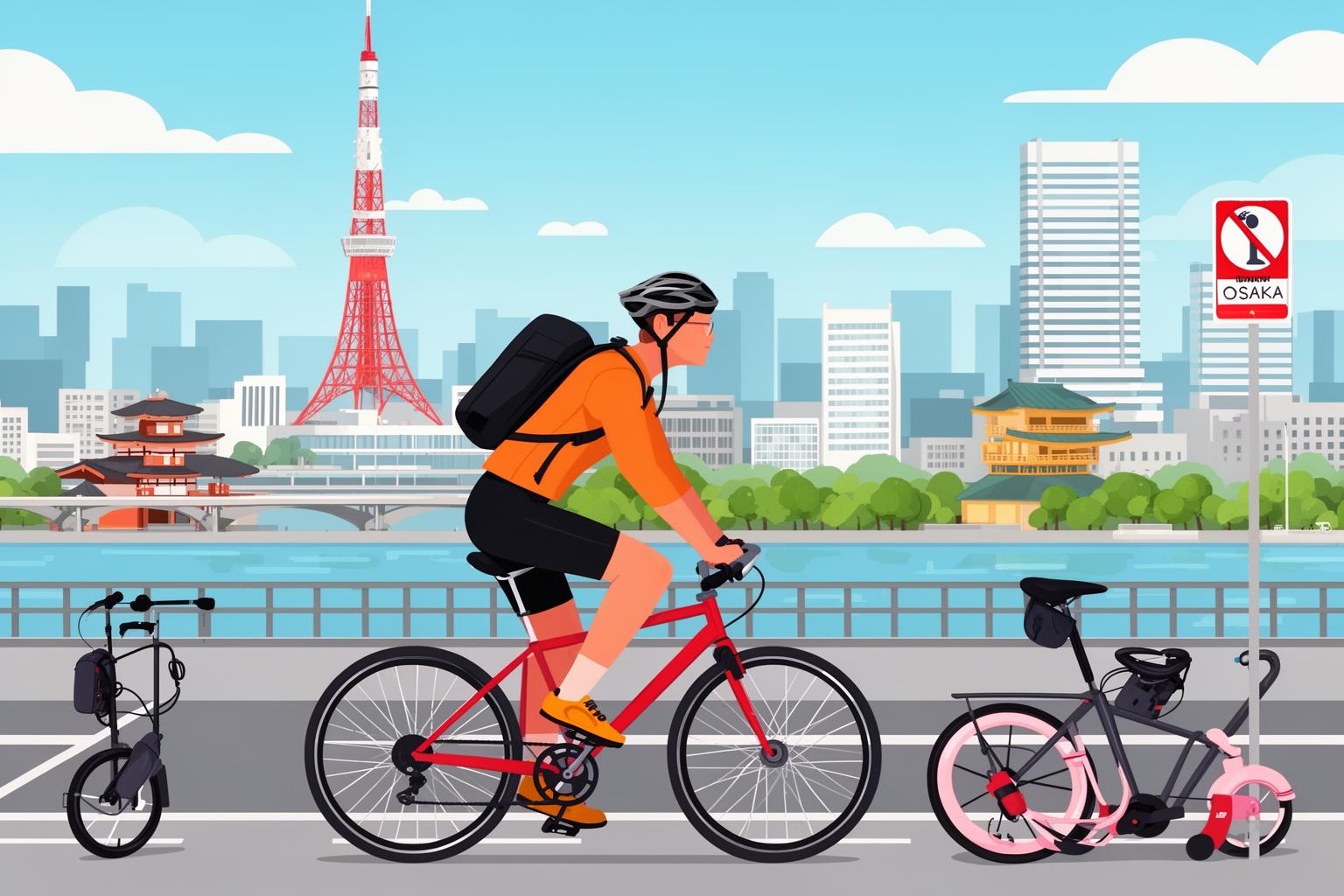
To start learning about Osaka’s two-wheeled dynamics, you first need to unlearn what you think you know. The neat diagrams from the licensing center? Put them aside. The fundamental principles of cycling in Osaka aren’t found in a manual; they are seen, absorbed, and ultimately mastered through daily experience. These principles center on a trio of tools and techniques that define the interaction between rider, pedestrian, and the urban landscape.
Sidewalks Aren’t Just for Walking: The Unspoken Permission
Your first major moment of cognitive dissonance will come when you realize that most cycling actually takes place on the sidewalk. Officially, Japanese law states that bicycles, as vehicles, belong on the road, with sidewalks reserved only for children, the elderly, or where signs allow. In Osaka, this rule is practically reversed. The sidewalk is the norm, and the road is the exception, generally used only by confident cyclists on multi-lane boulevards or on rare, quiet side streets.
Why is this? The reason is pure practicality. Osaka’s streets are a chaotic mix of narrow lanes, aggressive taxi drivers, and massive delivery trucks. Dedicated bike lanes are scarce. For the average person riding a clunky mamachari, taking to the asphalt feels like a death wish. The sidewalk, therefore, effectively becomes a cycling highway out of necessity. It’s a collective, unspoken understanding that safety and convenience take precedence over strict legality. This immediately distinguishes Osaka from Tokyo. While sidewalk cycling is also common there, it often carries a sense of hesitation. In Tokyo, there’s a feeling of “I probably shouldn’t be doing this.” In Osaka, it’s a confident “This is where the bike belongs.”
This creates a fluid, constantly shifting hierarchy. Pedestrians technically have the ultimate right of way, but in reality, it’s more of a negotiation. The unwritten rule is that the faster, more agile party—the cyclist—is responsible for maneuvering around the slower party—the pedestrian. You are expected to anticipate, swerve, and weave. You don’t command the space; you borrow it, bit by bit, as you glide through the crowd.
The Bell is Not a Warning, It’s a Declaration
In most cultures, the humble bicycle bell is used for urgent alerts, but in Osaka it serves a very different role. It’s not a panicked “Watch out!” but a calm, informative “I am here.” It’s a punctuation mark in the city’s soundscape, a gentle chirin-chirin that acts as an auditory cue for the complex dance on the sidewalk.
You ring it when approaching a pedestrian from behind, not to startle but to gently let them know a bicycle is nearby. This helps them maintain a steady, predictable path, creating an invisible corridor for you to pass through. You also use it when rounding a blind corner, a quick tap to announce your presence to anyone emerging.
The nuance lies in the way it’s delivered. A single, polite chirin from a distance serves as a friendly heads-up. A rapid series of insistent CHIRINCHIRINCHIRINs is the cycling equivalent of honking loudly. It means “You are being unpredictable, please choose a path so I can get by!” It’s not necessarily angry, but it’s direct and impatient—a very Osaka style of communication. The bell is a tool of efficiency, helping smooth the flow and prevent the awkward sidewalk dance where two people hesitate left and right, blocking each other. It cuts through uncertainty.
The Art of the ‘Sumimasen’ Weave
This is where the physical skill comes in—the technique that ties everything together. The Weave is the delicate, instinctive process of weaving your bicycle through a dense crowd of pedestrians in a shopping arcade or busy plaza. It showcases the human brain’s ability to process dozens of moving variables simultaneously.
You learn to read body language, predict the moves of the salaryman checking his phone, the couple pausing at a shop window, the child about to chase a pigeon. Your path isn’t a straight line but a flowing, organic curve that seeks the path of least resistance.
Accompanying this movement is a soft, almost subliminal vocalization: a muttered “sumimasen.” This isn’t an outright apology. It’s a versatile social lubricant. It conveys “excuse me,” “pardon me for squeezing by,” and “thank you for not making a sudden move” all at once. It’s a verbal acknowledgment that you’re temporarily encroaching on pedestrian space. Mastering the Sumimasen Weave means you’ve internalized Osaka cycling’s core principle: you share a crowded space, and your right to move efficiently depends on your ability not to inconvenience others. It’s a high-stakes, low-speed negotiation that plays out thousands of times daily on every sidewalk in the city.
Mamachari, the Unsung Hero and Sidewalk Tank
To truly understand the rhythm of Osaka’s streets, you must appreciate the chariot of choice: the mamachari. This is more than just a bicycle; it serves as the foundation of neighborhood life, a symbol of refined Japanese practicality, and, when navigating sidewalks, a formidable force demanding respect.
More Than a Bike, It’s a Life Support System
The name literally means “mom’s chariot,” which is a fitting description. The typical mamachari is a masterpiece of functional design. It boasts a low, step-through frame for easy mounting, even while wearing a skirt. It features a large front basket for groceries and a sturdy rear rack, often equipped with a child seat. In fact, it’s common to see one outfitted with two child seats—one at the front and one at the back—turning it into a veritable family transport vehicle. Accessories are standard: a built-in lock, a dynamo-powered headlight, a kickstand robust enough to keep the bike upright when loaded with thirty kilograms of rice and vegetables, and, importantly, a handlebar clamp designed to hold an umbrella.
This bike isn’t for leisure. It’s a tool. It transports children to daycare, handles supermarket runs, carries riders to the train station, and visits friends across town. For many Osaka households, the mamachari functions as a replacement for the second car, or even the first. This reflects the Osakan mindset: why pay for insurance, parking, and gasoline when this durable, affordable machine can manage 90% of your daily errands? It epitomizes cost-efficiency, a concept close to the Osakan heart. This choice isn’t driven by eco-consciousness; it stems purely from straightforward, practical reasoning.
The Physics of a Fully-Loaded Mamachari
Grasping the mamachari’s role is essential to understanding its presence on sidewalks. A mother cycling with a toddler in the front seat, a five-year-old in the back, and a basket full of groceries is no agile machine. It’s a sidewalk tank. It possesses tremendous inertia. It cannot stop suddenly. Its turning radius is broad.
That’s why you learn to give them space. Seasoned pedestrians and other cyclists instinctively recognize a fully-loaded mamachari and respect its limitations. They pause, step aside, and let it pass, knowing the rider isn’t out for a joyride; she’s engaged in an essential logistical task. Her journey is non-negotiable.
This creates a fascinating, unspoken hierarchy among sidewalk users. At the top is the mother carrying multiple children on her bike. Next are the elderly, granted respect due to age. Then come other adult cyclists, and finally, able-bodied pedestrians. This isn’t a strict order but an intuitive understanding of need and momentum. You learn to assess the situation quickly: that mamachari is heavy and commands the right of way because of physics. That high school student on a lightweight bike can easily swerve. This constant, subconscious calculation becomes a mental muscle that strengthens the longer you live here. It’s a form of collective, kinetic empathy.
Where Rules Bend and Break: Intersections, Parking, and the Rainy Day Umbrella
If the sidewalk is where the unwritten rules of negotiation unfold, then intersections and parking zones are where official regulations are most visibly and boldly bent. Here, the Osakan spirit of efficiency comes into direct conflict with the Japanese national obsession with order, and efficiency nearly always prevails.
Red Lights Are More of a Suggestion
Let’s confront the obvious: red lights. In much of Japan, a red light is absolute. You stop and wait. In Osaka, however, many cyclists treat a red light as a yield sign. This behavior is perhaps the most surprising for newcomers, especially those from Tokyo, where such an act would attract horrified stares.
From an Osakan viewpoint, the reasoning is straightforward and compelling: if no cars are coming and no pedestrians are crossing, why waste time waiting? Time is a resource. Stopping unnecessarily is inefficient. So the cyclist slows down, carefully scans the intersection—left, right, left again—and if it’s clear, proceeds through the red without hesitation. This is known as the infamous “Osaka Stop.”
It’s important to understand that this is not (usually) done recklessly. There’s a risk assessment involved. A cyclist won’t speed through a large, multi-lane intersection against the light. But a small neighborhood crosswalk with perfect visibility? The urge to keep moving is often too strong to resist. This behavior epitomizes the Osaka worldview: rules serve as guidelines for general safety, but when a rule is clearly unnecessary in a specific situation, individual judgment and efficiency take precedence. It’s a profound cultural distinction that favors situational logic over strict protocol.
The Parking Pandemic: Bicycles as Urban Vegetation
Approach any train station in Osaka, and you’ll be greeted by a remarkable sight of bicycle parking. They gather in dense, metallic clusters, chained to every guardrail, fence, and signpost available. They line the walls of shopping arcades and fill the plazas in front of supermarkets. They appear to emerge from the concrete like a hardy form of urban vegetation.
Official paid bicycle parking lots exist, naturally. Yet they’re often full, somewhat inconvenient, or require a small fee. For Osakan cyclists, the entire city is potential parking space, governed by a complex, invisible set of rules. The real law isn’t what the signs declare, but what the community tolerates. Parking here, by this convenience store, is acceptable. But parking there, in front of that apartment entrance, will earn you a scolding note or worse, lead to your bike being hauled away by the city’s removal trucks—the ultimate embarrassment of trekking to a distant impound lot to pay a fine and retrieve your ride.
This system operates on minimizing meiwaku (bother or inconvenience). Blocking tactile paving for the visually impaired breaks the rule. Preventing a shop owner from raising their shutter breaks the rule. Simply leaning a bike against a public wall, out of traffic’s way, is usually fine. This turns the act of parking into a constant social and spatial calculation, another example of how Osakans prefer fluid, community-enforced norms over rigid, top-down regulation.
The One-Handed Umbrella Technique: A Lesson in Reckless Elegance
When it rains, a new level of cycling skill emerges. Observe the incredible sight of a person steering their bicycle with one hand while holding a full-sized umbrella in the other, navigating a wet, crowded sidewalk. This is the kasa-sashi unten, or “umbrella-holding riding.” It’s technically illegal and undeniably risky. Yet it remains stubbornly and universally common.
Again, the reasoning is practical. Ponchos are cumbersome and cause sweating. Raincoats are a hassle to put on and remove. Umbrellas are quick, easy, and keep your hair dry. So the umbrella wins. Mastering this technique—balancing against the wind, steering with subtle body shifts, while avoiding pedestrians and puddles—is a rite of passage.
It’s a stunning, perilous display of skill and a deep-rooted belief in managing one’s own risk. It embodies the Osakan “get it done” mentality. The problem is rain, the goal is to get from A to B without getting wet, and the solution is the umbrella. The risk of disaster is just another factor to manage. It perfectly reflects the city’s approach to life: don’t let a few rules or a little bad weather slow you down.
The Social Contract: What Holds the Chaos Together?
With so many rules being bent, broken, or ignored, it’s easy to think the system is pure anarchy. But it isn’t. A powerful, invisible order prevents the city from devolving into a daily demolition derby. This order is upheld not by the police, but through a deeply ingrained social contract enforced by the citizens themselves.
The Glare, The Tut, and The Unspoken Judgment
How is the system maintained? Through a subtle yet powerful set of social cues. If you truly transgress—cut someone off too closely, nearly hit a child, or ring your bell with genuine aggression—you will face consequences. The punishment won’t be a ticket. Instead, it will be a sharp, withering glare from an elderly woman, an audible “tch!” of disapproval from a man you just passed, or a muttered “abunai!” (dangerous!) from a pedestrian forced to jump aside.
This is the enforcement mechanism. It’s highly effective because it directly judges your ability to function as a considerate member of society. In Japan, especially in the community-focused culture of Osaka, this social pressure is a stronger deterrent than any official fine. This is where the line is drawn. Bending a rule for efficiency (like running a clear red light) is often tolerated, but breaking the social contract by endangering or seriously inconveniencing someone is not. Osakans have a finely tuned radar for this distinction.
Spatial Awareness as a Sixth Sense
The apparent chaos of Osaka’s sidewalks compels everyone—cyclists and pedestrians alike—to operate with an elevated level of awareness. You can’t just put on headphones, stare at your phone, and expect the world to clear a path for you. Doing so invites collisions. Instead, you develop an urban sixth sense.
You learn to walk with an acute sense of the space around you, to listen for the faint chirin of an approaching bell, and to sense the crowd’s flow. As a cyclist, you constantly scan your surroundings, processing dozens of data points every second. It’s an intense, active form of transit. This contrasts sharply with cities where infrastructure—lanes, signals, barriers—manages interactions for you. In Osaka, responsibility is shared and decentralized. You must be an active, aware participant in the system. The chaos functions because everyone pays attention.
What Foreigners Get Wrong
Navigating this system as a newcomer often leads to misunderstandings. There are a few common missteps. The first is trying to be a model citizen by strictly following the official rules. Insisting on riding on a narrow, busy road because the law says so confuses and angers drivers, who expect you on the sidewalk with everyone else. You become a dangerous anomaly.
The second mistake is misreading the local communication style. The bell, the speed, the assertive weaving—it can seem aggressive or rude to outsiders. But it’s almost never personal. It’s the language of efficiency, the established way to negotiate shared space. It’s a signal, not an insult.
The final and most dangerous error is assuming that because some rules are broken, all rules are irrelevant. This is false. There is a deep, powerful, and consistent logic at work. The cardinal rule underpinning everything is this: be efficient, but do not cause meiwaku. Don’t endanger others, block the way, or create problems. The entire system of weaving, bell-ringing, and yielding upholds this single principle. Mastering Osaka cycling isn’t about recklessness; it’s about learning to read the unwritten rules that maintain delicate, chaotic harmony.
A Practical Guide for the Aspiring Osaka Cyclist
So, you’re ready to join the flow. It’s the best way to truly see and experience the city. But before you start, a few practical tips can ease your transition from cautious observer to confident participant.
Choosing Your Ride: Mamachari vs. The World
While any bike will work, the type you choose sends a social signal. A sleek, lightweight road bike with drop handlebars is fine, but it marks you as either a hobbyist or a serious commuter. You’ll be faster, but you might feel out of place weaving through a crowded market. The mamachari or a similar city bike is the native choice. Its upright posture offers better visibility, the basket is invaluable, and its sturdy frame can handle the occasional bump off a curb. Choosing the local ride is the first step toward blending into the local ecosystem.
Mastering the Fundamentals
Before you tackle the main streets, practice the essential skills. First, master the ultra-slow roll. Learn to ride at a walking pace without wobbling. This is crucial for navigating shotengai (covered shopping arcades), where you’ll share the lane with many pedestrians. Second, develop the peripheral vision scan. Keep your head on a gentle, constant swivel. Train yourself to notice movement in your periphery—a car door about to open, a cyclist emerging from an alley, a delivery person stepping into your path. Third, maintain a non-committal path. When riding on the sidewalk, avoid hugging the wall or curb. Stay roughly centered in the available space. This gives you room to swerve left or right as needed, making you more adaptable to the unpredictable movements of others.
The Golden Rule: Predictability is Kindness
If you take away only one thing, let it be this: the entire chaotic system depends on predictability. People can weave around you with impressive precision, but only if you act as they expect. Walk in a straight line. Cycle in a straight line. Avoid sudden stops or turns without a clear reason. Your goal as a newcomer isn’t to be fast or daring. It’s to be a predictable, consistent part of the flow. Don’t be a rock that blocks the current; be a drop of water that flows with it.
Do this, and you’ll find your place. The chaos will begin to feel less like chaos and more like the intricate, self-organizing system it truly is. You’ll sense the rhythm of the street, the silent communication among strangers, the hum of a city that has perfected the art of getting things done. You’ll learn more than just how to ride a bike in Osaka. You’ll learn to see the city as locals do: as a place where the best path forward isn’t always written down, but is discovered together.