
Step off the train in Osaka, and the first thing you notice isn’t the flashing lights of Dotonbori or the sheer scale of Umeda Station. It’s the sound. There’s a different rhythm here, a certain cadence in the way people speak. It’s faster, more energetic, and punctuated by sudden bursts of laughter. Coming from anywhere else in Japan, especially the polished, quiet hum of Tokyo, it can feel like you’ve walked into the middle of a city-wide performance. And in a way, you have. I used to wonder what the secret was. Why did a simple chat about the weather between two neighbors feel so much more… alive? Was everyone an aspiring comedian?
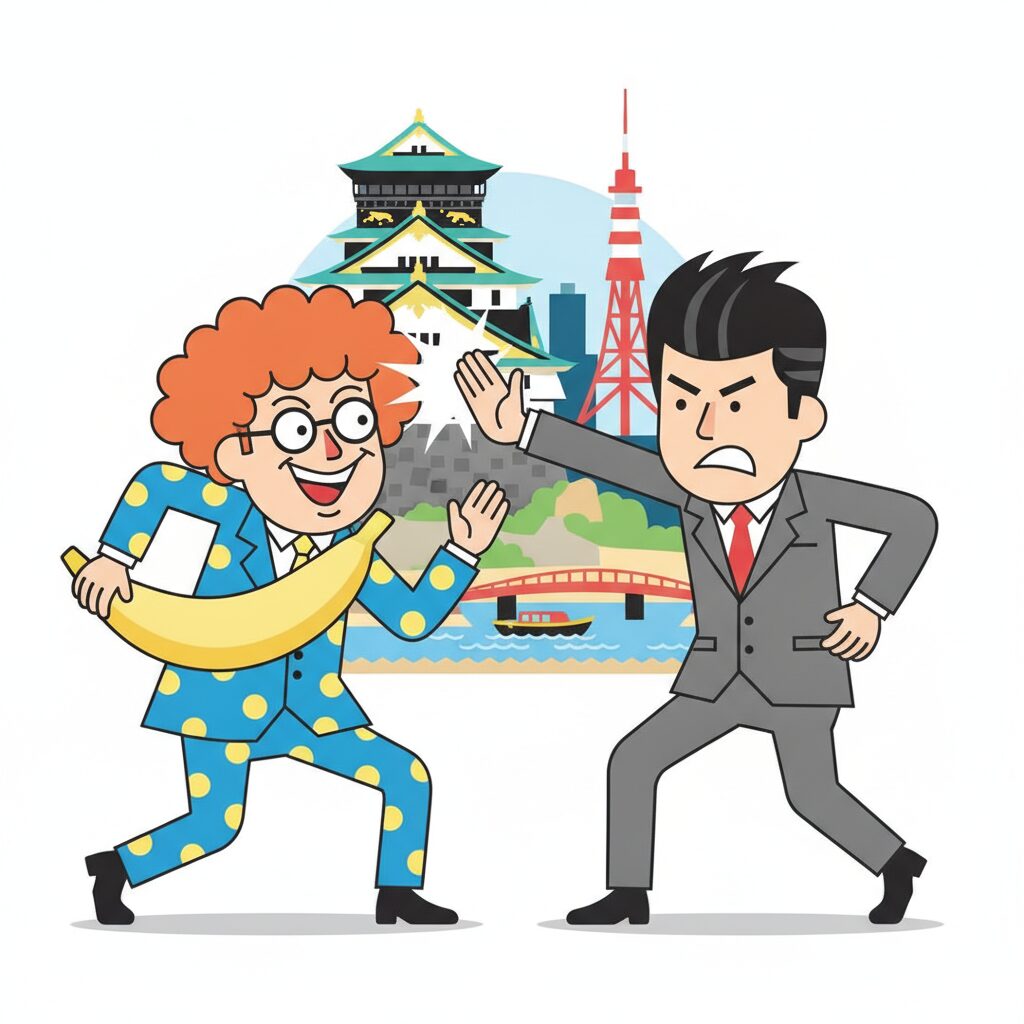
The answer, I discovered, isn’t on a stage but in the very DNA of Osakan communication. It’s a comedic duo routine called manzai, but stripped of the spotlights and microphones. It’s built on two roles: the boke, who plays the fool, and the tsukkomi, the sharp-witted straight man who calls out the nonsense. This isn’t just for the famous comedy duos from the Yoshimoto Kogyo theater. This is the invisible blueprint for how people connect here, every single day. It’s the key to unlocking the playful, direct, and deeply human spirit of Osaka. Forget your formal Japanese textbook phrases for a moment. To truly understand this city, you need to learn the steps to its favorite dance: the boke and tsukkomi two-step.
Osaka’s lively street banter is just one side of the story, as the region also grapples with practical concerns like hotel labor shortages in Kansai that underscore its multifaceted character.
The Unspoken Rules of the Osaka Two-Step
Before you can recognize this dynamic in real life, you need to grasp the basic mechanics. At first glance, it might seem like a simple joke and punchline pattern or even a mild argument. However, it’s much more subtle than that. It’s a collaborative effort, a game where both participants know their roles and cooperate to create a moment of shared amusement. It’s less about one person being funny and more about two people generating fun together.
What is ‘Boke’ and ‘Tsukkomi’ Anyway?
Let’s break down the roles. The boke (ボケ) stems from the verb bokeru, which can mean to become senile or act airheaded. The boke is the one who delivers the absurd line. They might pretend ignorance, make a wild exaggeration, or state something completely ridiculous with a straight face. The key is that it’s intentional. The boke isn’t genuinely foolish; they are skillfully creating a comedic opportunity, setting up a conversational softball for their partner to hit.
Then there’s the tsukkomi (ツッコミ). The verb tsukkomu means to thrust or poke into something. The tsukkomi is the one who “pokes into” the absurdity of the boke’s statement. They serve as the voice of reason, the sharp corrector, the person who brings the conversation back to reality with a witty comeback. In stage comedy, this often comes with a swift, harmless smack to the boke’s head using a paper fan, but in everyday life, the tsukkomi is purely verbal. It’s a quick, sharp, and perfectly timed response.
Imagine you’re with a friend, looking at the famous Glico Running Man sign in Dotonbori. A classic exchange might go like this:
- Your Friend (Boke): “Wow, look at that guy. He’s been running for hours. He must be exhausted.”
- You (Tsukkomi): “It’s a sign! He’s not real! What are you even talking about?!”
See? The boke sets up a ridiculous premise, and the tsukkomi quickly knocks it down. The result is a small spark of shared laughter—a moment of connection born from playful back-and-forth.
It’s Not an Argument, It’s a Dance
A crucial point for any foreigner navigating Osaka is this: a tsukkomi is not an insult. When you first hear it, the directness can be surprising. Someone makes a joke, and their friend immediately shoots it down with a sharp “No way!” or “That’s dumb!” To an outsider, it might sound like dismissive or even aggressive criticism. You might think, “Wow, that was a bit harsh.”
But that’s a complete misunderstanding of the situation. In Osaka, a good tsukkomi is a sign of affection. It shows the other person was listening carefully, understood the joke, and cares enough to play along. Ignoring a boke—just smiling politely or changing the subject—is actually the cold and distant response. It silently says, “I’m not on your wavelength” or “I don’t know you well enough to joke around.”
Receiving a tsukkomi means you’ve been accepted. It shows the other person is comfortable enough with you to engage in this rapid-fire verbal game. It’s a rhythmic dance, not a debate. The goal isn’t to win an argument but to keep the conversational ball bouncing, creating a lively and energetic atmosphere. It’s a social lubricant that says, “We’re friends, we get each other, and we don’t need to stand on ceremony.”
Boke & Tsukkomi in the Wild: Real-Life Sightings
Once you recognize what to watch for, you’ll begin noticing this dynamic everywhere. It’s the hidden soundtrack of the city, unfolding through countless small interactions that give life here its vibrant pulse. It’s not limited to close friends; it’s a public language shared by strangers, shopkeepers, and colleagues to bridge gaps and share a laugh.
At the Supermarket Checkout
The local supermarket serves as a perfect stage for witnessing everyday boke and tsukkomi. Imagine a middle-aged woman (obachan) at the checkout counter placing an enormous daikon radish on the belt. The younger cashier scans it.
- Obachan (Boke, sighing dramatically): “Ah, my weapon for tonight’s dinner battle.”
- Cashier (Tsukkomi, without missing a beat): “A weapon? Fighting ninjas or just making soup? Be careful not to break the table with that thing!”
The obachan chuckles, the cashier smiles, and the person waiting behind them grins. A routine transaction has turned into a mini-skit. This exchange isn’t about efficiency; it’s about connection. The cashier isn’t just a service worker; she’s a fellow participant in life’s daily comedy. This kind of interaction makes you feel like part of a community, not just an anonymous customer.
In the Office Breakroom
The workplace, often a bastion of formality in Japan, is not exempt from the charm of Osaka banter. Picture a young salaryman entering the breakroom, looking utterly exhausted after a long meeting.
- Exhausted Salaryman (Boke): “I think I just aged ten years in that meeting. I need to start planning my retirement.”
- Older Colleague (Tsukkomi, stirring her coffee): “Only ten? From the look on your face, I thought you were about to start collecting your pension! Pull yourself together, we still have three hours to go.”
Again, this isn’t a harsh jab at the younger colleague’s fatigue. It’s encouragement wrapped in humor. It’s a way to say, “I see you’re tired, we’ve all been there, so let’s laugh about it and get through the day.” This playful teasing breaks down hierarchical barriers and fosters camaraderie you might not find in a more reserved Tokyo office. It’s team-building, Osaka-style.
Ordering at an Izakaya
This dynamic is most alive among a group of friends out for drinks. The beer flows, the food arrives, and the conversation buzzes. One friend, known for a big appetite, scans the menu with intense focus.
- Hungry Friend (Boke, with utmost seriousness): “I think I’ll just start with something small… maybe the family-sized fried chicken platter and a large rice.”
- Another Friend (Tsukkomi, snatching the menu away): “‘Small?’ Is a family of bears joining us that I don’t know about? Order for yourself, not a whole village! We all need to eat, you know!”
Laughter erupts around the table. The boke has been perfectly set up and expertly delivered. This is the sound of friendship in Osaka — loud, teasing, built on mutual understanding. The jokes aren’t attacks; they’re affirmations of the group’s bond.
Why Osaka? The Cultural Roots of Conversational Comedy
This distinctive communication style didn’t emerge spontaneously. It is deeply embedded in the city’s history and identity, shaped by centuries of trade, commerce, and a friendly rivalry with its eastern counterpart, Tokyo.
A Merchant City’s Legacy
For much of its history, Osaka served as Japan’s commercial hub, known as the “nation’s kitchen.” It was a city of merchants (shōnin), where success depended not only on the quality of your goods but also on your ability to cultivate relationships. In a competitive market, being quick-witted, personable, and memorable was essential. Humor was a powerful tool—a sharp joke could ease tensions during negotiations, clever banter could establish rapport with new customers, and a reputation for approachability could secure loyal clients.
This merchant culture valued pragmatism and directness over strict formality. The aim was to bridge gaps between people, find common ground, and get things done. The boke and tsukkomi dynamic perfectly embodied this approach—it’s fast, engaging, and fosters an immediate connection. This legacy continues today, with Osakans still valuing straightforwardness and a good sense of humor as vital life skills.
Tokyo Formality vs. Osaka Frankness
The contrast with Tokyo is striking and sheds light on Osaka’s mindset. Tokyo, as the seat of the shogunate and later the imperial government, developed a culture grounded in samurai tradition and bureaucratic formality. Communication tends to be more indirect, emphasizing harmony (wa) and respect for social hierarchy. The concepts of tatemae (one’s public facade) and honne (one’s true feelings) are carefully balanced.
In contrast, Osaka often seems to discard tatemae in favor of a lively honne. The tsukkomi is the ultimate expression of this. Rather than politely ignoring an unusual comment to avoid conflict, Osakans instinctively respond directly and humorously. This frankness is not intended to be rude; it’s viewed as more honest and efficient. It’s a way of saying, “Let’s skip the formalities and be genuine with each other.” To an Osakan, Tokyo’s quiet, reserved style can feel cold and distant, while to a Tokyoite, Osaka’s banter can seem loud and overwhelming.
How to Join the Fun (Without Making a Fool of Yourself)
So, you’re curious. You want to go beyond merely observing and give the Osaka two-step a try. It can feel daunting for a non-native speaker, but it’s definitely doable. The secret is to start small, pay attention, and grasp the basic rules of engagement.
Rule #1: Read the Room
This is the golden rule. The boke and tsukkomi interplay depends entirely on context and relationship. Don’t attempt a sharp tsukkomi on your new boss or someone you’ve just met. That kind of interaction is a privilege earned through familiarity. Observe how your friends, coworkers, or local shopkeepers banter with each other. Notice the timing, tone, and who kicks things off. The aim is to flow with the conversation, not disrupt it.
Start with a Gentle ‘Boke’
For beginners, taking on the boke role is usually a safer and simpler way in than trying a tsukkomi. Your Japanese doesn’t need to be perfect; actually, a small mistake can often make for a natural and endearing boke. Try making a straightforward exaggeration or a playfully silly comment. For instance, if it begins to drizzle lightly, you might say with mock seriousness, “Oh no, a typhoon! We should find shelter immediately!”
The great thing about this approach is that it hands the ball to the other person. If they’re an Osakan who feels comfortable with you, they’ll likely respond with a friendly tsukkomi, like, “It’s just a little rain! You’re not made of sugar, you won’t melt!” If they reply this way, congratulations—you’ve just successfully kicked off your first boke-tsukkomi exchange.
The All-Purpose Tsukkomi: ‘Nande ya nen!’
If you feel ready to try a tsukkomi, there’s one phrase that’s your essential, versatile tool: Nande ya nen! (なんでやねん!). This is the quintessential Osaka-ben phrase, roughly translating to “Why?!”, “What the heck?!”, or “You’ve got to be kidding!” It’s the perfect reply to almost any boke.
Did your friend claim they could eat five bowls of ramen? Nande ya nen! Did your coworker say they spotted a UFO over Osaka Castle? Nande ya nen! The trick is the intonation. It’s not an angry or accusatory question, but a rhythmic, almost musical exclamation, with the stress usually on the “nen.” Listen to locals say it, practice it, and when the moment is right, deliver it with a smile. It’s a sure way to get a laugh and show you’re in on the joke.
The Heart of the Matter: It’s All About Connection
Ultimately, the endless banter and witty retorts are about more than just being funny. It’s not a contest to see who can get the biggest laugh. The boke and tsukkomi dynamic is a deeply ingrained social ritual meant to foster human connection. Every exchange, no matter how small, serves as a subtle affirmation of a relationship.
The person playing the boke makes themselves slightly vulnerable by saying something foolish. The person delivering the tsukkomi responds not with judgment but with engagement, signaling that they accept the playful cue and are on the same wavelength. It’s a rapid-fire cycle of trust and response that strengthens bonds and makes communication feel like a shared activity rather than a simple exchange of information.
This is the true reason why Osaka is so often described as “friendly.” It’s not a passive, polite smiling. It’s an active, participatory friendliness. The city’s culture invites you, and sometimes gently nudges you, to join the game. It encourages you to play along. When you first arrive, the constant chatter of Osaka might just sound like noise. But once you learn to hear the rhythm of the boke and the beat of the tsukkomi, you’ll realize it’s not noise at all. It’s music. And you’ll understand that you’re no longer just an observer living in the city but a welcome voice in its lively, ongoing conversation.








