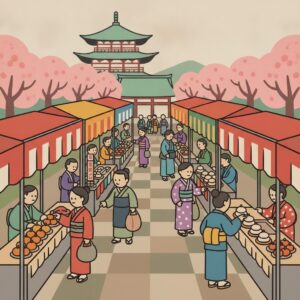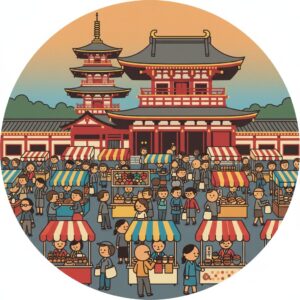
In the sprawling urban tapestry of Osaka, a city celebrated for its dazzling neon, its culinary prowess, and its boisterous, friendly spirit, there exists a neighborhood that hums with a different kind of energy. It’s a place that doesn’t just whisper tales of the past; it shouts them from its Showa-era rooftops, from the weathered facades of its standing bars, and through the resilient smiles of its long-time residents. This is Nishinari, a ward that represents the raw, unfiltered soul of Osaka. Far from the polished tourist trails of Namba and Umeda, Nishinari offers a journey not just through streets, but through time, through layers of history, and into the very core of what makes this city tick. It’s a place for the urban explorer, the photographer seeking character over gloss, the foodie chasing authentic, working-class flavors, and the traveler who believes that the true essence of a city is found in its most honest, unvarnished corners. To walk through Nishinari is to peel back the curtain on modern Japan and witness a living museum of a bygone era, a community forged in grit and bound by a powerful, unspoken camaraderie. It’s an experience that challenges perceptions, rewards curiosity, and leaves an indelible mark on all who wander its captivating labyrinth of streets. Forget what you think you know about Japan; Nishinari is here to show you a different story, one that is profoundly human, intensely local, and absolutely unforgettable. It is, in every sense, the city’s throbbing, authentic heartbeat, waiting to be discovered by those willing to listen.
For a taste of the authentic, working-class flavors that define this area, explore the rich and diverse Halal Pakistani cuisine found in nearby Tennoji.
The Vibe: What Nishinari Feels Like
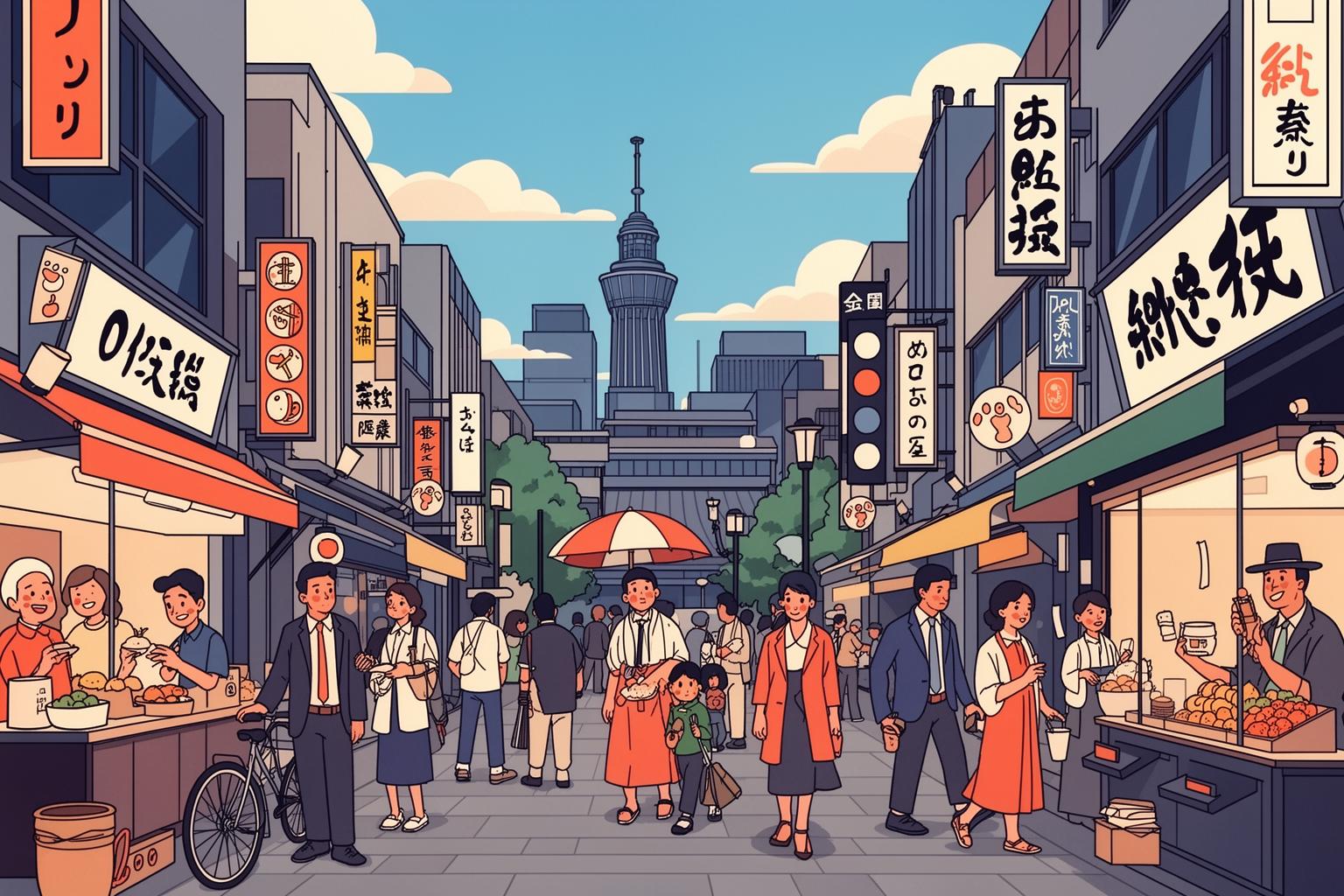
To step into Nishinari is to immerse all your senses in a symphony of urban life that feels both nostalgically familiar and vividly immediate. The air here carries a unique weight, dense with the savory aroma of grilling horumon (offal), the sweet fragrance of kushikatsu batter frying in hot oil, and the subtle, constant hum of the city’s hidden rhythms. It’s worlds apart from the sterile, solemn calm of Kyoto’s temples or the high-fashion buzz of Tokyo’s Ginza. This is a place that lives boldly, without apology.
A Symphony of the Streets
Your initial impression might be aural. The rhythmic clatter of pachinko balls tumbling behind sliding glass doors sets a steady, percussive rhythm. Layered over this are the raspy calls of street vendors, the rumble of JR Loop Line trains rumbling overhead on elevated tracks, and the lively, slightly distorted jingle of the Super Tamade supermarket—a theme so memorable it lingers in your mind throughout the day. You’ll catch the gentle click-clack of shogi (Japanese chess) pieces being set down by elderly men gathered in arcades and parks, their faces marked by deep focus. You’ll also hear sizzling food stalls, boisterous laughter spilling out from open tachinomi (standing bar) doorways, and the murmur of conversations thick with the expressive Kansai-ben dialect. It’s a chaotic yet harmonious soundscape, a tribute to a community living tightly together, sharing public spaces as if they were extensions of their homes.
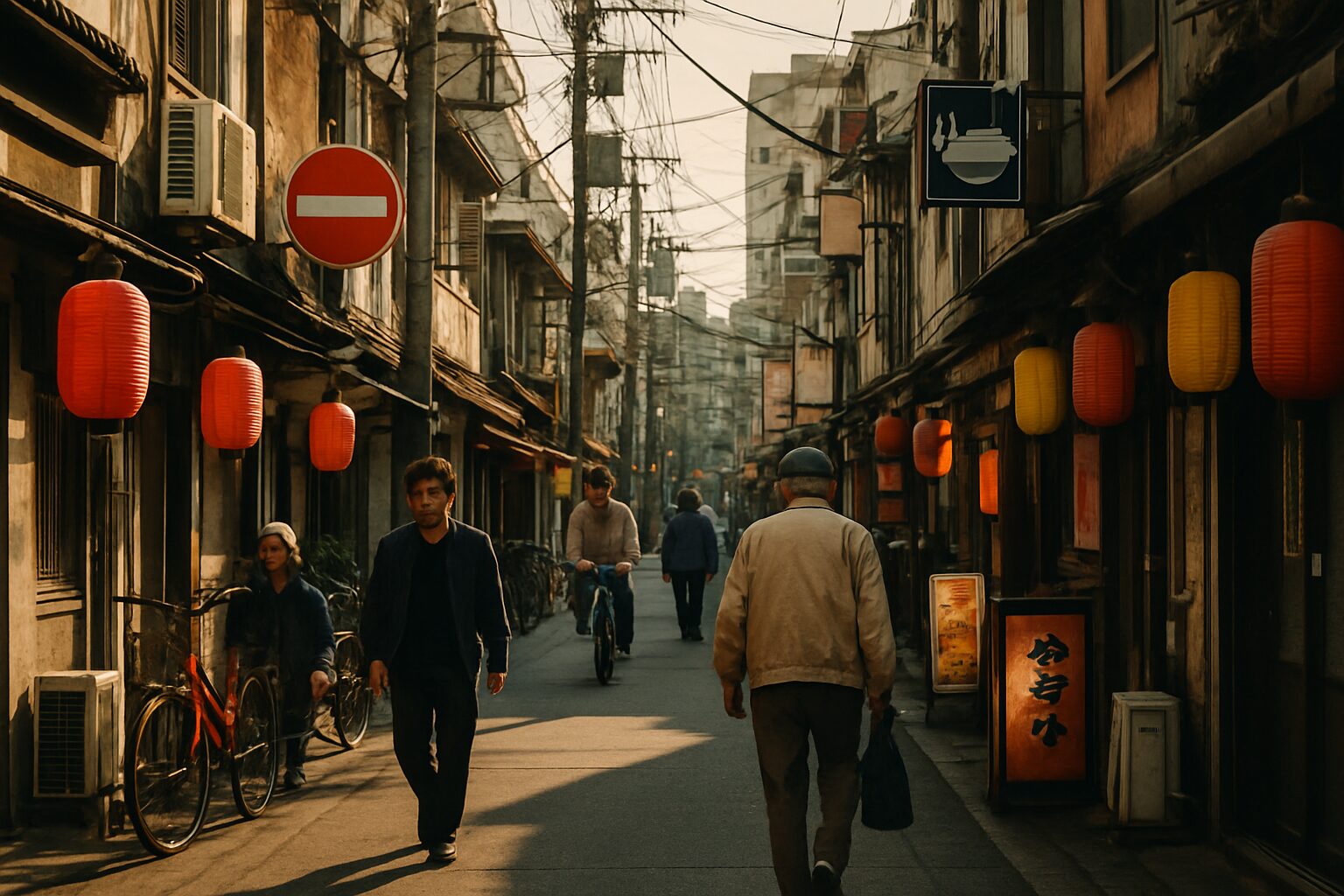
Visually, Nishinari is a treasure trove for those who appreciate the beauty in imperfection and the charm of a bygone era. The architecture mostly dates from the Showa Period (1926–1989), with low-rise buildings bearing fading hand-painted signs, a tangled canopy of overhead electrical wires, and narrow alleyways inviting you toward hidden discoveries. Neon signs—some flickering, some vibrantly garish—illuminate the evenings with a cinematic glow. You’ll notice bicycles, rusted but trusty, propped against every available surface, alongside meticulously cared-for potted plants adding spots of green to the concrete landscape. This visual story speaks of resilience, resourcefulness, and a history not polished away or replaced by glass-and-steel towers. Every crack in the pavement, every layer of peeling paint, reveals a fragment of Nishinari’s long and complex narrative.
The People of Nishinari
Beyond the buildings and food, the true essence of Nishinari is found in its people. This has long been a refuge for the working class, a place shaped by the labor of day workers who built much of modern Osaka. That spirit of hard work and humility still thrives. The residents embody the neighborhood’s distinctive character. You’ll see elderly men in work clothes sharing morning cups of sake, shopkeepers running family businesses passed down through generations, and an unexpected but growing number of young artists and entrepreneurs attracted by the affordable rents and the area’s authentic, anti-gentrification spirit.
There is a strong sense of community here often absent from more anonymous urban centers. People know their neighbors. Shopkeepers greet you with genuine warmth—not just a rehearsed “irasshaimase.” While newcomers might initially feel like outsiders, a simple nod, smile, or attempt at a Japanese greeting can quickly dissolve barriers. Nishinari’s people have a reputation for toughness, but beneath that tough exterior lies deep kindness and fierce pride in their neighborhood. They are survivors, storytellers, and guardians of Osaka’s most authentic traditions. Witnessing this human tapestry—the camaraderie, daily customs, and quiet dignity—is Nishinari’s most profound offering.
Navigating the Labyrinth: Key Areas of Nishinari
Nishinari is not a single, uniform entity; rather, it is composed of various distinct micro-neighborhoods, each possessing its own unique history, atmosphere, and purpose. Exploring these diverse areas is essential to fully grasping the complexity and allure of this fascinating ward.
Shinsekai’s Faded Glory: A Retro-Futuristic Dream
Located on the northern edge of Nishinari, Shinsekai — meaning “New World” — is a living paradox, embodying a vision of the future imagined more than a century ago. It was established for the 1903 National Industrial Exposition, a grand event meant to highlight Japan’s modernization. The northern section was modeled after Paris, featuring a grand centerpiece that became Tsutenkaku Tower, while the southern part drew inspiration from New York’s Coney Island. For a time, it was the height of modern entertainment in Osaka, a dazzling center of cinemas, restaurants, and amusement parks.
However, the post-war era was less kind, and Shinsekai’s glamorous veneer faded, leaving behind the remnants of its ambitious vision. Today, it stands in a state of beautiful, suspended decay. It is not a ruin; it is a perfectly preserved time capsule. The atmosphere brims with nostalgia, blending pre-war ambition with post-war resilience. Bright, loud, and unapologetically kitsch, it sharply contrasts with the quieter, more residential neighborhoods just blocks away in Nishinari.
Tsutenkaku Tower: The Eiffel Tower of Osaka
Tsutenkaku Tower is the unrivaled symbol of Shinsekai and southern Osaka. The original tower, built in 1912, was a steel structure inspired by both the Eiffel Tower and the Arc de Triomphe. It was dismantled during World War II for its metal, but public demand led to its reconstruction. The current tower, built in 1956, has become a cherished emblem of the city’s recovery and enduring spirit. Taking the elevator to the observation deck offers breathtaking panoramic views of Osaka, placing Nishinari and its surroundings in perspective. You can see the green expanse of Tennoji Park, the tall buildings of Abeno Harukas, and the densely packed urban landscape stretching to the mountains. Inside the tower, you’ll find Billiken, a cherubic, smiling deity originally from America who has become Shinsekai’s patron saint. Rubbing the soles of his feet is said to bring good luck, and visitors frequently partake in this ritual. At night, the tower is illuminated by colorful lights that change hues to indicate the next day’s weather—a practical beacon in an otherwise whimsical district.
Janjan Yokocho Alley: A Feast for the Senses
Extending south from Shinsekai, Janjan Yokocho is a narrow, covered shopping arcade that feels like a movie set brought to life. Its name reportedly stems from the ‘janjan’ sound of the shamisen once played to attract customers. The alley is barely wide enough for two people to pass comfortably and is packed with tiny kushikatsu eateries, standing bars, shogi clubs, and retro game arcades. The air is thick with the scent of frying oil and filled with the sound of lively conversation. Inside the shogi clubs, intense games unfold, the atmosphere charged with concentration. Vintage posters and handwritten menus plaster the walls, and the warm glow of lanterns lends the alley a timeless, intimate ambiance. This is Shinsekai’s social heartbeat, where you can enjoy a cheap beer, savor some of Osaka’s best soul food, and immerse yourself in the local vibe at its most authentic.
Dobutsuen-mae and the Airin District: The Heart of the Matter
Venturing further into Nishinari, you’ll reach the Airin district (historically known as Kamagasaki), centered around Dobutsuen-mae and Shin-Imamiya stations. This area forms the historical and emotional core of Nishinari, demanding a perspective grounded in respect and understanding. For decades, it has been Japan’s largest hub for day laborers. Men from across the country gathered here in the early morning, hoping to be hired for daily construction work, forming the backbone of Japan’s post-war economic boom.
The physical landscape reflects this history. Streets are lined with ‘doya’—simple, low-cost lodgings offering single rooms by the night. Numerous vending machines sell everything from hot coffee and soup to sake for as little as 50 or 100 yen. The area hosts many affordable eateries, 100-yen shops, and businesses tailored to residents living on very tight budgets. It is also home to numerous social support centers, NGOs, and community organizations offering assistance to locals.
Walking through Airin is a powerful and humbling experience, revealing a side of Japan seldom seen or discussed. It is not a tourist attraction and must be visited with the utmost respect. This is people’s home. The strict ‘no photography’ rule is imperative to protect the privacy and dignity of residents. Rather than a camera, bring an open mind. Observe daily life, the community’s remarkable resilience, and the social bonds that hold the neighborhood together. This is a place that shares a profound story about Japan’s social and economic history — a story of struggle, survival, and solidarity in the face of adversity.
Tobita Shinchi: A Walk Through the Taisho Era
South of the Airin district lies Tobita Shinchi, an area that necessitates great cultural sensitivity and is decidedly not a typical tourist destination. It remains one of the last and largest traditional red-light districts dating from the Taisho era (1912–1926). Although its primary business is adult entertainment, a respectful daytime stroll through its streets offers a rare and captivating insight into Taisho-era architecture and urban design. The district consists of a grid of streets lined with two-story wooden buildings, many preserved beautifully for a century. The intricate wooden latticework, curved roofs, and glowing lanterns create an atmosphere that feels entirely detached from the modern world—essentially a living architectural museum. Strict enforcement of the ‘no photography’ rule protects not only the privacy of workers and patrons but also helps preserve the district’s distinctive character. A quiet, respectful walk through Tobita Shinchi serves as a poignant lesson in history, one that must be undertaken with discretion and profound respect for its active role as both a place of business and residence.
The Flavor of the Streets: Culinary Adventures in Nishinari
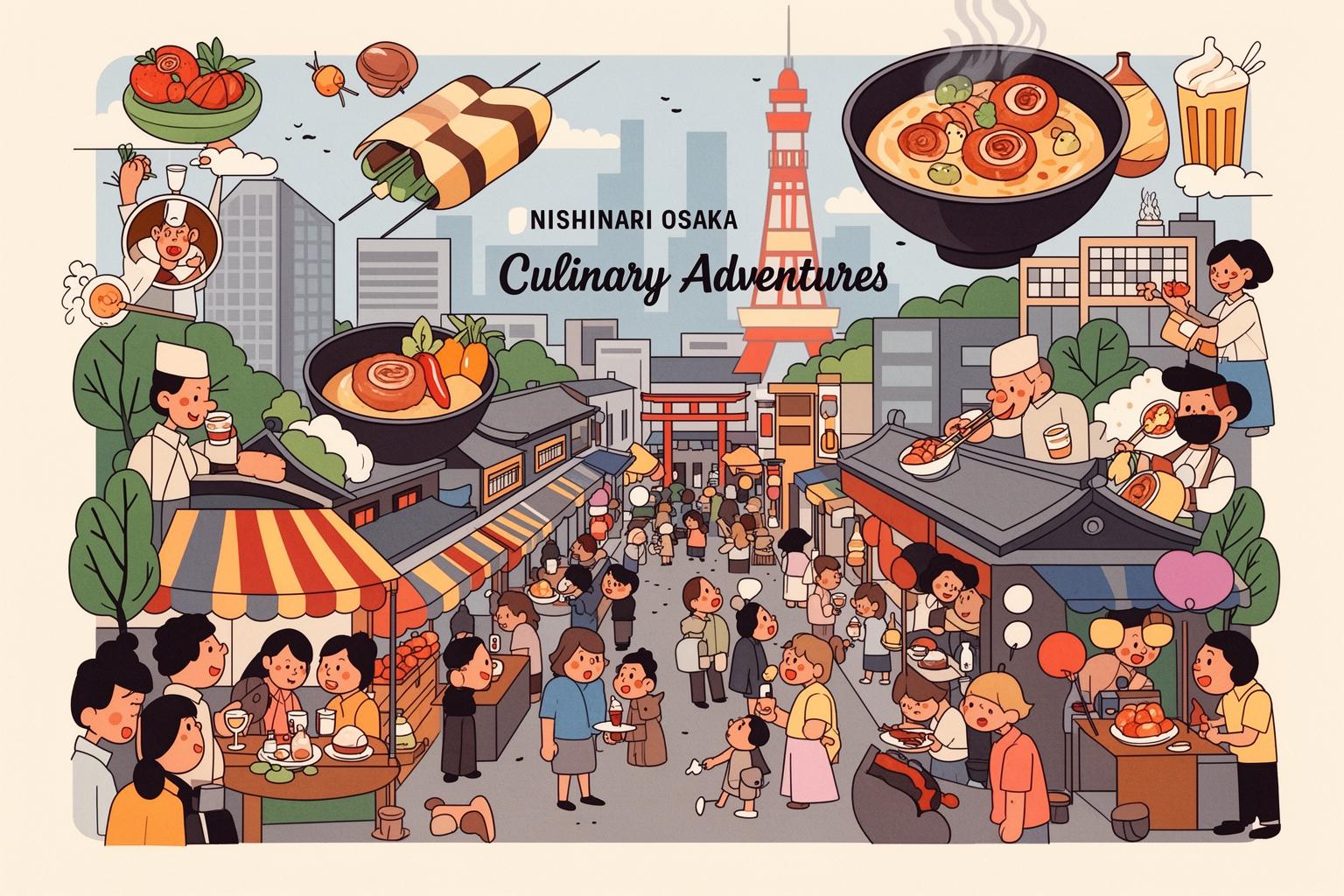
Nishinari is, above all else, a paradise for anyone who loves hearty, unpretentious, and incredibly flavorful food. The culinary scene here directly reflects its working-class roots: it’s affordable, delicious, and meant to be enjoyed in a lively, communal atmosphere. This area is the birthplace of some of Osaka’s most iconic dishes.
Kushikatsu: The Undisputed King
You can’t discuss Nishinari or Shinsekai without mentioning kushikatsu. These are skewers of various ingredients—meat, seafood, vegetables, even cheese and quail eggs—that are coated in fine panko breadcrumbs and deep-fried to a golden crisp. The experience is just as important as the food itself. You sit at a counter with a communal pot of thin, savory dipping sauce in the center. The cardinal rule, displayed in every restaurant, is ‘No Double-Dipping!’ You dip your skewer once, and only once, before taking your first bite. If you need more sauce, you use the provided raw cabbage slices to scoop it up and drizzle it over your skewer. The best kushikatsu is light, crispy, and far from greasy. Popular choices include beef (gyu-katsu), pork (buta-katsu), shrimp (ebi), lotus root (renkon), and gooey mozzarella cheese. Paired with a frosty draft beer, it’s the quintessential Osaka meal.
Horumon-yaki: The Taste of Resilience
Another cornerstone of Nishinari’s cuisine is horumon-yaki, or grilled offal. In the post-war era, when food was scarce, nothing was wasted. This led to the rise of grilling various cuts of beef and pork offal, which are packed with flavor. The name ‘horumon’ stems from the Kansai dialect phrase ‘horu mono,’ meaning ‘discarded things.’ Today, it’s a beloved delicacy. You’ll find tiny, smoky establishments where patrons grill their own horumon on small tabletop barbecues or watch a master cook it on a large iron teppan. The cuts vary from liver (rebā) and heart (hatsu) to different intestines like ‘ミノ’ (mino, first stomach) and ‘テッチャン’ (tetchan, large intestine). Marinated in a sweet and savory garlic-soy sauce, it offers a rich, powerful flavor that reflects the area’s history of resourcefulness.
Tachinomi: The Standing Bar Culture
The social life of Nishinari centers around its tachinomi, or standing bars. These are small, intimate spots where you stand shoulder-to-shoulder with locals, enjoying cheap drinks and simple, tasty bar snacks. There’s no pretense here. You order a beer, highball, or a cup of shochu and point to whatever looks good from the array of prepared dishes on the counter—items like doteyaki (beef sinew stewed in miso), potato salad, or sashimi. Tachinomi are fantastic places to experience local culture firsthand. The barrier to entry is low; just walk in, find a spot, and order. Even if you don’t speak the language, a smile and gesture go a long way. It’s a place for quick, affordable, and cheerful socializing, a staple of daily life for many residents.
Super Tamade: The Neon Temple of Bargains
No culinary tour of Nishinari is complete without visiting Super Tamade. This local supermarket chain is a cultural phenomenon. Its outrageously bright yellow and red facade, adorned with chaotic signage and garish neon lights, is impossible to miss. Inside, a relentlessly cheerful and incredibly loud theme song plays on repeat. But the real draw is the prices. Super Tamade is famous for its unbelievably cheap groceries, ready-made bento boxes, and sushi. They’re particularly known for their 1-yen sales, where, if you spend a certain amount, you can purchase selected items for just one yen. It’s a sensory overload in the best way, offering a fascinating glimpse into the local economy and the daily shopping habits of the neighborhood. Picking up a bento or some onigiri here for a budget lunch is a classic Nishinari experience.
Living History and Hidden Gems
Beyond its famous cuisine and gritty reputation, Nishinari and its surrounding areas are filled with unexpected attractions and peaceful spots that provide unique perspectives on the neighborhood.
Spa World: The Onsen Theme Park
Situated right next to Shinsekai, Spa World stands as a testament to Osaka’s flair for the extravagant. This is far from a quiet, tranquil onsen visit. It is a multi-level, 24-hour hot spring theme park. The bathing floors are separated by gender and switch monthly. One floor is the ‘European Zone,’ with baths inspired by ancient Rome, Greece, and Finland. The other is the ‘Asian Zone,’ which includes Japanese-style outdoor baths, a Persian-themed spa, and a Balinese resort-style bath. It offers a surreal, delightful, and deeply relaxing experience. After a long day exploring the tough streets of Nishinari, soaking in one of these elaborate baths is an ideal way to rejuvenate. There are also restaurants, massage services, and relaxation rooms where you can even stay overnight, making it a surprisingly convenient lodging option.
Tennoji Park and Zoo: An Urban Oasis
Located just next to Nishinari, Tennoji Park is a sprawling green space that serves as the neighborhood’s lungs. It’s a lovely escape from the dense cityscape. Within the park, you’ll find the Tennoji Zoo, one of Japan’s oldest, and the Osaka City Museum of Fine Arts. The park also features Keitakuen Garden, a stunning traditional Japanese stroll garden designed by a renowned landscape architect. The striking contrast between the tranquil, meticulously maintained beauty of Keitakuen and the energetic chaos of nearby Shinsekai is awe-inspiring. The park is a favorite spot for locals to unwind, for families to enjoy, and in spring, it becomes a prime location for cherry blossom viewing.
The Sentō (Public Bath) Experience
While Spa World is the giant, Nishinari is also scattered with many small, traditional sentō, or public bathhouses. For just a few hundred yen, you can experience a slice of life that has been a community pillar for generations. These baths aren’t aimed at tourists; they cater to locals. You’ll find elders soaking in the warm water, chatting about their day. The ritual of washing before entering the communal tubs, the classic murals of Mount Fuji on the tiled walls, and the warm sense of community create a genuinely authentic and restorative atmosphere. To truly grasp daily life in Nishinari, a visit to a local sentō is indispensable.
Practical Guide for the Intrepid Explorer
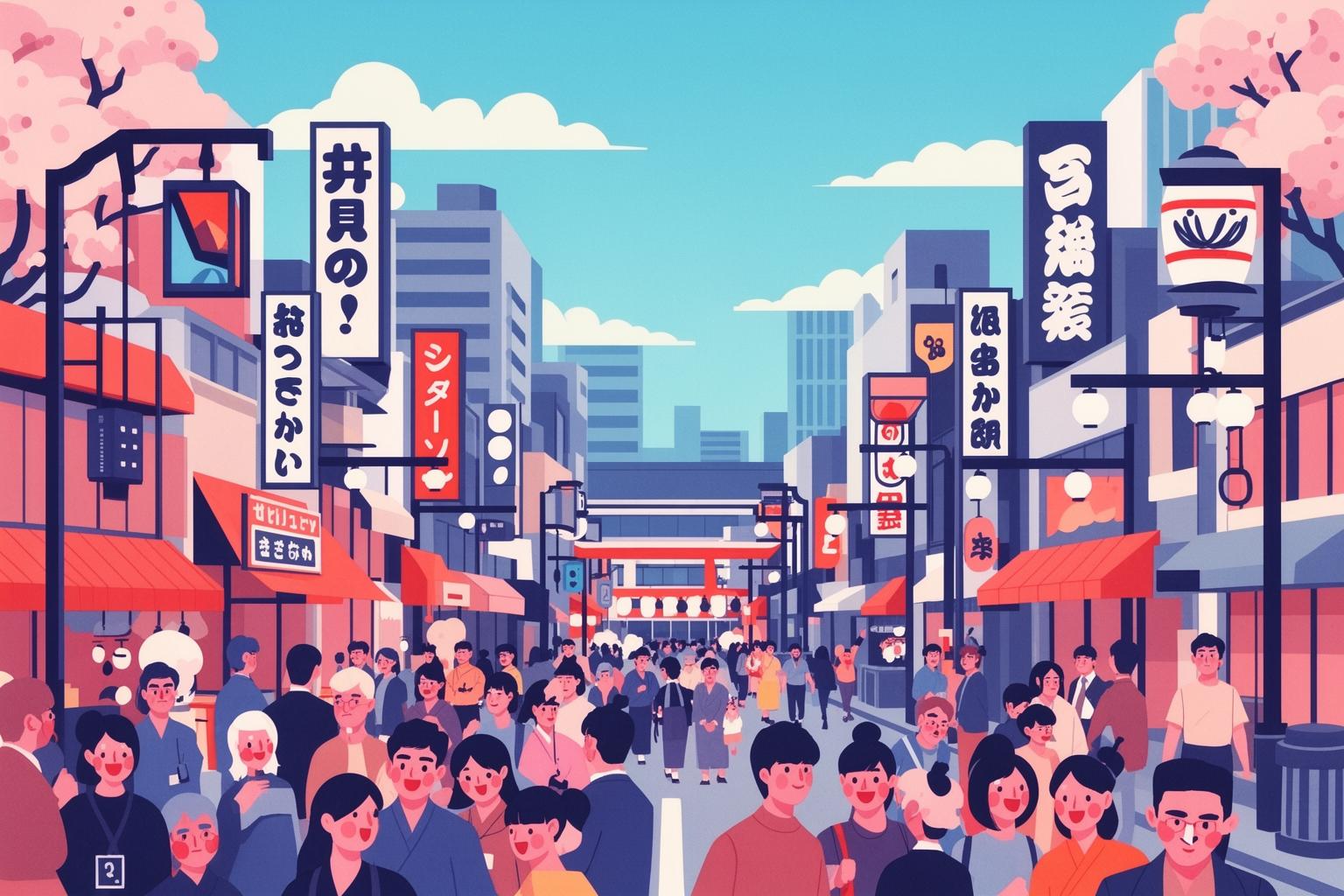
Visiting Nishinari is highly rewarding, and with some knowledge and the right attitude, it becomes a smooth and captivating experience.
Access and Transportation
Nishinari is one of Osaka’s most accessible areas, making it easy to reach.
- JR Loop Line & Nankai Line: Shin-Imamiya Station serves as the main hub. It connects you directly to other parts of Osaka via the loop line and offers a direct route to Kansai International Airport (KIX) via the Nankai Line.
- Osaka Metro: Dobutsuen-mae Station on the Midosuji Line (the primary north-south route) and the Sakaisuji Line is the gateway to Shinsekai and the Airin district. Hanazonocho Station on the Yotsubashi Line covers the more residential western section of the ward.
When to Visit
Nishinari can be enjoyed throughout the year, with each season bringing its own unique atmosphere.
- Spring (March-May): Mild weather perfect for walking, plus the opportunity to see cherry blossoms in nearby Tennoji Park.
- Summer (June-August): Hot and humid days give way to lively evenings where streets fill with a festive vibe as people spill out of bars and eateries.
- Autumn (September-November): Clear skies and comfortable temperatures make it ideal for extended explorations on foot.
- Winter (December-February): The cold weather enhances the cozy appeal of kushikatsu restaurants, izakayas, and sentō with their warm, steamy interiors.
Tips for a Respectful and Enjoyable Visit
- Cash is Preferred: Although cashless payments are growing in Japan, cash remains the preferred—and often only—payment method in Nishinari’s traditional small businesses. Always carry enough yen.
- Respect Photography Rules: This is crucial. In most areas of Nishinari, be considerate. In tourist-frequented Shinsekai, photography is generally acceptable but always stay respectful. In the Airin district and Tobita Shinchi, cameras should be put away entirely. These are residential neighborhoods, not tourist attractions. Respecting residents’ privacy is essential and non-negotiable.
- Learn Basic Phrases: Fluency is unnecessary, but knowing simple greetings and polite words like ‘Konnichiwa’ (Hello), ‘Sumimasen’ (Excuse me/Sorry), ‘Arigato Gozaimasu’ (Thank you), and ‘Oishii’ (Delicious) helps show respect and connect with locals.
- Safety Note: Nishinari is known as one of Osaka’s ‘rougher’ districts. While it feels different from other parts of the city, it’s generally safe for informed travelers. The main issue is poverty, not violent crime targeting visitors. Use common urban sense: stay aware of your surroundings, especially at night, and avoid flaunting valuables. Most residents are friendly and will leave you be. The area is defined more by its grit than danger.
- Keep an Open Mind: This is the most important advice. Leave any preconceived notions behind. Nishinari isn’t a sanitized theme park; it’s a living community with a complex history. Approach it with curiosity and empathy to be rewarded with one of the most authentic and memorable experiences in urban Japan.
Nishinari is not just another neighborhood on the Osaka map. It is a testament to the city’s enduring spirit, a place where history is not confined to museums but is lived on the streets every single day. It challenges the sleek, modern image of Japan and presents a reality that is far more nuanced, complex, and, ultimately, more human. A visit here is a journey into the heart of working-class culture, a deep dive into the flavors that fuel the city, and a powerful lesson in community and resilience. It may not have the tranquil gardens of Kyoto or the futuristic skylines of Tokyo, but it has something far more valuable: an honest, unapologetic soul. To explore Nishinari is to understand Osaka on a deeper level, to see beyond the takoyaki stands and the Glico Running Man, and to connect with the powerful, gritty, and beautiful heartbeat that keeps this incredible city alive. It’s an adventure that stays with you, long after you’ve brushed the last panko crumb from your shirt and boarded the train back to a more polished world.
Please make slight modifications to the entire sentence if possible, without altering its original meaning.