
They say Tokyo is the city you visit, but Osaka is the city you live in. It’s a catchy phrase, one you’ll hear tossed around in expat bars in Namba or whispered over steaming bowls of ramen in a Shinsaibashi alleyway. There’s a gritty, electric truth to it. Walk out of the colossal Umeda Sky Building, and you’re not just hit by the humidity; you’re hit by a wall of sound and scent. The sizzle of takoyaki batter hitting hot iron, the rhythmic clatter of a thousand salarymen walking home, the distant, tinny jingle of a Don Quijote store, and the boisterous laughter spilling out of a standing-room-only izakaya. This isn’t the silent, orderly procession of Tokyo. This is Osaka. It’s a city with its sleeves rolled up, a city that works hard, plays harder, and eats until it quite literally drops—a concept so ingrained in the culture it has its own word: kuidaore.
For the wide-eyed traveler, Osaka is a whirlwind of neon lights, historical castles, and world-class street food. But for the aspiring expat, the professional looking to plant their flag in the Land of the Rising Sun, it’s a whole different beast. It’s a complex, rewarding, and often bewildering landscape of opportunity and challenge. The dream of working in Japan, fueled by pop culture and tales of serene temples, often collides with the reality of navigating a deeply nuanced work culture, a labyrinthine bureaucracy, and the daily grind of being a foreigner, a gaijin, in a largely homogenous society. This isn’t just about finding a job; it’s about understanding the invisible currents of communication, the weight of tradition, and the unwritten rules that govern every interaction from the boardroom to the bar. It’s about building a life from scratch in a place that is as welcoming as it is demanding. This is the real story of working in Osaka, a guide to the exhilarating, frustrating, and ultimately transformative journey of carving out a professional existence in the heart of Kansai.
Understanding this dynamic business landscape is crucial, as seen in how the region’s hospitality sector is embracing high-tech solutions to adapt to changing visitor trends.
Cracking the Code: The Osaka Job Market for the Global Professional

The first, and perhaps most significant, obstacle for any aspiring expat is the job market. It serves as the gatekeeper to the visa, the apartment, and the life you envision. Fortunately, Osaka, the economic powerhouse of the Kansai region with a GDP exceeding that of some countries, boasts a robust and surprisingly diverse job market. The challenge is knowing where to search and how to position yourself as a valuable foreign asset instead of just another English speaker.
Beyond the English Classroom: Discovering Osaka’s Key Industries
While teaching English is a common path for many, it is far from the only option. To truly establish a sustainable career, you must delve deeper into the industries driving this metropolis. The stereotype of Japan as a nation of lifelong employees at a single company is slowly fading, opening new opportunities, especially for those with specialized skills.
First and foremost, the IT and tech sector is thriving. Japan has been undergoing a major push for digital transformation (DX), accelerated by the pandemic. Companies are rushing to modernize systems, adopt cloud computing, and enhance cybersecurity. This has created high demand for skilled software developers, data scientists, UI/UX designers, and IT project managers. While Tokyo may have a larger startup scene, Osaka’s tech ecosystem is expanding, featuring major players like Panasonic and Sharp, alongside a growing number of agile startups. Foreign professionals are highly valued here, not only for technical expertise but also for bringing global perspectives and familiarity with international software development methodologies such as Agile, which are still emerging in many traditional Japanese firms.
Next is Osaka’s lifeblood: tourism and hospitality. Despite recent global travel disruptions, the industry is rebounding strongly. Osaka serves as a key gateway to Japan, and with the forthcoming World Expo in 2025, demand for multilingual staff is surging. This extends beyond hotel front desk jobs to roles in tour operations, digital marketing for travel agencies, event management for international conventions, and luxury retail management catering to worldwide customers. If you bring experience in this field and speak English plus another language (especially Mandarin, Korean, or Southeast Asian languages), you will be in high demand. The ability to deliver world-class omotenashi service with a global flair is a sought-after talent in local companies.
Don’t forget Kansai’s industrial backbone. The region is a manufacturing, logistics, and trade powerhouse. Large pharmaceutical, electronics, and chemical firms maintain significant operations here. This opens doors for foreign engineers, supply chain experts, and international sales and business development managers. These positions typically require stronger Japanese language skills but offer stable, long-term careers. Tasks often include coordinating with global partners, navigating international regulations, and bridging communications between Japanese headquarters and overseas branches—a perfect fit for bicultural, bilingual professionals.
And yes, English teaching remains. It is the most accessible entry point into Japan’s job market. Opportunities include Assistant Language Teacher (ALT) roles in public schools, private conversation schools (eikaiwa), corporate English training, or university lecturing if you hold the appropriate qualifications. Though pay may be modest and career growth limited, it provides a reliable visa, steady income, and immediate immersion into Japanese society. For many, it serves as an ideal stepping stone to improve Japanese skills and explore alternative career paths once established.
The Job Hunt: Strategies for Securing Your Osaka Position
Understanding industries is one thing; mastering Japan’s unique job-hunting process is another. Your home-country methods may not apply directly.
Starting online is obvious, but strategy is key. LinkedIn’s popularity is rising, especially with globally minded companies and recruiters. However, Japan-specific websites like GaijinPot, Daijob, and CareerCross often prove more effective, as they cater to foreigners. When crafting your profile and resume, keep in mind that Japanese hiring managers prioritize detail and thoroughness. Unlike Western norms, a single-page resume is uncommon. Your shokumu keirekisho (work history document) should fully describe your duties and, more importantly, highlight achievements with concrete data.
Recruiters, or headhunters, play a crucial role. For mid-career professionals with sought-after skills, this often is the best approach. Leading international firms like Robert Walters, Michael Page, and Hays have major Osaka offices. They act as your advocates—refining your resume for the local market, coaching you through multi-stage interviews, and negotiating salaries. They maintain strong ties with companies eager to hire foreign talent and can help bypass automatic screening processes that might otherwise exclude you.
Never overlook the power of networking, or en (connections). In Japan’s relationship-driven culture, who you know can be just as important as what you know. This doesn’t mean you must be a polished corporate networker; it’s about forming sincere connections. Attend industry meetups, Chamber of Commerce events, language exchanges, and stay open to conversations. Many Japanese jobs are never advertised publicly; they are filled through personal introductions. A friendly chat at a local tachinomi (standing bar) could lead to an interview the next week—it happens more often than imagined.
Finally, consider direct applications, or chokusetsu oubo. Applying straight to companies you admire requires cultural finesse. You’ll need a Japanese-style resume, or rirekisho, which includes personal details like a photo and age—information uncommon in many Western resumes. Your cover letter must be humble, respectful, and clearly explain your motivation for wanting to join that specific company. Japanese firms want evidence of thorough research and genuine passion for their mission, not just someone looking for any visa-sponsoring job.
The Office Matrix: Navigating Japanese Work Culture in Kansai
Securing the job is only the first challenge. The ultimate challenge is the workplace itself. Japanese work culture is vastly different from the typically individualistic, direct, and flexible environments common in many Western countries. It is a culture steeped in centuries of tradition, where the group outweighs the individual, and harmony is the highest priority. Grasping its unwritten rules is essential for your survival and success.
The Unspoken Rules: Hierarchy, Harmony, and the Art of Reading the Air
At the core of the Japanese office lies a strict hierarchy, most clearly reflected in the senpai-kohai (senior-junior) relationship. This is not just about age or job title; it hinges on seniority within the company. Your senpai is anyone who joined the company before you, and you are expected to show them respect. They mentor you, but you are also expected to pour their drinks at gatherings, heed their advice without question, and generally fulfill the role of the respectful junior. This system of mutual obligation may feel restrictive to outsiders but forms the foundation of team cohesion.
This framework reinforces the critical importance of the group and maintaining wa (harmony). The Japanese saying, “The nail that sticks out gets hammered down,” is company doctrine. Individual brilliance is less prized than the ability to contribute to a smooth, cooperative team effort. Consequently, decisions are rarely made by a single person; they result from a slow, deliberate consensus-building process. Voicing a strong dissenting opinion in a meeting is a serious mistake, as it disrupts harmony and can cause others to lose face. Your brilliant, world-changing idea is worthless if you cannot present it in a way that makes everyone feel included and respected.
This brings us to the most important and challenging skill to acquire: kuuki wo yomu, or “reading the air.” Japanese is a high-context language, where what is left unsaid often carries more weight than what is spoken. Communication is indirect, relying on shared context, non-verbal cues, and subtle expressions to convey true meaning. A boss who says, “That’s an interesting idea, I will consider it” (kento shimasu) is most likely saying “no.” A colleague who says, “That might be a little difficult” (chotto muzukashii) is issuing a firm rejection. As a foreigner used to direct communication, you may feel like you’re trying to read minds. It’s a constant, mentally exhausting exercise in decoding subtext. Misreading the air risks being perceived as insensitive, aggressive, or simply not a team player.
The Rituals of Business: Meetings, Decisions, and After-Hours Bonding
Work processes are as ritualized as social dynamics. Consider meetings, for instance. A Westerner might see meetings as opportunities for brainstorming and vigorous debate. In many Japanese companies, meetings function as ceremonies to formally approve decisions already made behind the scenes. The real work is done through a process called nemawashi.
Nemawashi literally means “to turn the roots” and refers to the informal, one-on-one groundwork you must lay before any formal proposal. Before presenting your idea to the group, you need to speak individually with each key stakeholder, explain your concept, listen to concerns, make adjustments, and gradually build consensus. By the time the official meeting occurs, everyone is already on board, allowing the meeting to proceed smoothly and preserve the all-important wa. This may seem inefficient and secretive to outsiders, but it is essential for avoiding public conflict.
Then there is the most famous—and notorious—ritual: the nomikai, or company drinking party. This is not an optional social event; it is a vital, unofficial extension of the workday. Disregard everything you know about professional boundaries. The nomikai is where rigid office hierarchies relax, and people can express their honne (true feelings) rather than their tatemae (public facade). It’s fueled by copious amounts of beer and sake, often under an all-you-can-drink (nomihodai) plan.
Strict etiquette must be followed. You should never pour your own drink and must always stay attentive to keeping your colleagues’ and especially your boss’s glasses full. The first drink is always a toast with beer (toriaezu biiru, “beer for now”). It’s where you can ask your boss questions you would never dare to ask in the office, bond with teammates, and conduct much informal business. The night rarely ends at one venue; there will likely be a nijikai (second party), often at a karaoke bar, and sometimes even a sanjikai (third party) at a ramen shop. Participation is not just about enjoyment; it demonstrates your dedication to the team.
Overtime and Work-Life Balance: The Myth and Reality of Zangyo
The image of the Japanese salaryman working until midnight and sleeping on the train is persistent—and for good reason. The culture of zangyo (overtime) is deeply embedded. Historically, long hours were viewed as a symbol of loyalty and commitment. There is often intense social pressure to stay late, not necessarily because of workload but simply because your boss or colleagues remain. Leaving on time can be seen as a lack of dedication.
Yet, things are evolving. The Japanese government has launched a major initiative called hataraki-kata kaikaku (work-style reform) to combat overwork culture. Many companies now actively encourage employees to leave on time, introduce stricter work-hour tracking, and implement policies such as “no overtime days.” The reality varies significantly between companies. Traditional, old-school Japanese firms may still adhere to the old norms, whereas gaishikei (foreign-affiliated companies) or modern tech startups in Osaka are far more likely to offer genuine work-life balance, flex-time, and remote work options. If this matters to you, it’s crucial to research and ask carefully about it during the interview process.
The Daily Grind: Overcoming Challenges Outside the 9-to-5
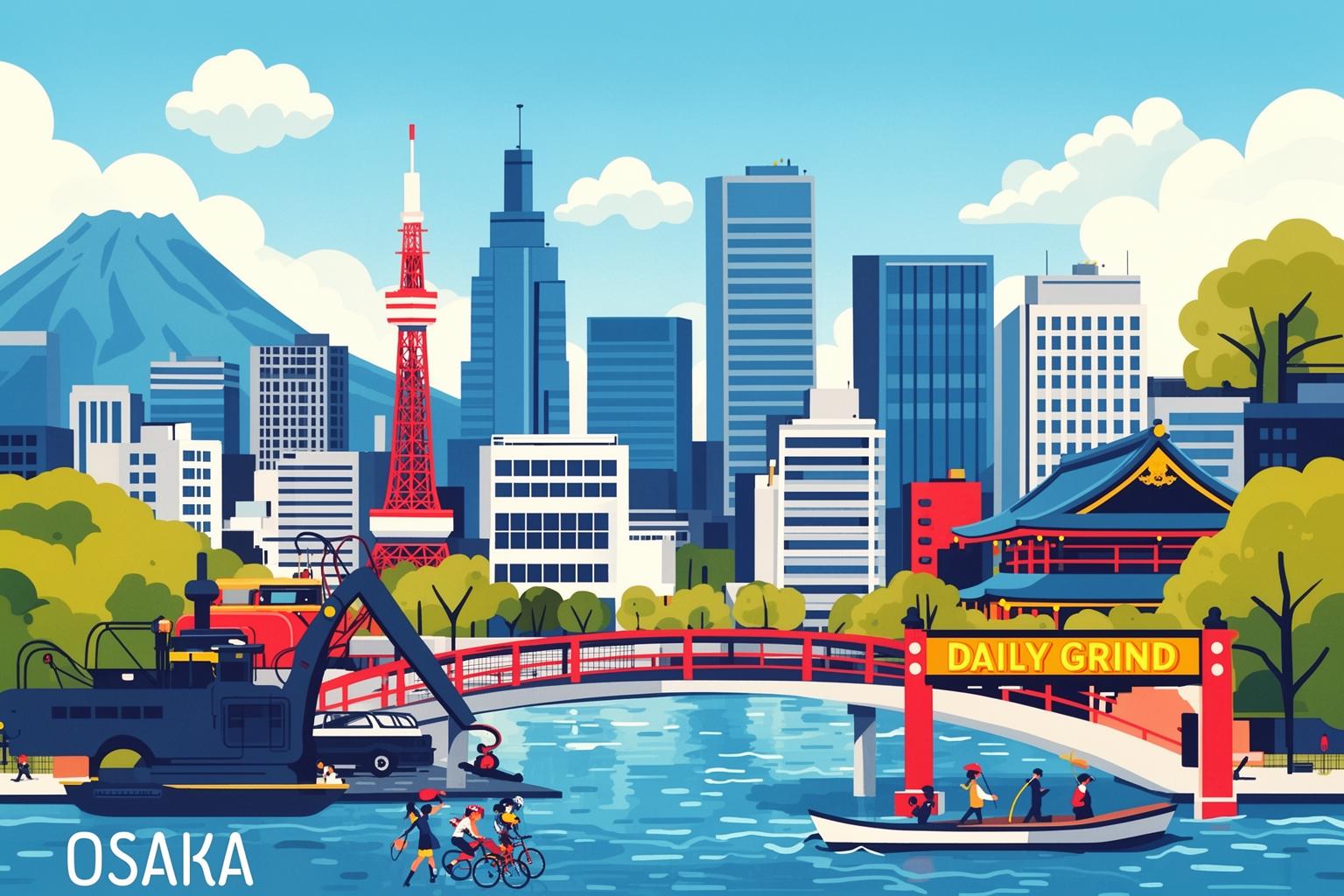
Your professional life tells only half the story. The challenges of living as an expat go far beyond the office. Establishing a life in Osaka demands a different set of skills: resilience, patience, and a readiness to embrace ongoing confusion.
The Language Labyrinth: Beyond Just Saying “Konnichiwa”
Let’s be straightforward: the language barrier is the biggest challenge you will face. Although Osaka is a major international city, English is not widely spoken. You can get by in tourist areas like Umeda and Namba with English, gestures, and translation apps. But to truly live here—to open a bank account, see a doctor, fix a leaking faucet, or build real friendships—you need Japanese. Without it, you’ll always rely on others and remain at the surface level of the culture.
To complicate things, you are in Kansai, where the local dialect, Kansai-ben, is distinct and beloved. Shopkeepers will thank you with a melodic okini instead of the standard arigatou. You’ll hear honma? instead of hontou? (Really?), and firm declarations like akan! rather than dame! (No good!). It’s faster, more direct, and some say more colorful than standard Japanese. While a pleasure to hear, it adds another layer to your language-learning challenge. The best strategy is to dive right in. Enroll in a language school, find a language exchange partner, and most importantly, practice your Japanese daily, no matter how awkward or broken it sounds. Every grocery store visit is a free lesson.
The Paperwork Mountain: Residency, Housing, and the Reign of the Hanko
Japan runs on paperwork, and you’ll quickly pile up a mountain of it. Your first stop will be the local ward office, or kuyakusho. This is where you register your address to get your residence card, sign up for National Health Insurance, and handle pension and tax documents. Expect long waits, confusing paperwork, and the use of the hanko, your personal seal, which replaces a signature on official forms. It’s a bureaucratic rite of passage demanding a great deal of patience.
Finding an apartment brings its own challenges for foreigners. Many landlords hesitate to rent to non-Japanese due to language barriers and fears of cultural misunderstandings. You will almost certainly need a guarantor company (hoshou-gaisha), which co-signs your lease for a substantial fee. Upfront costs are steep: a deposit (shikikin), non-refundable “key money” (reikin), the first month’s rent, guarantor fees, and agency fees often total 4 to 6 times the monthly rent. Working with a real estate agency that specializes in serving foreigners is highly recommended to help you navigate this complicated and often frustrating process.
Building Your Tribe: From Expat Circles to Genuine Bonds
Loneliness is a real and powerful challenge for expats everywhere, and Japan is no exception. It’s easy and comfortable to stay within the “expat bubble,” socializing only with other foreigners. This community can provide crucial support—a place to vent frustrations and share experiences with people who understand. But to truly feel at home in Osaka, you need to step beyond that bubble and build authentic connections with Japanese people.
This requires effort. Joining a club or class is a great way to meet people with shared interests. Try a martial art, a calligraphy class, or join a local futsal team. Become a regular at a neighborhood izakaya where the owner knows your name and your usual order. Be curious, open, and willing to initiate. Making Japanese friends can take time, as relationships often develop slowly, but the result is a deeper, more genuine connection to the country you now call home. You’ll need to get comfortable feeling like a perpetual outsider—the gaijin—but embracing that role with humor and grace will open more doors than you might expect.
The Osaka Payoff: Why It’s All Worth It
After learning about the endless challenges, you might question whether it’s all worth the effort. For those with the right mindset, the answer is a resounding yes. For every moment of frustration, Osaka provides a dozen moments of pure joy, discovery, and connection that make the entire experience worthwhile.
The Soul of the City: More Than Just Tokyo’s Gritty Neighbor
Osaka possesses a soul uniquely its own. While Tokyo can feel polished and reserved, Osaka is loud, proud, and refreshingly straightforward. The people of Osaka are known for their friendliness, warmth, and sharp sense of humor, rooted in the city’s history as the birthplace of manzai stand-up comedy. Strangers will strike up conversations with you on the train. The old lady at the market might slip an extra orange into your bag. There’s a human-scale warmth here that’s often harder to find amidst Tokyo’s vastness.
And then there’s the food. The concept of kuidaore—to eat until you drop—is not a catchphrase; it’s a way of life. This city is, without exaggeration, one of the world’s greatest food capitals. From iconic street foods in Dotonbori like takoyaki (octopus balls) and okonomiyaki (savory pancakes) to exquisite multi-course kappo dining, Osaka is a playground for your palate. Explore the covered shotengai shopping arcades like Tenjinbashisuji, the longest in Japan, and you’ll discover a universe of culinary delights—from tiny stalls selling freshly grilled unagi to tofu shops passed down through generations. The food here is not just tasty; it’s affordable and deeply interwoven with daily life.
Your Kansai Kingdom: A Gateway for Exploration
One of Osaka’s greatest strengths is its location. It is the undeniable hub of the Kansai region, placing an incredible wealth of cultural and natural beauty right at your doorstep. The ancient temples and tranquil gardens of Kyoto are just a 30-minute train ride away. The stylish, cosmopolitan port city of Kobe is even closer. The former capital of Nara, with its giant Buddha statue and free-roaming sacred deer, makes for a perfect day trip. Within two hours, you can hike in the mountains of Wakayama, soak in an onsen hot spring in Arima, or visit the magnificent Himeji Castle. Living in Osaka means you’re not just living in one city; you have an entire region rich with historical and cultural significance as your backyard.
Importantly, your money goes much further here. The cost of living in Osaka is significantly lower than in Tokyo. Rent, especially, is far more affordable, allowing you to have a larger, more centrally located apartment for the same price as a tiny space in the capital. This financial flexibility greatly improves your quality of life, letting you save more, travel more, and enjoy all the city has to offer without constantly worrying about your budget.
The Final Word on Your Osaka Chapter
Choosing to build a professional life in Osaka is a decision that should not be taken lightly. It requires an investment of time, energy, and emotion. The journey will undoubtedly be marked by moments of deep frustration—when the paperwork feels overwhelming, the language seems insurmountable, and the cultural signals are completely baffling. It is not an easy road.
However, it is a path of tremendous growth. It will challenge your beliefs, break down your preconceptions, and push you to become more adaptable, patient, and perceptive than you ever imagined. You will learn to communicate without words, find solace in uncertainty, and appreciate the beauty found in rituals and routines. You will uncover a city fiercely proud of its identity, one that embraces both its commercial grit and its warm, comedic spirit. You’ll enjoy the best food you’ve ever had, forge friendships in the most unexpected places, and create a life that is uniquely yours—challenging, rewarding, and beautiful. The reality of expat life in Osaka is a complex blend of highs and lows, but for those willing to embrace the full experience, the rewards are beyond measure. You may come here for a job, but you stay for the life you build in the vibrant, pulsating heart of Japan’s culinary capital.