
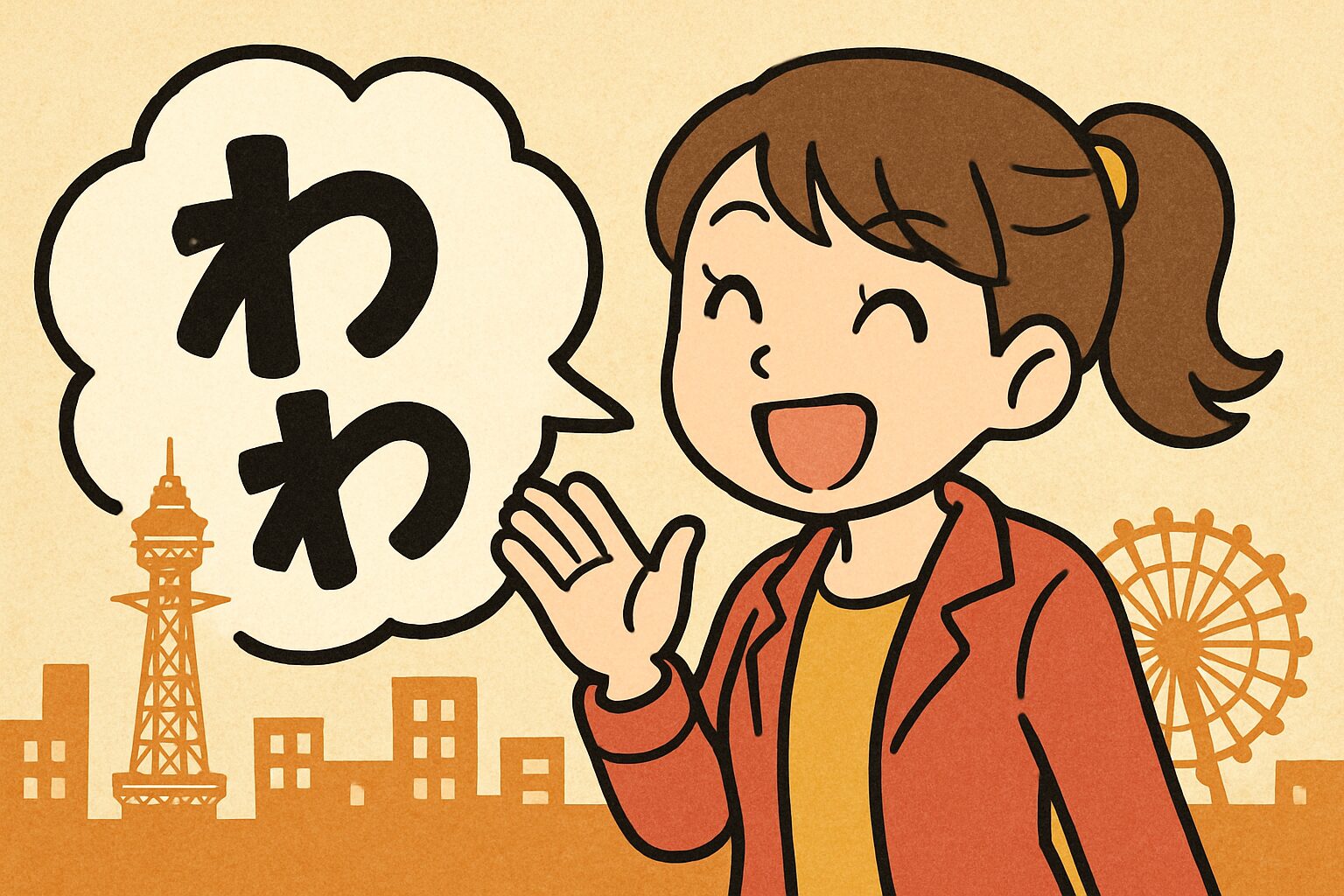
Step off the Shinkansen at Shin-Osaka station, and the first thing you’ll notice isn’t a landmark or a particular sight. It’s a sound. A vibrant, melodic, and undeniably energetic hum of human interaction that seems to pulse through the very concrete of the platforms. This is the sound of Osaka, a city that speaks with a rhythm all its own. This language, this living, breathing entity, is Osaka-ben, the Osaka dialect. It’s more than just a regional accent; it’s a cultural identifier, a historical document, and your all-access pass to understanding the soul of Japan’s most effervescent metropolis. While Tokyo speaks with a measured, standard cadence, Osaka talks, laughs, and bargains with a lyrical flow that reflects its long history as the nation’s merchant capital, its comedy powerhouse, and its culinary heart. To learn a few words of Osaka-ben is to do more than just learn a dialect; it’s to tune your ear to the city’s frequency, to grasp the inside jokes, and to feel the warmth of a culture that values directness, humor, and human connection above all else. It’s the key that unlocks a side of Japan many visitors never get to see, a world of boisterous shopkeepers, quick-witted comedians, and a generosity that’s as rich and satisfying as a hot plate of okonomiyaki. Understanding this dialect is understanding the very heartbeat of Kansai life.
This direct and humorous communication style is perfectly reflected in the city’s passionate food culture, where even a debate over grilled meats like horumon and yakiniku can feel like a lively, friendly conversation.
The Sound of the City: What Makes Osaka-ben Tick?

The fundamental difference between Osaka-ben and the standard Japanese you might learn from a textbook, known as Hyojungo, lies in its musicality. The dialect features a distinctive pitch accent and intonation that gives it a wave-like, rhythmic flow. While a simple sentence in standard Japanese may be delivered in a relatively flat manner, the same words in Osaka-ben rise and fall, stretching and contracting with emotion and emphasis. This speech pattern is inherently more expressive, more dramatic, and far more personal. Vowels are often elongated to express feeling—a simple `sugoi` (amazing) becomes a drawn-out `sugoooi`, imparting a tangible sense of awe. This melodic quality is not just a linguistic curiosity; it reflects the spirit of the city. Osaka has long been a place of commerce, performance, and community. Its dialect developed not in the quiet halls of imperial courts but in the noisy, bustling marketplaces where deals were made and relationships built.
This history is woven into the very fabric of the language. For centuries, Osaka was known as `Tenka no Daidokoro`, or the “Nation’s Kitchen,” serving as the central hub where rice and goods from across Japan were collected and distributed. Osaka’s merchants needed a language that was efficient, persuasive, and capable of quickly establishing rapport. There was no room for the subtle, indirect phrasing favored in the political centers of Edo (Tokyo) or Kyoto. Communication had to be clear, direct, and memorable. This gave rise to a dialect known for its straightforwardness—a trait sometimes misunderstood by outsiders as blunt or even rude. But for Osakans, this directness is a form of honesty and respect. It says, “I see you, I hear you, and I won’t waste your time.” It’s a pragmatism born from a tradition of getting things done.
Beyond its commercial origins, Osaka-ben is deeply connected to the world of Japanese comedy, or `owarai`. The city is the undeniable home of `manzai`, a style of stand-up comedy usually performed by a duo. This comedic tradition has profoundly influenced the dialect, giving it a playful, witty, and self-deprecating tone. The language is perfectly tailored for the rapid-fire banter, clever wordplay, and impeccably timed punchlines that define `manzai`. Its rhythm, unique vocabulary, and expressive sentence endings all enhance comedic effect. As a result, humor is not merely entertainment in Osaka; it is a core aspect of everyday communication. Conversations are often sprinkled with jokes, light teasing, and sharp retorts. Speaking Osaka-ben means engaging in this culture of laughter, understanding that a quick-witted comeback is often a sign of affection, and appreciating that not taking oneself too seriously is a valued quality.
Your First Osaka-ben Phrasebook: Words You’ll Hear Everywhere
Exploring the lively streets of Osaka, you’ll be surrounded by a symphony of sounds and expressions unique to this region. Learning a few essential phrases will not only help you find your way but also act as a bridge to more genuine and memorable interactions. These words are more than just language; they are cultural artifacts, each telling a story about Osaka’s history and its people.
Greetings & Everyday Phrases: A Warm Reception
First up is `Ookini` (おおきに). On the surface, it simply means “thank you,” serving as the local counterpart to the standard `arigatou`. However, `ookini` carries a warmth and depth often missing from the usual term. Coming from `ooki ni`, which means “greatly” or “very much,” it feels more heartfelt and traditional. When a Kuromon Market vendor says `ookini` after you buy freshly grilled scallops, it feels less like a routine courtesy and more like sincere gratitude. The word carries historical significance, echoing centuries of trade and community. It’s also versatile—depending on context and tone, it can mean “please” or even a gentle “no, thank you.” Hearing and using `ookini` is your first step toward speaking like a local, a small word representing deep appreciation for the culture.
Next is the iconic merchant’s greeting: `Maido` (毎度). Literally meaning “each time” or “always,” it shortens `maido arigatou gozaimasu`, which means “thank you for your continued patronage.” You’ll hear this cheerful greeting as you enter small shops, eateries, or izakayas. It’s ingrained in the city’s commercial spirit. `Maido` is more than a simple “hello”; it acknowledges an ongoing relationship between business and customer, even on a first visit. It instantly creates a welcoming and familiar atmosphere. It’s a friendly, efficient way to say, “We appreciate your business, now and always.” Responding with a nod, smile, or a quiet `maido` shows you respect this local custom.
Perhaps the most distinctive exchange you’ll encounter is the greeting, `Mokarimakka?` (儲かりまっか?), which cheekily translates to “Are you making money?” The typical reply, given with a wry smile, is `Bochi bochi denna` (ぼちぼちでんな), meaning “So-so” or “Little by little.” To outsiders, this may seem blunt or even rude since asking about finances is usually considered taboo. But in Osaka, it’s friendly banter, a social ritual that builds bonds. It’s not a serious inquiry into finances but a conversational icebreaker harkening back to merchant greetings in the marketplace. It’s a way of asking, “How’s life treating you?” through the lens of commerce and perfectly reflects the city’s open, pragmatic, and humor-filled social style.
Essential Vocabulary & Grammar Twists: The Foundations
One of Osaka-ben’s most powerful and flexible words is `Akan` (あかん), the local equivalent of `dame`, meaning “no good,” “not allowed,” “impossible,” or “oh no!” `Akan` is much more emphatic and expressive than `dame`, carrying a strong sense of finality or frustration. If you try crossing against a light, a local might shout, `Akan de!` (“Don’t do that!”). Upon realizing you forgot your wallet, you might mutter, `Akan, wasureteta!` (“Oh no, I forgot!”). It serves as a command, exclamation, or resigned sigh, with versatility that makes it essential for expressing various negative situations uniquely Osakan in flavor.
For softer, more playful negation, there’s `Chau` (ちゃう), Osaka’s version of `chigaimasu` or `chigau`, meaning “that’s wrong” or “it’s not that.” `Chau` is widely used in everyday talk and is less formal and friendlier than standard equivalents. It’s perfect for gentle corrections or lighthearted disagreements. `Chau` features in a famous Osaka-ben tongue-twister playing on its sound: `Are, chau chau chau?` `Chau chau, are wa chau chau chau n chau?` This tongue-twister humorously debates if a dog is a Chow Chow, showcasing the dialect’s rhythmic, percussive qualities. Mastering the quick-fire use of `chau` is a fun way to grasp local speech patterns.
To express sincerity or surprise, the word you’ll rely on is `Honma` (ほんま), Osaka-ben’s form of `hontou`, meaning “really” or “truly.” Though `hontou` is understood, `honma` is more commonly used and carries greater emotional weight. It feels more genuine and informal. `Honma ni?` (“Really?”) is the standard reaction to surprising news. Saying `Honma oishii!` (“This is truly delicious!”) shows high praise in a restaurant. `Honma arigatou` (“Thank you, really”) adds heartfelt sincerity to gratitude. Using `honma` brings a natural, genuine tone to conversations, aligning you with local speech.
For emphasis, nothing beats `Meccha` (めっちゃ), meaning “very” or “so.” This adverb, though now popular among young people nationwide, has its roots firmly in Kansai. It’s an energetic, informal intensifier. Examples include `Meccha atsui` (“It’s so hot”), `Meccha suki ya nen` (“I love it so much”), and `Meccha omoroi` (“That’s hilarious”). While more formal speakers might prefer `totemo`, `meccha` is the go-to in casual speech, adding a youthful, enthusiastic punch.
When shopping, the most useful word is `Nambo` (なんぼ), Osaka-ben for `ikura`, which means “how much?” Standing in a bustling market, pointing at an unfamiliar vegetable, and confidently asking, `Kore, nambo?` (“How much is this?”) immediately marks you as someone in the know. This word is deeply tied to Osaka’s commercial spirit. Using it initiates the friendly shopping and bargaining rituals central to the city’s culture. Simple yet powerful, it opens the door to a more authentic local experience.
Sentence Enders: The Flavor of Osaka-ben
The true essence of Osaka-ben shines through its sentence-ending particles, small suffixes that dramatically alter tone and feeling, turning standard Japanese into pure Osaka dialect. The most distinctive is `~nen` (~ねん), often replacing standard `~n desu` or `~da yo` to add emphasis and friendly assertion. It’s a declaration. For example, `Suki ya nen` (好きやねん) means “I love you” or “I really like it.” This phrase is widely seen on souvenirs and perfectly captures heartfelt Osaka spirit. `So ya nen` (“That’s right”) is a common emphatic agreement.
Another common particle is `~yan` (~やん) or its stronger form `~yan ka` (~やんか), used similarly to standard `~ja nai?` or `~desho?`, meaning “isn’t it?” or “right?” It seeks agreement, states the obvious, or shows surprise. For example, `Eえ yan!` (“That’s great, isn’t it!”) expresses approval, while `Wasureteta yan ka!` (“You forgot, didn’t you!”) gently chides someone. This social particle draws listeners into conversation, making speech feel like a collaborative dance.
For negative verb forms, Osaka-ben replaces the standard `~nai` ending with `~hen` (~へん), softening and smoothing the language’s sound. For example, `wakaranai` (I don’t understand) becomes `wakarahen` (also `wakaran`), `tabenai` (I don’t eat) becomes `tabehen`, and `ikanai` (I don’t go) becomes `ikahen`. Familiarity with this `~hen` ending is essential for understanding and speaking the dialect naturally.
Lastly, a nuanced feature of Kansai dialects, including Osaka-ben, is the `~haru` (~はる) suffix, a form of light honorific or `keigo` unique to the region. It shows respect to the person spoken about but in a warmer, less formal way than standard `keigo`. It’s used when referring to teachers, bosses, or elders. For example, `Sensei ga kiyaharimasu` (“The teacher is coming”) employs the `~haru` form instead of the standard honorific `irasshaimasu`. Using `~haru` reflects sophisticated cultural understanding, expressing respect without creating distance. It exemplifies Osaka’s blend of politeness with friendliness.
Navigating the Social Rhythms: Communication Styles in Osaka

Comprehending the Osaka dialect, or Osaka-ben, is only part of the challenge; the other part involves understanding the distinct social rhythms and communication styles that accompany it. Osakans are widely recognized across Japan for their straightforwardness, a trait that can sometimes surprise those used to the more nuanced, indirect communication common in other regions, especially Tokyo. This directness is not a sign of rudeness but rather a cultural preference for clarity, honesty, and efficiency. In a city driven by commerce, there is little patience for ambiguity. People tend to say exactly what they mean and expect the same in return. For foreigners who may find the subtleties of Japanese `tatemae` (public face) and `honne` (true feelings) challenging, this frankness can be very refreshing. In Osaka, what you see is often what you get, and this openness is a key element of the local personality.
An important aspect to grasp in Osakan conversation is the dynamic between `boke` (ボケ) and `tsukkomi` (ツッコミ), terms originating from `manzai` comedy. The `boke` plays the fool, saying or doing something absurd, illogical, or silly, while the `tsukkomi` acts as the straight man, promptly correcting the `boke` with a sharp, witty response, often accompanied by a playful tap on the head. This comedic pattern is not limited to the stage; it is a fundamental part of daily social exchanges. Friends and family regularly engage in this lively banter. When someone makes a silly mistake or wild comment (adopting the `boke` role), it is the social responsibility of those around to reply quickly with a `tsukkomi`. For instance, if someone points at a cat and says, “Look at that big dog!” the expected `tsukkomi` response is not a polite correction but a quick, humorous, `Nande ya nen!` (“Why would you say that?” or “What the heck?”). Taking part in this back-and-forth signals closeness and camaraderie—it shows you’re alert, witty, and part of the group.
This fondness for lively interaction extends to the marketplace, where a congenial form of bargaining called `nekiri` (値切り) still takes place in some locations, especially in traditional `shotengai` (shopping arcades). This is not about aggressively demanding a lower price; rather, it’s a playful exchange. The typical opening line is a hopeful, `Chotto makete?` (ちょっと負けて?), meaning, “Can you give me a little discount?” This serves as an invitation to conversation. The shopkeeper might laugh and say it’s impossible, you might counter by offering to buy two items if they reduce the price by a hundred yen, and so forth. The aim is not just to save a bit of money but to enjoy the human connection, share a laugh, and make the transaction more than a mere exchange of goods. It’s a delightful performance.
No reflection on Osaka culture would be complete without mentioning the iconic “Osaka obachan” (大阪のおばちゃん), the middle-aged or elderly woman who embodies the city’s spirit. Typically dressed in bright, often leopard-print clothing, she is famously loud, direct, and exceptionally warm. These women are the custodians of the culture. Known for their practicality, sharp humor, and great generosity, a classic image is every Osaka obachan carrying a stash of `ame-chan` (candy) in her purse, which she readily offers to anyone who appears in need of a sweet pick-me-up—a crying child, a weary student, or even a complete stranger. They will strike up conversations anywhere, offering unsolicited but kindly advice. Engaging with an Osaka obachan is like experiencing the true heart of the city—warm, a bit boisterous, and wonderfully generous.
Where to Hear and Practice Your Osaka-ben
To truly immerse yourself in Osaka-ben, you need to visit places where it is spoken in its purest, most vibrant form. The best language labs aren’t classrooms but the lively, everyday spaces throughout the city.
The richest environment is undoubtedly the city’s many `shotengai`, or covered shopping arcades. Make your way to Tenjinbashisuji Shotengai, Japan’s longest, and simply stroll. Listen to vendors calling out to customers, shoppers bargaining over fish, and friends chatting over coffee. The atmosphere is thick with genuine, unfiltered Osaka-ben. Another excellent spot is Kuromon Ichiba Market, known as Osaka’s kitchen. Here, you can practice your `Kore, nanbo?` and be met with a cheerful `Ookini!` from the vendors. These arcades serve as living museums of the dialect.
As night falls, explore Osaka’s world of `izakayas` (Japanese pubs) and `tachinomi` (standing bars). Neighborhoods like Namba, Tenma, and Umeda’s backstreets are peppered with small, cozy places where locals relax after work. The vibe is casual, and the drinks help loosen tongues. Osakans are famously friendly, and it’s common for strangers to strike up conversations at the bar. This is your opportunity to hear the dialect in a natural, conversational setting. Don’t hesitate; a simple `Konbanwa` (Good evening) can kick off a fun and educational night.
For a truly unique and entertaining experience, grab a ticket to a comedy show at Namba Grand Kagetsu theater, the main stage for Yoshimoto Kogyo, a giant in Japanese comedy. Here, you’ll see top-tier `manzai` comedians perform. Even if you don’t catch every joke, you’ll feel the rhythm, timing, and audience reaction. It’s a crash course in the `boke` and `tsukkomi` dynamic and the musicality of the dialect. You’ll gain a deeper appreciation for the link between language and humor in Osaka.
Ultimately, Osaka-ben can be heard everywhere—on the subway, in convenience stores, at the park—the city is a continual broadcast of its unique sound. The first and most crucial step is simply to listen. Tune your ear to the various cadences and intonations. Notice how a mother talks to her child, how colleagues joke around, and how an elderly couple affectionately bickers. Every conversation is a free lesson.
Practical Tips for Learners and Visitors
Starting your journey with Osaka-ben can be incredibly fulfilling. The most important advice is to be fearless. Don’t hesitate to use the phrases you’ve learned. Osakans usually appreciate it when foreigners try to speak their dialect. They won’t ridicule your errors; instead, they’ll likely be charmed by your effort and happily assist you with your pronunciation. A single, well-timed “Ookini” can warm hearts more than a flawlessly said “arigatou gozaimasu.”
At first, prioritize listening over speaking. Passive learning is very effective. Immerse yourself in the rhythm of the language. Observe the context closely. Notice the body language and tone that accompany different phrases. How does a playful “Akan!” compare to a serious one? When is “honma” used instead of “hontou”? This phase of observation will lay a solid foundation for when you begin to speak.
Keep in mind that everyone in Osaka can speak and understand standard Japanese. You’re never obligated to use Osaka-ben. It’s a bonus, an enriching addition to your experience, not a requirement for communication. Don’t feel pressured. Use standard Japanese when clarity is needed, and sprinkle in some Osaka-ben when you’re comfortable and want to connect on a more personal level.
Above all, embrace the energy. Osaka’s communication style reflects its personality: lively, open, and humorous. Don’t be put off by the loudness or directness. Enjoy the playful banter, laugh at the jokes (even if you don’t fully get them), and be open to spontaneous chats. The spirit of Osaka-ben is one of warmth and inclusivity.
A Parting Word: More Than a Dialect
Osaka-ben is much more than just a collection of quirky words and grammatical quirks. It is the audible essence of a city, a living record of its history woven into the everyday speech of its residents. It is the sound of a merchant’s friendly “Maido” resonating in a market, the sharp, rhythmic punchline of a “tsukkomi” in a Namba theater, and the warm, melodic “ookini” exchanged between neighbors over a garden fence. This dialect embodies the practicality of the counting house, the humor of the comedy stage, and the generosity of an “obachan” with her pockets full of candy.
As you explore Osaka, let your ears guide you. Listen for this distinctive music amid the city’s bustling noise. Try out a few phrases, share a smile, and experience the strong sense of connection that comes from speaking someone’s language, even if only a word or two. By doing so, you’ll find that Osaka-ben is not merely a way of speaking; it is a way of life. It is the key to unlocking the warm, witty, and wonderfully human heart of Japan’s most dynamic city.








