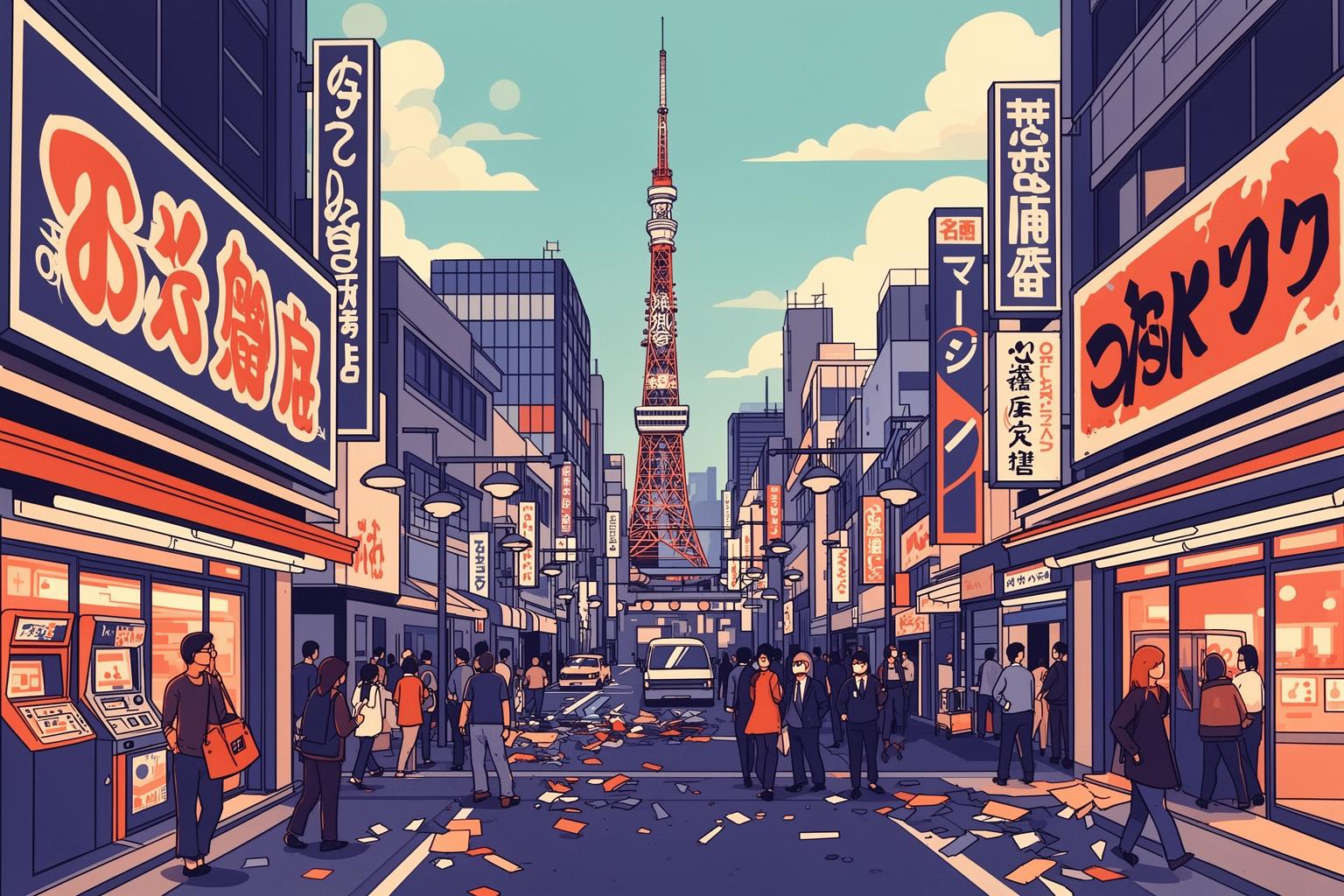
Step off the gleaming, hyper-efficient subway line in almost any residential corner of Osaka, walk past the ever-present gleam of a 24-hour convenience store, and you’ll likely find it: a covered arcade, a street humming with a different, older frequency. This is the shotengai, the local shopping street, a concept as integral to the DNA of Japanese urban life as ramen or cherry blossoms. For generations, these were not just commercial corridors; they were the living, breathing aortas of their communities. They were where you’d buy your daily tofu from a vendor who knew your mother, where the scent of grilling fish from the uoya-san mixed with the sweet perfume of flowers from the corner florist, and where neighborhood gossip was exchanged over cups of bitter green tea. The shotengai was the stage for daily life, a place of connection, familiarity, and shared identity. But a quiet, creeping silence has begun to fall over many of these arteries. The vibrant pulse is weakening, replaced by the hollow echo of footsteps and the mournful rattle of steel shutters. To understand Osaka, to truly feel its rhythm beyond the neon blaze of Dotonbori or the corporate sheen of Umeda, you must walk these streets and listen to their stories, both of a glorious past and a deeply uncertain future. This is a journey into the heart of a changing Japan, a reality check on what is being lost, what is being fought for, and what might yet be reborn from the ashes of the old.
This quiet shift in daily commerce is also reflected in the changing shopping habits at Osaka’s neighborhood supermarkets.
Echoes of the Showa Boom: The Golden Age of the Shotengai

To truly understand the melancholy that now lingers in many of Osaka’s local arcades, you first need to envision them at their peak during the Showa Era (1926-1989), especially in the decades of remarkable post-war economic expansion. During that time, the shotengai was the unquestioned heart of the community. It was far more than just a marketplace; it was an extensive open-air department store, a community hub, and a stage for everyday life—all combined into one vibrant, noisy, and wonderfully human environment. The architecture itself tells a tale. The distinctive arched roofs, often made from translucent plastic panels, were designed to shield shoppers from Osaka’s infamous summer heat and sudden rain showers, creating a semi-indoor space that encouraged people to linger and socialize. This was a pedestrian-friendly zone, meant for slow, meandering commerce and the kind of human interaction that fosters community bonds.
Imagine this scene: it’s a Saturday afternoon in the 1970s. The air is thick with a rich blend of competing aromas. The sharp, savory scent of soy sauce and bonito flakes drifts from the oden stand, where a grandmother ladles hot daikon and fish cakes into bowls for eager schoolchildren. A few shops down, the sweet, intoxicating smell of freshly baked bread pours from the local bakery, its window a colorful display of anpan (red bean paste buns) and fluffy shokupan (white bread). The butcher, his white apron lightly stained, calls greetings to passersby, the steady thump of his cleaver on the wooden block forming a familiar rhythm to the street’s soundtrack. His shop window is a mosaic of carefully arranged meats and homemade korokke (croquettes), golden and crispy, practically begging to be purchased as an afternoon snack. Nearby, the fishmonger, a man with weathered skin and a gravelly voice, arranges shimmering silver fish on ice, announcing the day’s catch with theatrical flair. His damp, calloused hands move with the precision of a surgeon as he scales, guts, and fillets a sea bream for a waiting customer.
Further along, the fruit and vegetable stand bursts with color. Neatly stacked pyramids of shiny red apples, deep purple eggplants, and bright green cucumbers create a visual feast. The owner, a woman with a sun-creased smile, might slip an extra mikan orange into a child’s bag with a knowing wink. The shops were hyper-specialized, reflecting craftsmanship and expertise. You didn’t just visit “the store.” You went to the tofu-ya for silky, fresh tofu made that morning. You stopped at the senbei-ya for crisp rice crackers, watching the master turn them over a charcoal grill. You visited the tatami-ya to have your floor mats repaired, the geta-ya for wooden clogs, and the futon-ya for bedding. Each shop was family-run, often for generations. The name on the sign wasn’t a mere brand; it was a family’s honor, their lifelong dedication.
More than commerce, the shotengai was the social network of its day. It was where the “three sacred treasures” of the post-war era—the television, the refrigerator, and the washing machine—first appeared in homes. Before every family could afford a TV, neighbors would gather at the local electronics shop in the shotengai, crowding around the small black-and-white screen to watch a popular sumo match or a drama series. It was a shared experience, a communal moment of modern life. Housewives exchanged recipes while comparing daikon prices. Children, armed with a few coins for a treat, ran to the dagashi-ya, the magical penny candy store, to choose from a dazzling variety of colorful sweets. The shotengai was where people learned of births, deaths, and marriages—not through a screen, but through face-to-face conversations. It was the glue that held the neighborhood together, a place of deep trust. You could send your child to buy groceries with a note, and the shopkeeper would make sure they received the right items and correct change. This intricate network of relationships was the shotengai’s true treasure, far more valuable than any product on its shelves.
The Slow Creep of Change: Why the Music Started to Fade
The decline was not abrupt but rather a gradual erosion, a slow-moving tide draining the life from these once vibrant streets. It was the result of powerful economic, social, and demographic forces that fundamentally transformed the way people in Japan lived, worked, and shopped. The shotengai, designed for a different era, increasingly found itself losing the fight for relevance.
The Supermarket Revolution
The first significant impact came with the rise of supermarkets. Beginning in the 1960s and gaining momentum through the 1980s, these larger stores introduced a revolutionary idea: one-stop shopping. Instead of visiting the butcher, fishmonger, and greengrocer separately, shoppers could find everything under one roof. They capitalized on economies of scale to provide lower, more consistent prices, pre-packaged goods, and the convenience of a shopping cart. For a younger generation of housewives, who were busier and less attached to traditional ways, the efficiency was undeniable. The personal connection with local shopkeepers gave way to the anonymous—but often cheaper and faster—experience of the supermarket checkout. The daily, leisurely stroll through the shotengai was gradually replaced by less frequent, more purposeful trips to larger stores.
The Age of the Automobile and the Megamall
If supermarkets were the first wave, the emergence of massive American-style suburban shopping malls was the tsunami. As car ownership became widespread, families were no longer confined to their immediate walkable neighborhoods. Developers constructed enormous shopping centers on city outskirts, surrounded by vast expanses of free parking. These were not just places to shop; they were destinations offering a wholly different experience: climate-controlled comfort, wide, clean corridors, a dazzling array of brand-name stores, food courts boasting dozens of options, multiplex cinemas, and play areas for children. AEON Malls and LaLaports became the new weekend pilgrimage spots for families. Why endure a hot, humid summer afternoon in a cramped shotengai when you could spend the entire day enjoying the air-conditioned comfort of a mall? With its narrow streets, lack of parking, and aging facilities, the shotengai simply couldn’t compete with this new vision of consumer paradise. It started to feel outdated, inconvenient, and somewhat shabby by comparison.
The Demographic Double-Punch
Beneath these commercial changes lay a profound demographic shift sweeping Japan: the dual pressures of a rapidly aging population (koreika) and a declining birthrate (shoshika). This impacted the shotengai from both sides. First, the shopkeepers themselves were aging. Many had inherited their businesses from their parents and had devoted their lives to their craft. However, their children—beneficiaries of Japan’s economic success—attended university and pursued white-collar careers in major cities like Tokyo and Osaka. They showed little interest in the long hours and slim profits of running a small family shop. With no successors, when owners retired or passed away, their shops closed permanently. This pattern repeated nationwide, leading to a loss of expertise and the gradual darkening of the arcades. Second, the customer base was also aging and shrinking. As young people moved out of older neighborhoods to new suburbs or central city high-rises, the shotengai’s clientele grew increasingly elderly. While loyal, this group had limited purchasing power and was naturally a shrinking market. The lively sounds of children playing were replaced by the slow, shuffling footsteps of seniors—a poignant soundtrack to the street’s twilight years.
Economic Stagnation and the Digital Disruption
The bursting of Japan’s economic bubble in the early 1990s ushered in the “Lost Decades” of stagnation, placing immense pressure on small businesses. Incomes tightened, and consumers became more price-sensitive than ever, flocking to 100-yen shops and discount supermarkets. The shotengai, with its higher overheads and specialized, often handmade goods, struggled to compete on price. Then came the final and perhaps most decisive blow: the internet. The rise of e-commerce giants like Amazon and Rakuten offered endless choice, competitive prices, and the ultimate convenience of home delivery. Why visit the local stationery store when you could order any pen online and have it the next day? Why go to a small bookstore when you could download an e-book instantly? The digital age rendered many of the shotengai’s core functions obsolete, accelerating its decline into irrelevance.
A Walk Through the Silence: The Anatomy of a Declining Arcade
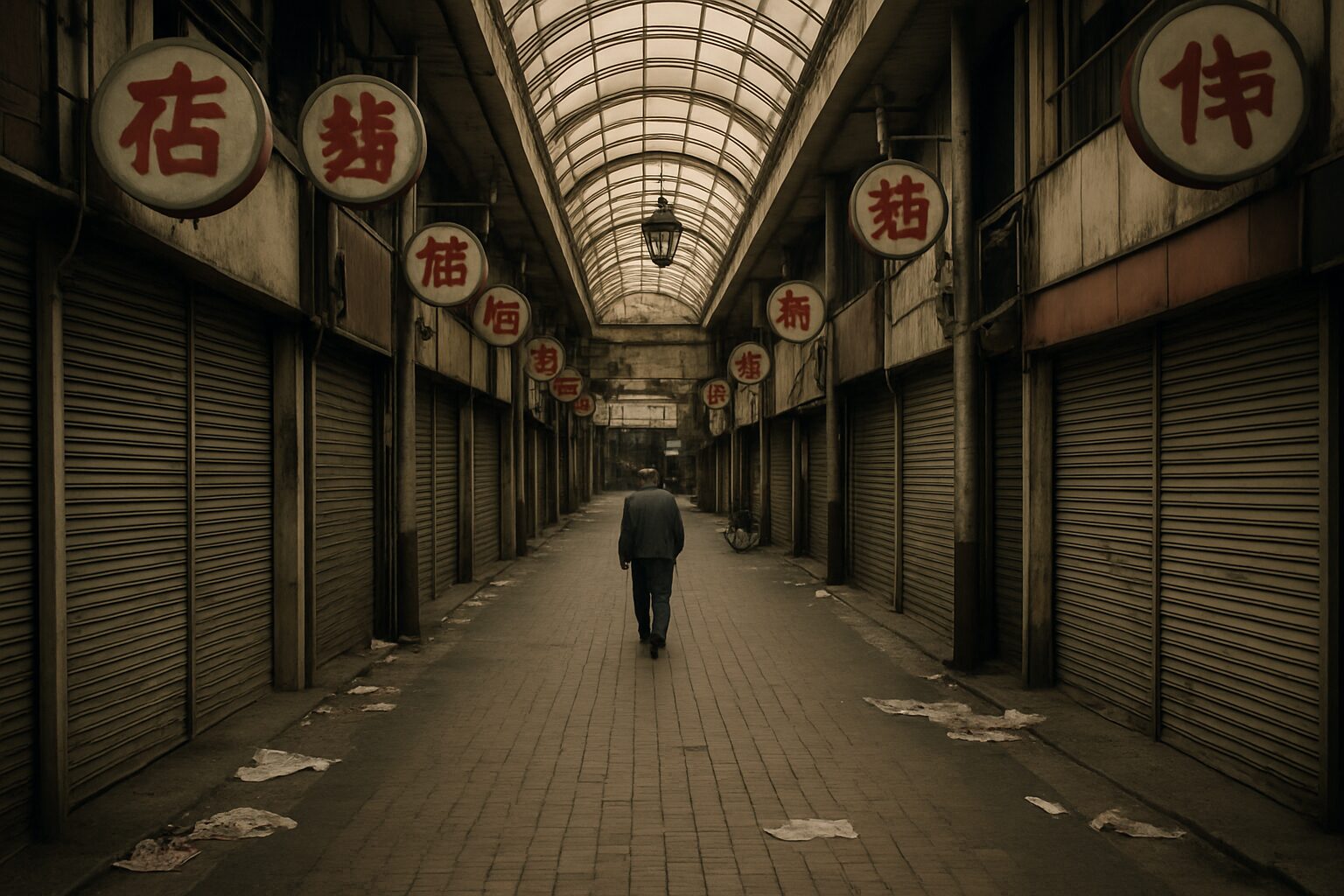
To truly grasp the situation, you must take a walk. Seek out a shotengai absent from the guidebooks, one nestled in a quiet residential district. The experience is often richly atmospheric, a passage through a living museum of what once existed. The entrance may still be grand, with a colorful archway proudly displaying the street’s name, a relic of more hopeful days. But as you step beneath the covered roof, the atmosphere changes. The first thing you notice is the light, or its absence. The translucent roof panels, once bright, are now frequently yellowed with age and coated with grime, casting a dim, sepia-tinted glow on the street below. Many overhead fluorescent lights are turned off to save electricity or perhaps burned out long ago and never replaced, creating pockets of shadow and a slightly somber, cathedral-like gloom.
Then you notice them: the shutters. They dominate the scene in a declining shotengai. Not the temporary shutters pulled down at day’s end, but the semi-permanent, rust-streaked steel curtains indicating a business long gone. Known in Japanese as shattā-dōri, or “shutter street,” some still bear the ghost of old signs—a faded, peeling decal marking what was once sold there: a clock shop, a shoe store, a tea merchant. Others are plastered with weathered movie posters or local election flyers, slowly fading away. Some are blank canvases of oxidized metal, silent monuments to forgotten dreams. The ratio of open to closed shops reveals the street’s vitality. In some places, more than half the storefronts stand sealed.
The sounds tell a similar tale. The once boisterous, chaotic symphony of the golden age has given way to a minimalist, ambient score. You hear the gentle hum of a refrigerator from an open butcher shop, the soft squeak of an elderly woman’s bicycle as she pedals slowly past, the distant clang of a train at a nearby crossing. Your footsteps echo oddly in the quiet. Occasionally, the silence is broken by the cheerful yet slightly forlorn jingle of a pre-recorded welcome message from the one pharmacy still holding steady business, serving the neighborhood’s elderly residents. The air, once thick with delicious food aromas, is now thin, smelling mostly of dust, damp concrete, and the faint, sweet scent of incense from a nearby temple.
Yet life persists stubbornly. Between shuttered storefronts, pockets of resilience remain. A tiny vegetable stand, its produce arranged in simple plastic crates, is run by a stooped but cheerful old woman. A small, family-run dry cleaner’s endures, the hiss of steam from its machines a lonely sign of industry. A kissaten, a classic Showa-era coffee shop, still serves its regulars, its interior dark, smoky, and unchanged for half a century. These remaining shops tend to the essentials of the dwindling local population: groceries, medicine, and a place for social connection. They are lifelines, holding the fragile ecosystem together. Walking through such a place is a deeply moving experience—an encounter with memory and loss, a quiet reflection on the relentless flow of time and the fragility of community. You feel like an archaeologist, sifting through the remnants of a lost civilization, except the last few inhabitants remain, living among the ruins.
Voices from the Arcade: The Human Cost of Change
Behind every rusted shutter and faded sign lies a human story, a family’s legacy, and a lifetime of effort. To truly understand the decline of the shotengai, one must listen to the voices of those who have witnessed it up close—the shopkeepers who remain, standing as steadfast sentinels against the tide of change. Their stories are woven with pride, nostalgia, resignation, and sometimes, a flicker of stubborn hope.
Picture yourself in that old kissaten. The owner, Tanaka-san, is a man in his late seventies. His back is slightly bent from years of leaning over the counter, yet his movements remain precise as he carries out the ritual of the siphon coffee maker. He inherited this shop from his father, who opened it in 1955. “When I was a boy,” he might say, his voice hoarse from years of speaking over the hiss of the coffee machine, “this street… you could barely pass through it on a Saturday. It was a river of people. Everyone knew everyone else. The butcher would give you a discount if you were having a rough week. The tofu maker would give your children the leftover okara (soy pulp) for free. We were all in it together.” He nods toward the shuttered store across the street. “That was a bookstore. The owner’s son is now a salaryman in Tokyo. Good for him. A better life. But the shop… it died with his father.” For Tanaka-san, his coffee shop is no longer just a business—it’s a public service. “Most of my customers are my age,” he says with a wry smile. “They come here every day. It might be the only real conversation they have. If I closed, where would they go? So, I stay open. As long as I can stand, I’ll be here.”
Two doors down, at one of the few remaining fresh food stalls, a fishmonger named Yamamoto-san cleans his knives at the end of the day. His hands tell the story of his trade, marked by small scars and calluses. He is a third-generation owner. “My grandfather started this business from a wooden cart after the war,” he says, punctuating his words with the rhythmic scrape of steel on stone. “My father built this shop. And me… I’m probably the last. My son works for a tech company. He can earn more in a month than I do in a year. I can’t blame him.” He reflects on the changes in people’s eating habits. “It used to be whole fish. People knew how to cook. Now? Everyone wants fillets. No bones, no head. They buy it at supermarkets, wrapped in plastic. They don’t know what fresh fish really tastes like anymore.” He is not bitter—just matter-of-fact. He is a master of a craft slowly fading away. He continues his work not just for money but out of a sense of duty to his regulars and to the memory of his father and grandfather.
Even in shops that seem stable, the pressure is immense. The owner of the local pharmacy, a younger woman who took over from her parents, talks about the challenges. “We survive because our customers are elderly and need their prescriptions. They trust us. They can’t or won’t use the big drugstores downtown. But it’s a constant struggle. Our suppliers favor the big chains. Our profit margins are tiny. We try to offer personal service, including deliveries for those who can’t leave their homes. That’s something AEON won’t do.” She belongs to a generation caught in between, trying to modernize a traditional business model while honoring the community-focused legacy she inherited. Her story is one of adaptation and resilience, a fight to carve out a place in a rapidly changing world.
These are not just stories; they are the living history of a nationwide transformation. They reveal broken chains of succession, shifting consumer values, and the deep social upheaval that happens when a community’s economic core stops beating. They are the human cost of convenience, the personal price of progress.
Rays of Hope: Reinvention and the New Shotengai
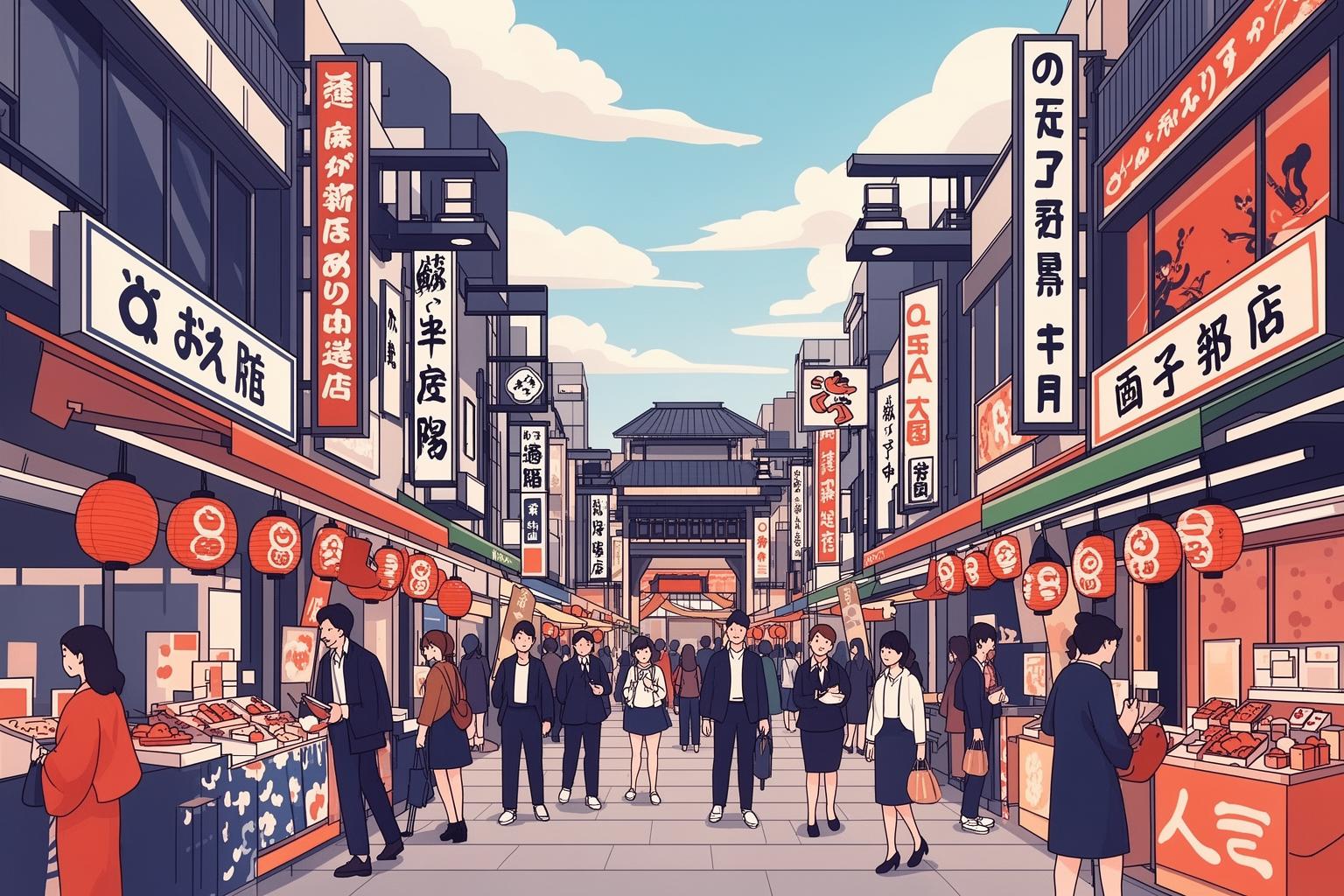
While the narrative of decline is compelling and widespread, it is not the only story. The shotengai is not dead; rather, it is evolving. Across Osaka and throughout Japan, a new chapter is being written—one of resilience, creativity, and reinvention. In the gaps left by the old system, new life is emerging, driven by a diverse group of people: young entrepreneurs, artists, community activists, and even savvy tourists. The future of the shotengai is not about returning to the past but about a smart fusion of old and new.
The Retro Revolution: Karahori and the Power of Nostalgia
One of the most exciting trends is the revitalization of old spaces by a new generation. Young people, who grew up in the sterile environment of shopping malls, are now rediscovering the charm and authenticity of the Showa era. Low rents in declining shotengai make them fertile ground for startups. A prime example in Osaka is the Karahori Shotengai. While it still hosts traditional grocers and hardware stores, it has been revitalized with fresh energy. Old, long-standing wooden townhouses (machiya) along the arcade have been carefully restored and transformed into stylish cafes, independent art galleries, artisanal bakeries, and boutique shops selling handmade crafts. The result is a fascinating blend of eras. You might see an elderly woman buying her daily vegetables next to a trendy cafe where young creatives sip artisanal lattes. This “retro-chic” charm has turned Karahori into a destination, attracting visitors seeking a unique, aesthetically pleasing experience that feels more “authentic” than a generic shopping mall. It’s a model demonstrating that nostalgia, combined with modern business savvy, can be a powerful force for revival.
Specialization and Scale: The Tenjinbashisuji Model
Another approach to survival is to grow large and specialize. Tenjinbashisuji Shotengai exemplifies this. Stretching an impressive 2.6 kilometers, it holds the title of Japan’s longest shopping arcade. Its vast size allows it to support an incredible variety of shops—from traditional tofu makers and kimono sellers to modern chain restaurants, bustling izakaya pubs, and lively pachinko parlors. It has rarely declined because it became a destination in itself, an iconic Osaka landmark. Its length and diversity draw not only locals but visitors from across the city and beyond. It offers a quintessentially Osakan experience—loud, vibrant, and full of bargains. While not every shotengai can replicate its scale, the lesson is clear: having a strong, unique identity—whether as the longest, the best for a specific product (like Osaka’s Doguyasuji for kitchenware), or the most traditional—is essential for maintaining relevance.
The Tourist Boom: A Double-Edged Sword at Kuromon Ichiba
Inbound tourism has been another potent, albeit controversial, force for revitalization. Kuromon Ichiba Market, once a local market known as “Osaka’s Kitchen,” has nearly completely transformed into a major international tourist hotspot. Where locals once did their everyday grocery shopping, crowds of tourists now indulge in grilled scallops, sea urchin, and Kobe beef skewers. Prices have surged, and many traditional vendors have been replaced by businesses catering exclusively to tourist tastes and budgets. On one hand, this has brought remarkable economic success to the market; it is bustling, profitable, and internationally renowned. On the other hand, many argue it has lost its soul. The original local community it was meant to serve has been largely priced out and pushed aside. Kuromon Ichiba embodies a difficult dilemma for struggling shotengai: is economic survival worth sacrificing your original identity? It’s a question many communities continue to wrestle with.
Community-Led Initiatives
Perhaps the most heartening stories of revival come from grassroots efforts. In many smaller shotengai, local business associations and dedicated residents are fighting back with creative, small-scale initiatives. They organize local festivals (matsuri) to draw families back to the street. They hold “100-Yen Shotengai” events where every shop offers a special bargain for just one coin. They create stamp rallies for children and walking tours for visitors. While these efforts may not reverse broader economic trends, they are crucial for rebuilding the sense of community and social connection that was the shotengai’s original purpose. These initiatives are acts of defiance and love for a place—a declaration that the street is more than just a collection of stores; it’s a home worth fighting for.
Your Role in the Story: Exploring Osaka’s Living History
As someone residing in Osaka, you are in a distinctive position. You are not merely a tourist passing through; you have the chance to look beyond the city’s polished exterior and connect with its deeper, more genuine layers. Exploring these local shotengai is one of the most fulfilling ways to do so. It offers an opportunity to witness a side of Japan that is gradually vanishing, engaging with the city not as a consumer but as a community member.
So, step off the beaten path. Choose a random station on the Tanimachi Line or the Hankyu Kyoto Line, get off, and simply walk. You will almost certainly discover a local shotengai. Don’t be discouraged if your Japanese is limited. A smile and a simple “Konnichiwa” (hello) or “Arigatou gozaimasu” (thank you) will be warmly welcomed. Shopkeepers in these neighborhoods often appreciate seeing a new face, especially one from abroad expressing interest in their community.
Be an active participant rather than a passive observer. Instead of grabbing your snacks at a convenience store, buy a freshly fried korokke from the butcher shop. It will be cheaper, more delicious, and you’ll be supporting a local family. Purchase your vegetables from the elderly woman at the fruit stand. Enjoy a coffee at the smoky, nostalgic kissaten. These small exchanges are more than transactions; they are acts of connection and support, signaling that these places and the people behind them still matter.
This is also where you’ll find some of the best and most authentic food in Osaka, far from the tourist-inflated prices of Dotonbori. Look for the small, humble eateries—the udon shop with steamy windows, the takoyaki stand with a line of locals, the tiny sushi counter run by an elderly couple. These are the spots where you’ll experience the city’s true flavors. Let your senses guide you—follow the aroma of grilling unagi or the sound of tempura sizzling in hot oil.
Visiting a fading shotengai can be a reflective experience. It’s a place to contemplate change, community, and memory. Bring your camera, but also take time to put it away and simply absorb the atmosphere. Notice the details: the old tiled storefronts, hand-painted signs, lucky cat figurines waving from windows. Listen to the soft conversations of elderly residents. It’s an immersion in the soul of residential Osaka, offering an experience that will deepen your appreciation of your adopted home far beyond another visit to a famous temple.
The Street Goes On
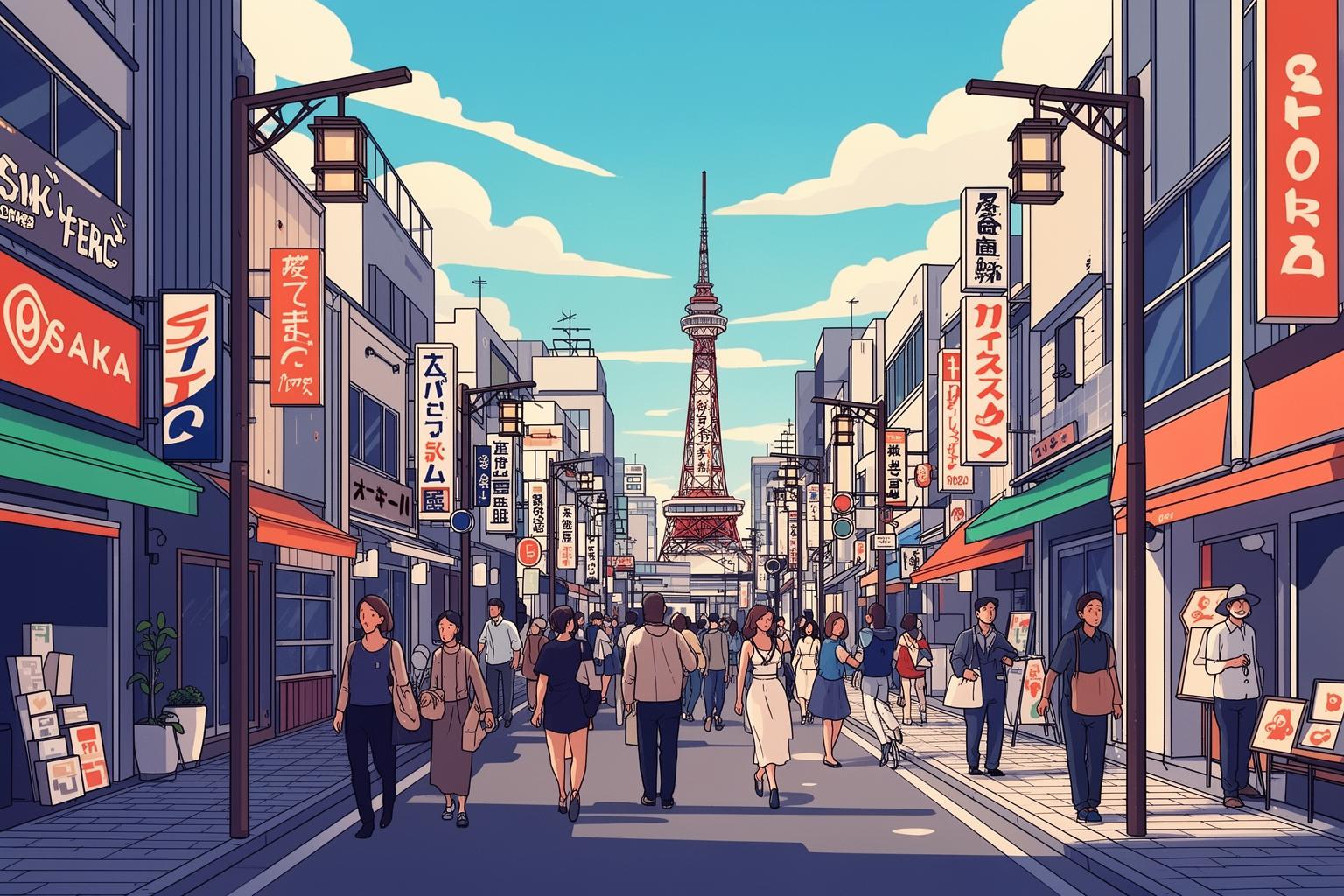
The story of the shotengai reflects the broader narrative of modern Japan. It tells of profound transformation, of the conflicts between tradition and modernity, between community and convenience, and between an aging past and an uncertain future. The golden era of the vibrant, all-encompassing community hub may have passed, and many of these streets will inevitably grow quieter. The number of rusted shutters will continue to increase.
However, to declare the shotengai dead would be mistaken. It is not so much dying as evolving, sometimes with difficulty, into something new. From the remnants of the old, creative and resilient new forms are emerging. The future may lie not in attempting to recreate the past, but in embracing a new role: as a niche for artisans, a refuge for retro-cool startups, a quiet social lifeline for the elderly, or simply a place offering a tangible, human-scale alternative to the impersonal gloss of the 21st-century megamall.
For us, the residents of this remarkable city, these streets are a gift. They are living museums, quiet corridors of memory, and spaces for connection. They invite us to slow down, to look closer, and to appreciate the fragile beauty of everyday life. So take a stroll. Buy a croquette. Have a coffee. Become a small part of the shotengai’s next chapter. Listen to its stories before they fade, and in doing so, you may find yourself weaving your own story into the rich, complex, and ever-evolving tapestry of Osaka.