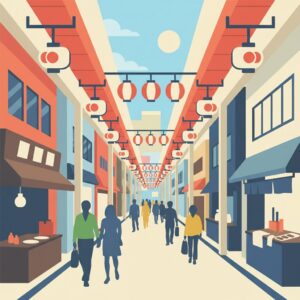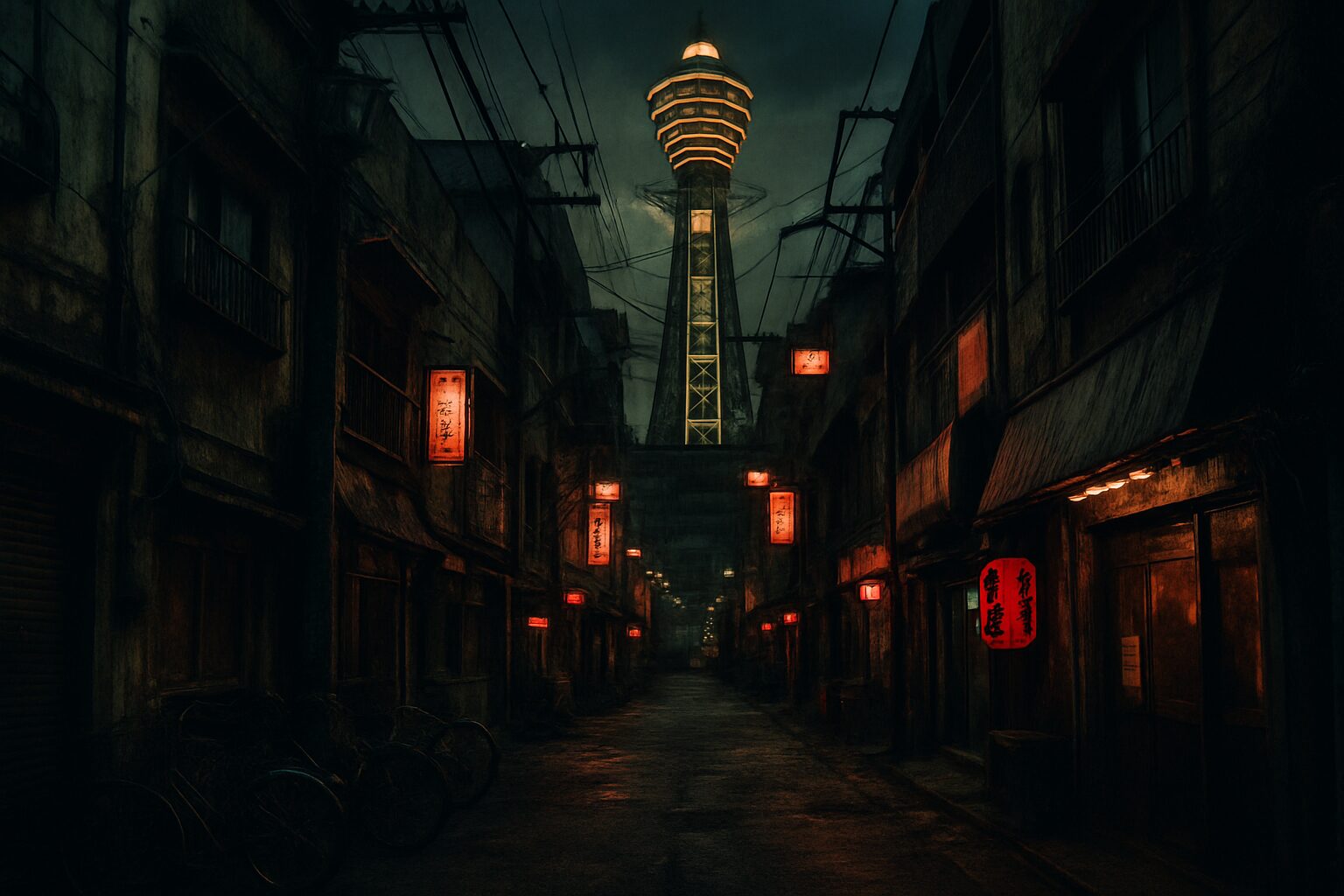
Hola, lovelies! Sofia here, ready to take you on a journey that feels like stepping through a time portal right in the heart of Osaka. Forget the sleek, minimalist cafes and the perfectly polished department stores for a moment. Today, we’re diving headfirst into a district that pulsates with a raw, unfiltered energy, a place where the past isn’t just remembered—it’s vibrantly, chaotically, and unapologetically alive. We’re heading to Shinsekai, the “New World” of Osaka. When you first hear the name, you might picture something futuristic, but the reality is a glorious, neon-soaked paradox. Shinsekai is a time capsule, a living museum dedicated to the boisterous spirit of mid-20th century Japan, specifically the Showa Era. It’s a district of dazzling lights and deep shadows, of savory street food aromas mingling with the scent of old wood and cheap beer. It’s a place that doesn’t try to be pretty for the tourists; it simply is. This is where you come to find the gritty, beating heart of Osaka, a world away from the curated perfection you might see elsewhere. It’s a feast for the senses, a photographer’s dream, and an absolute must for anyone who wants to understand the city’s complex, resilient soul. Prepare for a sensory overload in the best way possible, where every corner tells a story and every face has a history. This isn’t just a sightseeing spot; it’s an experience that grabs you and refuses to let go. So, grab your camera and an empty stomach, because we’re about to explore the beautiful, chaotic, and utterly unforgettable reality of Shinsekai.
If you find yourself captivated by Shinsekai’s raw energy and are considering a longer stay, you might want to explore renting an apartment in the surrounding Tennoji Ward.
The Electric Heartbeat: Tsutenkaku Tower’s Enduring Glow
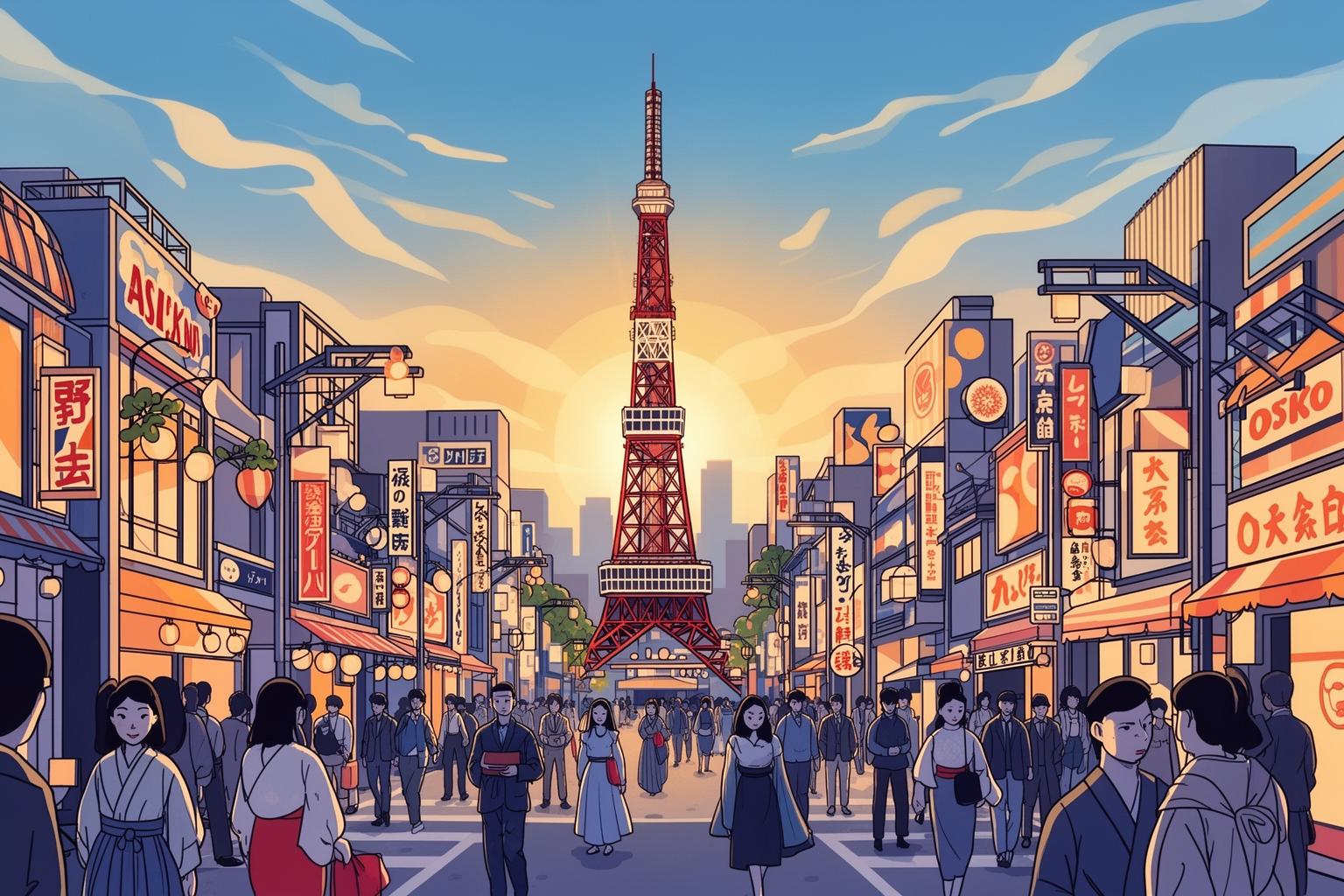
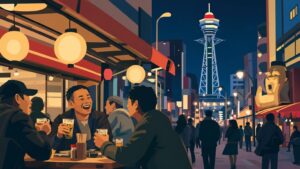
Dominating the entire district like a benevolent guardian forged of steel is the iconic Tsutenkaku Tower. You simply can’t discuss Shinsekai without beginning here. It serves as the district’s anchor, its North Star, its very essence. Its name poetically means “Tower Reaching Heaven,” and from the moment you step out of the subway, its familiar silhouette draws you in. This is more than just an observation deck; it symbolizes Osaka’s enduring spirit of resilience. The original tower, constructed in 1912 and inspired by a remarkable blend of the Eiffel Tower and the Arc de Triomphe, stood as a beacon of modernity. It was the centerpiece of an amusement park called Luna Park, a dazzling dreamscape modeled after Coney Island. Sadly, a fire followed by wartime scrap metal demands led to its dismantling in 1943. But Osaka refused to let its icon vanish. In 1956, through the determination and funding of its citizens, Tsutenkaku was reborn—taller and stronger, a testament to a city rising from the ashes. This history fills the air as you approach it; you can feel the pride locals hold for this landmark.
Ascending Tsutenkaku is an experience in itself. The elevators are decorated with quirky illustrations and boast a ceiling that shifts its celestial display as you climb. When the doors open on the main observation floor, you’re welcomed by a burst of golden light and a 360-degree panorama of sprawling Osaka. From this vantage point, 91 meters up, the city unfolds before you. You can follow the JR Loop Line train winding through the concrete canyons, spot the lush greenery of nearby Tennoji Park, and admire the towering glass facade of Abeno Harukas, Japan’s tallest skyscraper, a striking modern contrast to Shinsekai’s retro charm. On a clear day, your gaze can stretch to the distant Rokko Mountains and the shimmering waters of Osaka Bay. It’s a perspective that helps you piece together the city’s geographical puzzle.
Yet, the true highlight awaits inside. On the fifth floor stands a golden statue of a mischievous deity called Billiken. This cheerful, pointy-headed figure was actually created by an American artist but found a spiritual home here in Osaka. Known as “The God of Things As They Ought to Be,” tradition holds that rubbing the soles of his feet brings good luck. Believe me, his feet are worn smooth from millions of wishes and dreams gifted over the decades. It’s a wonderfully photogenic and heartwarming ritual that connects you to generations of visitors. Don’t hesitate; give those feet a good rub and make a wish!
For thrill-seekers, Tsutenkaku offers a modern rush. The “Tower Slider” is a recent adrenaline-pumping addition. This giant slide spirals around the tower’s elevator shaft, delivering a 60-meter, 10-second ride from the third floor down to the basement. It’s a dizzying, exhilarating experience that provides a uniquely fleeting perspective of the tower’s structure. As night falls, Tsutenkaku transforms magically. Its steel frame glows with a dazzling LED light show, with colors shifting for seasons and special events. The lights at its peak also serve a practical purpose—they act as a weather forecast for the next day, blending tradition with utility. Watching the tower illuminated against the dark sky, casting colorful reflections on the wet streets below, is a quintessential Shinsekai moment.
A Symphony of Sizzle and Spice: The Culinary Soul of Janjan Yokocho
If Tsutenkaku is the heart of Shinsekai, then the narrow, covered arcade of Janjan Yokocho is its lively, flavorful stomach. This bustling alleyway, whose name is believed to come from the onomatopoeic “jan-jan” sound of shamisen strings being played to attract customers in its heyday, offers a sensory feast. The moment you step beneath its roof, you’re surrounded by a warm cloud of savory aromas—the scent of sizzling batter, sweet-salty simmering sauces, and grilled meats. The air buzzes with the cheerful noise of vendors calling out, the clatter of plates, the raucous laughter of locals sharing drinks, and the clinking of beer mugs. It’s a place brimming with life, a vibrant artery pumping the culinary lifeblood of working-class Osaka.
The Golden Rule of Kushikatsu
The undisputed culinary star of Shinsekai, and the primary draw for any foodie visit to Janjan Yokocho, is kushikatsu. The concept is simple yet sublime: a variety of ingredients—from meat and seafood to vegetables and even cheese—are skewered, coated in a light panko batter, and deep-fried to a perfect golden crisp. The experience is interactive and immensely satisfying. You sit at a small counter, often shoulder to shoulder with strangers who quickly become temporary friends, and point to the skewers you want. They arrive piping hot, presenting a delectable range of textures and flavors. You’ll find classics like beef (gyu-katsu), pork (buta-katsu), shrimp (ebi), and onion (tamanegi), alongside more adventurous choices like lotus root (renkon), quail eggs (uzura), and even fried ice cream for dessert.
Before you take your first bite, however, you must learn the sacred, unbreakable rule of kushikatsu: NO DOUBLE-DIPPING. The large communal pot of dark, savory-sweet tonkatsu-like sauce on the counter is shared by all. You dip your skewer once, and only once, at the start. If you need more sauce mid-bite, you use a piece of the complimentary raw cabbage provided to scoop some up and drizzle it on your food. Breaking this rule is a serious culinary faux pas, earning the stern (though usually good-natured) disapproval of staff and fellow diners. This rule is about more than hygiene; it’s a social contract, a shared understanding that unites everyone in the small, crowded restaurant. Renowned establishments like Ganso Kushikatsu Daruma, with its iconic angry chef mascot, or the ever-popular Yaekatsu, often have lines stretching down the alley, a testament to their mastery of this simple dish. The experience of crowding at a counter, dipping freshly fried skewers, and washing it down with a cold beer captures the very essence of Shinsekai dining.
Beyond the Skewers
While kushikatsu is king, the culinary offerings of Janjan Yokocho and the surrounding streets are delightfully diverse. Another local specialty you must try is Doteyaki, a rich, comforting stew of beef sinew slow-cooked in a sweet and savory blend of miso, mirin, and dashi. Simmered for hours until the meat becomes melt-in-your-mouth tender, it pairs perfectly with a cold drink. Large pots of it bubble away at many izakayas’ counters. Of course, this is Osaka, so you won’t be far from excellent Takoyaki (battered octopus balls) and Okonomiyaki (savory pancakes). The versions found here often feel more rustic and homemade compared to those in busier tourist areas.
Many Shinsekai establishments are tachinomi, or standing bars—tiny, no-frills spots where you eat and drink while standing at a counter. They are incredibly affordable and offer a fantastic window into local life. You’ll see elderly men reading newspapers, salarymen unwinding after work, and young couples on casual dates, all packed into small spaces creating a warm and convivial atmosphere. Don’t be put off by menu language barriers in some smaller places; a simple point and a friendly smile will get you far. Here, you’ll find the most authentic flavors and the most memorable encounters.
The Ghosts of Showa Past: Atmosphere and Architecture
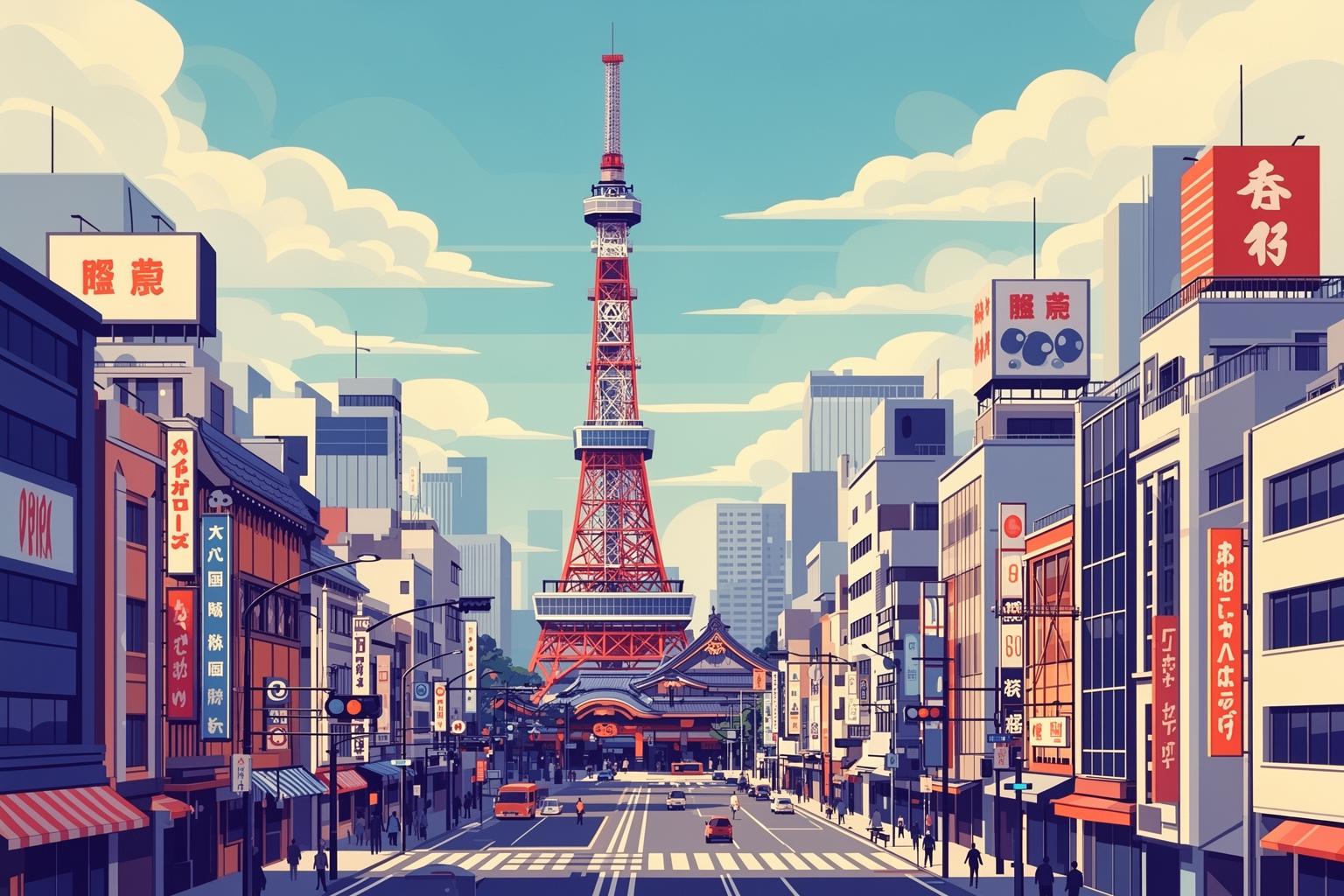
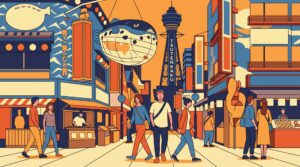
Walking through Shinsekai feels like stepping onto the set of a nostalgic film. The entire district stands as a living, breathing monument to the Showa Era (1926-1989), a period of profound transformation in Japan that holds a special place in the nation’s collective memory. The aesthetic is bold, proud, and delightfully extravagant. The streets serve as a chaotic gallery of enormous, three-dimensional signboards, or kanban, each one more flamboyant than the next. A colossal fugu (pufferfish) lantern glows with a nearly mischievous grin outside Zuboraya, a renowned fugu restaurant. Sumo wrestlers in dynamic poses decorate the facades of kushikatsu joints, paying homage to the area’s historical ties to the sport. Billiken, the district’s lucky mascot, is ubiquitous, his smiling face shining down from signs, statues, and storefronts. These signs aren’t merely advertisements; they are folk art pieces, infused with humor and a bygone charm that is utterly captivating. My camera works overtime here; every storefront is a masterpiece of retro design.
The real magic, however, lies in the details. Venture down the narrow side streets branching off the main thoroughfare, where the neon glow softens into the gentle light of paper lanterns. There, you’ll find tiny, family-run eateries that have stood for generations, their wooden facades smoothed by time. You’ll come across old-school game centers—not boasting the latest VR technology—but featuring vintage pachinko machines and, if you’re lucky, a rare Smart Ball parlor. Smart Ball is a pinball-like game, almost entirely mechanical, a charming analog relic offering a gentle, clattering form of entertainment. The sounds of Shinsekai form a unique symphony: the constant metallic cascade of pachinko balls, cheerful jingles of shop advertisements on a loop, and the melancholic strains of enka—a sentimental style of Japanese ballad—wafting from the open doors of tiny bars.
This nostalgic atmosphere, however, is layered with an unmistakable rawness. Shinsekai’s story is one of boom, bust, and stagnation. After its glamorous pre-war origins, the area fell into decline and was largely overlooked during Japan’s post-war economic miracle. It became a neighborhood for laborers, drifters, and those living on society’s margins. This legacy remains visible today. The buildings show wear, some displaying signs of neglect. A significant homeless population can be seen, especially around the train stations. This is not the pristine, perfectly manicured Japan often showcased in travel brochures. And that is precisely why it matters so much. Shinsekai offers an honest portrayal of urban life, with all its complexities and contradictions. It’s a place rich with character, where the resilience of its community shines through a weathered exterior. To appreciate Shinsekai is to embrace its imperfections and to find beauty in its unpolished reality.
Entertainment for the People: From Theaters to Spas
Shinsekai has always been a district devoted to public entertainment, a place where ordinary people could escape the daily grind. Although the original Luna Park no longer exists, its spirit of amusement and relaxation continues to thrive in various forms, ranging from traditional theaters to a modern spa haven.
The Urban Oasis of Spa World
Just a short walk from the base of Tsutenkaku Tower stands a building that seems as if it’s been transported from another realm: Spa World. This immense, multi-level complex is a true temple of bathing, a 24-hour onsen and spa theme park offering a surreal and wonderfully calming contrast to the rough streets outside. The concept is wonderfully eccentric. The bathing floors are divided into a European Zone and an Asian Zone, with access alternating between men and women every month. One month, women might be relaxing in a Roman-style bath surrounded by classical statues while men enjoy a Finnish sauna. The next month, they switch. The Asian Zone delivers a journey through various bathing cultures, from a rustic Japanese hinoki cypress bath to a milky Balinese-inspired pool. The variety is truly remarkable. Beyond the baths, there are several floors dedicated to different types of saunas from around the globe (including ganban’yoku, or hot stone therapy), massage services, restaurants, and relaxation lounges with reclining chairs and personal TVs. You can easily spend an entire day here, washing your worries away. For budget travelers, its 24-hour operation and late-night pricing make it an unusual but practical alternative to a hotel stay.
Traditional Pastimes and Hidden Worlds
For a more traditional entertainment experience, Shinsekai still preserves a few treasures. The district hosts some of Osaka’s last remaining taishu-engeki (popular theater) venues. These theaters stage lively performances blending period dramas, comedies, and dance, often featuring male actors portraying female roles in a style reminiscent of kabuki. Though the shows are entirely in Japanese, the colorful costumes, dramatic music, and expressive acting transcend language barriers, offering a captivating glimpse into a cherished form of local entertainment. Another familiar sight in Shinsekai’s quieter corners are Go and Shogi clubs. Peering through their windows, one can see rows of elderly men bent over game boards, their expressions marked by deep concentration. These clubs serve as essential social hubs for the community, places where time seems to slow. They poignantly remind us that Shinsekai is not simply a tourist spot but a living neighborhood and a home. It’s also important to note the district’s location plays into its complex identity. It borders areas with their own distinct and sometimes challenging histories, including Tobita Shinchi, one of Japan’s most famous red-light districts. While Shinsekai itself focuses on food and retro fun, visitors should remain aware of their surroundings, especially late at night, as the atmosphere can shift considerably just a few blocks away.
A Practical Navigator’s Guide to the New World
Exploring Shinsekai is part of the adventure. It’s a compact district best enjoyed on foot, allowing you to wander through its maze-like streets and uncover hidden gems. Getting there is easy, thanks to Osaka’s excellent public transportation system.
How to Get There
Shinsekai is conveniently accessible from multiple train and subway stations, making it a straightforward journey from major hubs like Namba, Umeda, or Tennoji.
- Dobutsuen-mae Station: Often the most convenient choice, served by the Midosuji Line (Osaka subway’s main north-south route) and the Sakaisuji Line. Take Exit 5, and you’ll find yourself right at the entrance to Janjan Yokocho.
- Ebisucho Station: Located on the Sakaisuji Line, this is the best stop if Tsutenkaku Tower is your primary destination. Exit 3 leads you directly to the base of the tower.
- Shin-Imamiya Station: A significant hub served by the JR Osaka Loop Line and the Nankai Railway Line (ideal if you’re coming from Kansai Airport). From here, it’s a brief 5-10 minute walk east to reach Shinsekai’s heart.
The Best Time to Visit
Shinsekai offers two distinctly different yet equally enchanting experiences depending on the time of day. A daytime visit is perfect for a relaxed exploration. The sunlight highlights the faded hues of the old buildings, allowing you to appreciate the detailed signboards. It’s a great time to browse quirky shops, visit the nearby Tennoji Zoo, or enjoy wide, clear views from Tsutenkaku Tower. You’ll also get a glimpse of the local community going about their daily routines.
However, after sunset, Shinsekai truly comes alive and transforms into its most iconic self. As darkness falls, thousands of neon lights flicker on, bathing the district in a vibrant, kaleidoscopic glow. The giant fugu lantern, Tsutenkaku Tower, and countless smaller signs create a scene reminiscent of a cyberpunk film. The izakayas and kushikatsu restaurants fill up, their warm light spilling onto the streets, and the atmosphere buzzes with energy and excitement. For the full experience, I highly recommend arriving in the late afternoon. You can enjoy the fading daylight, watch the stunning transition as the neon lights illuminate the area, and then immerse yourself in the lively nightlife for dinner and drinks. It’s the best of both worlds.
Local Tips and Etiquette
- Cash is King: While larger venues like Spa World and Tsutenkaku Tower accept credit cards, many small family-run kushikatsu spots, bars, and shops in Janjan Yokocho accept cash only. It’s wise to carry some yen with you.
- Respectful Photography: Shinsekai is highly photogenic, but it’s also home and workplace to many people. Be considerate when taking photos—avoid aiming your camera directly at people without permission and be discreet in quieter, residential alleys.
- Stay Aware: Shinsekai is generally safe for visitors, but its gritty nature means you should use the same common sense as in any major city. Stay aware of your surroundings, especially at night, and stick to well-lit main streets unless accompanied by someone familiar with the area.
- Explore the Surroundings: Shinsekai’s location is a major advantage. It borders the beautiful Tennoji Park and the excellent Tennoji Zoo. You can easily combine your Shinsekai visit with a stroll through the park, a trip to the historic Shitennoji Temple (one of Japan’s oldest), or a ride up the sleek Abeno Harukas skyscraper for a contrasting cityscape view.
Embracing the Unpolished Gem
Shinsekai is more than a mere tourist destination; it is a declaration. It stands as a bold, defiant assertion that there is deep beauty in the imperfect, the aged, and the genuine. This is a place that openly displays its history—both the triumphant and the challenging—for everyone to witness. In a country that often prizes pristine order and quiet subtlety, Shinsekai bursts forth as a vibrant, noisy, and chaotic celebration of humanity. It challenges your perceptions and offers an experience that feels remarkably authentic.
So, when you visit, I urge you to look beyond the retro postcards and flawless Instagram shots. Stay a little longer. Listen to the cadence of the pachinko parlors. Squeeze into a tiny kushikatsu counter and share a laugh with the person beside you. Sense the ghosts of the Showa Era in the weathered facades and hear the echoes of a century of dreams in the bustling alleys. This is Osaka’s “New World”—not a world of futuristic gloss, but one of lasting spirit, unapologetic character, and a heart of gold. It is, without question, absolutely unforgettable.