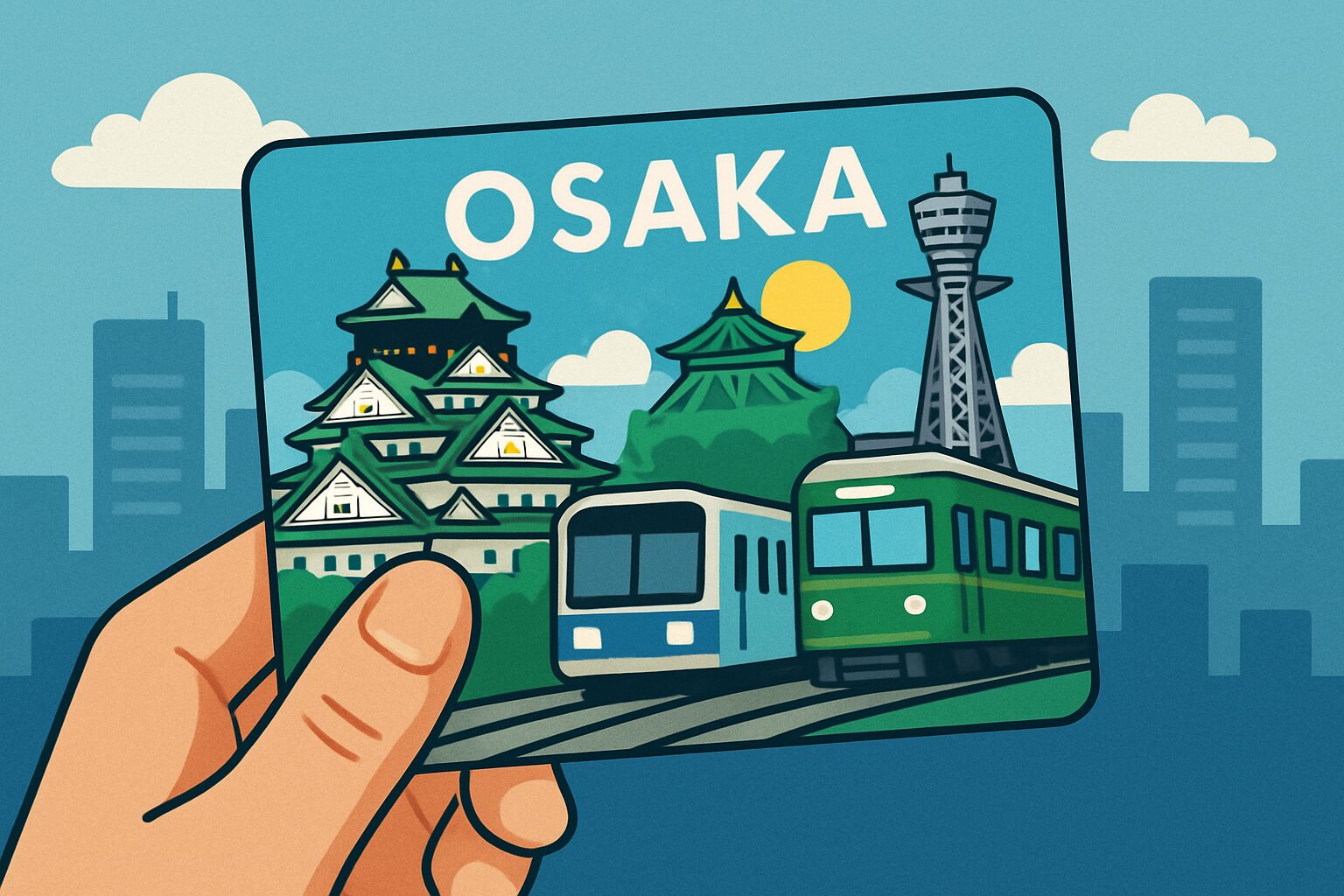
Welcome to Osaka, a city that pulses with a relentless, infectious energy. From the neon-drenched canals of Dotonbori to the sky-piercing towers of Umeda, the city moves to a rhythm all its own. And the heartbeat of that rhythm? Its world-class public transportation system. It’s a sprawling, intricate network of trains, subways, and buses that act as the city’s arteries, pumping life into every corner of the Kansai region. For a newcomer, it’s a marvel of efficiency and punctuality. But as you settle in, transforming from a wide-eyed tourist into a seasoned resident, the initial wonder gives way to a practical, pressing question: how in the world do you navigate this system without your wallet springing a leak? The sheer number of ticket options, multi-day passes, and competing railway companies can feel like trying to solve a Rubik’s Cube in the middle of a packed rush-hour train. Is a commuter pass, the venerable teiki-ken, truly the golden ticket to savings? Or are you better off with the simple tap-and-go freedom of an IC card? This isn’t just a guide to buying tickets; it’s your deep-dive financial strategy session, a cost-benefit analysis designed specifically for the long-term foreign resident. We’re about to decode the system, run the numbers, and explore the lifestyle perks hidden within each choice, empowering you to conquer the daily commute and master the financial beat of your new home in Osaka.
Once you’ve optimized your commute budget, you might also want to explore delicious and affordable lunch options like a depachika bento to fuel your day in the city.
The Foundation: Understanding Osaka’s Transit Landscape
Before you can devise a strategy, you need to familiarize yourself with the players on the field. Osaka’s transit map is not controlled by a single entity; it is a complex and sometimes overlapping network created by several major operators. Understanding their respective territories is the first step toward financial insight. First, there is JR West (Japan Railways West), the giant of the group. JR runs the iconic Osaka Loop Line, or Kanjo-sen, the bright orange train that circles the city’s core, linking major hubs like Osaka Station (Umeda), Tennoji, and Kyobashi. It also serves as your main carrier for reaching other Kansai cities such as Kyoto, Kobe, and Nara, in addition to running the principal airport lines to Kansai International Airport (KIX). If your routine involves frequent intercity travel, JR is an indispensable and unavoidable part of your daily routine.
Next, beneath the city streets lies the Osaka Metro, the true backbone of inner-city transit. With nine subway lines crisscrossing the metropolis, the Metro is your key to accessing nearly every neighborhood within Osaka City proper. The crimson Midosuji Line serves as its main artery, a crucial north-south route connecting commercial hubs like Umeda, Shinsaibashi, Namba, and Tennoji. For most residents whose lives revolve within Osaka City, the Metro will be their most common mode of transportation.
Following that are the private railways, known as shitetsu, each with its own unique character and domain. Think of them as regional kingdoms, each efficiently servicing specific corridors. The Hankyu Railway, with its classic wine-red trains, departs from the luxurious Osaka-Umeda Station, carrying passengers northwest toward affluent suburbs and onward to Kobe and Kyoto. Its counterpart, the Hanshin Railway, also leaves from Umeda, running a parallel route to Kobe and famously serving Koshien Stadium, home to the beloved Hanshin Tigers baseball team. To the east, the Keihan Railway traces the Yodo River from Yodoyabashi and Kyobashi, offering a scenic journey to Kyoto and the matcha-green hills of Uji. Spanning south and east is the vast Kintetsu Railway, Japan’s largest private operator, which connects Osaka-Namba to the ancient capital of Nara, the industrial center of Nagoya, and the sacred Ise-Shima peninsula. Lastly, the Nankai Railway stretches south from Namba, providing a gateway to the spiritual mountain retreat of Koyasan and an alternative, often quicker, route to KIX.
With this ensemble of operators, the fundamental choice for residents comes down to opting for either a pay-as-you-go IC card or a dedicated pass. The IC card—ICOCA from JR West or PiTaPa from the private consortium—forms the baseline. It offers unparalleled convenience; you either load it with cash (ICOCA) or link it to your bank account (PiTaPa), then simply tap on and off at the gates. Fares are calculated automatically. For casual users or those with unpredictable travel schedules, this option is ideal. However, this guide targets those who suspect there’s a better deal available, those whose daily journeys follow patterns and rhythms that can be leveraged for substantial savings.
The Commuter’s Lifeline: The Teiki-ken (定期券) Commuter Pass
For those with a regular, fixed commute to work or school, the Teiki-ken (定期券) stands as the undisputed champion of cost-effective travel. Essentially, a Teiki-ken is a pass that allows unlimited travel between two specific stations—such as your home and office stations—for a fixed period of one, three, or six months. The longer the validity, the greater the discount. Its primary purpose is to reduce the daily commuting cost, and it excels in doing so.
However, the real value extends beyond simple A-to-B travel. The break-even point is the first calculation to consider. Generally, a one-month Teiki-ken costs about the same as 15 to 18 round trips on your chosen route. If you work a typical five-day week, you’re making roughly 20-22 round trips per month. Right away, you’re saving money. The benefits are immediate and obvious. A six-month pass offers an even better discount, effectively providing almost a full month of free travel compared to purchasing six individual one-month passes.
Let’s consider a real example. Suppose you live near Esaka Station, at the northern end of the Osaka Metro Midosuji Line, and commute to an office in Namba. A one-way fare is ¥290, so a daily round trip costs ¥580. Over a 20-day work month, that’s ¥11,600 spent just on commuting. A one-month Teiki-ken for this route would cost about ¥9,980, resulting in an instant saving of over ¥1,600. Yet, the real game-changer is the Teiki-ken’s hidden benefit: you can get on and off at any station along your designated route at no extra charge. In the Esaka-to-Namba case, your pass becomes a free ticket to Shin-Osaka, Umeda, Yodoyabashi, Honmachi, and Shinsaibashi. Suddenly, meeting friends for dinner in Umeda after work, weekend shopping in Shinsaibashi, or running errands in Honmachi comes with no additional transport cost. This transforms the pass from a simple commuting tool into a lifestyle enhancer, encouraging exploration and spontaneity along your daily path.
The Teiki-ken comes in two main types. The Tsukin Teiki (通勤定期) is the standard commuter pass, available to anyone for their work commute. The Tsugaku Teiki (通学定期), or student pass, offers the most significant savings. If you are enrolled in a recognized Japanese school, university, or language program, you qualify for this heavily subsidized pass, which can be 50-70% cheaper than a regular Teiki-ken. The savings are so substantial that they can noticeably ease a student’s monthly budget.
Of course, commuting in Osaka often involves more than one train line. If your journey requires transferring between two different companies, this is where the Renraku Teiki (連絡定期), or combination pass, comes in. For example, if you commute from a Hankyu line to an Osaka Metro line, you don’t have to buy two separate passes. Instead, you can purchase a single Renraku Teiki that covers the entire route from your Hankyu starting station to your final Metro destination. This combined pass is issued on one IC card and offers a slight discount compared to buying two separate passes. It simplifies your commute, requiring only one purchase and one card.
Obtaining a Teiki-ken is simple. Most major stations have dedicated ticket vending machines with English menus that can issue new passes or renew existing ones. You’ll just need to enter your name and phone number. Alternatively, you can visit a ticket office—the Midori no Madoguchi for JR lines or the station master’s office for private lines—for personal assistance. The best part is you don’t need a separate card. The Teiki-ken data can be loaded directly onto your ICOCA or PiTaPa card, turning it into a hybrid: functioning as your unlimited pass within your route, and as a standard pay-as-you-go card for travel outside it. It offers the perfect blend of maximum savings and ultimate convenience.
Beyond the Daily Grind: Exploring All-You-Can-Ride Passes

While the Teiki-ken is ideal for a structured daily commute, what about those whose lives don’t follow a straightforward A-to-B pattern? Freelancers, gig workers, or simply adventurous individuals who constantly explore the city require a different kind of solution. This is where all-you-can-ride passes and discount systems step in, providing flexibility tailored to the non-traditional traveler.
For heavy users of the city’s subway and bus networks, Osaka Metro offers several attractive alternatives beyond the single-day tourist pass. The best-known option is the Enjoy Eco Card (エンジョイエコカード), granting unlimited travel for a full day on all Osaka Metro subway lines, the New Tram, and Osaka City Bus routes. It costs ¥820 on weekdays but drops to just ¥620 on weekends and holidays. The weekday break-even point is usually four or five subway rides, making it an excellent choice for a day of intensive city exploration—a “resident tourist” day, so to speak. The weekend price is an even better deal; only three rides will cover the cost. Additionally, it provides same-day discounts at various museums and attractions, adding extra value.
Long-term residents with consistently high but varied Metro usage will find the PiTaPa card system especially beneficial. PiTaPa is a post-pay IC card, meaning your monthly usage is totaled and billed to your Japanese bank account or credit card the following month. Its standout feature is the sophisticated discount program called Riyogaku Waribiki (利用額割引), which has two tiers. The “Free Plan,” automatically applied to all PiTaPa users, offers a 10% discount on total Osaka Metro and City Bus bills for any calendar month exceeding ¥3,000 in spending. This is a nice perk for moderate users.
The true advantage, however, lies in signing up for the “Maido Plus” plan. This subscription-style model is designed for heavy Metro users without a fixed commute. You commit to a certain spending level up front, and in return, receive extra travel credit. For instance, paying a base fee of ¥5,000 for the month could earn you ¥5,500 in travel credit. This approach is ideal for a freelance designer moving between client meetings in Honmachi, Umeda, and Tennoji, or a retiree spending their days exploring different city districts. It rewards high, irregular use in a way no other system does.
Private railways also provide options for the non-traditional commuter. Some, such as Hankyu and Hanshin, offer premium Teiki-ken versions granting unlimited travel across their entire networks rather than just a single route. Though costly, these passes may be suitable for salespeople or consultants whose work requires traveling throughout the Hankyu or Hanshin service areas. More typical for irregular travel on a specific private line is the Kaisuken (回数券), or coupon ticket booklet. These bundles, often sold as 11 tickets for the price of 10, apply to a particular fare. If you make weekly trips to visit family in Nara via the Kintetsu line, a Kaisuken can provide consistent savings. It’s worth noting, however, that many rail companies are phasing out physical Kaisuken in favor of loyalty point programs linked to their branded IC cards, rewarding frequent travelers with points redeemable for future travel or shopping.
The Ultimate Freedom: Kansai Thru Pass vs. JR Kansai Area Pass for Residents
Step into any tourist information center, and you’ll be welcomed by posters advertising grand, all-encompassing regional passes: the Kansai Thru Pass and various JR West Rail Passes. These passes offer unlimited travel for several days across vast areas of the region, promising freedom and adventure. For a tourist on a fast-paced 10-day trip, they can provide excellent value. But for a long-term resident, do they ever truly make financial sense? The short answer is: rarely, and only during very specific, concentrated travel periods.
The Kansai Thru Pass (KTP) looks impressive on paper. Available as a 2-day or 3-day pass, it covers an extensive network of private railways, subways, and buses throughout Osaka, Kyoto, Kobe, Nara, and Wakayama. Its major drawback is that it does not cover any JR lines. From a resident’s standpoint, its relatively high daily cost makes it nearly impossible to justify for regular use. A 3-day pass costs ¥5,600, which breaks down to over ¥1,850 per day. To get your money’s worth, you would need to undertake a hectic multi-city itinerary. Take a day trip to Kyoto, for example. A ride on the Keihan line from Yodoyabashi to central Kyoto costs about ¥430 each way. A trip to Himeji from Osaka on the Hanshin/Sanyo network is around ¥1,320. You’d have to pack an enormous amount of travel into a single day to exceed the KTP’s price. Its real value for a resident appears only when hosting guests from abroad. If you plan to be a tour guide for three straight days—visiting Himeji on day one, Arashiyama and Fushimi Inari in Kyoto on day two, and Mount Koya on day three—then, and only then, might the KTP prove worthwhile through convenience and cumulative fare savings.
Similarly, the JR Kansai Area Pass grants unlimited travel on JR lines within a specific zone. It’s a powerful option for utilizing JR’s fast and convenient Special Rapid Service (Shinkaisoku) trains. A one-day pass costs ¥2,800. Its value proposition is much clearer and more focused than the KTP. A standard round trip on the JR line from Osaka to Himeji costs over ¥3,000. Therefore, if you plan a single day trip to Himeji, the JR Kansai Area Pass is an absolute no-brainer; it covers its cost in that one journey alone, and any extra JR travel that day is essentially free. It’s an ideal option for a planned weekend getaway or a long-distance day trip. However, as a daily travel or commuting solution, it’s completely impractical. For routine journeys, the Teiki-ken remains unbeatable in terms of value.
The conclusion for long-term residents is clear: these wide-area tourist passes are tools for special occasions, not everyday use. They are designed for vacations, not for daily life. Keep them in your strategic back pocket for when you have visitors or when you’re organizing a specific, travel-intensive outing. For the remaining 350 days of the year, focus on the more sustainable, long-term savings offered by commuter passes and local discount programs.
Crafting Your Personal Transit Strategy: Case Studies

Theory is one thing, but practical application is everything. To gain a true understanding of how these systems function, let’s develop detailed case studies of fictional Osaka residents, each with distinct needs and routines, to explore how they would devise their ideal transit strategies.
Case Study 1: “The University Student” – Kenji
Kenji is a 20-year-old student living in an apartment near Tennoji. His daily routine revolves around commuting to Osaka University’s Toyonaka campus. This journey involves multiple operators: he first boards the JR Osaka Loop Line from Tennoji to Osaka-Umeda Station, then navigates the extensive underground complex to transfer to the Hankyu Takarazuka Line, which takes him to Ishibashi handai-mae Station. On weekends, Kenji and his friends often visit Namba or Shinsaibashi, using the Metro Midosuji Line. Due to financial constraints typical of student life, every yen matters to him. His optimal plan centers on the substantial student discount available. He would purchase a Renraku Gakuwari Teiki—a combined student commuter pass—for the entire route from JR Tennoji to Hankyu Ishibashi handai-mae. This single pass, loaded onto his ICOCA card, grants unlimited travel for his daily commute at a fraction of the regular adult fare. The savings would be significant, likely amounting to hundreds of dollars over six months. For weekend outings to Namba, he doesn’t require a separate pass; the small round-trip Metro fare is paid using the stored cash value (pay-as-you-go) on the same ICOCA card holding his Teiki-ken. This dual approach maximizes savings on his essential daily travel while preserving flexibility for his social activities.
Case Study 2: “The Freelance Designer” – Chloe
Chloe is a freelance graphic designer in her late 20s, living in the trendy, retro neighborhood of Nakazakicho near the Osaka Metro Tanimachi Line. Her work schedule is dynamic and unpredictable, with no fixed office. One day she might attend a client meeting in the business district of Honmachi, followed by a collaboration session in Yodoyabashi; the next day, she could visit three different print shops across the city. She frequently uses the Osaka Metro, often taking four or five separate trips in a single day. Once or twice a month, she also travels to Kobe to meet a major client. A Teiki-ken is useless for her, as she doesn’t have a fixed route, and relying on an ICOCA card would lead to a high monthly bill. Chloe’s ideal solution is the PiTaPa card, particularly with the Maido Plus subscription. Her frequent but irregular Osaka Metro use makes her a perfect candidate. By subscribing to this plan, she receives a significant bonus value on her monthly spending, effectively discounting every Metro ride. The post-pay system of PiTaPa also simplifies her accounting. For occasional Kobe trips, her PiTaPa card works seamlessly on the Hankyu line, with fares simply added to her monthly bill. This strategy offers maximum flexibility, accommodating her unpredictable schedule while providing automatic discounts for her high-volume travel.
Case Study 3: “The Suburban Family” – The Patels
Mr. and Mrs. Patel live with their young child in a quiet residential area of Higashi-Osaka along the Kintetsu Nara Line. Mr. Patel has a steady commute, taking the Kintetsu line every morning to his office near Osaka-Namba Station. Mrs. Patel is a homemaker who uses the local Kintetsu line for grocery shopping, taking their child to nearby parks, and running errands; she also uses the local bus system. On weekends, the family enjoys exploring the region, often taking day trips to see the deer in Nara or the temples in Kyoto. Their transit needs are varied, requiring a multifaceted approach. For Mr. Patel, the choice is straightforward: a six-month Kintetsu Teiki-ken from his home station to Osaka-Namba, loaded onto his ICOCA. The six-month pass offers the greatest discount for his consistent daily commute. For Mrs. Patel, a Teiki-ken is impractical due to her frequent but short and irregular travel. A standard ICOCA card suits her best. To further optimize, she could use a KIPS ICOCA card, Kintetsu’s branded point card, allowing her to earn points on her regular travel and shopping at Kintetsu-affiliated stores. For family weekend trips, they use their ICOCA cards on a pay-as-you-go basis. For a full-day outing to Nara, they might purchase a special excursion ticket like the Nara Ikaruga 1-day Ticket, which combines round-trip Kintetsu train fare with unlimited bus travel within Nara city, offering better value than buying each segment separately. Their strategy blends a long-term pass for predictable commutes, a flexible point-earning card for local errands, and strategic use of day-trip tickets for leisure.
The Digital Revolution and Future of Osaka Transit
The way we engage with public transportation is continually changing, and Osaka is no exception. The traditional plastic IC card is rapidly being supplemented, and sometimes replaced, by more advanced digital options. One of the most notable changes for residents is the rise of mobile IC cards. By using services like Mobile ICOCA (on Android) or adding Suica/PASMO/ICOCA to the Apple Wallet on an iPhone, your smartphone effectively becomes your train pass. The convenience is undeniable: you can check your balance, recharge instantly with a credit card, and even buy a Teiki-ken directly through the app—all without ever needing to visit a ticket machine. Although tapping your phone at the ticket gate may feel futuristic at first, it quickly becomes second nature, removing the worry of a lost or forgotten wallet.
Alongside this digital shift, the infrastructure itself is gradually modernizing. While traditional ticket gates remain common, some railway companies are testing new technologies. You might encounter QR code readers at gates for specific airport express or limited express trains, enabling online ticket purchases that bypass the station entirely. Additionally, the transit system is moving away from paper-based discount tickets like the Kaisuken and towards digital loyalty programs. Companies are heavily investing in creating ecosystems around their services. By joining JR West’s “WESTER” point program, Hankyu’s “STACIA” program, or Kintetsu’s “KIPS” program, your regular travel on their lines earns you points. These points matter: over a year, they can accumulate into free train rides, discounts at department stores and supermarkets owned by the railway company, and other worthwhile perks. For long-term residents, choosing the railway you use most and committing to its point program is a simple, effortless way to gain extra value from daily travel.
This ever-changing landscape means that the best strategy today might differ a year from now. It’s wise to regularly check the English-language websites of the major railway operators. They frequently announce new discount campaigns, app features, or adjustments to their pass offerings. Staying informed ensures you’re always getting the best deal tailored to your travel habits.
Ultimately, there is no single, magical pass that perfectly suits every Osaka resident’s transit needs. The right choice is highly personal, reflecting your unique lifestyle. It depends on where you live, work or study, and how you spend your free time. The first step is to become a detective of your own habits. Track every trip you take for a week. Record the stations, train lines, companies, and cost. With that information, you can confidently crunch the numbers. Calculate the cost of a Teiki-ken for your most frequent route. Explore the break-even point for a PiTaPa subscription. Compare your pay-as-you-go expenses with the price of a day pass on a busy Saturday. This small time investment will yield benefits for months or even years ahead.
Mastering Osaka’s public transit system is more than a financial task. It’s a rite of passage. It’s when a vast, intimidating map transforms into a familiar network of possibilities. It becomes the key that unlocks the city, turning distant neighborhoods into reachable destinations and the entire Kansai region into your personal backyard. When you discover the perfect pass, the one that matches your life’s rhythm, you are no longer just living in Osaka—you are moving with it, in harmony with its powerful, vibrant, and relentless heartbeat.