
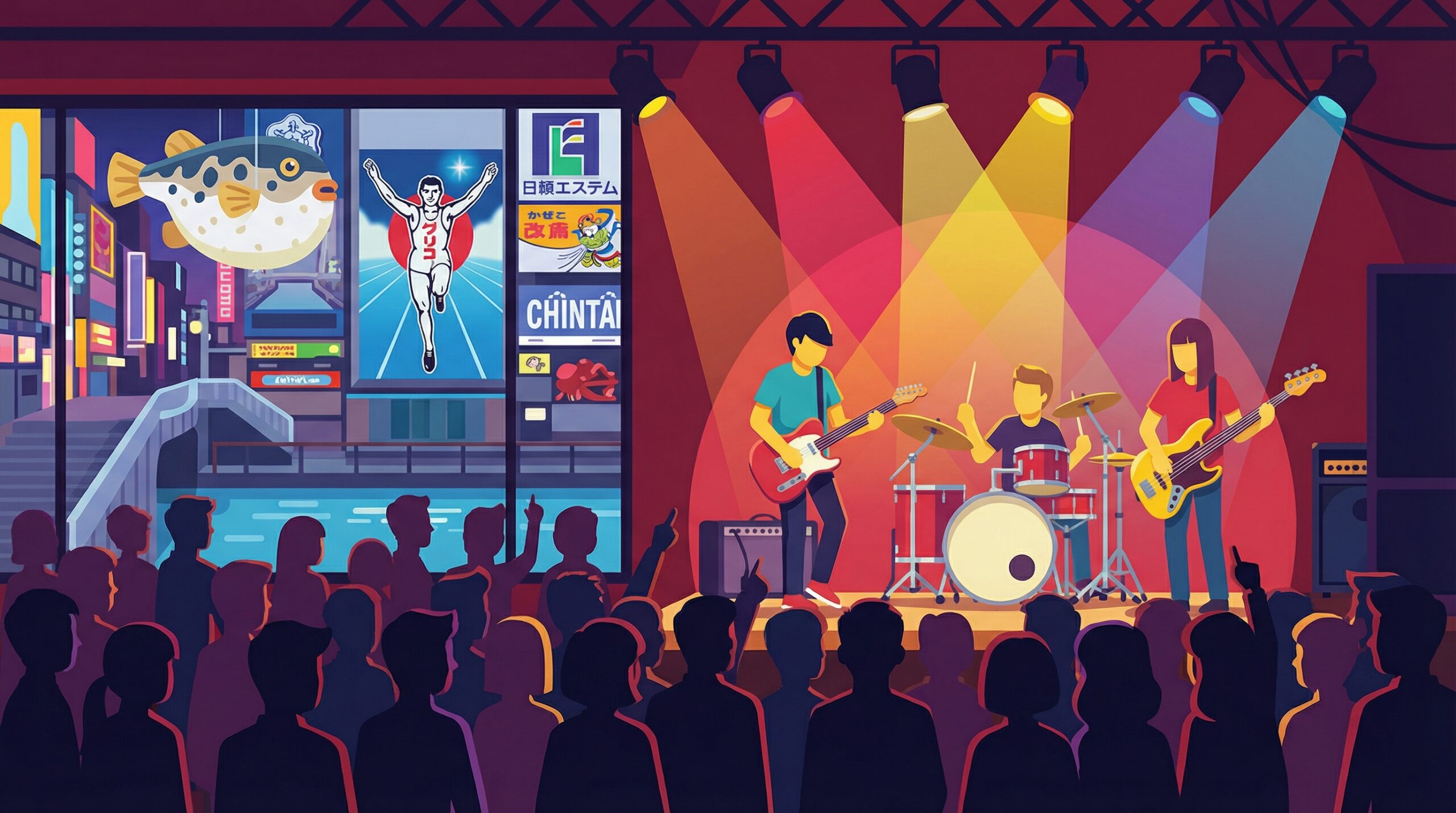
Japan. For many, the name conjures a very specific image, a hyper-modern tapestry woven with the electric threads of Tokyo. You picture the Shibuya Scramble, a mesmerizing human tide flowing under a canyon of neon billboards. You imagine pristine temples, flawless service, and a culture of polished perfection. And you wouldn’t be wrong. Tokyo is a dazzling metropolis, a testament to precision and futuristic vision. Its music scene often reflects this: state-of-the-art venues, internationally acclaimed artists, and productions so slick they could have been beamed in from another dimension. But travel a few hundred kilometers west on the Shinkansen, and you’ll find the nation’s rebellious, rhythm-fueled heart beating in a city that dances to a different, grittier drum. Welcome to Osaka. And more specifically, welcome to the raw, untamed soul of its music scene, thriving in the concrete jungles of neighborhoods like Amerikamura. This isn’t about the sterile perfection of a stadium show; it’s about the sweat, the feedback, and the visceral thrill of music in its most beautifully unfiltered form. It’s where you don’t just see a band; you feel them, in a space so intimate you can almost feel the vibration of the strings. Forget the polished gleam of Shibuya’s mega-venues for a moment. We’re going underground, down a flight of sticker-bombed stairs, to discover why Osaka’s independent ‘live houses’ offer an experience that is profoundly more raw, accessible, and, frankly, more real.
If you’re planning to immerse yourself in this raw music scene, securing your accommodation through a new AI-powered booking platform targeting Kansai’s luxury market can be the first step to an unforgettable Osaka adventure.
Welcome to Amerikamura: The Concrete Heartbeat of Osaka’s Underground

Before you even set foot inside a live house, you must first navigate its natural environment. In Osaka, the heart of this unfiltered energy is Amerikamura, affectionately called “Amemura” by locals. Forget the wide, orderly boulevards of Tokyo; stepping into Amemura from the polished commercialism of the nearby Shinsaibashi shopping arcade feels like crossing a cultural divide. The streets narrow, the buildings become grittier, and the very air seems to hum with youthful, rebellious energy. The name “American Village” harks back to the 1970s when the area was a hub for stores importing West Coast American fashion and culture. Today, that influence has evolved into something distinctly Osakan. It’s a chaotic, vibrant collage of street style, music, and art that feels completely organic and alive. Lamp posts are plastered with layers of band stickers and event flyers, creating an urban papier-mâché that narrates the neighborhood’s musical history. The walls serve as canvases for sprawling graffiti murals—some breathtakingly artistic, others raw and anarchic tags. Even the architecture rejects conformity, with quirky sculptures and bizarre storefronts, like the famous giant clown head of the Peace on Earth building watching over the crowds.
The sensory experience is exhilarating in the best way. The smell of grilled octopus from a takoyaki stand mingles with the sweet scent of crêpes and the faint, enticing aroma of old leather from a vintage clothing store. The soundscape blends J-pop blasting from a cosmetics shop, the low rumble of bass from a basement club, and the constant chatter and laughter of those who claim this space as their playground. This is the stomping ground for Osaka’s youth. Every subculture imaginable parades down the street like it’s their personal runway: punk rockers with meticulously spiked hair, Harajuku-inspired kids in vibrant layered outfits, skaters weaving through the crowds, and hip-hop enthusiasts sporting the latest streetwear. The central meeting spot is Sankaku Koen, or Triangle Park—a small concrete plaza that functions as the area’s unofficial town square. It’s not a park in the grassy, peaceful sense; it’s an urban stage where kids hang out, practice dance moves, showcase fashion, and simply exist in a space that feels wholly theirs. Sitting on the concrete steps here, you truly feel Amemura’s pulse. It’s a place of self-expression, a refuge for those who don’t fit into the neat boxes of mainstream Japanese society. This entire neighborhood sets the stage for the music. It establishes the tone. It declares that you’ve entered a space where creativity is raw, unfiltered, and celebrated. The live houses here aren’t just located in Amerikamura; they are an extension of it. They are the basements and backrooms where the neighborhood’s creative energy is distilled, amplified, and sent back out into the night.
Descending into the Sound: What is a Japanese ‘Live House’?
For those unfamiliar, the term ‘live house’ (or ‘raibu hausu’ in Japanese) might seem a bit puzzling. Is it a bar? A concert hall? The truth lies somewhere beautifully in between. A live house is a small, intimate music venue, though that clinical label hardly does it justice. It serves as the heartbeat of Japan’s independent music scene. These are not grand, luxurious theaters. More often than not, they’re tucked away in the most unassuming spots: down a narrow staircase into a windowless basement, hidden on the third floor of an ordinary building, or down a back alley you might easily overlook. The entrance is often just a heavy door plastered with years’ worth of band stickers, a tribute to the countless acts that have poured their souls onto its stage. These spaces exist for one reason only: to connect a band with its audience in the most direct and powerful way possible. Capacities can vary from a cramped, sweat-soaked room holding about fifty people shoulder-to-shoulder, to a slightly larger venue accommodating a few hundred. Yet even the largest maintain an intimacy wholly absent in stadiums or arenas.
More Than a Venue, It’s a Feeling
Walking into a classic Osaka live house is a full sensory onslaught. The air is often thick with the scent of stale beer, sweat, and the electric buzz of amps ready to explode. Lighting is dim, typically just some simple colored gels casting dramatic focus on the small stage. The walls are nearly always painted black, serving as a backdrop for the chaotic collage of band posters and graffiti covering them. There’s no pretense here. No velvet ropes, no VIP areas, no corporate branding plastered everywhere. You instantly become part of the experience. The stage is frequently just a foot or two above the floor, sometimes without any barrier separating performers from the crowd. That closeness is the secret ingredient. You’re not merely watching musicians—you’re close enough to see sweat beading on their brows, the fire in their eyes, and their fingers flying across the fretboard. You share the same air, trapped in the same bubble of raw, creative energy. This proximity breeds an unspoken, powerful connection between everyone present. The band feeds off the crowd’s energy—and the crowd feeds it right back. It forms a symbiotic bond that turns a simple musical performance into a shared, almost tribal, experience.
The Wall of Sound: Raw and Unfiltered
The sound in a live house is another defining trait. In short: it’s loud. It’s not the polished, digitally balanced audio you’d expect at a large concert hall, where each instrument is carefully mixed to occupy its own space. This is something far more visceral—a wall of sound that hits you square in the chest, a physical force you feel deep in your bones. The bass drum pounds against your ribcage, the bass guitar rattles your teeth, and the guitars scream with feedback. It’s beautifully imperfect. You catch the hum of amps between songs, the scrape of a boot on a distortion pedal, the raw, unrefined strain of a vocalist pushing their voice to the edge. In these compact, acoustically challenging rooms, sound isn’t just heard—it’s felt. It surrounds you, consumes you, leaving no room for distraction. Though overwhelming at first, surrendering to it is exhilarating. It’s the sound of passion and effort, of a band giving everything they have just feet away. This is the opposite of a sterile, overproduced show. It’s music in its purest, most powerful form.
The Tale of Two Cities: Amerikamura’s Grit vs. Shibuya’s Gleam
The stark contrast in experience becomes immediately apparent when comparing Osaka’s live house culture to that of Shibuya in Tokyo. Shibuya is an incredible place—an iconic global hub for fashion, technology, and entertainment. Its music scene is formidable, featuring some of the country’s most famous and technically advanced venues. However, the philosophy behind the experience is fundamentally different. This contrast highlights the deep cultural divide between the Kanto (Tokyo) and Kansai (Osaka) regions.
The Shibuya Standard: Polished, Professional, Predictable
Attending a show in Shibuya is often a highly professional experience. Venues like the iconic O-EAST or WWW are larger, cleaner, and more organized, equipped with powerful, finely tuned sound systems, dazzling lighting setups, and multiple bars. They attract bigger, more established domestic and international acts, making the experience more akin to attending a theatrical performance. Tickets are significantly pricier, and for popular bands, you often must enter a lottery system weeks or even months ahead just for the chance to purchase one. There is a certain physical and emotional distance; you’re part of a large crowd watching a polished performance from a high stage. Security is tighter, rules are stricter, and spontaneity is limited. The audience, while appreciative, tends to be more reserved, observing the spectacle with respectful distance rather than fully immersing themselves. Although the quality is undeniable, it can sometimes lack an unpredictable, raw spark. It’s a transaction: you pay a premium for a high-quality, professional show. It’s a fantastic performance, but ultimately, it is a show.
Osaka’s Authentic Edge: Raw, Accessible, and Real
Amerikamura offers the perfect contrast. Here, the philosophy centers on accessibility and community. Cover charges are only a fraction of what you’d pay in Tokyo, often just a couple thousand yen, usually including a mandatory drink ticket. There’s no need to plan months ahead; one of the greatest joys of the Osaka scene is the sense of discovery. You can simply wander through Amemura on a Tuesday night, listen for a kick drum pounding through a basement vent, check the handwritten sign taped to the door, and take a chance. For the price of a couple of beers, you might discover your new favorite band—a group of kids pouring their heart and soul into a crowd of thirty people. The connection is immediate. After the show, it’s common to see band members packing up their own gear before heading to the small bar at the back of the venue to chat with fans who stayed late. You can buy their self-produced CD or a t-shirt directly from them, share a laugh, and feel like you’re genuinely supporting their art. This direct connection between artist and fan tends to get lost in the corporate machinery of larger music scenes. It fosters a strong sense of community and loyalty. In Osaka, you’re not just a consumer of music; you’re an active participant in the scene. The experience is less of a transaction and more of a shared passion—a celebration of the simple, powerful act of making and listening to loud music in a small, dark room.
A Cultural Chord: The Roots of Osaka’s Rebellious Rhythm
What makes Osaka’s music scene so distinct? The answer lies deeply embedded in the city’s history and culture. For centuries, while Tokyo (formerly Edo) stood as the political center dominated by the disciplined samurai class, Osaka was the nation’s kitchen—a hub of merchants, artisans, and entertainers. This cultivated a culture known for its pragmatism, straightforwardness, and a touch of irreverence. There is a strong-rooted distrust of authority and a passion for supporting the underdog. This mindset directly fuels a vibrant ‘do-it-yourself’ spirit that runs through the city’s creative communities. Artists and musicians in Osaka don’t wait to be picked up by major Tokyo record labels; instead, they establish their own labels, organize their own gigs, and nurture their own networks from scratch. This independence inspires a fierce pride.
In addition, Osaka is widely recognized as Japan’s comedy capital. It is the birthplace of manzai, a rapid-fire style of stand-up comedy. This cultural enthusiasm for humor and entertainment has a marked impact on the music scene. Performers in Osaka, even within heavier genres like punk or metal, often deliver a more direct and lively stage presence. There is less detachment and aloofness. They engage with the audience, crack jokes, and treat their performances as interactive exchanges. At their heart, they are entertainers who grasp the importance of audience connection. This breaks down the barrier between stage and crowd, making the experience more inclusive and enjoyable. This rich historical and cultural backdrop provides the fertile ground in which the raw, straightforward live house scene has thrived. It’s a scene that mirrors the city itself: slightly rough around the edges, proudly independent, and bursting with energy.
Your Backstage Pass: A First-Timer’s Guide to the Amerikamura Gig
So, you’re sold. You want to plunge straight into this world of raw sound. But where should you begin? Exploring the scene for the first time might feel a bit daunting, yet it’s much easier than it seems. The secret is to adopt a spirit of adventure.
Searching for the Gig
Unlike the widely advertised shows in Tokyo, discovering what’s happening in Amerikamura involves a more traditional approach. While some of the slightly larger venues may have websites with schedules, the best way is often to simply roam the streets. Stroll through Amerikamura and check out the posters and flyers stuck on walls and lampposts. Many live houses display their monthly lineup on a board right outside their entrance. Don’t worry if you can’t read all the Japanese; you can usually get the general idea from the band photos, and dates and times typically appear in Arabic numerals. Another excellent resource is local free magazines aimed at expatriates and tourists, often featuring music listings. But honestly, the most thrilling way is pure chance. Pick a night, wander around, and follow your ears. If you catch sounds you like coming from a basement, chances are you can just head inside and pay at the door. That spontaneity is part of the charm.
The Drink Ticket Tradition
This is a standard system in Japanese live houses and can confuse newcomers. When you pay your entry fee at the door, you will almost always have to pay an extra charge, usually around 500 or 600 yen. In return, you’ll receive a small token, either a plastic chip or a paper ticket. This is your ‘drink ticket’. Take it to the bar inside the venue and exchange it for one drink. It’s basically a way for the venue to guarantee at least a minimum bar sale from every guest, which helps keep them afloat. Of course, you can buy more drinks with cash after using your ticket. It’s a straightforward, non-negotiable part of the experience, so just have some extra cash on hand and consider it included in the ticket price. It’s a small quirk that adds to the culture’s unique flavor.
Navigating the Noise: Live House Etiquette
Generally, the vibe in Osaka live houses is very relaxed and welcoming. There aren’t many strict rules. However, a few things are worth remembering. In a crowded venue, be aware of your space. If moshing or the chaos up front isn’t your thing, it’s perfectly fine to hang back by the bar or along the walls. If you do go to the front, expect some jostling, especially during punk or rock shows. It’s all in good fun, rarely aggressive. Look out for your fellow fans. If someone falls, help them up. That’s the universal rule. One of the best ways to show your appreciation is to stay after the main act. There are often several bands on the bill, and it’s polite to give each your attention. Perhaps most importantly, if you really enjoyed a band, consider buying some of their merchandise. For these small, independent artists, merch sales are a crucial source of income that allows them to keep creating music. A t-shirt or CD purchased straight from the artist means more than a thousand online streams.
The Encore: Pre-Show Fuel and Post-Show Hangouts
Make an entire night of it. Amerikamura is perfectly set up for a full evening of entertainment. Before the show, grab some affordable and tasty street food. A boat of takoyaki, drenched in sauce and mayonnaise, is the classic Osaka pre-gig snack. It’s quick, hot, and utterly delicious. After the show, your ears will be ringing, and you’ll be buzzing with energy. The night doesn’t have to end there. Amemura and the nearby areas are filled with small, intriguing bars where you can enjoy a post-show drink and chat about the gig. Explore the side streets and look for a lantern-lit entrance leading to a tiny standing bar or a cozy rock-themed pub. It’s the perfect way to relax and soak up the lingering energy of the performance, often alongside other fans and sometimes even the musicians themselves.
Beyond the Music: Soaking in the Amerikamura Atmosphere
While the live houses serve as the vibrant core of Amerikamura, the neighborhood itself is an attraction well worth exploring on its own. Take some time before your show to wander its maze-like streets. The area is a haven for vintage clothing enthusiasts. Shops are packed from floor to ceiling with carefully curated collections of American denim, vintage band t-shirts, and unique items you won’t find elsewhere. It’s like a treasure hunt, with every rack holding the promise of a special discovery. The shopping experience here is distinct; it’s less about spotless department stores and more about character and passion. You’ll come across small, independent record shops run by knowledgeable owners who can introduce you to obscure Kansai punk bands. You’ll find quirky cafes, art galleries tucked away on upper floors, and stores selling everything from skateboard decks to handmade jewelry. The joy of Amerikamura lies in exploration. It rewards the curious. Don’t limit yourself to the main street; venture down the narrow alleys. Look up to admire the murals on the buildings. Spend half an hour sitting in Triangle Park, simply watching the world go by. This perspective is essential because it reveals that the music scene isn’t an isolated phenomenon; it’s the sonic expression of a neighborhood that celebrates individuality, creativity, and a lively, chaotic energy. It’s a place that reminds you that sometimes the most beautiful and exciting things in life are a bit messy and imperfect.
A Final Feedback Wail
Tokyo will always be Japan’s shining, futuristic emblem. Its size, efficiency, and cultural influence are truly impressive. Attending a show in Shibuya offers an experience of technical excellence and world-class artistry. But if you seek something with more soul, grit, and a deeper sense of connection, Osaka is waiting. It provides a gateway to a world where music is not a distant product to consume, but a raw, living energy to be felt up close. It’s in the pulse of the bass drum resonating in your chest, the taste of cheap beer from a plastic cup, the shared energy of an intimate crowd moving as one, and the exhilaration of watching a band give their all for you and a handful of others. It’s about choosing the sweaty, chaotic basement over the sterile, air-conditioned arena. It reminds us that music, at its finest, is a communal, visceral, and deeply human experience. So, when you’re next in Japan, by all means, explore Tokyo’s wonders. But then, catch a train heading west and spend an evening wandering through Amerikamura. Follow the music, descend the stairs, and experience the raw, roaring, and unforgettable heartbeat of Osaka.








