South of the neon-drenched heart of downtown Osaka, where the city’s pulse softens and the air tastes of the nearby sea, lies a place where time is measured not in minutes, but in the rhythmic fall of a hammer. This is Sakai, a name whispered with reverence in kitchens around the globe, from three-star Michelin temples of gastronomy to the humble home of a passionate cook. It’s a city whose reputation was not built on towering skyscrapers or bustling nightlife, but forged, quite literally, in the searing heat and deafening clang of its countless blacksmith workshops. For over six hundred years, this corner of Osaka has been the undisputed epicenter of Japanese cutlery, a place where steel is given a soul and a simple tool is elevated into a work of art. To understand Sakai is to understand the Japanese philosophy of shokunin, the master artisan’s relentless pursuit of perfection, a spirit that flows through the very streets and imbues every handcrafted blade with a living legacy. Forget what you know about mass-produced knives stamped from sheets of metal. Here, we delve into a world where fire, water, steel, and human intuition collide, creating instruments of such sublime sharpness and balance that they can change the way you think about food forever. This isn’t just a story about knives; it’s a journey into the heart of a tradition, a meeting with the masters who keep an ancient flame burning brightly in a modern world.
To truly immerse yourself in the soul of South Osaka, complement your journey into Sakai’s craft with a taste of the region’s deep culinary heritage by savoring a bowl of its iconic Kasu Udon.
The Echo of Hammers: A Legacy Forged in Fire

The story of Sakai’s blades does not begin in the kitchen, but rather in the earth itself. The city’s fate was molded by its geography, perfectly positioned between the ancient capitals of Nara and Kyoto and the deep harbor that connected it to the wider world. Its venture into metallurgy started in the 5th century during the Kofun period, an era marked by the construction of massive keyhole-shaped tombs for the ruling elite. Building these imperial mounds, such as the majestic Daisen Kofun—the largest tomb in the world—required an enormous number of high-quality tools like spades, hoes, and plows. Sakai’s blacksmiths met the challenge, their skill in crafting iron implements gaining renown throughout the land. This was the foundation, the initial spark in the forge that would eventually illuminate the global world of cutlery.
Centuries went by, and Sakai’s reputation for metalwork steadily increased. The true turning point, however, came with the arrival of tobacco aboard Portuguese ships in the 16th century. As the new habit of smoking spread across Japan, a specialized tool was needed to finely slice the dried leaves. Sakai’s artisans, armed with their established forging expertise, adapted their methods to produce small, exceptionally sharp tobacco knives (tabako-bōchō). The precision and edge retention of these knives were unmatched, earning them the official Sakai Kiwame seal from the Tokugawa Shogunate—a mark guaranteeing supreme quality. Suddenly, Sakai knives were in high demand everywhere. This shift from agricultural tools to precision blades paved the way for Sakai’s dominance in the realm of professional kitchen knives (hōchō).
As Japan entered a prolonged era of peace under the Tokugawa regime, the demand for samurai swords declined, prompting many skilled swordsmiths to turn their craftsmanship toward kitchen knives. They brought with them advanced sword-making techniques—laminating hard steel for the cutting edge with softer iron for the spine, differential hardening, and expert sharpening. Sakai evolved into a crucible where practical tool-making knowledge merged with the artistic spirit of sword-making. This unique blend gave rise to the single-bevel knives that define Japanese cuisine, blades crafted for specific tasks with surgical precision, directly inheriting the functional elegance of the samurai sword.
The city developed a distinctive and highly efficient division of labor that persists today. Unlike other regions where a single craftsman might complete the entire knife-making process, Sakai perfected a collaborative system involving specialized artisans. There is the blacksmith (kajiya) who forges the blade, the sharpener (togishi) who grinds and polishes the edge, and the handle maker (e-tsuke) who fits the final piece. Overseeing this intricate process is the wholesaler (toiya), who commissions the work, ensures quality control, and connects the craftsmen to the market. This system fosters extreme specialization, enabling each artisan to devote a lifetime to mastering their specific role, pushing the limits of quality to remarkable heights. It is a community of craft, a network of trust and mutual respect built over generations, and it is the real secret behind the enduring excellence of Sakai uchihamono (Sakai forged blades).
The Anatomy of a Sakai Blade: More Than Just Steel
To hold a Sakai knife is to experience the culmination of countless small choices, a harmony of elemental forces shaped by a master’s hand. This process is a tribute to patience and precision, a ritual handed down through generations. It stands in stark contrast to the cold, impersonal world of automated factories. Here, in dimly lit workshops scented with hot metal and grinding stone, each blade is crafted with its own distinctive character.
Forging (Hizukuri): The Dance of Steel and Flame
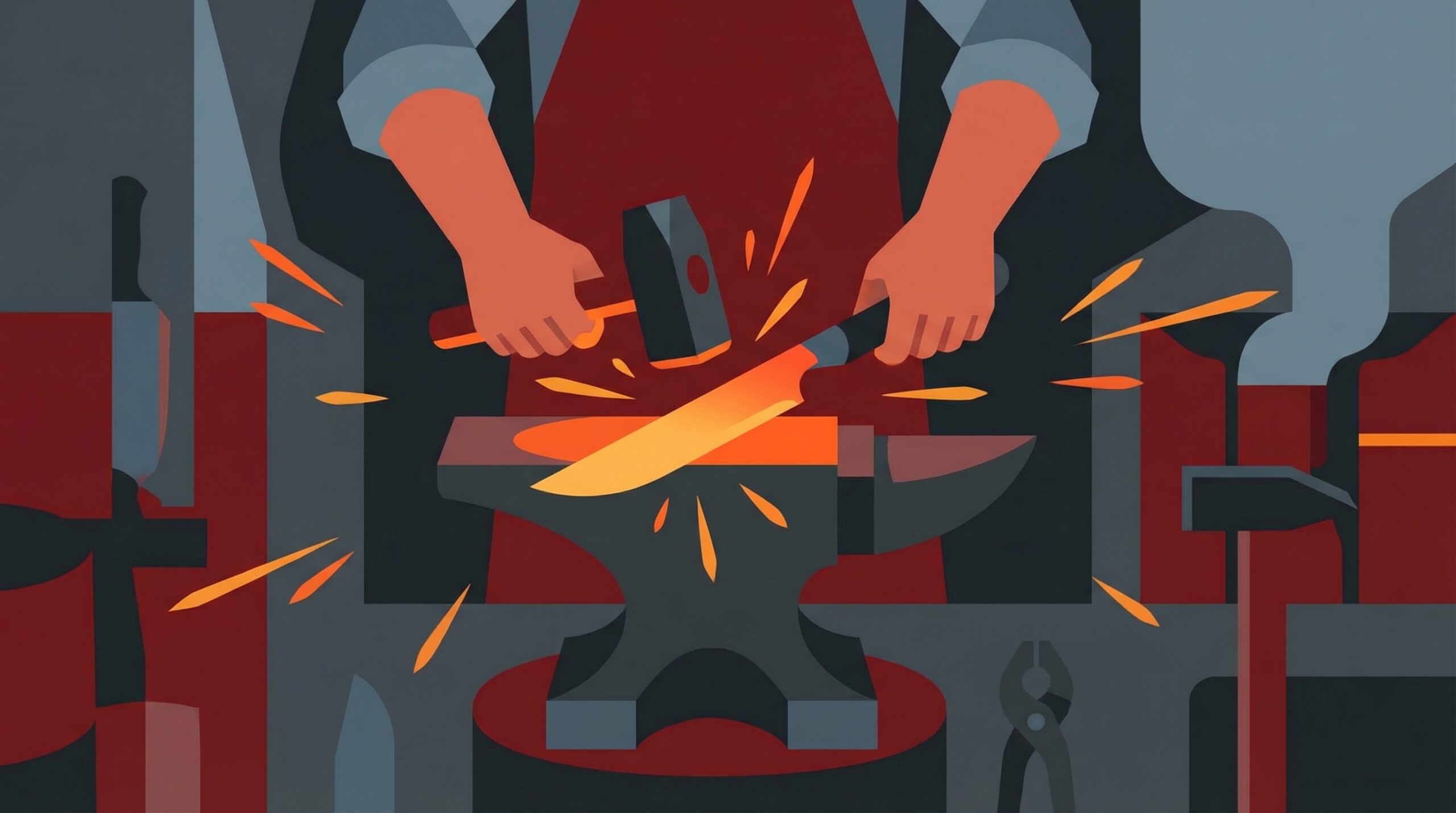
The journey begins in the forge’s fiery heart, a place that feels both primal and vibrantly alive. The blacksmith, the kajiya, stands before a roaring furnace, his face glowing in the incandescent firelight. His craft is guided by sound and touch—the roar of flames, the sharp hiss as steel meets water, and the rhythmic beat of his hammer against the anvil. He is not just shaping metal; he is breathing life into it. The most traditional Sakai knives are crafted using a technique called kasumi, meaning ‘mist,’ referring to the blade’s hazy laminate line. The smith starts with two steels: a very hard, high-carbon steel called hagane for the cutting edge, and a softer, more pliable iron called jigane for the blade’s body and spine. The jigane offers support and shock absorption, protecting the brittle hagane from chipping or breaking.
Heated to an exact bright yellow-orange known instinctively to the smith, the two metals are forge-welded together through a series of powerful, deliberate hammer blows. This moment is critical. If the temperature is too low, the metals won’t fuse; too high, the carbon in the hagane will burn off, ruining its edge retention. Working with remarkable speed and confidence, the smith turns and hammers the welded billet, drawing it out and shaping it into the rough outline of a knife—a process called hizukuri. Sparks fly as impurities are hammered out. He then carefully forms the tang, bevels, and tip entirely with his hammer. No molds or guides are used—only his keen eye and the muscle memory ingrained in his arms. After initial shaping, the blade is annealed, heated, and slowly cooled to relieve metal stress. It is then cold-hammered to refine the grain structure further before being quenched—plunged into water or oil—to rapidly cool and harden the hagane edge. This is another critical moment, a violent thermal shock that locks in hardness but risks warping or cracking. Finally, the blade is tempered at a lower heat to reduce brittleness, achieving the ideal balance of hardness and toughness.
Sharpening (Togi): The Soul of the Edge
When the blade leaves the blacksmith’s hands, it is a rough, blackened form, its potential hidden beneath a scale of oxide. It is the togishi, the sharpening master, who uncovers its soul. Sharpening in Sakai is not merely a final step; it is a transformative art. The togishi works in a cool, damp environment—the opposite of the fiery forge—where the low hum of massive, water-cooled grinding wheels fills the air. The process demands methodical care and intense focus. Sitting before the spinning stone, the artisan holds the blade with a delicate yet firm touch. The scent of wet stone and metal fills the space as he skillfully grinds the rough bevels, water spraying from the wheel.
He gradually moves through a sequence of stones, from coarse (arato) for initial shaping, to medium (chu-to) for refinement, and finally ultra-fine (shiage-to) for finishing. Each stone smooths away scratches from the previous stage, creating an ever finer edge. For traditional single-bevel knives like the yanagiba (sushi knife), the togishi crafts a complex geometry: a wide, flat bevel (kireha) on the front, and a hollow ground (urasuki) back side. This design minimizes drag, enabling the blade to glide through food with minimal cell damage—essential for preserving the fresh taste and texture of delicate ingredients like raw fish. The final edge is honed and polished by hand on natural water stones, achieving a razor sharpness that is both elegant and fearlessly effective. The togishi reads the steel through his fingertips, sensing the slightest imperfection, aiming not just for sharpness but perfect, flawless geometry that performs effortlessly in a chef’s hand.
Handle Fitting (E-tsuke): The Final Touch
With the blade sharpened and gleaming, it passes to a third artisan, the handle specialist. A knife is a tool made to be held, and the handle (e) serves as the vital interface between the user and blade. A poorly crafted handle can spoil the feel of even the finest blade. The traditional Japanese wa-handle is elegant in its simplicity, often octagonal or D-shaped for a secure, comfortable grip. The most commonly used wood is Japanese magnolia (ho-no-ki), prized for its lightness, water resistance, and pleasant texture. For higher-end knives, woods such as ebony, rosewood, or yew are chosen. The handle is fitted with a ferrule or bolster (kakumaki), usually crafted from water buffalo horn, providing strength and a striking aesthetic contrast. The blade’s tang is heated and burned into the handle for a precise, tight fit, often secured with epoxy. The artisan’s goal is perfect balance: the knife should feel neither blade-heavy nor handle-heavy but like a natural extension of the arm, poised and ready for work. This final step completes the transformation from raw steel into a finely tuned culinary instrument.
Portraits of the Masters: Voices from the Forge

To truly grasp Sakai, you must look beyond the process and into the faces of those who dedicate their lives to this craft. Their workshops are not tourist attractions but sacred spaces of creation—places where knowledge is gained through decades of repetition and refinement. These artisans are often quiet, humble individuals who let their work speak for itself, their hands telling stories of calluses, burns, and unwavering commitment.
The Blacksmith (Kajiya): Keeper of the Flame
Picture an old master, perhaps a third-generation kajiya, working in a workshop built by his grandfather. The wooden walls are darkened black from a century’s worth of soot. Tools hang from every surface, each smoothed by years of use. He moves with an economy of motion, a quiet grace that belies the great physical strength his work demands. His day begins before dawn, lighting the forge and waiting for the coals to reach the perfect heat. He doesn’t rely on a thermometer; instead, he reads the fire’s color—a language he learned as a boy watching his father. He speaks of steel as though it were alive, with its own temper and character. “You cannot force it,” he might say, his voice hoarse from the workshop’s heat. “You must listen to the steel. The hammer tells you what it needs.” He worries about the future—whether the younger generation will have the patience and grit to endure the long, arduous apprenticeship. Yet, he continues working, not for fame or fortune, but because it defines who he is. The rhythmic beat of his hammer is the heartbeat of his family’s legacy, a sound that connects him to his ancestors and ensures their spirit lives on in every blade he crafts.
The Sharpener (Togishi): The Silent Artist
Elsewhere in the city, a younger artisan, a togishi, works in a clean, well-lit space. Unlike the blacksmith’s fiery domain, his workshop is a place of calm, wet precision. He may be a fourth-generation sharpener, but he applies a modern, almost scientific approach to his craft. He understands metallurgy, the crystal structures of steel, and the precise angles needed to optimize performance for various tasks. He works silently, fully focused on the point where the blade meets the spinning stone. He senses vibrations through his fingertips, feeling subtle changes in the steel as the edge takes shape. He describes sharpening as a reductive art. “The blacksmith adds fire and force to create the form,” he might explain, barely looking up. “My job is to take away, removing every flaw, every unnecessary bit of material, until only the perfect edge remains.” He feels a deep responsibility to the blacksmith. A poor sharpening can spoil a perfectly forged blade. His work is the final voice in the dialogue, granting the knife its ultimate purpose. His satisfaction does not come from praise but from seeing the spotless, mirror-polished bevel and knowing the edge is flawless—ready to perform in the hands of a chef.
The Wholesaler (Toiya): The Bridge to the World
The system could not function without the toiya. His shop is a bustling hub, a stark contrast to the quiet solitude of the individual workshops. Blades at various stages of completion line the shelves. The air is heavy with the scent of grinding oil and wood. The toiya is a master of logistics and quality control, but also a connoisseur. He knows the styles and specialties of every blacksmith and sharpener in Sakai. Acting as a creative director, he commissions specific knives based on feedback from chefs and customers worldwide. He examines each finished blade with a critical eye, checking straightness, the quality of lamination, and the perfection of the grind. He is the guardian of the Sakai brand, ensuring every knife bearing the city’s name meets exacting standards of excellence. He serves as the link between the cloistered artisans and the global market, a vital connection that allows these masters to focus solely on their craft, confident their work will reach those who truly appreciate it.
Beyond the Kitchen Knife: The Diverse World of Sakai Uchihamono
While Sakai is best known for its kitchen knives, the city’s artisans craft a diverse range of high-quality forged blades, showcasing their remarkable versatility.
For the Culinary Artist
The overwhelming variety of kitchen knives can be confusing for beginners, yet each shape addresses a specific culinary challenge. The Deba is a robust, heavy blade with a thick spine, designed for butchering and filleting fish, strong enough to cut through bones. The Yanagiba, meaning ‘willow leaf blade,’ is a long, slender slicer used to prepare sashimi. Its length enables the chef to draw the blade through the fish in a smooth, uninterrupted motion, producing a glossy, flawless slice. The Usuba is a vegetable knife with a tall, straight edge, crafted for precision tasks such as katsuramuki—the technique of peeling a daikon radish into a paper-thin, continuous sheet. Lastly, the versatile Santoku, meaning ‘three virtues,’ excels at slicing, dicing, and mincing, making it a staple in Japanese households. Grasping these diverse forms reveals the profound respect for ingredients that lies at the heart of Japanese cuisine.
For the Green Thumb and the Craftsman
The same forging and sharpening mastery is applied to other tools. Sakai’s gardening shears are highly valued by horticulturists and bonsai enthusiasts for their ability to make clean, precise cuts that minimize harm to plants. The blades remain sharp for a remarkably long time and operate with a smooth, satisfying action. Likewise, traditional Japanese carpentry tools, such as chisels (nomi) and planes (kanna), made in Sakai are renowned among woodworkers for their outstanding edge retention and the flawless finish they deliver. Like the kitchen knives, these tools are not disposable but lifelong companions for devoted craftsmen.
Stepping into the Legacy: Your Visit to Sakai

Experiencing Sakai’s craftsmanship firsthand is an unforgettable journey. The city is conveniently accessible from central Osaka, making a day trip a meaningful way to explore a world of timeless artistry. The atmosphere here feels distinct; it’s a working city rather than a polished tourist destination. The very air seems to resonate with the energy of creation.
The Sakai Traditional Crafts Museum (Sakai Dentō Sangyō Kaikan): Your First Stop
This museum should be your initial destination. It offers an excellent overview of Sakai’s key industries, especially knife-making. The exhibits illustrate the entire production process, from raw materials to finished products. You’ll see the remarkable variety of knives made in the city and learn about their specific uses. Often, live demonstrations allow you to watch a master at work, deepening your appreciation for the skill involved. The museum also houses a superb shop where you can buy authentic Sakai knives from a broad selection of makers. The staff are knowledgeable and ready to help you find a knife that fits your needs and budget. It’s a relaxed environment where you can see, touch, and compare different styles without any pressure.
Workshop Tours and Hands-On Experiences
Although many workshops are closed to the general public for safety reasons and the need for intense concentration, more artisans and companies now offer guided tours and hands-on experiences by appointment. A tour might take you into the intense heat of a working forge to watch a blacksmith in action or to a sharpening workshop. Some experiences even let you try your hand at the final sharpening stages using a water stone or attaching a handle to your own knife. These moments are invaluable. Feeling the radiant heat of the forge, hearing the thunderous ring of the hammer, and observing a master’s focused expression connects you deeply with the craft. Remember to be respectful, as these are not performances but the artisans’ real workplaces and means of livelihood.
Navigating the Knife District
The area around the museum is filled with small, family-run knife shops and workshops. Take a walk and peek inside. Unlike large department stores, these shops provide a personal experience. You might even meet the artisan who crafted the knives on display. Don’t be intimidated when choosing a knife. The shopkeepers are passionate about their products and eager to share their knowledge. Consider what you’ll use the knife for. Think about the steel—high-carbon steel holds a sharper edge and is easier to resharpen but requires more care to prevent rust, while stainless steel is more user-friendly and resistant to corrosion. Hold different knives in your hand to feel their weight and balance. A good knife should feel like a trusted partner in the kitchen. Investing in a Sakai knife means acquiring a piece of functional art that, with proper care, will last a lifetime and bring joy with every use.
The Soul of Craftsmanship: A Feeling That Lingers
A visit to Sakai offers more than just a souvenir; it imparts a deep appreciation for human dedication and the artistry behind a deliberately crafted object. In an era of instant gratification and mass production, Sakai serves as a powerful reminder of the importance of tradition, patience, and the relentless pursuit of mastery. It embodies the spirit of community, a city united by a shared, noble purpose. The sound of hammers echoing through the streets for centuries creates a rhythm that speaks to resilience and pride.
When you return to your kitchen and hold a Sakai knife, you will sense its story. You will recall the forge’s fire, the sharpener’s quiet focus, and the generations of knowledge infused in the steel. As you slice through an onion with effortless grace, you’ll realize you are not merely preparing a meal, but participating in a legacy—holding a piece of Osaka’s soul and connecting to a long line of masters who believe that even the most ordinary tools can, and should, be objects of sublime and enduring beauty.