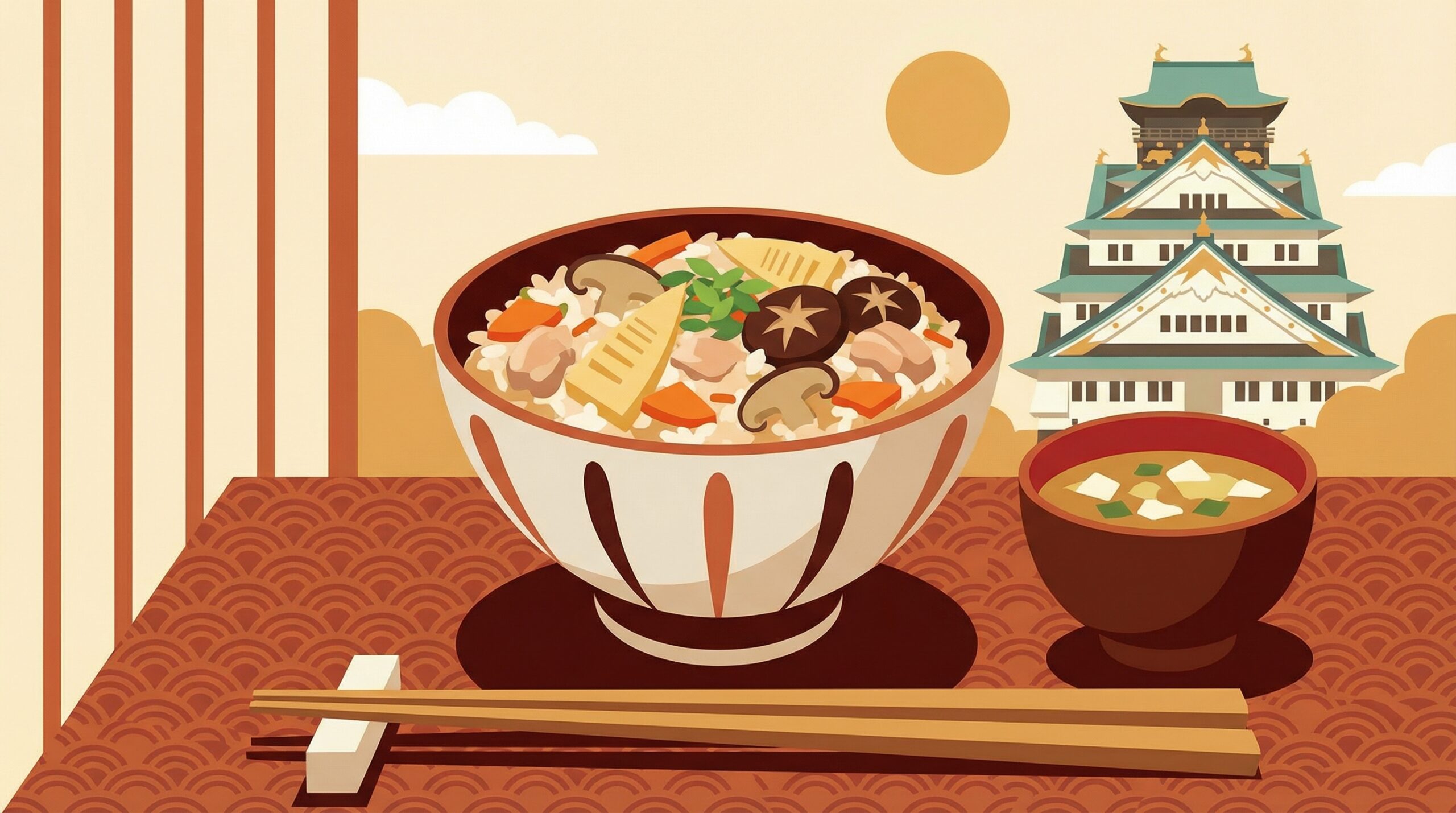
Step off the neon-drenched avenues of Osaka, past the towering department stores and the echoing arcades. Duck under a short, faded noren curtain into a space where the air is thick with the scent of dashi and the gentle hiss of cooking rice. This is the world of the local shokudo, the neighborhood diner, and it is here that you will find one of the city’s most honest and beloved dishes: Kayaku Gohan. It is not a dish that shouts for attention. It doesn’t glitter on social media feeds or feature in glossy travel magazines. Instead, it whispers. It whispers of home, of resourcefulness, and of a deep, abiding love for flavor that defines the spirit of Osaka. Kayaku Gohan is, in its simplest terms, seasoned mixed rice. But to call it just that is like calling a symphony just a collection of notes. It is a mosaic of finely chopped vegetables, tender chicken, and savory fried tofu, all cooked together with Japanese short-grain rice in a delicate, umami-rich broth. Each ingredient, humble on its own, contributes its unique voice to a harmonious chorus of taste and texture. This is not festival food; it is daily sustenance. It is the comforting meal an Osakan mother might make, a dish that nourishes not just the body but the very soul. It is a taste of the everyday, and in a city famous for its extravagant culinary delights—the kuidaore or ‘eating oneself into ruin’ culture—this humble bowl of rice stands as a testament to the idea that the most profound satisfaction often comes from the simplest of things. It is the bedrock of Osaka’s food culture, the quiet foundation upon which the more flamboyant dishes are built. To understand Kayaku Gohan is to understand the heart of this vibrant city. It’s a culinary rhythm that beats steadily beneath the surface, a taste of authentic, unpretentious life waiting to be discovered in a simple, steaming bowl.
For those looking to experience this authentic, budget-friendly side of Osaka beyond the shokudo, you can learn how to assemble a complete meal for under 500 yen at a local supermarket.
The Poetry in a Name: Unpacking ‘Kayaku’

To truly grasp the depth of this dish, we must first examine its name. In Japanese, it is written as かやくご飯. The intriguing element is the word kayaku (かやく). When rendered in kanji, it becomes 加薬. For those familiar with Chinese culture, these characters immediately evoke a profound sense of history and philosophy. The first character, 加 (ka), means ‘to add’ or ‘to supplement,’ while the second character, 薬 (yaku), means ‘medicine.’ Together, they literally translate to ‘added medicine.’ This may seem unusual for a food item. Are we eating medicine? In a way, yes, but not in the clinical, Western sense. The term originates from kanpō, traditional Japanese medicine, which itself is deeply rooted in ancient Chinese medicinal practices. In this tradition, food is medicine, and medicine is food. Ingredients were chosen not only for flavor but also for their perceived health benefits, their ability to balance the body’s energies, and their seasonal suitability. The ‘medicine’ in Kayaku Gohan refers to the added ingredients—the vegetables, proteins, and mushrooms—that enhance plain rice, transforming it from a simple staple into a more flavorful, aromatic, and nutritionally complete meal. It’s a beautiful concept, suggesting that every addition is a deliberate prescription for well-being and enjoyment. It elevates cooking from mere assembly to a nurturing practice. This philosophy sharply contrasts with the idea of merely mixing ingredients into rice. The choice of the word kayaku implies intention and care. The ingredients are not random leftovers; they are a carefully selected ‘addition’ that elevates the dish. In Osaka and the surrounding Kansai region, this term is specifically used for this type of mixed rice, distinguishing it from similar dishes elsewhere in Japan. In Tokyo and the Kanto region, for instance, a similar dish is more commonly called gomoku gohan (五目ご飯), meaning ‘five-item rice’—a name that is more descriptive and less poetic. The enduring use of the name ‘Kayaku Gohan’ in Osaka reflects the region’s unique culinary identity and its deep-rooted connection to a holistic view of food. It’s a small linguistic detail that reveals a rich cultural significance—a reminder that in every bowl, there is a story of tradition and a philosophy of nourishment.
A Symphony in a Bowl: The Anatomy of Flavor
Lifting the lid from a bowl of freshly prepared Kayaku Gohan releases a gentle plume of steam, carrying an aroma that is simultaneously earthy, savory, and subtly sweet. This scent doesn’t overpower but warmly invites you in. Peering inside, you see a canvas of pearly white rice, speckled with a jewel-toned mosaic of ingredients, each carefully prepared and perfectly cooked. The beauty of the dish lies in the harmony of these components, a culinary ensemble where every element plays a vital role.
The Foundation: Rice and Dashi
The essence of Kayaku Gohan lies not in the solid ingredients alone, but in the invisible elements that unite them: the rice and the dashi. The rice is typically uruchimai, the classic Japanese short-grain rice renowned for its slightly sticky texture and its capacity to absorb flavors without becoming mushy. Each grain is a perfect vessel, swollen with the essence of the cooking liquid. And that liquid is everything. In Kansai cuisine, dashi reigns supreme. Unlike the bolder, soy sauce-heavy flavors often found in the Kanto region, Kansai dashi is delicate and nuanced, usually made from high-quality kombu (kelp) and katsuobushi (dried bonito flakes). This produces a broth that is light in color yet remarkably rich in umami—the savory fifth taste that brings profound satisfaction. When preparing Kayaku Gohan, this dashi, seasoned with a touch of soy sauce, mirin, and sake, serves as the medium in which the rice and other ingredients cook. It seeps into every corner, infusing the dish with a gentle, savory depth that enhances without overpowering the natural flavors of each component. The rice doesn’t simply taste of soy sauce; it carries the sea from the kombu, the smokiness of bonito, and the earthiness of the vegetables. It’s a masterclass in subtlety.
The Earthy Undertones: Root Vegetables
As you dig your chopsticks into the bowl, you’ll likely encounter the satisfying crunch and earthy flavor of gobo—burdock root. This modest root is a staple in traditional Japanese cooking, characterized by its distinctive, almost medicinal aroma and a firm, fibrous texture that softens just enough when cooked while retaining a pleasant bite. Its deep, woodsy flavor grounds the dish, providing a rustic contrast to the other ingredients. Alongside the gobo, finely julienned carrots add a dual purpose: a natural sweetness that balances the savory dashi and soy sauce, and a vibrant orange hue that creates a beautiful visual contrast against the rice. These root vegetables form the foundation of the flavor profile, connecting the dish to the earth and the changing seasons.
The Savory Heart: Chicken and Abura-age
Though vegetarian versions exist, classic Kayaku Gohan often features small, tender pieces of chicken, usually thigh meat. The chicken is diced into small, bite-sized pieces that cook evenly with the rice. It brings an essential layer of savory richness, lending the dish a more substantial feel. Yet, perhaps the most iconic ingredient is abura-age—thin sheets of deep-fried tofu. When simmered in dashi, the abura-age acts like a sponge, absorbing all the savory goodness of the cooking liquid. Biting into a piece releases a burst of flavorful broth. Its slightly chewy texture and rich, oily character provide a delightful mouthfeel and a comforting, homey flavor that is quintessentially Japanese. It is the secret weapon of Kayaku Gohan, elevating the dish from simple mixed rice to something truly special.
The Textural Dance: Konnyaku and Shiitake
Adding another dimension is konnyaku, a firm, gelatinous cake made from the corm of the konjac plant. On its own, konnyaku has little flavor, but its brilliance lies in its texture. With a unique, slightly rubbery and pleasantly springy bite, it offers fantastic contrast to the soft rice and tender chicken, creating a textural surprise that keeps each mouthful intriguing. Then there are the shiitake mushrooms, often rehydrated from their dried form. Using dried shiitake is a key technique because the rehydrating liquid becomes a potent, umami-rich broth that can be added to the dashi, further intensifying the flavor. The mushrooms themselves, once rehydrated and simmered, provide a dense, meaty texture and an intense, smoky flavor that permeates the entire dish. Together, these ingredients create a bowl that is a true journey of textures and tastes—a testament to the Japanese culinary philosophy of washoku, which emphasizes harmony in flavor, color, and cooking methods, producing a dish far greater than the sum of its parts.
The Shokudo Sanctuary: An Atmosphere of Comfort

To eat Kayaku Gohan in its natural setting is to glimpse an authentic slice of Osaka life. The perfect place is not a fancy restaurant but a modest shokudo, a local eatery that has probably served the community for generations. Discovering one feels like stepping back in time. The entrance is usually understated, perhaps featuring a plastic food model of kitsune udon or curry rice displayed in a glass case outside. You pull aside the noren curtain and are immediately wrapped in a warm, inviting atmosphere.
Inside, the air carries a comforting blend of scents: the savory steam of dashi, the clean aroma of cooking rice, the subtle sweetness of mirin, and occasionally the sizzle of something grilling in the background. The space tends to be small and cozy. A wooden counter, worn smooth by countless elbows, often dominates the room, behind which the owner—usually an elderly man (ojisan) or woman (obachan)—moves with practiced efficiency honed over years. They might call out a cheerful “Irasshaimase!” (Welcome!) without breaking their rhythm of chopping vegetables or stirring a pot. The décor is simple and practical. Walls may be decorated with handwritten menus on paper strips, yellowed with age, listing the day’s specials. A small television may murmur softly in a corner, tuned to a baseball game or a daytime talk show. The other customers represent a neighborhood cross-section: a salaryman in a crisp shirt slurping noodles during lunch, a pair of elderly ladies chatting over tea and pickles, a student quietly reading manga while waiting for his set meal. There’s a gentle, unobtrusive hum of activity—the clatter of ceramic bowls, the soft murmur of conversations, the rhythmic chop-chop-chop from the kitchen. It’s a soundscape of everyday life. You find a seat at the counter or one of the few small tables. The menu may be entirely in Japanese, but pointing is always a suitable way to order. When you request Kayaku Gohan, it often arrives as part of a teishoku, or set meal. This is where the true worth and harmony of the meal become apparent. Your bowl of speckled rice arrives on a tray, accompanied by a few essential sides. There will be a bowl of steaming miso soup, its cloudy broth dotted with tofu and wakame seaweed, offering a warm, savory comfort. Beside it, a small dish of tsukemono, Japanese pickles, which might be crisp, yellow slices of pickled daikon radish (takuan) or tangy pink pickled ginger (gari). Their sharp, clean flavors refresh the palate between bites of the rich rice, a perfect contrast that keeps the meal feeling balanced. There may also be a small side dish, a kobachi, such as boiled spinach with sesame dressing (goma-ae) or a neatly rolled omelet (tamagoyaki). The entire presentation exemplifies balance and completeness. It’s a full, satisfying meal that feels both nourishing and light. Dining in a shokudo is deeply comforting. It’s a place without pretensions. You aren’t there to be impressed, but to be fed, to be nourished, to feel welcome. It’s a refuge from the city’s hustle and bustle, a place where time seems to slow. As you savor each spoonful of Kayaku Gohan, you become part of the quiet rhythm of the neighborhood, a temporary local sharing in a timeless culinary tradition.
A Tale of Two Rices: Kayaku Gohan in Context
For those unfamiliar with the subtleties of Japanese cuisine, the realm of mixed rice dishes can appear somewhat perplexing. You might encounter terms like takikomi gohan or maze gohan on restaurant menus and wonder how these differ from the beloved Osaka specialty, Kayaku Gohan. Grasping these nuanced differences enhances one’s appreciation of the diverse regional flavors within Japanese food.
In essence, Kayaku Gohan is a particular regional variation of takikomi gohan (炊き込みご飯). The term takikomi gohan is a broader, more general expression used throughout Japan. It literally means “rice cooked with,” referring to any dish where raw rice is cooked together in one pot with assorted ingredients and a seasoned broth. The ingredients—whether seafood, mushrooms, chicken, or vegetables—infuse their flavors into the rice during cooking, producing a richly aromatic and harmonious dish. Technically, Kayaku Gohan fits perfectly within this definition. The main distinction lies in culture and language. In the Kansai area, the traditional and preferred name for this style of mixed rice is ‘Kayaku Gohan,’ which carries the unique concept of “added medicine.” Ordering takikomi gohan in Osaka will get you the expected dish, but choosing the local term kayaku gohan demonstrates a deeper cultural insight.
Then there is maze gohan (混ぜご飯), literally “mixed rice.” The key difference centers on preparation. Unlike takikomi gohan, where all ingredients are cooked together from the start, maze gohan involves cooking the ingredients separately and mixing them into freshly steamed plain rice afterward. This creates a distinct texture and flavor profile—the rice grains remain more separate, and the flavors of the added ingredients are brighter and less infused into the rice itself. A well-known example of maze gohan is chirashi sushi, where a variety of toppings such as sashimi, egg, and vegetables are scattered over and mixed with vinegared sushi rice. Thus, the critical factor is timing: takikomi and kayaku are cooked together, while maze is combined after cooking.
Looking through a cross-cultural lens, as someone familiar with Chinese cuisine, Kayaku Gohan evokes a strong kinship with savory sticky rice dishes like nuòmǐ fàn (糯米饭) or yóu fàn (油饭). These also involve cooking rice (typically glutinous rice) with savory ingredients such as Chinese sausage, shiitake mushrooms, dried shrimp, and shallots, all seasoned with soy sauce. The underlying philosophy is strikingly similar: transforming plain rice into a flavorful, one-pot meal rich in texture and taste. However, the execution reflects the distinct palates of each culture. Chinese versions tend to be richer, using more oil and stronger seasonings, alongside the chewy density of sticky rice. Kayaku Gohan, true to its Japanese roots and the refined Kansai aesthetic, is lighter and more subtle, focusing on the delicate flavor of dashi and the natural taste of each ingredient, with textures that are soft and tender rather than heavy. It’s a fascinating example of how a simple idea—mixing ingredients with rice—can evolve into countless delightful variations, each perfectly embodying its cultural origin.
Embracing the Seasons: A Dish for All Year
One of the most beautiful features of traditional Japanese cuisine, or washoku, is its deep connection to the changing seasons, and Kayaku Gohan perfectly exemplifies this expression. While staple ingredients like carrots, gobo, and abura-age provide a dependable base year-round, the dish truly shines with the incorporation of seasonal specialties, reflecting nature’s bounty at any given time. This practice, known as shun (旬), honors ingredients when they are at their peak flavor and nutritional value.
In spring, as cherry blossoms begin to bloom, Kayaku Gohan may be enhanced with the delicate tastes of the season. Tender young bamboo shoots, takenoko, often appear, their subtle sweetness and crisp, distinctive texture symbolizing spring in Japan. Another spring favorite could be sansai, wild mountain vegetables, offering a pleasant and refined bitterness that balances the richness of the rice. Green peas, or usui endo, might also be scattered throughout, adding a fresh, vibrant note with their bright green color and sweet pop.
When the humid summer arrives, the focus shifts to lighter, more refreshing ingredients. Edamame beans, with their firm texture and nutty flavor, make a wonderful addition. Finely diced ginger, or myoga (Japanese ginger), might also be mixed in, providing a zesty, aromatic kick that is exceptionally refreshing in the summer heat. Some coastal versions may even include small, sweet sea bream (tai), a fish at its prime during this season.
Autumn is perhaps the most celebrated season for Kayaku Gohan due to the harvest’s rich, earthy flavors. This is the time for kuri gohan, rice mixed with sweet, tender chestnuts. The creamy texture and nutty sweetness of chestnuts pair perfectly with the savory dashi broth, making it a beloved autumn classic. Mushrooms of all kinds also play a central role. Beyond the staple shiitake, you might find fragrant maitake (hen-of-the-woods) or delicate, slippery shimeji mushrooms, each contributing unique aromas and textures. In some luxurious versions, precious slices of the prized matsutake mushroom appear, whose incredible fragrance embodies autumn in Japan. Sweet potatoes (satsumaimo) are another popular fall addition, lending creamy sweetness and a lovely golden hue.
During winter, as the weather turns cold, the dish adopts a heartier, warming character. Root vegetables like taro (satoimo), with their starchy, comforting texture, may be included. Oysters, at their plump and flavorful peak in the cold months, can be added to create kaki meshi, a briny, luxurious treat. This seasonal adaptability is what keeps Kayaku Gohan endlessly fascinating. It is not a fixed recipe but a living tradition that evolves throughout the year. Eating it means savoring more than just a bowl of rice; it is a taste of a specific moment—a snapshot of the season. For those living in Osaka, noticing these seasonal changes in local shokudo is a wonderful way to connect more deeply with the rhythm of life in Japan.
Practical Wisdom for the First-Timer
Exploring local Japanese diners can feel a bit daunting at first, but it is an incredibly rewarding experience. The key is to approach it with curiosity and respect. When you spot a promising shokudo serving Kayaku Gohan, don’t hesitate to enter. The owners are usually very welcoming to newcomers, even if there is a language barrier.
When ordering, keep in mind that Kayaku Gohan is often part of a set meal, or teishoku. Look for menu items ending in 定食 (teishoku) or セット (setto). These options tend to offer the best value and a balanced meal. If the menu is entirely in Japanese, simply say “Kayaku Gohan, kudasai” (Kayaku Gohan, please). If you want it as a set, you can try “Kayaku Gohan teishoku, kudasai.” Pointing at a picture or food model is also completely acceptable and easily understood.
The dish may come in a bowl with a lid. It’s proper etiquette to remove the lid and place it upside down on the table or tray beside the bowl. When you finish, replace the lid before indicating you are ready to pay. This small gesture shows tidiness and respect.
In most traditional shokudo, you pay at the front register after your meal. Sometimes the bill is brought to your table, but more often you walk up to the counter to settle it. Tipping is not customary in Japan and can cause confusion, so there’s no need to leave anything extra. A simple “Gochisousama deshita” (a polite thank-you for the meal) as you leave is the best way to show appreciation. It honors the effort of the chef and staff and is a lovely part of Japanese dining culture.
Don’t hesitate to try the side dishes. Miso soup is meant to be sipped directly from the bowl, like a cup. Use your chopsticks to pick up solids like tofu and seaweed. The pickles, or tsukemono, are not merely a garnish but an essential part of the meal. Eating a piece between bites of rice refreshes your palate. This harmony of flavors is central to enjoying a Japanese set meal. Embrace the experience, watch how locals do it, and savor the simple, profound pleasure of a carefully prepared meal.
A Taste of Home, A Bite of Osaka

In the vibrant culinary scene of Osaka, where sizzling takoyaki, savory okonomiyaki, and intricate multi-course meals shine, Kayaku Gohan holds a quiet yet essential role. It serves as the culinary foundation, a comforting flavor of home treasured by Osakans for generations. This dish embodies a philosophy of frugality and nourishment, proving that you don’t need lavish ingredients to create something deeply satisfying. Its charm lies in its simplicity—the subtle magic that unfolds when rice, dashi, and a select few ingredients are cooked together with patience and care.
Eating Kayaku Gohan means embracing the unassuming, warm-hearted spirit of the city. It invites you to step away from busy tourist spots and into the quiet backstreets, into small family-run eateries that form the true heart of the community. This meal doesn’t demand your focus but gently wins your affection. Each bite reveals a unique mix of textures and flavors—the earthy gobo, sweet carrot, savory chicken, broth-soaked abura-age, all unified by perfectly seasoned rice. Though simple, it is also rich, comforting, and utterly delicious. It tells a story of tradition, seasonal change, and the enduring power of a humble dish to make you feel completely at home, no matter how far you are from your own. So when you next wander Osaka’s lively streets, watch for the worn noren curtain. Step inside, take a seat, and order a bowl. You won’t just be eating lunch; you’ll be tasting the very soul of the city.