Let’s be brutally honest for a moment. When you think of immersing yourself in the rich, historical tapestry of Japan, a colossal American theme park located on reclaimed industrial land in Osaka Bay is probably not the first image that springs to mind. Universal Studios Japan, or USJ as it’s ubiquitously known, can feel like the antithesis of the serene temples of Kyoto or the deep cultural heritage of Nara, both just a short train ride away. It’s a riot of sound and color, a cathedral of consumerism dedicated to Hollywood blockbusters, screaming rollercoasters, and butterbeer. On the surface, it’s a corporate implant, a globalized entertainment product dropped into the Kansai region. A foreigner might reasonably ask: what can this place possibly teach me about the real Osaka? Is it anything more than a tourist trap, a distraction from the authentic soul of the city?
This is a valid question, and one that deserves a nuanced answer. Because while USJ is, without a doubt, a masterfully engineered machine for separating you from your yen, it is also, paradoxically, one of the most authentically Osakan places you can visit. It’s not authentic in the way a centuries-old castle or a traditional puppet theater is. Instead, it’s a hyper-modern arena where the unvarnished, energetic, and deeply pragmatic character of Osaka is on full, glorious display. The way Osakans interact with this park—the way they conquer it, adopt it, and reshape it in their own image—reveals more about their mindset than a thousand guidebooks. It’s a living laboratory of the city’s spirit. To understand USJ is to understand the engine that drives Osaka: its relationship with money, its unabashed love for a good time, its rivalry with Tokyo, and its remarkable ability to take something foreign and make it completely its own. So, before you dismiss it as just another theme park, let’s peel back the layers. You might be surprised to find that the heart of Japan’s most boisterous city beats loudest somewhere between a flying dinosaur and a wizarding castle.
For a more grounded taste of Osaka’s energetic and pragmatic character, explore the city’s famous offal barbecue scene in Tsuruhashi.
The Osaka Mindset on Display: Why USJ Thrives Here
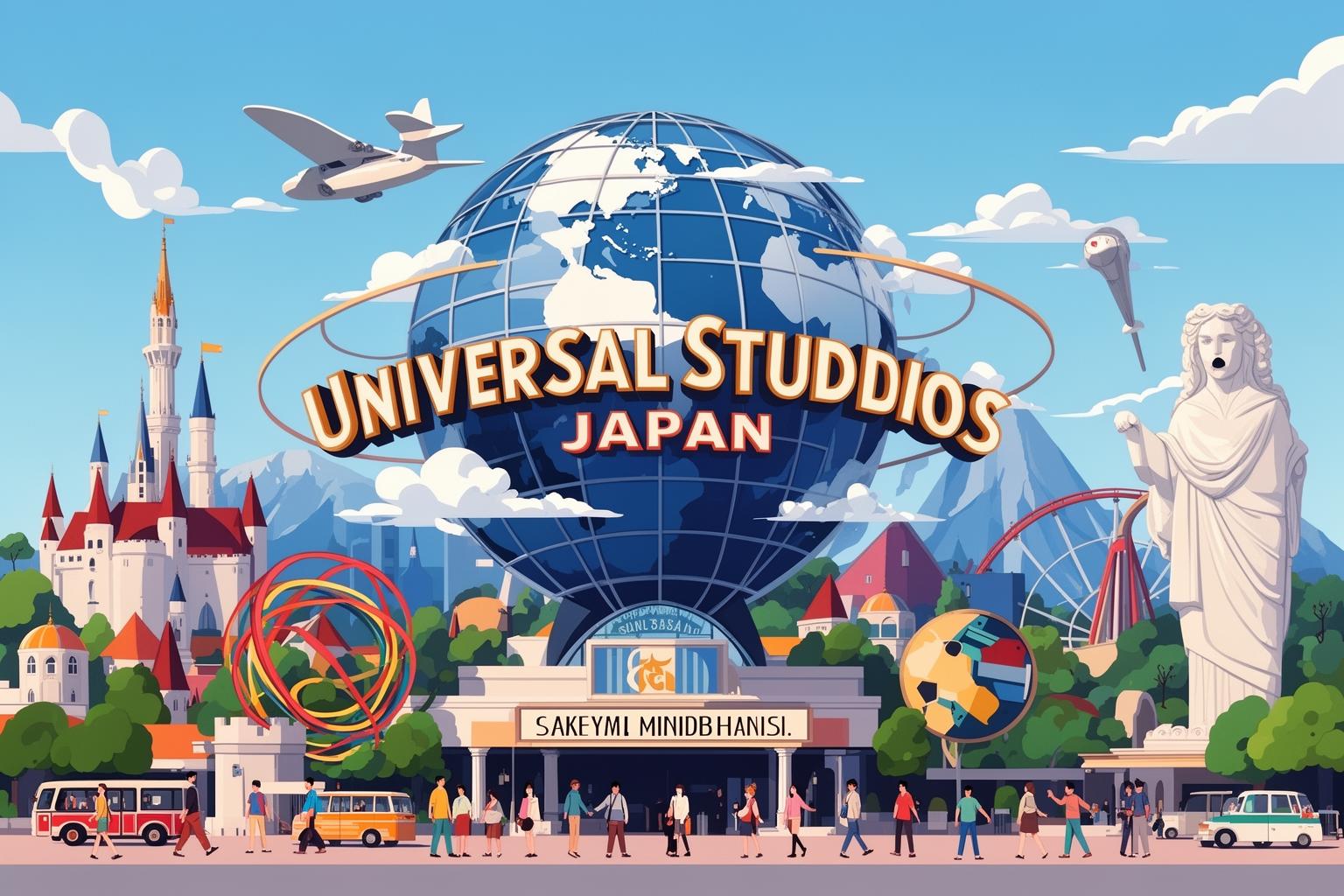
To understand why USJ feels so perfectly at home in Osaka, you need to grasp the city’s DNA. For centuries, Osaka was Japan’s commercial core, known as the `tenka no daidokoro` or “the nation’s kitchen.” It was shaped not by samurai lords or imperial courts, but by merchants, artisans, and financiers. This heritage created a unique civic character: pragmatic, straightforward, innovative, and deeply focused on value. Historically, Osakans are conditioned to ask, “Am I getting my money’s worth?” This isn’t about being cheap; it’s about being savvy. It’s a mindset that favors tangible results and spectacular experiences over subtle aesthetics or quiet contemplation. And it’s precisely this mindset that makes USJ a huge success.
“Akindo no Machi” (The Merchant City) Takes on Hollywood
At its core, Osaka embodies the spirit of the `akindo`, the merchant. This essence shows up in a passion for things that are big, bold, and unmistakably impactful. USJ perfectly embodies this preference. It’s not a place for quiet reflection; it’s a sensory onslaught. The rides move faster, the explosions are louder, the characters more animated, and the food outrageously themed. This is not a flaw; it’s the defining feature. Osakans don’t visit seeking delicate artistry. They come for a loud, high-energy, world-class spectacle, and they expect it to deliver for the price of admission.
Watch a local family entering the park, often with a clear mission. They arrive with a finely tuned schedule, probably cross-checked against online crowd forecasts. They know which rides have the longest lines and tackle those first. They follow the best route to cut down walking time and maximize the number of attractions. This isn’t the behavior of casual visitors; it’s the diligent execution of a carefully crafted leisure plan. The Express Pass, a pricey add-on that allows you to bypass queues, is seen by many not as an indulgence but a smart investment. You’re buying back time, the day’s most precious resource. The calculation is straightforward: “If I pay an extra 10,000 yen, can I ensure my family rides every major attraction? Yes? Then it’s worth it.” This kind of cost-benefit analysis applied to leisure is pure Osaka merchant logic.
This quest for value is evident everywhere. Observe the strategic plate-stacking at all-you-can-eat buffets or the intense debates over which souvenir popcorn bucket offers the best long-term value. Osaka is the birthplace of instant ramen and conveyor belt sushi, both created to offer maximum satisfaction and efficiency at a reasonable price. USJ, with its blockbuster thrills and carefully calculated fun, is simply the latest and grandest expression of this results-driven culture.
The Rejection of “Tatemae” (Public Facade)
One of the starkest contrasts foreigners notice between Tokyo and Osaka is the social atmosphere. Tokyo often adheres to `tatemae`, the public facade of politeness, harmony, and emotional restraint, with public spaces usually quiet and orderly. In contrast, Osaka’s culture thrives on `honne`, the open expression of true feelings. People are louder, more direct, and more emotionally expressive. USJ serves as the ultimate sanctuary for this `honne` culture.
It’s a designated area where the usual social norms of quiet conformity are not just relaxed but completely discarded. Screaming at the top of your lungs on a rollercoaster is not only allowed but expected. Loud laughter, animated conversation, and uninhibited joy are the standard. This is deeply liberating for a population that, despite its reputation, still operates within Japan’s broader social expectations.
A striking example is the local embrace of costumes, or `kosupure` (cosplay). While Tokyo’s Harajuku district is famous for dressing up, it’s often confined to subcultures or certain locations. At USJ, cosplay is free-for-all and not limited to Halloween. On any given day, you’ll see groups of friends, couples, and families dressed in carefully coordinated outfits. They might be Minions, Super Mario characters, or students from the Hogwarts houses. This isn’t just for children—you’ll spot middle-aged men in full Snoopy gear or grandmothers wearing matching Elmo hats. This is more than fun; it’s exuberant self-expression and group identity deeply woven into the Osaka experience. It’s a visual declaration: “We’re here to have a great time, and we don’t care about being reserved.” In Osaka, being a little over-the-top (`hadekichi`) is often celebrated as a sign of a lively personality.
The Art of the Deal: Annual Passes and the Local Connection
For tourists, a ticket to USJ is a significant one-day expense. For many Osakans, however, their relationship with the park is entirely different thanks to the Annual Pass. The pricing is designed to appeal strongly to the local mindset: if you visit two or three times a year, the annual pass is already the more economical option. This shifts USJ from a special-occasion destination to something resembling a neighborhood park or community center—albeit with a Hollywood budget.
This changes everything. Locals use the park in ways tourists wouldn’t imagine. Students in school uniforms might be sitting in a café within the Wizarding World of Harry Potter, using the magical setting as a backdrop for homework. Young mothers meet for coffee and strolls with strollers, letting parades and music entertain their toddlers. Office workers drop in after 5 p.m. for a quick ride on the Hollywood Dream rollercoaster to unwind before heading home. At first, my British sensibilities found this puzzling—the time and money investment just to hang out seemed extraordinary. But I quickly realized I was missing the point. It’s not about conquering the park every visit; it’s about owning a piece of it. The annual pass makes it their park.
This sense of ownership fosters a close, almost familial bond between the city and the park. People discuss new attractions or seasonal events with the same familiarity they might have for a new shop opening in their local `shotengai` (shopping arcade). They have favorite spots, routine routes, preferred snack stands. Routine access demystifies the park and weaves it into the fabric of daily life. It’s the ultimate Osakan bargain: unlimited access to world-class entertainment, turning a global brand into a cherished local haunt.
USJ vs. Tokyo Disneyland: A Tale of Two Cities
The cultural contrast between Osaka and Tokyo stands as a defining feature of modern Japan. Nothing captures this friendly yet intense rivalry better than comparing their flagship theme parks: Universal Studios Japan and Tokyo Disney Resort. These parks are not merely different entertainment venues; they reflect the very essence of their respective cities. Visiting both provides a profound insight into the cultural, aesthetic, and social distinctions that make Japan so intriguingly diverse.
The Kingdom of Dreams vs. The Blockbuster Movie Set
Tokyo Disneyland and its companion park, DisneySea, are designed to create a perfect, hermetically sealed fantasy. From the moment you pass through the gates, you are meant to leave reality behind. The architecture is impeccable, the landscaping pristine, and every employee, or “Cast Member,” performs as part of an elaborate production of happiness. The core principle is immersion in a dream. The experience is crafted to be seamless, elegant, and magical—an embodiment of `omotenashi`, the Japanese art of hospitality, polished to perfection. This perfectly aligns with Tokyo’s image as Japan’s sophisticated, global face—a city of precision, elegance, and carefully managed appearances.
In contrast, USJ operates on a different axis. Its main aim isn’t to whisk you away to a gentle dreamworld but to throw you headfirst into the high-energy, high-stakes universe of blockbuster films. The primary emotional experience is not wonder, but adrenaline. It’s about the gut-punch thrill of a rollercoaster drop, the heart-stopping fear of a zombie attack at Halloween, and the overwhelming awe of a massive pyrotechnic display. The park is deliberately louder, faster, and more chaotic. While The Wizarding World of Harry Potter exemplifies immersive detail, much of the park feels like a sprawling, working movie studio backlot. It is less about concealing the artifice and more about celebrating it. This raw, direct, and powerful style of entertainment is quintessentially Osaka. The city has always prioritized substance and impact over polished appearances. It’s a place of bold flavors, strong opinions, and daring statements, and its theme park reflects that spirit.
The “Kawaii” vs. “Omoroi” Cultural Divide
The emotional tone of the two parks also reveals a fundamental cultural difference. Tokyo Disney is the unchallenged global capital of `kawaii` (cute). Its language is nostalgia, innocence, and heartwarming charm. The characters are adorable, the songs uplifting, and the overall mood is gentle, family-friendly fun. It taps into a deep cultural affection for the small, lovable, and emotionally safe.
USJ, while certainly featuring cute elements like Minions and Hello Kitty, is fundamentally rooted in the Osakan concept of `omoroi`. `Omoroi` is a rich term in the Kansai dialect—meaning more than just “funny” or “interesting.” It suggests something clever, amusing, surprising, and often a bit strange or edgy. It’s laughter born from an unexpected punchline. USJ’s entertainment is full of `omoroi`. Its street shows have a more comedic, interactive, and sometimes sarcastic flavor. Halloween Horror Nights exemplify this perfectly; they are genuinely terrifying and push the limits of what a mainstream theme park might dare. This embrace of the scary, the weird, and the intensely thrilling over the merely cute is a hallmark of Osaka’s cultural taste. The city that gifted Japan with `manzai` comedy (a fast-paced, witty double act) prefers its entertainment with a bite.
Consider the parades. A Disney parade is a stately, graceful procession of characters waving kindly from elaborate floats—beautiful and enchanting. A USJ seasonal parade, by contrast, is often a chaotic, high-energy street party. Visitors might be sprayed with water in summer, doused with foam in spring, or blasted with confetti right in the face. The music pulses with J-pop or EDM beats, and dancers perform with explosive energy, feeling less like a royal procession and more like a music festival. One is a spectacle to be admired; the other, an irresistible party you’re drawn into.
Staff Interaction: The Script vs. The Banter
The clearest differences often emerge in the smallest interactions—specifically, how staff members engage with guests. At Tokyo Disney, Cast Members are meticulously trained to preserve the fantasy. They remain in character at all times, their replies are polite and often scripted, and their aim is to be helpful without ever breaking the fourth wall. The interaction exemplifies flawless, professional service.
At USJ, the staff, or “Crew,” follow a different set of social norms—purely Osaka in style. While still professional and helpful, they are much more likely to be informal, personable, and witty. They engage in banter. If you wear a funny hat, they’ll comment on it; if it’s your birthday, they might burst into a spontaneous, slightly off-key song. They embody the classic `boke` (fool) and `tsukkomi` (straight man) comedic dynamic fundamental to Osaka communication. A crew member might make a silly joke (`boke`), inviting you—the guest—to reply with a witty comeback (`tsukkomi`). This moment transforms a routine service exchange into a shared spark of human connection and humor. This style mirrors interactions with a friendly shopkeeper in Shinsaibashi arcade or the chef at a local okonomiyaki restaurant. It’s less about formal `omotenashi` and more about fostering a warm, lively, and unpretentious atmosphere, assuming a social intimacy and playfulness that define Osakan public life.
Navigating USJ as a Resident: The Unspoken Rules

For someone living in Osaka, USJ raises a recurring question: when, if at all, should I visit? The thought of navigating a park crowded with tens of thousands of people can be intimidating. Yet, many locals discover their own way to coexist with this entertainment giant. Doing so involves understanding the unspoken rules and rhythms of the park, which, in many respects, are a high-stakes extension of the skills needed to navigate the bustling city itself.
The Crowd Issue is Both an Osaka Challenge and Solution
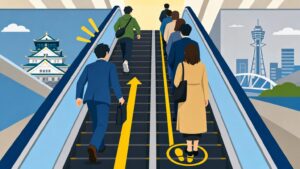
Let’s be clear: USJ becomes astonishingly, overwhelmingly packed. Queues for popular rides can easily extend to two or three hours on busy days. For anyone with even a slight dislike of crowds, this sounds like a nightmare. However, living in a major Japanese city like Osaka means mastering crowd-management skills is essential for survival. Your daily commute on the Midosuji subway line during rush hour is a masterclass in maneuvering through dense human traffic. Shopping at Kuromon Market on a weekend demands the spatial awareness of a chess grandmaster. USJ is simply an amplified version of this daily reality, enhanced with the addition of giant animatronic sharks.
Locals tackle the USJ crowd issue using the same practical tools they rely on for the rest of the city. There’s an entire ecosystem of crowd-prediction websites and apps that residents consult as seriously as a weather forecast. They know that Mondays can be busier than Tuesdays due to school trip schedules. They understand the “golden hours” in the early morning and late evening when wait times drop considerably. They have an intuitive grasp of the park’s human tides, knowing which zones will be flooded right after a major parade and which quiet spots offer a brief escape.
Watching an experienced local navigate the park is like observing a professional athlete. They move with intent, anticipating bottlenecks, finding the path of least resistance through an apparently impassable sea of people. This skill, `kuuki wo yomu`, or “reading the air,” is vital in Japanese society, and at USJ it’s amplified. It’s about feeling the flow of the crowd and moving with it, not against it. In this way, a day at USJ is not a break from urban life but an advanced training ground in one of its most essential disciplines.
For the Thrill-Seeker: Is It Worth It?
If you crave adrenaline, the answer is an unequivocal yes. USJ’s lineup of world-class rollercoasters and thrill rides is impressive by any global measure. Attractions like The Flying Dinosaur, where you’re suspended face-down, and Hollywood Dream – The Ride, featuring exhilarating zero-gravity “floating” sensations, deliver a powerful physical experience. This dedication to extreme thrills reflects the Osakan preference for direct and impactful experiences. There’s no subtlety to the sensation of hurtling toward the ground at 90 kilometers per hour, and that is exactly the point.
There’s a certain civic pride tied to this. When USJ creates a new attraction, it aims to make a statement. The rides are often promoted as the “world’s best” or “first of their kind.” This embodies Osaka’s ongoing underdog ambition to surpass Tokyo. While Tokyo holds the nation’s political and economic clout, Osaka strives to be the capital of fun, the destination for a truly unforgettable, heart-pounding experience. The raw physical power of the park’s main rides is a tangible expression of this bold, competitive spirit.
For Families: A Glimpse into Modern Japanese Parenting
For those interested in sociology, a day at USJ provides a fascinating, though occasionally stressful, glimpse into modern Japanese family life. The park is a high-pressure setting where parenting dynamics are clearly visible. You’ll see the remarkable organizational skills of Japanese mothers, who often arrive equipped with bags containing everything from homemade `onigiri` (rice balls) and wet wipes to extra clothes and first-aid supplies. Their day is meticulously planned, a complex coordination effort aimed at maximizing enjoyment and minimizing meltdowns.
Leisure time in Japan often isn’t the spontaneous, relaxed experience it can be in the West. It’s frequently as structured and goal-oriented as work. The aim at USJ is to “complete” the park: ride the essential rides, watch the must-see shows, purchase key merchandise. This can lead to universally recognizable moments of tension—the tired child crying in line, the exasperated parent negotiating a snack break. But it also shows a deep commitment to creating perfect family memories. The significant effort and expense invested in a family trip to USJ highlight the value placed on these shared experiences, especially in a society where parents, notably fathers, may have limited leisure time with their children.
For Those Who Dislike Crowds: The “USJ-Adjacent” Experience
What if you want to appreciate the USJ phenomenon but can’t bear the thought of being inside the park? Fortunately, there are ways to engage with it from a comfortable distance. Universal CityWalk, the shopping and dining complex that serves as the park’s entrance area, is a destination on its own. It’s an excellent spot for people-watching. Sitting at an outdoor café in the late afternoon, you can witness the full range of human emotions. You’ll notice the wide-eyed excitement of newcomers, full of promise for the day ahead. Later, you’ll see families leaving exhausted but happy, dragging bags of souvenirs, their faces a mixture of joy and fatigue. CityWalk is the threshold between park fantasy and the reality of the train ride home.
Another option is to take a trip on the Captain Line ferry, which runs between the USJ port and the Osaka Aquarium Kaiyukan. This short boat ride across the Aji River offers stunning panoramic views. Here, you see the park not as an immersive world but as an object within the landscape. Towering rollercoasters rise against a backdrop of cranes, warehouses, and the industrial infrastructure of the Port of Osaka. This perspective is essential. It reminds you that this dream factory is built on the foundations of the city’s working past. It anchors the fantasy in the very real, pragmatic context of Osaka as a port city, a hub of commerce and industry. From the water, you can appreciate USJ for what it truly is: one part of a larger, dynamic, and ever-evolving urban ecosystem.
A Symbol of Osaka’s Reinvention
To truly understand USJ’s role in the city’s collective mindset, one must look beyond the daily attractions and reflect on its history. The park is more than just a series of rides; it stands as a testament to Osaka’s post-industrial aspirations and its relentless drive for reinvention. Positioned along the shores of Osaka Bay, it symbolizes the city’s transition into the 21st century.
From Industrial Port to Entertainment Hub
The site where USJ now resides, located in Konohana Ward, was once the center of Osaka’s heavy industry. This area was dominated by steel mills, shipyards, and factories. It was gritty, practical, and crucial to Japan’s economic boom, yet also characterized by smoke and hard labor. By the close of the 20th century, as Japan’s economy evolved, much of this industrial infrastructure had diminished, leaving large expanses of underused land.
The choice to establish Universal Studios Japan here, opening in 2001, was a daring and bold move. It marked a deliberate shift from an industrial identity to a future focused on tourism, culture, and entertainment. This was Osaka’s response to the challenges of deindustrialization—a statement that the city would not be a relic of its past but a vibrant participant in the global creative economy. The park’s construction, coupled with the nearby aquarium and convention centers, formed part of a vast urban renewal initiative aimed at transforming the city’s waterfront and global image. It embodied Osaka’s dynamic, restless spirit and its determination not to be eclipsed by its eastern rival, Tokyo.
The “Naniwa” Spirit in a Corporate Wrapper
`Naniwa` is an ancient moniker for Osaka, conjuring the city’s intrinsic character: its earthy humor, pragmatic merchant spirit, and warm, unpretentious humanity. Skeptics might argue that a multi-billion dollar American corporation could never truly capture the `Naniwa` spirit. Yet, USJ has been deeply embraced and adapted by the local culture, becoming something distinctly Osakan.
Despite its global branding, the park feels inherently local. Collaborations with popular Japanese franchises like Detective Conan, Attack on Titan, and various video games tailor the experience specifically to a domestic audience. Seasonal food offerings often incorporate playful Osaka twists. Most importantly, as we’ve seen, the guests’ behavior and the staff’s interaction style imbue the park with the city’s uniquely chaotic, friendly energy. The American blueprint runs on Osakan hardware, producing a hybrid entity—globally recognizable but locally enlivened.
Ultimately, Universal Studios Japan serves as a mirror. It reflects modern Osaka in all its vivid contradictions—a city fiercely proud of its local identity while welcoming global influences. It is a culture that deeply respects tradition yet continuously innovates and looks ahead. Here, the art of negotiation and the art of enjoyment are viewed as two sides of the same coin. USJ is loud, somewhat flashy, relentlessly commercial, and unapologetically focused on delivering value. In short, it’s a quintessential theme park for the great merchant city of Osaka.
So, is USJ for you? That depends on what you seek. If you desire a quiet, reflective experience of traditional Japan, it’s probably not your destination. But if you wish to witness the vibrant, pulsating heart of contemporary Osaka—its energy, humor, pragmatism, and people—a trip to this Hollywood on the bay could be one of the most revealing cultural experiences you undertake. You don’t have to adore every moment, but to overlook it is to miss an essential chapter in the story of what this city is and what it aims to become.