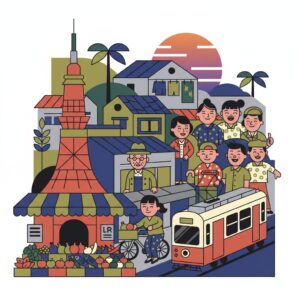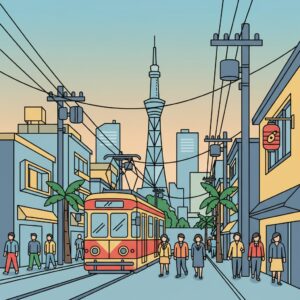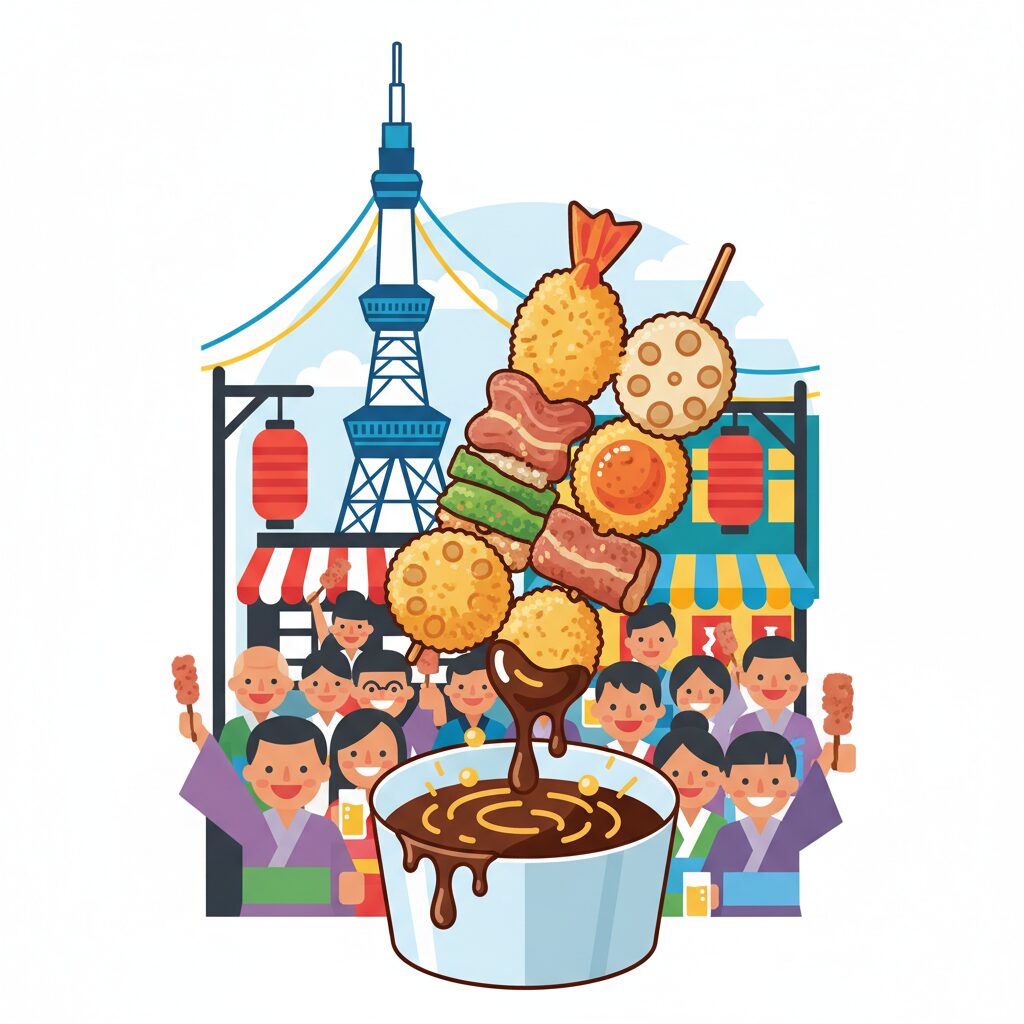
Walk out of Dobutsuen-mae Station, and the air changes. It’s not just the faint, sweet smell of cooking oil that hits you first, nor the visual assault of neon signs fighting for attention under the watchful gaze of the Tsutenkaku Tower. It’s a shift in frequency. The polished, predictable rhythm of modern Japan seems to fall away, replaced by something grittier, louder, and unapologetically alive. This is Shinsekai, Osaka’s “New World,” an entertainment district that feels more like a time capsule from the mid-20th century than a part of a 21st-century metropolis. For many foreigners, and even for many Japanese from other parts of the country, Shinsekai is often dismissed as a caricature. It’s seen as a gaudy tourist trap, a slightly seedy relic filled with oversized blowfish lanterns and an inexplicable mascot named Billiken. They come, they take a photo of the tower, they eat a few fried skewers, and they leave, thinking they’ve “done” Shinsekai. But they’ve missed the point entirely. They’ve treated it like a theme park, when in reality, it’s a living, breathing social laboratory where the unfiltered soul of working-class Osaka is on full display. To truly understand this city, you have to understand its relationship with this neighborhood, and to understand the neighborhood, you have to understand its signature food: kushikatsu. These deep-fried skewers are not just a snack; they are a ritual, a social contract, and a delicious, greasy window into the Osakan psyche. The famous rule—nidozuke kinshi, or “no double-dipping”—is the first thing anyone learns, but it’s merely the entry point into a complex system of unspoken rules, shared values, and social dynamics played out at standing counters across the district. It’s a performance of trust, efficiency, and communal living, all conducted over a shared vat of savory dipping sauce. This isn’t about elegant dining. This is about connection, value, and the very real, very human culture of a city that has always prioritized substance over style. So, let’s peel back the layers of fried batter and get to the heart of what kushikatsu hopping in Shinsekai really tells us about life in Osaka.
This deep appreciation for local craftsmanship and tradition extends beyond the kitchen, as seen in the meticulous work of Kishiwada’s master carpenters and their year-long dedication to building festival floats.
Shinsekai: More Than Just a Retro Disneyland
To truly understand the essence of kushikatsu culture, you first need to grasp the setting in which it unfolds. Shinsekai is neither a carefully preserved historic district like Kyoto’s Gion nor a relentlessly modern commercial center like Tokyo’s Shibuya. It exists as something entirely different: a neighborhood born from great ambition yet now a testament to gentle neglect. This very paradox defines its deeply Osakan identity.
A Neighborhood Stuck in Showa Time
Despite its name, “Shinsekai,” meaning “New World,” the area emerged from the boundless optimism of the early 20th century, developed for the 1903 National Industrial Exposition. Its northern half was inspired by Paris, with the original Tsutenkaku Tower echoing the Eiffel Tower, while the southern half evoked New York’s Coney Island, complete with an amusement park called Luna Park. For a short time, Shinsekai represented Japan’s shining future. But as often happens, the future moved on. The park closed, the area’s prosperity dwindled, and it entered a prolonged decline after World War II. While other Japanese city centers were rebuilt and modernized relentlessly, Shinsekai was mostly left untouched. What emerged is a district that feels less like a preserved relic and more like an area forgotten by time, serving as an authentic, living museum of the Showa Era (1926-1989). This sharply contrasts with Tokyo, where demolition and reconstruction are constant, driven by a corporate obsession with innovation. Osaka, and Shinsekai especially, embodies a different attitude—a pragmatic one that says, “If it ain’t broke, don’t fix it.” There’s a stubborn resistance to erasing the past. Faded hand-painted billboards, the noisy pachinko parlors, small theaters screening vintage yakuza films, and countless statues of the quirky Billiken good-luck god—all these form a functional, lived-in aesthetic. It’s not staged for tourists but is the genuine daily backdrop for those who live here. The rough edges are intentional, reflecting an Osakan mindset that prizes authenticity over a polished, impersonal appearance.
The People of the “New World”
Who are these people? On any day, Shinsekai’s crowds offer a revealing cross-section of Osaka’s society, far more diverse than in typical tourist areas. Sure, there are groups of tourists, but look closer. You’ll find elderly men in flat caps gathered around a shogi (Japanese chess) board in the park, their voices low and murmuring. You’ll see day laborers, dusty from work, stopping for a cheap and hearty lunch of kushikatsu skewers and rice. Young couples on dates are drawn by the retro ambiance and reasonable prices, and families celebrate weekends as kids marvel at the colorful signage. This vibrant mix is the neighborhood’s lifeblood. Unlike Tokyo’s socially and economically segregated districts, Shinsekai acts as a great equalizer. Everyone—from company presidents to construction workers—stands side-by-side at the same stainless-steel counter, eating the same 150-yen beef skewer and dipping it into the communal sauce pot. This social leveling is echoed in the neighborhood’s aesthetic, often described with the Osaka-ben terms kote kote and gottsui. Kote kote refers to the gaudy, over-the-top, almost tacky visual style—think glittering signs and giant 3D food models—while gottsui means gutsy, rough, or in-your-face. This contrasts sharply with the refined, minimalist wabi-sabi aesthetics often associated with Japan. It is loud, bold, and unapologetically present—a visual expression of the Osakan spirit: direct, unpretentious, and full of life.
The Kushikatsu Counter: A Stage for Osaka’s Social Theater
At the heart of Shinsekai lies the kushikatsu-ya. These venues vary from large, brightly lit chain restaurants to tiny, cramped stalls tucked away in the back alleys of Janjan Yokocho. Yet, they all share a central feature: the counter. This is more than just a place to eat; it serves as a stage where Osaka’s social culture is enacted every single minute.
The Golden Rule: “Nidozuke Kinshi” and the Logic of Shared Trust
Let’s begin with the well-known rule: nidozuke kinshi (no double-dipping). Every establishment proudly displays signs enforcing this rule in Japanese, English, Chinese, and Korean. At first glance, the rule appears simply hygienic. The thin, flavorful dipping sauce is kept in a large communal stainless-steel container on the counter, shared by all customers. Once you’ve bitten your skewer, dipping it back would contaminate the sauce. But the rule’s importance goes far beyond cleanliness. It stands as a powerful symbol of a social contract. The communal sauce pot represents a shared public resource. By adhering to the rule, you show that you’re a trustworthy member of the community, respectful of shared space and others around you. Violating the rule is more than just a faux pas; it’s a profoundly anti-social act. It signals a selfish disregard for the collective good, an attitude that proclaims, “My desires outweigh the well-being of the group.” In a city built on tight-knit cooperation among merchants and artisans, this is the gravest offense. The way Osakans enforce this rule is revealing. They avoid subtle hints or passive disapproval. Instead, huge, unmistakable signs are posted. The message is direct and unambiguous: “This is how we do things here. We all agree to this for everyone’s benefit. Now, let’s move on.” This straightforwardness is a hallmark of Osaka’s communication style, starkly contrasting with the often indirect and nuanced cues typical of Tokyo. Then comes the clever twist: the cabbage. Each customer is given a bowl of raw, crisp cabbage wedges. Need more sauce after your first bite? Instead of dipping your skewer again, you use a piece of cabbage as a spoon to scoop sauce from the pot and drizzle it onto your kushikatsu. This isn’t a loophole; it’s the officially approved workaround. Mastering the cabbage scoop is a rite of passage, signaling that you are not just a tourist blindly following rules but an insider who understands the system. It showcases the Osakan knack for kufuu—finding clever, practical solutions within existing boundaries. It’s about being smart and resourceful, not rule-breaking.
The Unwritten Menu: Reading the Room, Not Just the Words
The ordering process itself offers another lesson in Osakan culture. Menus exist, but in a bustling traditional shop, the real interaction is verbal. The environment buzzes with sizzling oil, clattering dishes, and lively chatter. To get service, you must be assertive. You catch the taisho’s (chef’s/boss’s) eye behind the counter and call out your order clearly and confidently: “Biiru ippon to, kushi moriawase kudasai!” (One beer and an assorted skewer set, please!). Hesitation will get you nowhere. This demand for directness may intimidate newcomers, but it’s grounded in efficiency. The staff juggle dozens of orders, so clear communication is essential. Many regulars don’t even glance at the menu; they simply ask for an omakase (chef’s choice) set. Whereas in a Tokyo sushi restaurant omakase often implies a quiet, reverential multi-course experience costing a fortune, in a Shinsekai kushikatsu-ya it means the chef will fry a steady succession of whatever is fresh—beef, shiitake mushrooms, quail eggs, lotus root slices—and place them on your tray until you say “stop.” This reflects a different kind of trust. It’s not submission to a master artist’s grand vision but a practical faith that the chef knows what’s good today and will deliver fair value. This practical spirit extends to the menu itself. Alongside classics—beef (gyu-kushi), pork (buta-bara), onion (tamanegi), and shrimp (ebi)—are playful, experimental items: cheese, mochi, gyoza, even quirky offerings like banana or vanilla ice cream, deep-fried in the same batter. This willingness to fry anything reveals a culinary curiosity and lack of pretension. If it tastes good dipped in batter and fried, it’s fair game. There’s joy in this experimentation, a sense that food should be fun as well as serious.
The Counter Dynamics: Standing Room Only, Shoulder to Shoulder
Many authentic kushikatsu experiences take place at a tachinomi, or standing bar. The absence of chairs is purposeful. It serves several aims. First, it ensures a swift customer turnover, maximizing business in limited space—again, merchant efficiency in action. Secondly, and more importantly, it fosters a lively, communal atmosphere. Standing means you’re not confined to a private booth but literally shoulder-to-shoulder with fellow diners. Personal space, highly valued in much of Japan, shrinks considerably here. This close proximity breaks down social barriers. It’s common for the elderly man next to you to comment on your order, perhaps recommending: “Ah, renkon ka. Umai de. Koko no doteyaki mo zettai tabenaアkan de.” (Ah, lotus root. Good choice. You absolutely must try the doteyaki here, too.) This exemplifies the cliché of “friendly Osakans.” This friendliness isn’t just an abstract trait; it’s a behavior shaped by the very architecture of these social spaces. In Tokyo, starting a conversation with a stranger in a bar can be met with suspicion. But in a Shinsekai kushikatsu-ya, it’s part of the experience. You’re all sharing this small space, this moment, this shared pot of sauce. This common context makes interaction natural and expected. You become temporary members of a community, united by the simple pleasure of fried food on a stick.
Kushikatsu Economics: The Philosophy of “Cheap, Fast, and Good”
To truly understand Osaka, you need to grasp its connection with money. This city was founded by merchants (shonin no machi), and the values of commerce—value, efficiency, and customer satisfaction—are deeply embedded in its culture. Kushikatsu perfectly embodies this akindo seishin, or merchant spirit, in edible form.
The 100-Yen Skewer and the Worth of a Single Coin
The most notable feature of kushikatsu is its price. A single skewer of a basic ingredient like beef, onion, or fish cake typically costs between 100 and 200 yen. It is essentially democratic food—warm, filling, and accessible to all, regardless of economic standing. This emphasis on value is central to Osaka. While Tokyo’s food culture often celebrates exclusivity, ornate presentation, and high prices as indicators of quality, Osaka’s culture is famously skeptical of such displays. The highest compliment for a meal here is not that it was “refined” or “artistic,” but that it was “yassui noni umai”—surprisingly delicious for how inexpensive it was. This phrase captures the essence of the city’s culinary spirit. It expresses a deep-rooted belief that good food should not be a luxury. It’s a straightforward, practical outlook that judges a dish by its intrinsic quality, not by branding or fancy décor. A kushikatsu chef’s reputation depends on their skill in taking simple, cheap ingredients and, through expert frying and their secret sauce, transforming them into something deeply satisfying. This is the core of the merchant spirit: delivering maximum value and making customers feel they’ve gotten an excellent deal. This mindset even extends to the payment system. In most traditional shops, there’s no paper bill. Instead, empty skewers are stacked in a tall metal cup at your spot on the counter. When you’re ready to leave, staff count the skewers in your cup to tally the total. It’s a system built on transparency and trust—elegantly simple and efficient.
The Art of the “Chottonomi” (A Quick Drink)
Kushikatsu establishments are not usually places for a long, leisurely meal. They excel at the chottonomi, literally “a little quick drink.” The culture revolves around brevity. An office worker might stop by on their way home from the station, stand at the counter for twenty minutes, drink two beers and eat five skewers, then move on. It serves as an essential “third space,” a transitional area between work stress and home duties. This culture of hopping—hashigozake—is deeply rooted in Osaka’s nightlife. A typical night out might avoid settling into one spot for hours. Instead, you may begin at a kushikatsu-ya for an appetizer, head to a takoyaki stand for the next dish, drop into a standing bar for a drink, and finish with ramen. Each stop is quick, purposeful, and affordable. This creates a lively, fluid social scene that encourages exploration and spontaneity. The low cost and rapid turnover at a kushikatsu place make it an ideal starting point for such an evening. It’s a low-commitment, high-reward social experience. This contrasts with the often more formal, reservation-based dining culture in parts of Tokyo, where a night out tends to be a planned, singular occasion. Osaka’s approach is more like grazing—a continuous journey through the city’s abundant culinary delights.
Debunking the Myths: What Foreigners Get Wrong About Shinsekai
Like any place with a strong, distinctive character, Shinsekai is surrounded by myths and misunderstandings. Looking beyond these stereotypes is essential to truly appreciating its essence and, by extension, the spirit of Osaka itself.
Myth: It’s Dangerous and Dirty
Shinsekai has long been known, even among Japanese, as a somewhat rough area. It is indeed visually grittier than the polished shopping arcades of Umeda or Shinsaibashi. The neighborhood borders Airin-chiku (also known as Kamagasaki), which has one of Japan’s largest populations of day laborers and homeless people. This long-standing proximity has shaped its reputation over the years. However, for a resident or visitor walking through Shinsekai’s main tourist spots, the reality is that it is overwhelmingly safe. The streets are well-lit, there is a steady flow of pedestrians, and police boxes (koban) are clearly present. The “dirtiness” is more an aesthetic feature than a sign of poor sanitation. It reflects the patina of age and the visual clutter of a place that has not been stripped of its history. This is a stark contrast to Tokyo’s often meticulously maintained public spaces. Osaka is unafraid to reveal its wrinkles, scars, and social complexities. There is a genuine honesty in Shinsekai’s grit. It does not pretend to be anything else. It is a real neighborhood with real residents and a real, layered history, and that authenticity is exactly what makes it captivating.
Myth: All Kushikatsu is the Same
To those unfamiliar, one fried skewer might appear just like another. Nothing could be further from the truth. For locals, the subtle differences between kushikatsu shops are a passionate subject of debate and fierce loyalty. Saying all kushikatsu is identical is like saying all pizza or barbecue is the same. The variations are many and meaningful. First, there’s the batter (koromo). Some establishments, like the well-known chain Kushikatsu Daruma, use a very fine, almost powdery panko breadcrumb, resulting in a thin, light, and extremely crispy coating. Other, more traditional places may use a thicker, fluffier batter resembling a tempura-fritter hybrid. Then there’s the oil. Most use neutral vegetable oil, but some include lard in the mix, adding a richer flavor and aroma to the final product. The most closely guarded secret is the sauce. Each shop has its unique recipe, which remains undisclosed. Some are sweeter, featuring a pronounced fruity tang from tomatoes and apples. Others are more savory and complex, with a stronger soy sauce and Worcestershire-like spice profile. Locals can often recognize a shop by its sauce alone. This meticulous attention to the nuances of a seemingly simple, inexpensive dish is quintessentially Osakan. This is the heartland of B-kyu gurume (B-grade gourmet), celebrating affordable, unpretentious, yet expertly crafted everyday foods like takoyaki, okonomiyaki, and kushikatsu. Here, people bring the same passion and discernment to a 150-yen skewer as a Tokyo connoisseur might to a 30,000-yen sushi meal.
Myth: It’s Just for Tourists
Although the presence of tourists with selfie sticks is inescapable, it is a serious misconception to believe they are the only ones here. On a weekday afternoon, the balance between tourists and locals changes significantly. Counters fill with neighborhood residents. The fast, rich Osaka-ben dialect rings out all around. Groups of men in work uniforms, sleeves rolled up, celebrate the end of a long day’s shift. Grandmothers treat their grandchildren to a few skewers after school. For many Osakans, Shinsekai is not a novelty. It’s their local haunt. It is a place of comfort and routine where they can enjoy food that is reliable, affordable, and deeply tied to their city’s identity. It serves as the city’s living room, a space where pretense is shed and community thrives. Viewing it this way—as a functioning neighborhood rather than just a tourist spot—is key to understanding its lasting charm.
Your Guide to a Real Kushikatsu Hop: Thinking Like a Local
How can you experience Shinsekai not as a tourist, but as an observer of its culture? It’s less about the places you visit and more about the mindset you bring. It involves tuning into the neighborhood’s rhythm and engaging in its social performance.
The Mindset: Embrace the Chaos
First, discard any expectations of a quiet, orderly dining experience typical at a station. Shinsekai is loud. The kushikatsu-ya are bustling with crowds. Service moves quickly and isn’t about pampering. Your aim isn’t to resist this chaos but to immerse yourself in it. Stay present and attentive. Listen to the exchanges between staff and regulars. Observe how people order, eat, and pay. Don’t hold back. When ready to order, make eye contact and speak clearly. Directness and a friendly demeanor are the local currency. A simple “Oishii!” (Delicious!) or “Gochisousama!” (Thanks for the meal!) with a smile will be warmly welcomed. You are a guest in their space, and showing appreciation for their food and customs is the fastest way to feel at home.
The Strategy: Less is More, More Often
Resist the urge to find the “best” place and settle there for the night. The real skill lies in the “hop.” The approach is to sample lightly and keep moving. At your first stop, order three or four skewers—perhaps a classic beef, an onion, and something more daring—and one drink. Enjoy them, soak in the atmosphere for 20-30 minutes, settle your bill, and go on. The pleasure is in the journey and comparison. Wander from the main, brightly lit street beneath Tsutenkaku Tower into the narrower, moodier Janjan Yokocho alley. This covered shopping street is a world of its own, filled with tiny eateries, retro game parlors, and shogi clubs. Kushikatsu shops here tend to be smaller, cozier, and feel even more local. Visiting two or three different spots lets you notice subtle differences in batter, sauce, and ambiance. You develop your own tastes, your own judgments. This is when you move from being a passive consumer to an active participant in the culture.
Beyond the Skewer: What to Drink and What Else to Eat
While kushikatsu is the star, the supporting cast matters too. The classic drink pairing is a frosty mug of draft beer, or nama biiru. Its crisp, slightly bitter flavor perfectly offsets the rich fried food. A highball (whisky and soda) is another common choice for the same reason. These simple, no-frills drinks refresh the palate. Also, watch for a dish called doteyaki. It’s a slow-cooked stew of beef sinew and konjac jelly in a sweet-savory white miso broth, often simmering in a pot on the counter. Ordering a small bowl of doteyaki alongside your kushikatsu is a savvy move. It’s one of Osaka’s great soul foods, with a rich, comforting taste that pairs beautifully with crispy skewers. And never overlook the cabbage. It is not just a garnish. Use it to scoop sauce and eat it between skewers to cleanse your palate. It’s a vital tool and a key part of the flavor experience, providing a fresh, crunchy contrast that keeps the meal from feeling too heavy.
Kushikatsu hopping in Shinsekai is much more than a food tour. It’s an immersive dive into Osaka’s cultural DNA. Every detail—the no-double-dipping rule, the standing counters, the low prices, the lively atmosphere—is a thread in a rich tapestry that reflects the city’s core values. It’s a culture that values pragmatism over polish, community over isolation, and genuine value over empty prestige. It reveals a social contract founded on direct communication and shared trust, and a spirit that is unapologetically bold, vibrant, and fun. Spending an evening navigating the controlled chaos of these small shops explains why Osaka is not, and will never be, a second-rate Tokyo. It operates on a unique wavelength, driven by the enduring spirit of its merchants and the hearty appetites of its people. Learning the unspoken rules of the skewer felt, to me, like learning a new language—a language of gestures, shouts, and shared sauce, a dialect that, once grasped, revealed the warm, beating heart of my adopted city. It’s in these moments, standing shoulder-to-shoulder with a stranger at a worn steel counter, that you stop being just a foreigner in Osaka and start truly feeling part of it.