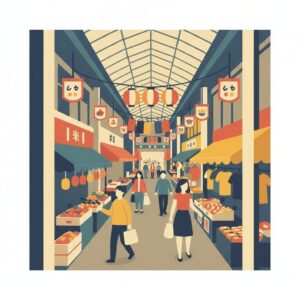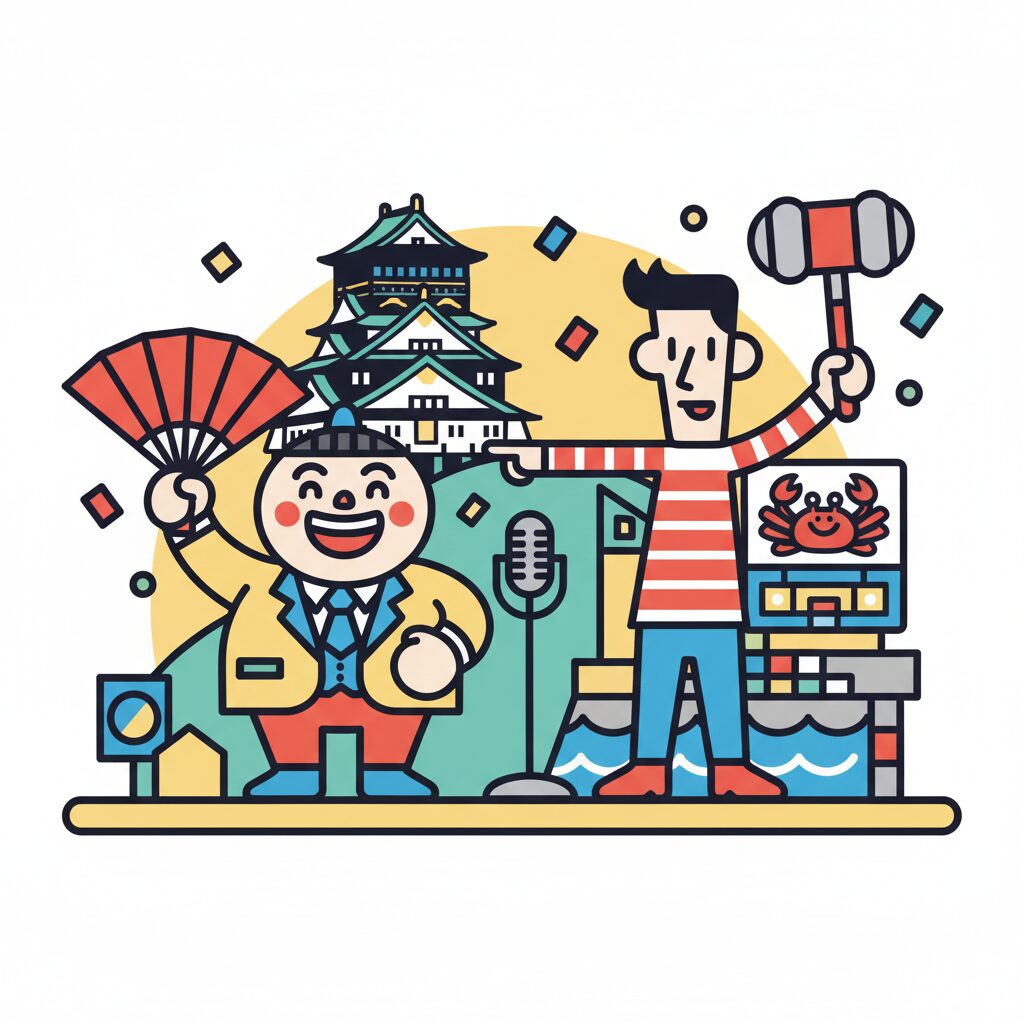
Walk into a tiny, standing-only takoyaki stand in the labyrinthine Shotengai arcades of Tenma. You order, and the old man behind the grill, sweat beading on his forehead, squints at you. “Eight pieces? For you? That’s not enough to feed a bird! You need at least twenty.” He doesn’t crack a smile. For a split second, you’re confused. Is he criticizing your appetite? Is this an upsell? Then his wife, wiping down the counter, smacks him lightly on the arm with a towel. “Leave the customer alone! He knows what he wants, you greedy old fool.” The man finally breaks into a grin, a gold tooth flashing. “Just making sure! Gotta keep our customers strong.” The regulars chuckle. You’ve just stumbled into the middle of a classic Osaka conversational performance. This wasn’t a transaction; it was a scene. And in Osaka, life is a series of scenes, all waiting for a punchline.
For anyone moving here from Tokyo, another part of Japan, or anywhere else in the world, this is one of the first and most profound culture shocks. The stereotype of Japan is one of reserved politeness, of unspoken rules and delicate social maneuvering. And while that exists, Osaka operates on a different frequency. Here, conversation isn’t just a way to exchange information; it’s a sport, a collaborative art form, and the primary tool for building human connection. Humor isn’t a special occasion feature; it’s the default operating system. It’s woven into business negotiations, casual greetings, and even minor complaints. To an outsider, it can feel like you’ve walked into a city-wide improv show where you were never given the script. Why is communication here so different? How do you navigate a world where a straight answer is often the least interesting one? Understanding this comedic undercurrent is not just a fun cultural quirk; it’s the key to truly understanding how to live, work, and connect with people in this vibrant, noisy, and wonderfully human city.
To truly grasp this comedic undercurrent, it’s essential to understand the foundational unspoken rules of Osaka’s unique social fabric.
The Holy Trinity of Osaka Conversation: Ochi, Tsukkomi, and Boke
To understand Osaka, you first need to grasp Manzai. Manzai is the traditional form of Japanese stand-up comedy, usually performed by a duo. However, in Osaka, it’s not merely entertainment on TV; it forms the fundamental, implicit framework of daily conversation. The two roles in Manzai are the ‘boke’ and the ‘tsukkomi’. Mastering this interaction is the key to unlocking the city’s social dynamics.
It’s Not a Conversation, It’s a Manzai Routine
Picture a conversation as a game of catch. Elsewhere, the aim is to toss the ball back and forth smoothly. In Osaka, the goal is to see who can throw the most unexpected, amusing, and entertaining curveball. This is where the essential roles come in. The ‘boke’, or the funny man, is the one who throws the curveball by saying something absurd, exaggerated, out of place, or simply silly. This is a deliberate act of comedic disruption. For example, on a sweltering August day, an Osaka local might fan themselves theatrically and say, “Man, it’s freezing today. Feels like winter in Siberia.” This is a boke: the statement is clearly untrue, designed to create a humorous opening.
Then comes the ‘tsukkomi’, or the straight man, whose role is crucial. They catch the absurd curveball and highlight its ridiculousness to everyone else in the conversation. A straightforward correction like “No, it’s hot” would be dull and break the flow. A good tsukkomi delivers a sharp, witty comeback, often accompanied by a playful smack on the boke’s arm or shoulder. “Siberia?! Have you lost your mind? Go stick your head in the freezer and tell me what that’s like!” The tsukkomi isn’t merely correcting facts; they are endorsing the joke by reacting to it. This quick exchange of absurdity and reaction is the heartbeat of communication in Osaka.
Finally, every exchange needs an ‘ochi’, meaning ‘the fall’ or ‘the drop’, but essentially the punchline. Without an ochi, a story or conversation feels deeply unsatisfying to an Osaka native. It’s like a song that ends without its final chord. The ochi provides the resolution that makes the entire exchange meaningful. It might be the tsukkomi’s final zinger or a self-deprecating laugh from the boke. The whole setup aims to reach this shared moment of humor or amusement. A conversation that simply fizzles out is seen as a failure. That’s why you’ll often be prompted after telling a story: “De, ochi wa?” (“So, what’s the punchline?”). They’re not being rude—they’re seeking the satisfying conclusion their conversational culture demands.
Everyone’s a Critic, Everyone’s a Performer
Because this structure is so deeply embedded, people in Osaka are constantly and often unconsciously playing both performer and audience. When you speak, you’re judged not merely on what you say, but on how you say it—your timing, your delivery, and your entertainment value. Telling a straightforward, factual story about your weekend might serve its purpose but won’t win social points. You’re expected to embellish, exaggerate, and find the humor. A dull story is more than boring—it’s a missed opportunity for connection.
This creates subtle social pressure to be ‘omoroi’ (interesting, funny). It shows in the way stories are told, with animated gestures, changing tones, and acted-out parts. A simple supermarket trip can turn into an epic tale featuring a battle with a stubborn shopping cart and a climactic encounter with a bizarrely shaped daikon radish. The goal isn’t to deceive but to entertain. The truth takes a backseat to the quality of the narrative. While this performance-based communication can be exhausting at first, it also makes interactions vibrant. You’re not a passive receiver of information but an active participant in a shared daily theater. Your reactions, laughter, and witty responses are as vital as the original story. In Osaka, being a good listener means being a good reactor.
Humor as a Social Lubricant: Breaking Down Barriers
In many cultures, particularly within the more formal settings of Japanese society, there is a distinct separation between professional and personal life, between business and leisure. In Osaka, however, this boundary is often blurred, sometimes completely erased by a well-timed joke. Here, humor is not merely a distraction from the ‘real’ conversation; it is a vital part of it. It serves as a diagnostic tool, a means of building relationships, and the primary way to facilitate commerce and community.
The Business Meeting That Resembles a Late-Night Show
Consider a typical business meeting in Tokyo. It is usually a formal occasion, governed by strict protocols such as exchanging business cards, precise seating arrangements, and a carefully worded, respectful agenda. The focus is on efficiency and avoiding any potential conflicts. Now, contrast that with a meeting in Osaka. The atmosphere is completely different. The meeting might begin with the host lamenting their favorite baseball team, the Hanshin Tigers, losing again, or cracking a self-deprecating joke about the garishness of their own tie. This is not unprofessionalism; it is deliberate strategy.
Humor is used as an icebreaker to build rapport and, more importantly, to assess the character of the other person. Can they take a joke? Can they return one? Do they have good ‘nori’—a hard-to-translate concept meaning good rhythm, willingness to play along, and a generally positive, flexible vibe? Someone with good ‘nori’ is regarded as approachable, reasonable, and easy to work with. Conversely, someone who responds to a lighthearted joke with rigid, literal seriousness is immediately marked as difficult, inflexible, and potentially untrustworthy. Before discussing the contract, they are testing the human connection. A shared laugh builds more trust than a dozen PowerPoint slides.
This can be quite confusing for those used to a more formal business culture. An Osaka salesperson might gently poke fun at their own product’s minor flaw to signal honesty and openness. For example, “This new software is great, but the loading screen icon is so ugly, my dog barked at it.” They expect a playful reply, such as, “Well, as long as it doesn’t bite, we’re good!” This banter positions them as partners working through a problem together. A Tokyo-based client might take the comment at face value and worry about the product’s quality, requesting detailed specs of the loading screen’s design. The ‘nori’ breaks, the mood darkens, and the Osaka salesperson thinks, “This person is too rigid. This partnership will be tough.”
“How Much?” and the Art of the Playful Haggle
This mindset extends beyond the boardroom into the very fabric of local commerce, especially in the city’s beloved shotengai (covered shopping arcades). The interaction between shopkeeper and customer is a performance founded on humorous rituals. The typical greeting is not the formal “Irasshaimase” (Welcome), but the more personal “Maido!” (Thanks always!). This is often followed by a classic call-and-response: “Mokari makka?” (“Are you making money?”). The usual reply is a wry smile and “Bochi bochi denna” (“Just so-so”).
This is not a genuine inquiry into the shop’s financial situation; it’s a verbal handshake, a ritual affirming community and shared experience. Answering with a detailed breakdown of quarterly earnings would be utterly bizarre. The ritual is what matters. Likewise, haggling is often more about the performance than the price. A customer might pick up a shirt and exclaim, “Oba-chan, this is way too expensive! My whole weekly food budget!” The shopkeeper is expected to retort, “What are you talking about? At this price, it’s a steal! I’m practically giving it away! My grandkids will starve!” This playful back-and-forth continues, full of dramatics and exaggerations, until a slight discount is agreed upon or, often, the original price stands. The goal isn’t really to save a few hundred yen but to share an experience—a laugh and a moment of human connection. It transforms a simple purchase into a memorable exchange and builds long-term relationships. Simply paying the sticker price without engaging may be efficient, but it is viewed as cold and distant. You’ve bought an item but missed the culture.
The Great Misunderstanding: Why Tokyo Doesn’t Get It
The cultural and linguistic divide between the Kansai region (centered around Osaka) and the Kanto region (centered around Tokyo) stands as one of the most pronounced in Japan. This gap is especially evident in the use and interpretation of humor. What is regarded as friendly banter in Osaka can be seen as rude, aggressive, or simply odd in Tokyo, resulting in frequent misunderstandings.
Literal vs. Layered: The Communication Gap
Fundamentally, the difference stems from contrasting views on the purpose of communication. In Tokyo, particularly in public or professional contexts, communication tends to emphasize precision, politeness (‘teinei’), and maintaining surface-level harmony (‘tatemae’). The goal is to deliver information clearly while avoiding causing offense. In Osaka, communication focuses more on engagement, emotional expression, and building rapport (‘honne’). The aim is to connect, with humor serving as the most effective tool, even if it sacrifices formal politeness.
This often causes misunderstandings around the ‘tsukkomi’. As noted, a tsukkomi is a sharp retort or action meant to highlight the absurdity of a ‘boke’. It can be verbal, like a loud “Nande ya nen!” (“Why the heck!”), or physical, such as a tap on the head or a light shove. Within an Osaka context, this signals intimacy and affection. It conveys, “I’m paying attention to you, I’m engaged in what you’re saying, and I care enough to play my part in our conversation.” It functions as a form of active listening. However, to someone from Tokyo or another region, someone shouting “Nande ya nen!” and tapping their friend’s arm in a café may appear shockingly aggressive and rude. They miss the comedic context, seeing only the surface action, which seems to breach norms of public decorum.
Self-deprecation is another key point of divergence. In Osaka, putting oneself down is a common and effective way to seem humble, approachable, and funny. An Osaka business owner might say, “Welcome to our tiny, messy office! Sorry it’s not a palace like you’re used to in Tokyo.” They expect the visitor to respond with laughter and a reassuring denial. It’s a dance of feigned humility. If a Tokyo counterpart takes the remark at face value, they might feel awkward or even pity the Osaka host, resulting in an uncomfortable atmosphere. They fail to recognize the statement not as a literal description but as a humorous invitation to relax and set aside formalities.
The “Kuki Yomenai” Conundrum
The phrase ‘kuki yomenai’ (literally, “can’t read the air”) is widely used in Japan to describe someone socially inept or oblivious to the atmosphere of a situation. Yet, what constitutes ‘the air’ differs greatly between Osaka and Tokyo. In Tokyo, ‘reading the air’ often means sensing unspoken tensions and understanding what not to say to maintain group harmony. It is a subtractive process—the art of restraint.
In Osaka, however, ‘reading the air’ often involves sensing the energy of the room and knowing when to throw in a joke to enliven the atmosphere. It is an additive process—the art of contribution. An Osaka person in a quiet, solemn Tokyo meeting might feel the ‘air’ is heavy and stagnant. Their instinct is to ‘read the air’ by telling a joke to break the tension. To Tokyo participants, this is the ultimate failure to read the air; a disruptive breach of the established solemnity. Conversely, a Tokyo person at a lively Osaka gathering may try to ‘read the air’ by staying quiet and observant. To Osaka participants, this individual seems cold, aloof, and dull. They appear unwilling to engage with the group’s energy—’nori ga warui’ (having bad rhythm). The same phrase, ‘read the air,’ implies opposite behaviors in these two cultures, creating a classic catch-22 in inter-regional communication.
Practical Survival Guide for Foreigners
So, you’re a foreigner in Osaka, caught up in this whirlwind of banter, often feeling like you’re always one step behind the joke. How can you survive, let alone join in? The good news is that as a non-native, you’re given a lot of grace. No one expects you to be a Manzai master. However, showing that you get the game and are willing to try is the quickest way to earn respect and build genuine friendships.
To Boke or To Tsukkomi? Finding Your Role
Your first and most important task is to be a good audience. Laugh. Smile. Use your body language to show you appreciate the humor, even if you don’t catch every subtlety. An appreciative audience is essential to any performance, and your positive response will be warmly welcomed. This is the easiest and safest way to take part. The next stage is to try a simple ‘tsukkomi’. You don’t need a clever, lightning-fast retort. A playful, questioning tone will do. If a friend tells an obviously exaggerated story, like catching a fish as big as a car, you can simply smile and say, “Hontou ni?” (“Really?”) with an exaggerated look of disbelief. This shows you understand it’s a joke and are playing along. You’re taking on the tsukkomi role by pointing out the boke’s absurdity.
Trying to be the ‘boke’ is the advanced level. It requires strong language skills and cultural insight to say something that’s absurd in a funny way, not just strange or incorrect. However, the charm of being a foreigner is that your language mistakes can sometimes work as unintentional, and often endearing, boke. If you mix up a word and say something silly by accident, the best thing is not to be embarrassed but to lean into it and laugh at yourself. Self-deprecation is a superpower in Osaka. Owning your mistake with a laugh instantly turns a potentially awkward moment into a moment of connection. Your friends will lovingly tsukkomi you, and everyone will share a laugh. You’ve successfully completed a conversational cycle.
Decoding Compliments and Insults
The line between friendly teasing and genuine insult can be surprisingly thin. In Osaka, teasing is a sign of affection. If people make fun of your new haircut or music taste, it often means they like you and feel comfortable enough to joke with you. A relationship without teasing can feel oddly distant and formal. The key is to pay attention to context: Are they smiling? Is the tone light? Is everyone else laughing? If so, it’s almost certainly friendly. The right response is not to get defensive but to laugh it off or, if you’re feeling brave, tease them back.
This is especially true with the word ‘aho’. In most of Japan, ‘aho’ (idiot) is a harsh insult, much like ‘baka’. But in Osaka and the Kansai region, ‘aho’ is a multi-purpose term often used affectionately. It’s the punctuation at the end of a tsukkomi. When a friend forgets their keys and the companion says, “Aho ya naa!” (“You’re such an idiot!”) with a sigh and a smile, it’s an expression of affectionate exasperation. It means, “I can’t believe you’re so silly, but that’s why I like you.” Of course, tone matters. It can be used harshly, but in everyday banter, it’s more like a verbal hug than a slap.
What NOT to Do
There are a few cardinal sins to avoid. First, don’t take everything at face value. Always assume there’s a second, humorous layer to what’s being said, especially if it sounds a bit strange or exaggerated. Second, don’t be a passive conversationalist. Just nodding and saying “hai” will make you seem uninterested. React. Raise your eyebrows. Say a surprised “Eeeh?!” Laugh. Your reactions are your contribution. Third, never be afraid to laugh at yourself. Humility and self-deprecation are highly valued. Fourth, and most importantly, don’t try to fact-check a boke. When someone makes a joke by stating something factually wrong, the point isn’t the accuracy but the absurdity. Correcting them with facts misses the point and breaks the comedic flow. You’re meant to challenge the absurdity, not the error.
The Roots of the Rhythm: A Quick Dive into Why
This distinctive style of communication didn’t emerge spontaneously; it is deeply embedded in Osaka’s history and identity as a city of merchants, contrasting sharply with Tokyo’s origins as a city of samurai and bureaucrats.
The Merchant City Mentality
For centuries, Osaka served as Japan’s commercial center, known as the ‘nation’s kitchen.’ Life centered around business, trade, and negotiation. For the merchants (‘shonin’), success relied on quick thinking, rapid relationship-building, and effective persuasion. Unlike the strict, hierarchical society of the samurai in Edo (Tokyo), where status was fixed, the merchant world was fluid and competitive. Humor became a vital business tool, helping to break down social barriers, quickly assess a potential partner’s personality, and leave a lasting impression. A witty and personable merchant was more likely to close a deal than a stern, formal one. Transactions were never just about goods or money, but about the human connection created through shared conversation and laughter. This pragmatic focus on human relationships rather than rigid protocol is ingrained in the city’s very nature.
Yoshimoto Kogyo and the Media Saturation
Moving into the 20th and 21st centuries, this inherent cultural trait was greatly amplified by the media. Osaka is the undisputed heart of Japanese comedy, largely due to Yoshimoto Kogyo, the large entertainment conglomerate founded there in 1912. For generations, Osaka’s media has been filled with Manzai shows, comedy sketches, and variety programs starring comedians. Children in Osaka grow up watching these performers on TV daily. The rhythms, catchphrases, and boke-tsukkomi dynamics of professional comedy are absorbed early on, becoming the natural, default pattern for their own communication. They learn the timing and structure of a good joke just as a child elsewhere might learn a nursery rhyme. This shared cultural language is practiced and refined every day on the streets, in shops, and at home.
Life Beyond the Punchline
After reading all this, you might picture Osaka as a city of nonstop, exhausting comedy, where every interaction feels like a performance. However, it’s important to add a touch of reality: humor is the default, not a requirement. People in Osaka can, of course, be serious.
It’s Not Always “On”
In genuinely serious or solemn moments—a heartfelt apology, a discussion about someone’s health, a funeral—the comedic mask slips away. Osaka locals are fully capable of being sincere, empathetic, and serious when the occasion demands it. The challenge for outsiders is to discern when a situation is ripe for a joke and when it calls for solemnity. Generally, when the topic is light, the mood stays light; but when it involves deep personal troubles, sincere apologies, or respect for the deceased, the humor is set aside. Humor is a tool for navigating daily life, not for diminishing serious matters.
The Warmth Behind the Wit
Ultimately, it’s essential to realize that Osaka’s culture of humor isn’t about being flippant or insincere. It’s the city’s unique way of expressing warmth, friendliness, and a desire to connect. The cliché that “Osaka people are friendly” holds true, but it’s not the passive, polite friendliness found elsewhere. It’s active, engaging, and participatory. They don’t just want to be pleasant; they want to engage, share a moment, and include you in their world.
A joke is an invitation to let down your guard. A tsukkomi shows they are listening closely to what you say. The loud, chaotic, sometimes baffling back-and-forth is the sound of human connection being actively formed. It can be intimidating, but beneath the layers of wit, exaggeration, and performance lies a deep desire to treat everyone not as a stranger but as a potential partner in the next great conversation. Living in Osaka means learning that the shortest path between two people is often a shared punchline.