It’s a Tuesday evening. The workday is done, the air is thick with the promise of a cold beer, and your brain, still buzzing with the day’s tasks, craves the simple release of good food and easy conversation. You turn to your colleague, an Osaka native, and suggest the obvious. “Hey, let’s go for a drink in Namba.” A flicker of something crosses their face. It’s not annoyance, not quite pity, but a sort of gentle recalibration. They smile, a knowing, patient smile, and say, “Namba? Nah. Too much hassle. Let’s go to Tenma. It’s better.”
For anyone new to Osaka, this is a moment of quiet confusion. Namba is the beating heart of the city’s nightlife, isn’t it? It’s the place with the giant crab, the Glico running man, the canals glittering with a million neon reflections. It’s the image plastered across every travel guide and influencer’s feed. To suggest going anywhere else feels like suggesting a trip to Paris to see the second-best tower. Yet, for the person who actually lives here, who navigates the city’s rhythms not as a tourist but as a resident, the choice is clear. Namba is for show. Tenma is for real.
This isn’t just a matter of preference, like choosing between two different brands of beer. The Namba-or-Tenma question cuts to the very core of what Osaka is, how its people think, and what they value. It’s a daily referendum on authenticity versus spectacle, community versus commerce, and the gritty, unpolished soul of a city that has always resisted being easily defined. Namba is the face Osaka shows the world, a dazzling, high-energy performance designed for maximum impact. Tenma, and places like it, is the city’s living room—a little messy, incredibly loud, and intensely, unapologetically alive. Understanding why your colleague chooses the crowded, chaotic backstreets of Tenma over the electric grandeur of Dotonbori is the first step to understanding the real Osaka, the one that exists long after the last tour bus has departed.
To truly understand the city’s work-hard, play-hard ethos, one must also appreciate the dedication of its people, as seen in the early morning routines of vendors at Kuromon Ichiba Market.
Deconstructing the Spectacle: Namba as Osaka’s Public Face
The Glico Man Avoids Drinking Here on a Tuesday
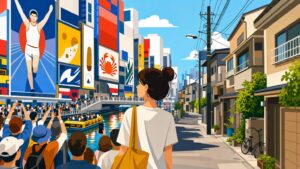
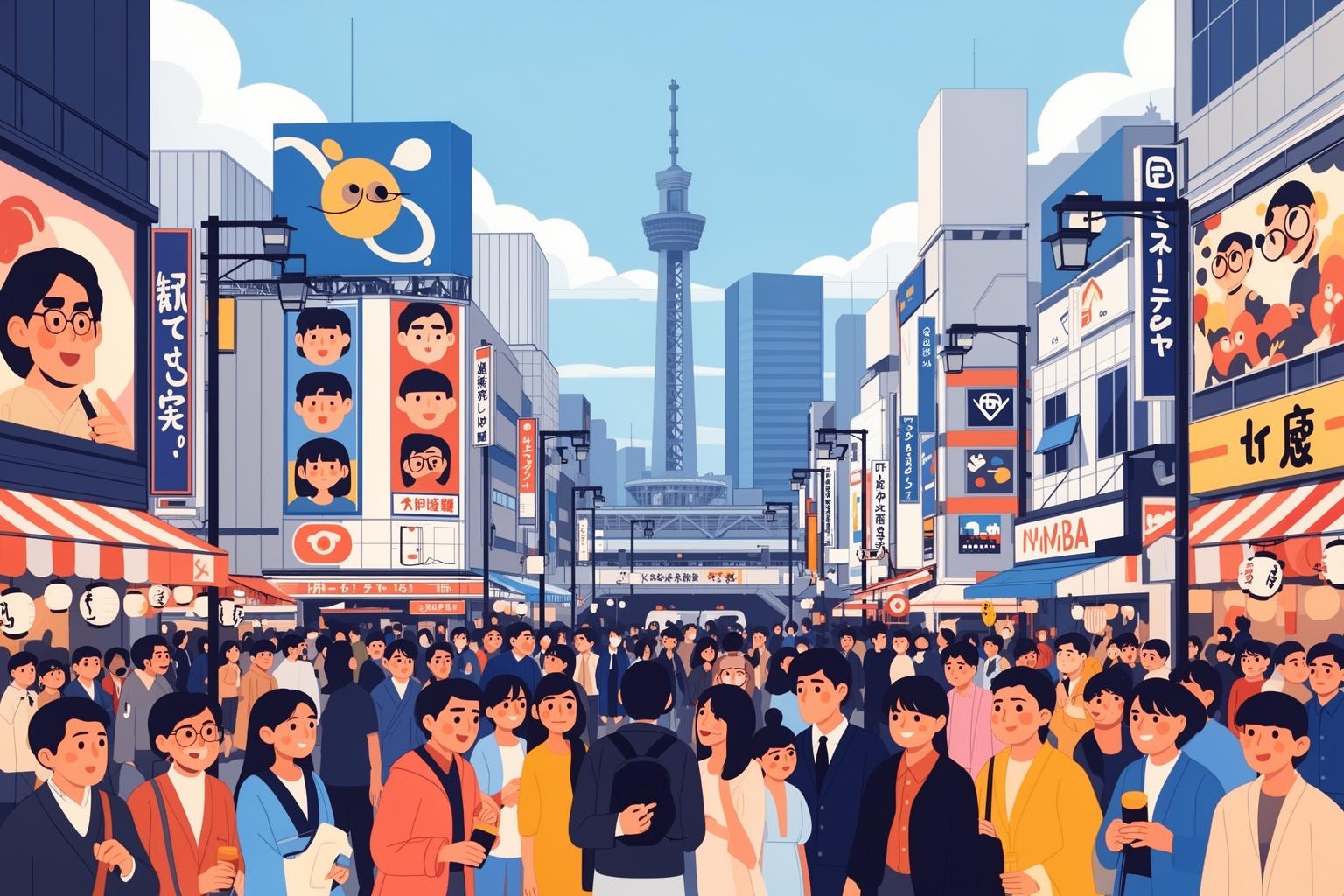
To grasp why locals steer clear of Namba for a casual weeknight drink, you first need to understand what Namba is really for. Step out of the station and you’re immediately bombarded by a sensory overload. Towering screens flash advertisements, music blasts from countless storefronts, and the air is thick with the aroma of takoyaki mixed with the chatter of a thousand languages. This is Osaka’s front door, its welcome mat, its grand, theatrical stage. And like any stage, everything on it is carefully choreographed.
The giant mechanical crab, the pufferfish lantern, the stern-faced Kuidaore Taro doll—these aren’t remnants of an old tradition; they are intentionally curated icons meant for consumption. They serve as selfie backdrops and landmarks to help lost tourists orient themselves. The whole district, especially along the Dotonbori canal, is designed for a very specific kind of experience: a memorable, photographable, one-time visit. The restaurants are expansive, multi-level establishments built to accommodate busloads of tourists. Their menus are laminated and filled with glossy photos of every dish, usually with English, Chinese, and Korean translations. The staff provide efficient, impersonal service, aiming to get you in, fed, and out again swiftly to make room for the next group.
To a local Osaka resident, this doesn’t feel lively—it feels inefficient. It’s an environment made for transactions, not genuine interactions. You don’t visit Dotonbori to have a quiet chat with the bartender or catch up with the owner. Instead, you come because your cousins are visiting from the countryside, or because a foreign friend is in town and you have to play the part of the local guide. It’s an event, a special outing. For the simple, beautiful ritual of an after-work beer, it’s fundamentally the wrong place. The Glico Man is an advertisement, and Namba, at its core, feels much the same. It’s selling Osaka, and locals rarely want to buy what already belongs to them.
The “Tourist Tax” Extends Beyond the Bill
The most practical, and perhaps the most Osakan, reason to avoid Namba is straightforward economics. Osakans are famed for their keen, almost instinctual, awareness of value, a principle they call “kospa” (short for “cost performance”). It’s not about being cheap but about being wise. It reflects a deep refusal to pay more than something is worth. In Namba, everything carries an unseen surcharge, a “tourist tax.” A standard draft beer that might cost 350 yen in a neighborhood bar could be 550 or 600 yen at a Dotonbori izakaya. The food, though often decent, is priced for a captive, uninformed audience.
But the cost isn’t only financial—it’s experiential. Drinking in Namba means sacrificing your anonymity. You become just another face in the crowd, another number on a bill. The service is courteous but detached. There’s no sense of community, no recognition, no shared connection. In a city where human relationships are a rich social currency, this is a high price to pay. The Osaka way is deeply rooted in relationships—with the local butcher, the corner store owner, and especially the proprietor of your preferred bar. These bonds represent a form of wealth, built over time through repeated, casual encounters. Namba’s entire setup is designed to prevent these relationships from developing. It’s a temporary space for temporary visitors.
This is fundamentally alien to the local mindset. Why pay a premium for an experience that removes the very element that makes drinking in Osaka special? It’s like owning a luxury car with no engine. It might look impressive, but it won’t get you anywhere. To the local eye, Namba’s bright lights don’t evoke excitement—they signal a bad deal. And if there’s one thing an Osakan despises, it’s a bad deal.
Welcome to the Labyrinth: Tenma as the City’s Living Room
A Geography of Controlled Chaos
Now, let’s head to Tenma. If Namba is a grand, open-air theater, Tenma is a backstage maze—a labyrinth of narrow, covered shotengai and even tighter side alleys branching out from JR Tenma Station. There are no grand landmarks here, no single iconic sight. The charm of Tenma lies not in any one view, but in the overwhelming density of experiences it offers. It’s a neighborhood of a thousand tiny doors, each opening into its own unique world.
Exploring Tenma is an act of discovery. You might slip under a plastic curtain into a smoke-filled yakitori joint seating just six people, their knees nearly touching. Next door could be a sleek, modern standing bar specializing in craft sake. Around the corner, a grizzled old master serves life-changing sushi from a stall no bigger than a walk-in closet. The air blends a rich tapestry of scents—charcoal smoke, simmering dashi, sizzling oil, spilled beer. The soundtrack is a medley of clattering plates, roaring laughter, and vendors’ and bartenders’ shouts, all echoing beneath the corrugated roofs of the arcades.
This environment embodies the Osaka spirit. It’s not clean, not orderly, and certainly not spacious. But it is profoundly human. The chaos is intentional, not accidental. It demands engagement, attention, the ability to squeeze past people and make eye contact. Unlike Namba’s wide, impersonal boulevards that keep people apart, Tenma’s tight quarters bring them together. It’s a geography that fosters community by necessity, a perfect incubator for the spontaneous, unpretentious interactions that define the city.
The Gospel of “Senbero”: The Thousand-Yen Philosophy
At the heart of the Tenma experience is a concept almost sacred in Osaka: “senbero,” a blend of “sen-en” (1,000 yen) and “berobero” (drunk). The idea is simple: you can get happily buzzed for about a thousand yen. This isn’t a challenge or a cheap gimmick; it’s a guiding philosophy. It declares that enjoying a drink and a bite after work isn’t a luxury, but an affordable, everyday right.
Tenma is the high temple of senbero. Bars offer draft beer and two skewers for 500 yen. A glass of shochu may cost 300 yen. Small plates of oden or doteyaki (beef sinew stew) go for a couple of hundred yen coins. The aim isn’t to eat a full sit-down meal in one place but to partake in “hashigo-zake”—bar hopping. You grab a quick beer and some gyoza here, then a glass of sake and sashimi next door, finishing with a highball at a standing bar down the alley. Each stop costs just a few hundred yen, letting you curate your own evening, following your whims without worrying about the bill.
This is the purest form of the Osakan “kospa” philosophy. It’s not just about saving money; it’s about maximizing enjoyment. For the price of two drinks in a sterile Namba tourist bar, you can have a multi-act gastronomic adventure in Tenma—sampling different foods, soaking in varied atmospheres, and meeting diverse people along the way. It’s a smarter, livelier, and ultimately more rewarding way to spend an evening. It turns the simple act of going for a drink into a form of exploration and play.
Tachinomi Culture: The Art of Standing Shoulder-to-Shoulder
Perhaps the most defining characteristic of Tenma’s drinking scene is the prevalence of “tachinomi,” or standing bars. For outsiders, especially from Western cultures where sitting is expected, paying to stand in a crowded room may seem odd. But to grasp tachinomi, you must understand its social purpose.
A tachinomi is a social accelerator. It removes the formalities and barriers of traditional seating. There are no tables to separate groups, no chairs to define personal space. By design, you stand close to everyone else in the bar. Shoulder-to-shoulder with strangers, sharing a counter, your elbows nearly touching. This physical closeness fosters psychological closeness. It feels more awkward not to talk to the person beside you.
This is where Osaka’s famous friendliness takes shape. It’s not an abstract trait but a behavior molded by the environment. In a Tenma tachinomi, conversations ignite naturally. Someone might ask what you’re drinking. You might comment on the delicious plate the person next to you ordered. The bar master, at the center of it all, acts as a conductor—introducing regulars, telling jokes, keeping the energy alive. You may walk in alone and leave after chatting with five different people from all walks of life—a salaryman, a shopkeeper, a student, a retiree. The tachinomi is a great equalizer, a temporary village square where status and background are left by the door, replaced by the simple joy of sharing a drink.
The Social Currency: Why Connection Outweighs Convenience
“Taisho, Itsumo no!”: The Strength of Being a Regular
In the transactional world of Namba, you are simply a customer. But in the relational world of Tenma, the aim is to become a “jouren,” a regular. This status, earned over time, comes with privileges far more valuable than any loyalty points program.
Once you become a jouren at a small Tenma bar, you’re no longer just a person ordering a drink. You become part of the place’s fabric. The master, or “taisho,” greets you by name. They know your usual drink and might have it ready before you even say a word (“Taisho, itsumo no!”—”Master, the usual!”). They might save a special dish for you off the menu. They ask about your work, your family, or the local baseball team’s disastrous season. They become a confidante, a neighborhood fixture, a steady point in the chaos of city life.
This relationship forms the foundation of the local drinking culture. It offers a sense of belonging and the comfort of being recognized. In a vast, anonymous city, these small community pockets are crucial. The bar turns into a “third place,” a home away from home. This is a kind of social capital money can’t buy. It must be nurtured. And it is in neighborhoods like Tenma, not in the concrete-and-tourist-filled hubs like Namba, that these bonds thrive. The convenience of a large, centrally located restaurant in Namba can’t compare to the warmth of entering a tiny bar where your presence is not only welcome but expected.
The Unspoken Language of “Chaimannen”
To truly capture the vibe of a Tenma bar, you need to understand some Osaka dialect, or Osaka-ben. More than just an accent, it represents a distinct style of communication. It’s more direct, playful, and less bound by the formalities typical of standard Japanese. A key phrase is “chaimannen,” a rhythmic, almost sing-song way of saying, “That’s not it!” or “You’re wrong!”
But this phrase goes beyond simple negation. It reflects a culture of friendly teasing, “tsukkomi” (sharp, witty retorts), and not taking oneself too seriously. The atmosphere in a good Tenma bar is charged with this energy. People banter loudly, joke at one another’s expense, and argue passionately—often hilariously—about trivial matters. It’s a performance, but an interactive one where everyone is invited to join. This can be surprising to those used to the more reserved, harmony-focused atmosphere of Tokyo izakayas, where loud conversations might draw disapproving looks.
In Tenma, the noise is central. The lively, freewheeling conversation is the main event, with food and drink as fuel. This reflects the Osaka spirit of “nori,” getting into the groove and sharing collective energy. It’s a social contract that values candid, direct engagement—even if a bit rough around the edges—over polite, sterile silence. Namba’s places are often too large, filled with canned music, and focused on turnover, making it difficult for this kind of organic, chaotic, and deeply human interaction to thrive.
Reading Between the Lines: What This Choice Says About Osaka
The Fierce Pride in the “Uncool”
At the heart of choosing Tenma over Namba lies a fundamental aspect of Osaka’s identity: a stubborn pride in the practical rather than the pretentious, the authentic rather than the aesthetic. For centuries, Osaka was Japan’s merchant hub, a city shaped by people who valued quality and substance more than status and appearance. Tokyo, by contrast, was the domain of samurai and bureaucrats, characterized by rigid hierarchies and refined, elegant culture. Osaka, known as the nation’s kitchen, was a place of commerce, common sense, and earthly pleasures.
This historical identity endures. Osaka often defines itself in opposition to Tokyo, rejecting what it sees as the capital’s preoccupation with trends, branding, and superficial coolness. Tenma embodies this counter-cultural attitude. It makes no attempt to be trendy or to appear in glossy design magazines. Many of its best establishments are gritty, decades-old venues with peeling paint and menus written on yellowed paper. Their value lies not in their looks but in the quality of their offerings and the strength of their community.
Choosing Tenma is an embrace of this value system. It quietly proclaims that a 150-yen skewer of perfectly grilled chicken skin, served by a gruff yet skilled master in a humble shack, surpasses a 1,000-yen fusion dish presented in a sleek, minimalist setting. This isn’t inverted snobbery; it’s a fundamentally different way of measuring worth. It’s pride in substance, in the genuine, the “honmono,” coupled with a healthy skepticism of anything overly polished.
A City of Neighborhoods, Not Monuments
The key insight from the Tenma-Namba divide is that Osaka is not a city defined by monuments but by neighborhoods. While Tokyo’s identity often revolves around its large, iconic stations and districts—Shinjuku, Shibuya, Ginza—Osaka’s identity is much more detailed and intimate. Life is lived at the local level.
An Osaka native rarely just says they’re from Osaka; they specify Tennoji, Kyobashi, Juso, or Nakazakicho. Each neighborhood boasts its own distinct character, ecosystem of shops, restaurants, and bars, and unique sense of community. The local shotengai serves as the backbone of this community, with its small bars and eateries at the heart.
Choosing Tenma is an endorsement of this neighborhood-centered life. It’s a preference for the local over the national, the small-scale over the corporate. It reflects a way of living deeply rooted in a specific place. You’re not merely experiencing generic “nightlife in Osaka”; you’re engaging in the life of a particular community. This is what foreigners living in the city long-term come to realize. You stop thinking about “going out in Osaka” and start thinking about “going for a drink in my neighborhood.” Namba is a destination for everyone, and therefore a true home for no one. Tenma is fiercely, proudly local—and that is exactly its strength.
So, When Should You Go to Namba?
This is not to say that Namba lacks purpose. It definitely has one. You visit Namba for the dazzling spectacle. You go when friends or family are visiting from abroad and you want to give them a concentrated, high-impact “Welcome to Osaka!” experience in just two hours. You go for a particular, well-known okonomiyaki or ramen restaurant that draws lines for good reason. You go for a large, celebratory group dinner where you need seating for twenty people. You go to catch a show at the Namba Grand Kagetsu comedy theater or to shop for items you can’t find anywhere else.
Namba is an excellent choice for a planned event, a night with a clear purpose and destination. It fulfills its role as the city’s entertainment hub admirably. However, for most locals, it is not the default spot for a spontaneous, unplanned, “let’s just grab a drink” kind of evening. That kind of night isn’t about the destination; it’s about the experience. It’s about relaxing, connecting, and feeling part of the city’s daily, unscripted rhythm. For that, you need a place that feels less like a stage and more like home.
The Takeaway: Drink Where the City Lives
Ultimately, the decision between Tenma and Namba is a choice between two distinct ways of experiencing Osaka. One is the perspective of an observer; the other, that of a participant. Namba provides a stunning view from the outside. You can admire the lights, take photos, and enjoy the famous food. You can feel the energy of Osaka from a safe and comfortable distance. It is like a postcard—bright, beautiful, and two-dimensional.
Tenma, however, asks you to step inside the scene. It invites you to navigate its crowded streets, engage with its people, and adapt to its noisy, chaotic rhythm. It isn’t always comfortable. It can be overwhelming. You may not catch every word of the rapid-fire Osaka-ben spoken around you. But it is where the city truly lives and breathes. It’s a conversation, and you are welcome to join.
So next time you’re thinking of going for a drink, pause before pointing to the glittering lights of Dotonbori. Consider what you really want. If you want to watch the show, by all means, go to Namba. But if you want to understand the actors once the curtain falls, hop on the Loop Line, dive into the nearest shotengai, push open the door to a small, crowded bar, and order a drink. You won’t just be having a beer—you’ll be tasting the authentic Osaka.