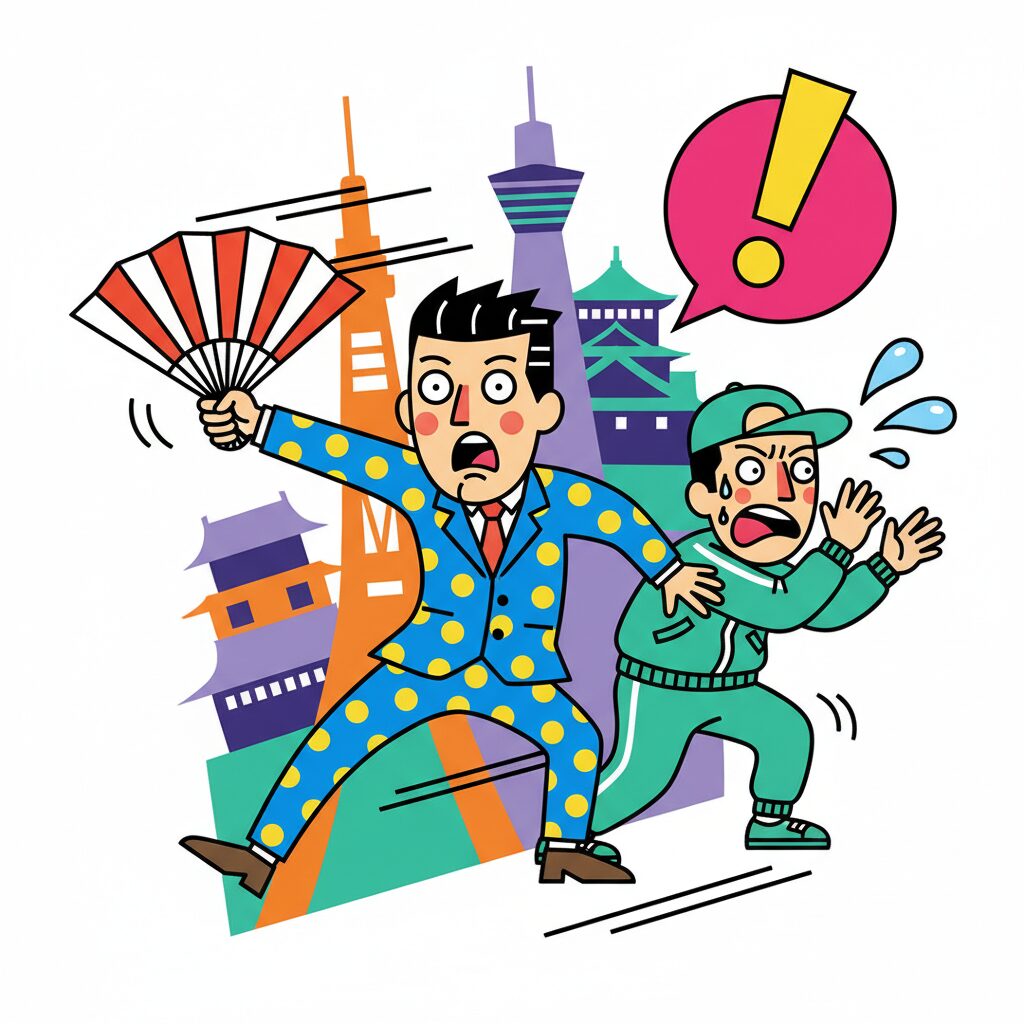
You’ve just landed a job in Osaka. Congratulations. You’ve mastered the bowing, the business card exchange, the intricate dance of workplace etiquette you studied for. You walk into your first team meeting. The air is thick with the smell of green tea and determination. Your boss, Tanaka-bucho, is outlining a new project strategy. He pauses, looks at a complex slide he just presented, and says with a completely straight face, “This plan is so brilliant, I should probably run for prime minister.” The room is silent for a beat. You panic. Is this a test? Is he serious? Your Tokyo-trained instincts scream: Nod politely. Look impressed. Say nothing. But before you can react, a young team member, Suzuki-san, pipes up from the back, not even trying to hide his grin. “Prime minister? Bucho, you’d probably lose your security deposit. Let’s just try to hit our quarterly target first, yeah?” Instead of the horrified gasp you expect, the room erupts in warm, rolling laughter. The boss, Tanaka-bucho, laughs the loudest, slapping his knee and pointing a finger at Suzuki-san. “You got me, you got me! Okay, maybe just mayor of this floor for now.” The tension in the room vanishes. The meeting continues, but the energy has shifted. It’s lighter, more collaborative, more… human. You’re not in Tokyo anymore. You’re in Osaka, where humor isn’t a distraction from work; it’s how work gets done. This is the world of casual humor and the mighty tsukkomi, the witty retort that serves as the social glue, the tension-breaker, and the ultimate team-building tool in the Kansai region’s vibrant economic heart. For an outsider, this can be utterly baffling, a cultural code that seems to defy every stereotype of the Japanese workplace. But understanding this dynamic is the single most important key to not just surviving, but thriving, in the fast-paced, straight-talking, and surprisingly warm world of an Osaka office. It’s a communication style born from centuries of commerce, perfected on comedy stages, and practiced every single day in the meeting rooms, hallways, and after-work pubs of this incredible city. Forget what you think you know about corporate Japan. We’re about to dive into the art of the deal, the joke, and the perfectly timed comeback.
This vibrant business culture is a key driver of the region’s prosperity, which is further fueled by a booming tourism sector and major developments like the upcoming Expo 2025.
The “Why” Behind the Wit: The Historical and Cultural Roots of Osaka’s Humor
To understand why your Osaka boss might jokingly compare himself to the prime minister, you need to look back—way back. Osaka’s identity is fundamentally distinct from Tokyo’s, and this difference forms the foundation of its communication style. While Tokyo, historically known as Edo, was the stoic stronghold of samurai and shoguns—a city built on strict hierarchy, protocol, and saving face—Osaka was the nation’s vibrant commercial hub, the tenka no daidokoro, or “the nation’s kitchen.” It was a city of merchants, not warriors, and merchants operate by a different set of rules.
A Merchant City’s Legacy
In a samurai city, your status was fixed. You bowed to those above you and expected bows from those below. Communication was formal, codified, and meant to reinforce the power structure. In a merchant city like Osaka, success didn’t come from birthright but from your wit, charisma, and ability to build relationships. You had to haggle, persuade, and charm. Quickly assessing a person’s character, earning their trust, and closing a deal often happened within the same conversation. Formal, rigid language doesn’t build rapport; it creates distance. What builds rapport? Shared laughter. Humor became an essential tool of the trade—a social lubricant that could break the ice with new customers, a gentle way to haggle over prices without offense, and a method for forming lasting bonds beyond single transactions. A sharp, witty merchant was viewed as intelligent and trustworthy. This mentality isn’t just historical; it pulses through modern Osaka’s veins. The philosophy remains constant: business is personal. Strong relationships are the foundation of good business, and in Osaka, these bonds are often forged through friendly banter. The aim is to reduce distance between people, not emphasize it. While a Tokyo office may prioritize formal respect and established protocol, an Osaka office values camaraderie and shared purpose. Laughter is the shortcut to achieving that.
The Manzai Effect: How Comedy Shapes Conversation
You can’t talk about Osaka without mentioning comedy. The city is the unrivaled home of manzai, a traditional stand-up style that has deeply influenced how Osakans communicate. The manzai duo features two performers: the boke (the funny man, or fool), who says something absurd or silly, and the tsukkomi (the straight man), who counters with a sharp, witty retort, often accompanied by a playful smack on the head with a paper fan. This isn’t just a TV act; it’s a conversational pattern ingrained in local culture. Everyday chats in Osaka often follow this rhythm. People naturally slip into these roles. The boke–tsukkomi exchange is a verbal dance, a lively back-and-forth that keeps conversation engaging and entertaining. Someone might deliberately say something ridiculous (playing the boke) just to set up a perfect tsukkomi. Delivering a good tsukkomi is more than humor; it’s a prized social skill. It shows you’re attentive, quick-witted, and fully engaged. Failing to respond with a tsukkomi when expected can make you seem dull, uninterested, or even a little arrogant. This cultural rhythm doesn’t stop when work begins; it carries into the office, turning meetings, coffee breaks, and brainstorming sessions into subtle, high-speed comedic exchanges where punchlines help forge team cohesion.
Decoding the Office Banter: Tsukkomi in Action
So, you’re in the office, and the banter is lively. To an outsider, it might sound like a string of non-sequiturs, friendly jabs, and exaggerated grievances. Yet beneath the surface, a complex and refined communication system is at play. The key lies in understanding what tsukkomi is, and perhaps even more importantly, what it is not.
What is “Tsukkomi” and What it Isn’t
A tsukkomi is not an insult. It’s not sarcasm in the sharp, cynical Western sense, nor is it a genuine critique of a person. A skillful tsukkomi is a clever retort aimed at the absurdity of a statement or situation rather than the individual who made it. Its role is to highlight the silliness of the boke’s comment, restoring a playful order to the conversation and sparking a shared laugh. It’s a verbal nudge that says, “I’m listening, what you said is ridiculous, and I’m joining in the fun.” Let’s explore this through some real office examples. Picture your colleague, Sato-san, submitting a report. He sighs dramatically and says, “I poured my very soul into this report. It’s my masterpiece.” In a formal Tokyo office, a typical response might be a polite, “Otsukaresama desu. Thank you for your effort.” It’s respectful but doesn’t foster connection. In an Osaka office, this statement is like a giant neon sign flashing “TSUKKOMI WANTED!” A fitting reply might be, “Your soul? Looks more like you copied last year’s report and just changed the date. Come on, show me this ‘masterpiece.’” This isn’t an accusation of plagiarism but a playful jab acknowledging Sato-san’s flourish and bringing him down to earth in a friendly way. Sato-san would likely laugh and say, “If it ain’t broke, don’t fix it!” This exchange strengthens their bond. The tsukkomi here serves three purposes: it shows you were paying attention, it diffuses potential arrogance, and it creates a shared moment of humor. Skipping the tsukkomi would feel odd. Nodding seriously would imply either you believe Sato-san’s soul is literally in the report or you’re too detached to engage in the conversational game.
Reading the Room: The Unspoken Rules of Office Humor
This lively, humorous environment is not chaotic. It follows a set of deeply rooted, unspoken rules. Breaking these rules separates the funny, well-liked colleague from the one who’s simply rude. For any non-Japanese person wanting to fit in, mastering this is essential.
Rule 1: Hierarchy is Flexible, Not Ignored
What surprises many foreigners is seeing a subordinate make a witty comeback to their boss. Yes, in Osaka, you can definitely tsukkomi your superiors, but it’s a high-skill move. The key is delivering the joke with an undercurrent of respect. You’re not challenging their authority but engaging in a shared cultural ritual. Usually, the boss takes on the boke role to appear more approachable and human. When your manager says, “I was so productive this morning, I think I did a week’s worth of work,” they’re not bragging—they’re tossing an easy pitch. A good tsukkomi from a team member might be, “Does that mean we can all go home for the week, bucho?” This is spot on: funny, gently poking at exaggeration, while reinforcing team spirit. A poor reply would be, “Well, you didn’t answer any of my emails, so I’m not sure what work you were doing.” The first builds camaraderie; the latter delivers direct criticism. The art is in playfully challenging the statement, never the person or their status.
Rule 2: It’s About Connection, Not Hurtfulness
Osaka humor’s ultimate aim is to include everyone. It’s about laughing with people, never at them. Jokes that belittle, exploit insecurities, or are genuinely mean violate the unwritten code. The humor fosters belonging—a sense that “we’re all in this together.” If a coworker trips over a cord, a Tokyo reaction might be silent politeness to avoid embarrassment. The Osaka response is to turn it into a shared joke. Someone might yell, “Whoa, Tanaka! Trying out your new dance moves for us?” This instantly reframes an awkward moment into a funny one. It gives the person who fell a playful role; they can laugh at themselves and say, “Yeah, that’s the ‘I-haven’t-had-my-coffee-yet’ shuffle.” By making it a joke, the group absorbs and defuses the embarrassment and moves on. The humor acts as support.
Rule 3: Timing and Context Matter
There’s a time and place for everything. Though banter is common, Osakans are serious about work. Cracking jokes during a tense client negotiation or a formal performance review would be completely inappropriate. The lively atmosphere belongs to internal settings—brainstorming, team lunches, casual breakroom conversations. The humor’s purpose is to strengthen the internal team so they present a united, professional front externally. Knowing how to read the room—kuuki wo yomu—is as vital in Osaka as in Tokyo. The difference is, in Osaka, the “right” atmosphere is often light and humorous, and your role is to foster that, not just observe. But when the mood turns serious, you must adjust immediately.
The Role of the “Boke”: Welcoming the Tsukkomi
It’s important to recognize that people often invite a tsukkomi by deliberately playing the boke role. This is a conscious social gesture. By saying something slightly foolish or exaggerated, they make themselves vulnerable, giving their partner an easy opportunity to shine—a conversational softball. For instance, a senior manager arriving Monday morning might say, “I played golf all weekend. I think I’m ready to go pro!” He doesn’t truly believe he’s the next Tiger Woods. This is a deliberate social move, inviting tsukkomi from the team. The ideal reply from a junior employee would be, “Go pro? Bucho, from what I heard, you spent more time in the sand traps than a desert camel!” This exchange works perfectly. The manager shows he doesn’t take himself too seriously, making him more approachable. The junior demonstrates wit and social grace, marking themselves as a sharp, integrated team member. This brief interaction does more for morale than a lengthy, trust-building workshop.
The Practical Impact on Team-Building and Productivity
This ongoing flow of lighthearted banter serves more than just entertainment. It profoundly and practically influences how work is carried out, nurturing an environment that is often more agile, transparent, and resilient than more formal settings. Though it may seem like people are simply joking around, this communication style is actually a highly effective tool for collaboration and management.
Breaking Down Barriers and Encouraging Flat Communication
In a traditional hierarchical office, information typically flows downwards. Orders are given, and junior employees are expected to follow without question. This can suppress creativity and prevent valuable feedback from reaching decision-makers. The humorous, banter-rich culture of an Osaka office naturally dissolves this rigid structure. When a junior employee feels comfortable enough to playfully tsukkomi their manager, they also feel freer to express real concerns about a project or propose unconventional ideas. The humor fosters psychological safety, signaling that the workplace is a space where all voices are valued, regardless of rank. This can result in a more dynamic and innovative atmosphere. Brainstorming sessions become livelier, with ideas flowing more openly because people aren’t afraid of immediate rejection. The constant back-and-forth of boke and tsukkomi sharpens quick thinking, responsiveness, and creative problem-solving — all valuable assets in any business.
A Tool for Honesty? The Indirect “No”
One of the biggest challenges for foreigners in Japan is navigating indirect communication. Getting a straightforward “no” is nearly impossible. People often say “that might be difficult” (sore wa chotto muzukashii desu ne) or “I will consider it” (kentou shimasu), which are polite ways of declining. Osaka offers a unique approach: delivering criticism or rejection through humor. This allows for a more direct honesty while maintaining harmony and saving face. Imagine a team discussing a proposed marketing campaign, and a junior member suggests an impractical and costly idea. In a Tokyo office, the leader might say, “Thank you for your suggestion. We will take it into consideration,” then quietly drop it. In an Osaka office, the leader is more likely to laugh and reply, “Great idea! If we were Apple with an unlimited budget, we’d do it tomorrow! Who’s next?” The message is clear: the idea is rejected, but in a way that isn’t personal or discouraging. The junior employee laughs along, understands why it’s not feasible, and feels comfortable speaking up again. Humor softens the blow of rejection, speeding up feedback loops and improving efficiency.
When It Goes Wrong: Misunderstandings for Foreigners
For someone not raised in this culture, the Osaka office’s style can be a minefield of misunderstandings. Miscommunications easily occur. A foreigner accustomed to a clear boundary between professional behavior and personal friendship might see constant teasing as unprofessional or even bullying. If you are the target of a tsukkomi without knowing the nature of the banter, you may feel mocked or not taken seriously. You might interpret playful remarks as passive-aggressive or harsh criticism. Conversely, if you come from a culture where sarcasm is common, you might try to join in with your own sarcastic comment, only for it to fall flat or cause offense. Western sarcasm tends to be dry, deadpan, and cynical, whereas Osaka’s tsukkomi humor is lively, warm, and fundamentally optimistic. The intent is entirely different. The greatest risk is a feedback loop of misunderstanding: you see the banter as unprofessional and respond with formal politeness; your Osaka colleagues see your formality as cold or unfriendly and may assume you dislike them or are arrogant. This creates distance, the opposite of the connection humor aims to build. They might stop engaging you with banter, leaving you feeling more isolated. Breaking this cycle requires deliberate effort to grasp the positive intent behind the words.
Osaka vs. Tokyo: A Tale of Two Office Cultures
Nowhere are the differences in Japanese communication styles more striking than when comparing Osaka and Tokyo. Transitioning between corporate jobs in these two cities can feel like relocating to an entirely different country. It offers a perfect case study in how regional history and culture influence the modern workplace.
The Tokyo Standard: Formality, Tatemae, and Reading the Air
Tokyo, as Japan’s political and administrative hub, reflects this status in its office culture. The legacy of the samurai bureaucracy is deeply ingrained. The environment tends to be more formal, reserved, and hierarchical. There is a strong focus on tatemae (one’s public facade or official story) versus honne (one’s true feelings). Openly expressing honne is often viewed as immature or disruptive. The crucial skill in a Tokyo office is kuuki wo yomu (reading the air), meaning grasping the unspoken consensus of the group and conforming without explicit communication. Meetings tend to be long and deliberate, often serving as formal confirmations of decisions already made through behind-the-scenes, one-on-one consensus-building (nemawashi). While humor does exist, it is usually subtle, reserved for after-work gatherings, and seldom used as a primary tool for business interaction. The direct, joke-laden style typical of Osaka can come across in Tokyo as loud, brash, and potentially disrespectful, leading to the perception that the person “cannot read the air,” which is a serious social critique.
The Osaka Alternative: Honesty Through Laughter
Osaka, with its merchant heritage, follows a different approach. Though the goal remains group harmony, the method differs. Osakans prioritize speed, efficiency, and directness—traits vital for commerce. They typically get to the point much faster than their Tokyo counterparts. To soften the bluntness of direct communication, they often employ humor. The tsukkomi serves as a socially acceptable way to disagree, critique, or say “no” quickly. Rather than spending days on nemawashi to build consensus before meetings, an Osaka team is more likely to settle issues in lively, boisterous, joke-filled debates during meetings. The laughter helps maintain relationships even amid disagreements. A common anecdote involves an Osaka salesperson transferring to their company’s Tokyo branch. On their first day, they greet their new Tokyo boss with a lighthearted comment like, “Wow, this office is so quiet! Is everyone asleep?” expecting laughter and a witty reply. Instead, they encounter awkward silence and disapproving looks, having failed their first test in “reading the air.” Conversely, a Tokyo worker relocating to Osaka might feel overwhelmed by the constant chatter, personal questions, and the expectation to always be “on” and ready with a comeback. They might interpret the friendly teasing as hostile, retreating into formal politeness, which, as seen, can be misunderstood as coldness. Neither style is inherently better or worse; they are distinct systems, each shaped by the historical and cultural contexts from which they evolved.
How to Navigate and Thrive in an Osaka Workplace

So, you’re committed. You want to embrace the culture and become an effective member of your Osaka team. How do you transition from being a confused observer to an active participant? It’s a gradual process of listening, learning, and taking small, calculated risks.
Your First Few Weeks: The Observation Phase
Rule number one: don’t try to be a comedian on your first day. For the first few weeks, your role is that of an anthropologist. Just watch and listen closely. Pay attention to the conversational dynamics. Who are the main boke players in the office? Who are the sharpest tsukkomi performers? Notice who jokes with whom. Does the banter flow freely across all levels of the hierarchy, or is it mostly among peers? What topics are safe? Joking about the terrible weather is always okay. Joking about the boss’s new haircut might be reserved for his most trusted lieutenant. Listen to the rhythm, the cadence, and the tone. Notice that even the sharpest tsukkomi is delivered with a smile and a warm voice. You’re collecting data, building a mental map of the office’s unique social ecosystem.
Entering the Conversation: Your Toolkit
Once you’ve got a sense of the room, you can begin to join in. You don’t need to be a natural stand-up comic. There are different levels of engagement, and you can start with the simplest ones.
The Smile and Laugh: The Foundation
This is the most important and easiest first step. When a joke lands and the room laughs, laugh with them. A genuine smile and laughter show that you understand, appreciate the humor, and are part of the group. This alone will get you 90% of the way there. Being a good audience is a respected role in the boke–tsukkomi dynamic. Your appreciation fuels the performers.
The Simple Question: The First Tsukkomi
A very basic but effective form of tsukkomi is to respond to a boke statement with a playful, incredulous question. When your colleague says, “I’m so smart, I think I’ll finish all my work by noon and go home,” you don’t need a clever one-liner. A simple, smiling, “Honma desu ka?” (“Really?” or “Are you serious?”) does the job. The tone is key. When said with a laugh, it perfectly communicates, “I know you’re joking, and I’m calling you on it.”
The Exaggerated Agreement: Riding the Wave
Another safe and effective technique is to take the boke’s statement and exaggerate it to an even more ridiculous degree. If your coworker complains, “Ah, I’m so tired today,” instead of a simple “me too,” you can say, “Tired? You look like you just ran the Osaka Marathon! Twice!” This is a form of agreement, but playful and humorous. You’re joining in the game by taking the premise and running with it, demonstrating creativity and engagement.
Using Osaka-ben: The Advanced Move
Once you’re more confident, sprinkling in a little local dialect, Osaka-ben, can earn you major points. The classic tsukkomi phrase is “Nande ya nen!” which roughly means “Why?!” or “What the heck?!” or “No way!” Used at the right moment in response to a particularly silly boke, it can bring the house down. However, this is an advanced move. Use it sparingly and only when you’re sure of the context. A poorly timed “Nande ya nen!” can sound odd. But a well-timed one clearly signals you’re no longer just a visitor—you’re starting to become a local.
A Word of Caution: What to Avoid
As you begin to experiment, it’s equally important to know what to avoid.
- Avoid Mean-Spirited Sarcasm: As mentioned, the warm, inclusive nature of tsukkomi differs greatly from the often cutting, cynical tone of Western sarcasm. Avoid dry, deadpan delivery that may come across as a genuine insult.
- Stay Away From Sensitive Topics: Don’t joke about physical appearance, family, or other deeply personal matters unless you have a very close, established relationship. Stick to safe, work-related topics or general observations.
- The Client is Off-Limits: The internal team is a safe space for humor. This humor should never be directed at clients or customers. When interacting outside the company, professionalism is essential. The internal joking builds a strong team so you can be serious externally.
- Don’t Force It: The worst thing you can do is try too hard. If you’re not naturally funny, don’t pretend to be. People will value your authentic, quiet self far more than a forced, awkward attempt at comedy. Being a warm and appreciative audience is a perfectly valid and respected role.
Beyond the Office: How This Mindset Shapes Daily Life
This style of communication isn’t limited to the confines of the office; it extends into and influences every part of daily life in Osaka. This is the core reason the city is nationally known for being friendly, warm, and a bit rowdy. The boke and tsukkomi dynamic is happening all around you, constantly. Visit a local shotengai (shopping arcade), and you’ll witness it firsthand. The woman selling fish might notice your hesitation and exclaim, “What’s wrong, never seen a fish this beautiful? It’s better looking than I am!” This is an invitation. The expected reply isn’t silent avoidance but a comeback like, “Well, that’s not a very high bar to clear!” She’ll burst out laughing, you’ll share a moment, and you’ll probably buy the fish. You’ll hear this at the train station ticket agent, from the old man next to you at the ramen counter, and from the lady giving you directions on the street. This is what people mean when they say Osaka is “friendly.” It’s not a passive, smiling kind of friendliness; it’s an active, participatory, often humorous engagement. The city speaks to you, expecting you to respond. The office is merely a small reflection of the wider city. Mastering the banter at work is, in essence, learning Osaka’s primary social language.
In the end, the culture of humor and tsukkomi in an Osaka office is far more than just a quirky personality trait of the city. It is a highly evolved, sophisticated communication system rooted deep in the city’s merchant history and its love affair with comedy. It is a practical tool used to break down hierarchical barriers, foster a sense of psychological safety, deliver feedback efficiently, and ultimately, build teams that are more resilient, collaborative, and deeply connected on a human level. For a foreigner, stepping into this environment can initially feel like being dropped into the middle of a fast-paced improv comedy show without a script. The rhythms can be confusing, the jokes can be missed, and the fear of saying the wrong thing is very real. But it is not an exclusive club. The entire point of this communication style is to be inclusive. The constant banter is a continuous, open invitation to join the conversation. Mastering the art of the tsukkomi is not about transforming yourself into a world-class comedian. It’s about learning to listen, appreciating the intent behind the humor, and finding your own authentic way to participate in the lively, energetic dance of Osakan conversation. It is a skill that will pay dividends far beyond the workplace, allowing you to connect with the city on its own terms. Because once you understand why a sharp comeback is a sign of affection, you don’t just understand the Osaka office; you understand the very heart of Osaka itself.
Please make small changes to the overall expression without altering the original sentence’s content.