
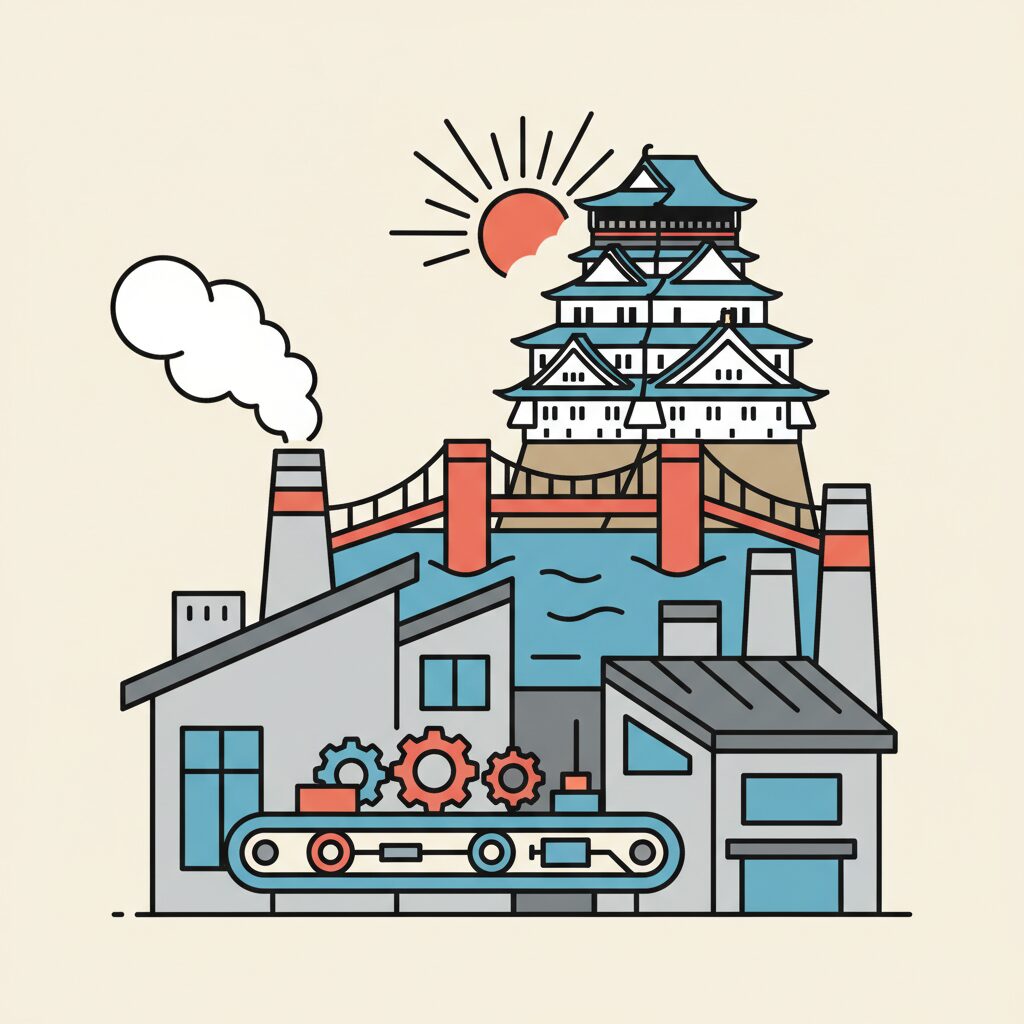
People come to Osaka and see two things. They see the glittering, chaotic carnival of Namba and Dotonbori, a river of neon reflecting off the canal, a place where giant crabs wave mechanical claws and the air smells of grilled octopus and sweet batter. Then they see Umeda, a canyon of steel and glass, where immaculate department stores rise like titans and legions of salarymen in dark suits march through gleaming underground corridors. You see the commerce, you see the consumption. You see the wild, expressive face of the city and its polished, corporate mask. And you think, okay, I get it. Osaka is the loud, hungry merchant cousin to Tokyo’s stoic, imperial presence. But that’s not the whole story. It’s not even the most important part.
To really understand Osaka, you have to leave the looped announcements of the JR Line. You have to ride the Kintetsu Line east, past the chic cafes and into the low-slung neighborhoods where the buildings are a uniform gray and the sky is latticed with power lines. You need to go to a place like Higashi-Osaka. This isn’t a tourist destination. There are no ancient temples or famous photo spots. What you’ll find instead is the city’s heart, its roaring, tireless engine. This is the land of monozukuri—a word that translates imperfectly to ‘making things’ but means so much more. It’s a philosophy, a way of life, an identity built on the profound pride of craftsmanship. While Tokyo’s power is concentrated in massive corporate headquarters, Osaka’s strength is decentralized, spread across thousands of small and medium-sized enterprises (SMEs), many of them family-run workshops, or koba, tucked into quiet residential streets. These places don’t make the finished products you buy. They make the invisible parts—the single, perfect screw, the impossibly precise gear, the spring that makes a medical device work. They are the masters of the unseen, the artisans of the essential. This is the culture that truly defines Osaka’s character: pragmatic, resourceful, fiercely independent, and built on a foundation of human relationships, not corporate flowcharts. This is the real Osaka, the one that works with its hands.
This deep-seated culture of craftsmanship and local pride is also reflected in Osaka’s distinct regional mindset, which shapes everything from its corporate life to its innovative startups.
The DNA of an Osaka Workshop: More Than Just Making Things
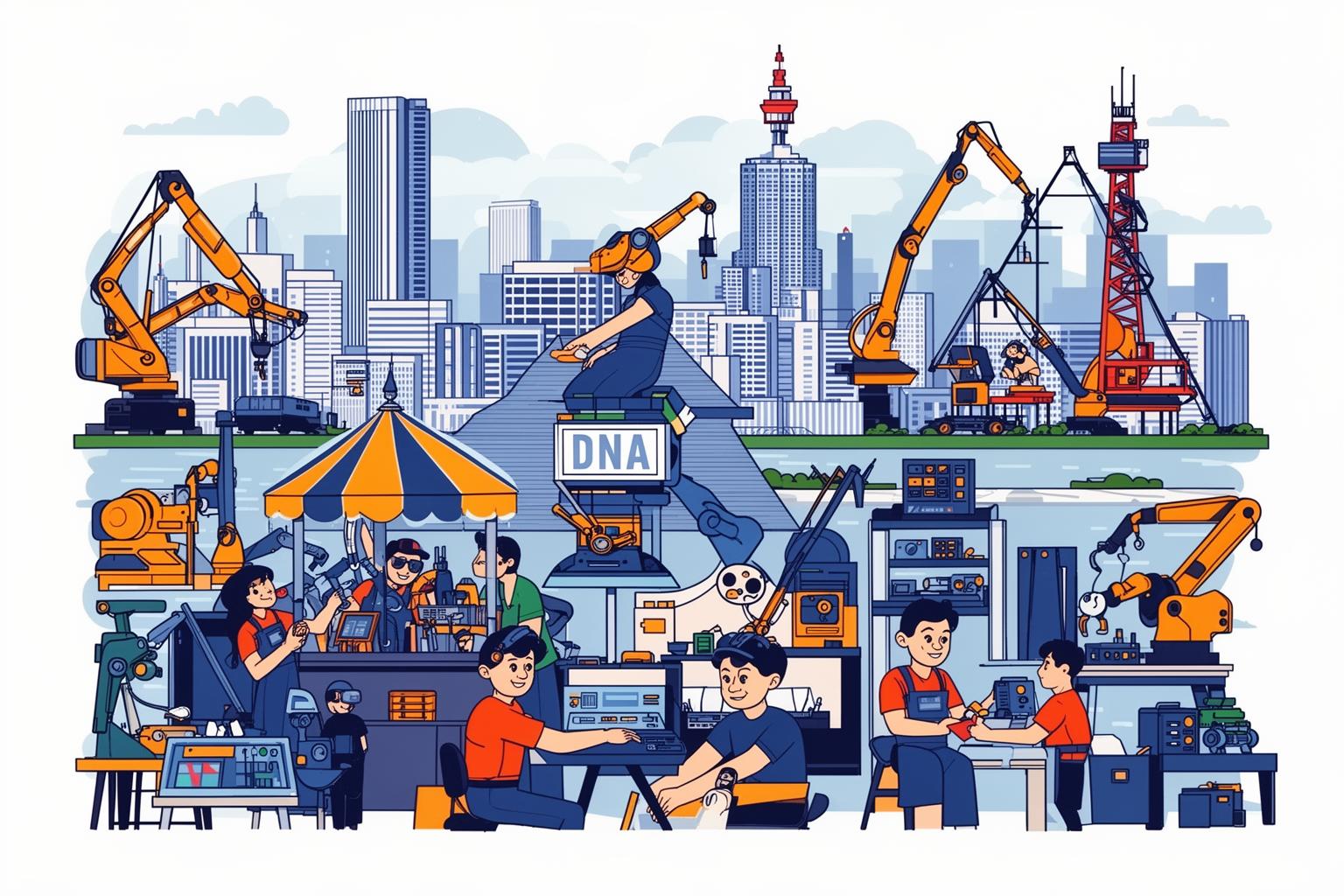
Step into a typical Higashi-Osaka workshop, and the first thing you’ll notice is that it doesn’t resemble a modern factory. There are no sleek robots smoothly gliding over polished floors. Instead, it’s a controlled chaos of machinery, metal shavings, and the lingering aroma of cutting oil. The owner, the shacho, isn’t secluded in a corner office dressed in a suit. He’s right there on the floor, his hands as greasy as everyone else’s, hunched over a lathe, examining a newly milled part with a well-worn micrometer. This scene reveals the fundamental principles that govern the monozukuri world—principles that are deeply cultural and often puzzling to outsiders, especially those familiar with Western or even Tokyo-style corporate settings.
Giri and Ninjo in the Factory
In large corporations, business is driven by contracts, quarterly reports, and shareholder value. But in Osaka workshops, it’s motivated by something far more personal: giri and ninjo. These two concepts form the invisible threads that hold the entire industrial ecosystem together. Giri is often translated as ‘duty’ or ‘obligation,’ but it’s better understood as a deeply ingrained code of social and professional reciprocity. It’s the understanding that you bear responsibility toward the people in your network—suppliers, customers, and even competitors. Ninjo means ‘human feeling’ or ‘compassion.’ It’s the emotional counterpart to giri’s logic: genuine empathy and care for those you do business with.
How does this manifest in reality? Imagine a small screw manufacturer in Higashi-Osaka receives a frantic call at 4 PM on a Friday. A long-term client, a company that assembles medical equipment, has a huge, unexpected order from a hospital. They’ve run out of a specific, custom-made titanium screw and need 5,000 units by Monday morning or risk losing the contract. A typical contract-focused company might say it’s impossible—the order is too last-minute, overtime costs too high, paperwork not in place. But in Osaka, the shacho of the screw factory won’t hesitate. He’ll say, “Wakatta. Nantoka suru.” “Got it. I’ll make it work.”
He and his team will work through the night, all weekend if necessary. They’re not doing it solely for the money from this one order; they’re doing it because of giri. Thirty years ago, when their own factory was struggling, that medical equipment company gave them a chance with a small but steady contract. They helped them survive. Now, the obligation is to repay that support. And ninjo means the shacho truly understands the panic and pressure his client is facing. He feels their problem as his own. This relationship, built over decades of mutual support, carries more weight than any legal document. Business here is personal. A handshake and a promise hold immense value. This often surprises foreigners expecting every detail to be spelled out in a 100-page contract. In Higashi-Osaka, your reputation and commitment to your network are your most precious assets.
The “Yatteminahare” Spirit: Try It and See
There’s a well-known phrase in Osaka dialect, popularized by Shinjiro Torii, Suntory’s founder: “Yatteminahare.” It means, “Go on, give it a try!” It embodies a spirit of bold experimentation, embracing calculated risks, and not being paralyzed by fear of failure. This attitude is the lifeblood of innovation in the monozukuri world. It sharply contrasts with the highly bureaucratic, risk-averse culture typical of large Tokyo corporations, where a new idea must pass through countless committees and receive dozens of approvals before moving forward.
In a Higashi-Osaka workshop, innovation happens on the factory floor. A seasoned machinist might glance at a client’s blueprint and say, “This design is inefficient. If we adjust the angle of this cut slightly and use a different tool, we can strengthen it and reduce production time by 15%.” There’s no formal proposal process. The shacho will likely listen, inspect the material, and say, “Honma ka? Omoshiroi. Yattemiyo.” “Really? That’s interesting. Let’s try it.”
They’ll produce a test piece, measure it, stress-test it, and if successful, they’ll call the client to share the improved design. This proactive, hands-on problem-solving is expected. It’s not just about completing the order as specified; it’s about enhancing the product. This spirit enabled a group of small Higashi-Osaka factories, despite having no prior aerospace experience, to collaborate and build a fully functional satellite—the Maido-1—and launch it into space. The project began with a simple question asked over drinks at a local izakaya: “Could we, the small workshops of this town, build a satellite?” The answer was an enthusiastic “Yatteminahare!” They combined their collective skills—one company for the chassis, another for precision bolts, another for wiring—and succeeded. This kind of bold, grassroots innovation is quintessentially Osaka. It’s founded on the belief that with enough skill, ingenuity, and collaboration, nothing is impossible.
A Day in Higashi-Osaka: The Rhythm of the Machine
Grasping the work ethic of Higashi-Osaka means understanding the rhythm of its daily life. The city doesn’t rise to the gentle rustle of newspapers or the polite chime of a train station; instead, it awakens to the low rumble of machinery, the clang of metal, and the scent of industry. It’s a rich sensory experience that reveals a place where things are crafted, a community where life and labor are intricately woven into one inseparable fabric.
The Morning Commute and the Sounds of Industry
The morning rush hour here feels different. While central Osaka’s Midosuji subway line is packed with suited commuters, the Higashi-Osaka commute is more scattered and local. Factory workers pedal sturdy bicycles, lunchboxes strapped to the rear racks. Small, flatbed kei trucks, the unsung workhorses of Japan, maneuver through narrow streets, delivering raw materials and collecting finished parts. The very air is filled with the start-of-day sounds: the high-pitched whine of CNC machines spinning up, the rhythmic pulse of stamping presses, the sharp hiss of welding torches. These aren’t mere noises; they are the city’s heartbeat.
What strikes outsiders most is the blending of home and factory. A three-story apartment building might stand beside a small metal-plating workshop. The ground floor of many family homes often serves as the workshop, with living spaces above. Children play in small parks just steps away from workshops where sparks fly. This closeness fosters a unique community spirit. The local tofu vendor knows the factory workers’ routines next door; the owner of the corner kissaten recognizes exactly how the shacho from the plastics factory takes his coffee. Unlike many developed countries, there’s no clear division between industrial and residential zones here. Life unfolds alongside machinery, embedding a shared identity of being “makers” deeply into the local culture.
Inside the Koba: The Workshop as a Second Home
The koba, or small workshop, is the core of this world. To the untrained eye, it may appear cluttered and chaotic. Tools hang from every inch of wall; stacks of raw materials and boxes of finished parts form narrow passages. The machines, some decades old but meticulously maintained, bear a fine layer of grime and oil. Yet beneath this apparent disorder lies a deeply rooted order. Every worker knows exactly where each tool, jig, and blueprint is kept. The space acts as a living extension of their craft, designed less for aesthetics and more for efficiency and familiarity.
The social dynamic inside the koba is equally distinct. The hierarchy is remarkably flat. Yes, there is a shacho (president), but he is a player-coach rather than a distant manager. He wears the same grease-stained sagyofuku (work uniform) as the newest apprentice. He knows how to operate, repair, and optimize every machine on the floor because he probably built the business with his own hands. His authority stems not from his title but from his experience and skill, earning respect as often the most talented craftsman present.
This stands in sharp contrast to the rigid, top-down hierarchies of typical Tokyo corporations. In a Tokyo office, you’d never see a department head making coffee for a junior employee. In a Higashi-Osaka koba, you might find the shacho sweeping the floor alongside everyone else at day’s end. Communication is straightforward and unfiltered. Ideas and feedback flow freely. A young worker can challenge established practices if they have a better idea—and they will be heard. The workplace feels less like a corporation and more like a close-knit family or a sports team, united by a single shared goal: producing the best possible product.
The Language of the Workshop
The language spoken on the factory floor reflects this direct, pragmatic culture. Workers converse in thick, rapid Osaka-ben, a dialect known for its bluntness and straightforwardness. Formal honorific Japanese (keigo) is rarely used. Instead, communication is pared down to its essentials.
Feedback is immediate and often blunt. If a part is machined to the wrong tolerance, the senior craftsman won’t soften his criticism with polite language. He’ll hold it up and say, “Akan!” (“No good!” or “This won’t do!”). This isn’t meant as an insult; it’s a clear, efficient statement of fact. There’s a problem, and it must be fixed immediately. Time is money, and ambiguity leads to errors. For those accustomed to Japan’s usually indirect communication style, this can be surprising—sometimes feeling rude or harsh. However, in the workshop context, it’s actually a sign of respect. It implies the speaker trusts you to accept direct criticism professionally and prioritizes the quality of work over feelings.
This pragmatic use of language extends to problem-solving. Meetings aren’t long sessions aimed at consensus-building. Instead, they involve quick, standing huddles around a machine or blueprint. The conversation is a rapid exchange of ideas and solutions. “What if we try this?” “No, that will cause too much friction.” “Okay, how about this?” Decisions are made in minutes, and everyone refocuses on their work. This is a culture of action, not words. The proof lies in the finished part, not in a polished report.
Osaka vs. Tokyo: A Tale of Two Work Cultures
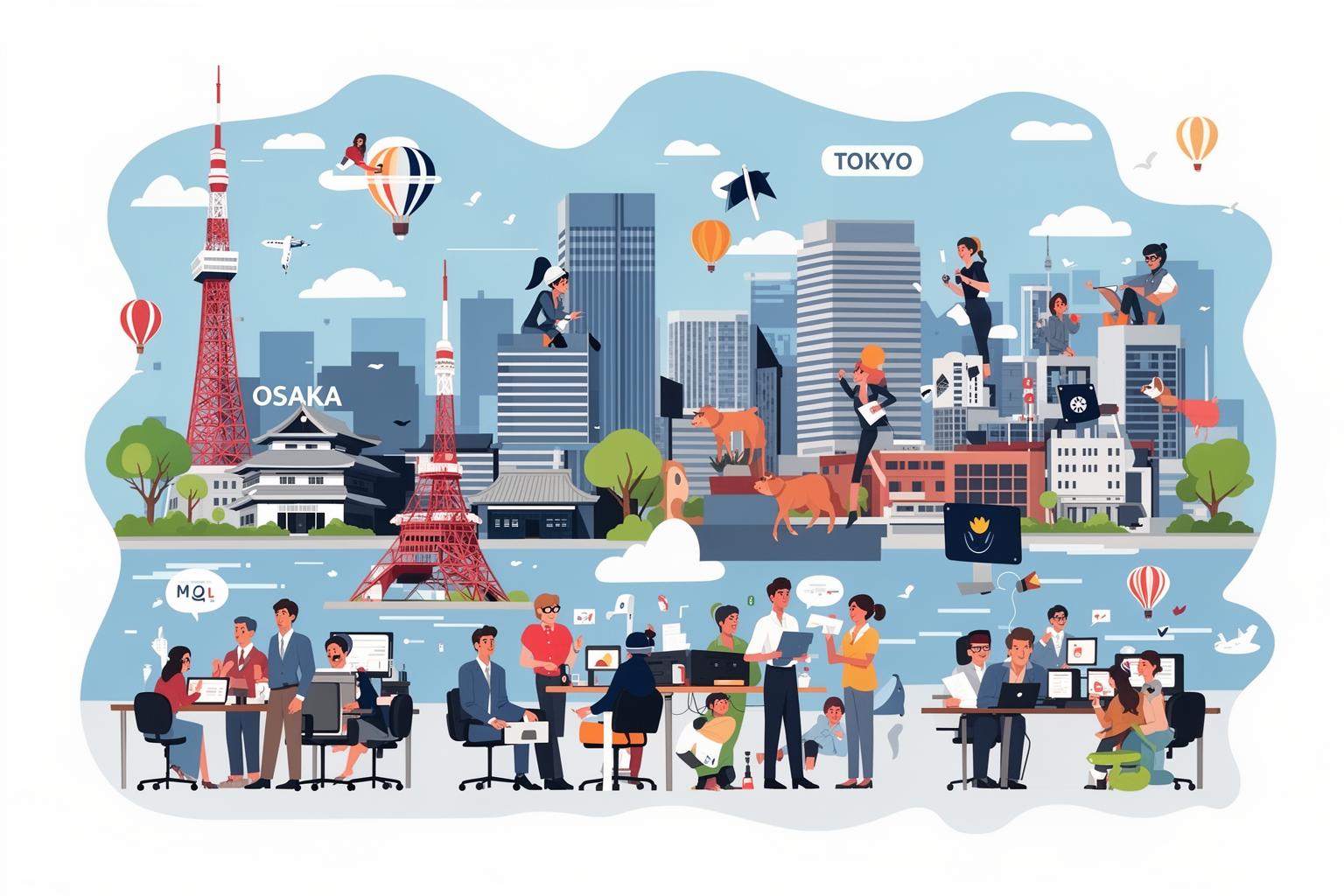
The differences between Osaka and Tokyo fuel endless fascination and rivalry within Japan, and these contrasts are most evident in the workplace. Although both cities are major economic centers, their approaches to business, skill, and money diverge fundamentally. Tokyo embodies the corporate, white-collar ideal of modern Japan, while Osaka, especially in its monozukuri sector, represents a more rugged, entrepreneurial, and craft-focused alternative.
Specialists vs. Generalists
In the large corporations based in Tokyo’s Marunouchi or Shinjuku districts, the ideal employee is typically a generalist. Prominent companies like Mitsubishi, Mitsui, or Sumitomo famously recruit top university graduates and place them on career paths that involve rotating through various departments—sales, marketing, accounting, planning—every few years. The aim is to develop well-rounded managers who understand the organization as a whole. Their value lies in their broad knowledge and loyalty to the company.
Osaka’s monozukuri culture operates on the opposite premise, venerating the specialist, the shokunin. The star of a workshop in Higashi-Osaka isn’t the MBA-holding manager, but the 65-year-old craftsman who has spent four decades polishing metal. He can take a dull titanium piece and, using a customized sequence of grinding wheels and polishing compounds, transform it into a flawless, distortion-free mirror. His knowledge isn’t theoretical; it’s tactile, residing in his hands, eyes, and ears. He can tell if a machine is running smoothly just by its sound and detect deviations of a few microns by touch. This depth of skill can’t be taught at university or acquired in a few years.
This devotion to a single craft inspires immense pride. These workers don’t see themselves as mere cogs in a machine but as masters of their specific fields. Their identity is tied not to a company name but to their personal expertise. Whereas a usual question in a Tokyo business introduction might be, “Which company do you work for?” in a Higashi-Osaka izakaya, it’s more likely, “What do you make?” The response might be “precision springs” or “non-ferrous metal casting.” This focus on deep expertise creates a workforce that is highly skilled and adaptable within its niche. They are the artists of the industrial world.
The Logic of Money: Kechi but Generous
One enduring stereotype about Osaka residents is that they are kechi—commonly translated as ‘stingy’ or ‘cheap.’ Tokyoites often tell stories of Osakans willingly walking an extra ten minutes to save ten yen on groceries. While there is some truth to this, ‘frugal’ or ‘value-conscious’ is a more accurate characterization. In the monozukuri world, this attitude is not a personal quirk but a fundamental business strategy.
The owner of a small workshop will bargain persistently with suppliers over raw material costs, haggling for every last yen. This insistence isn’t born from greed; it arises because in a business with razor-thin margins, controlling costs is vital for survival. This practice, known as negiri (price negotiation), is an expected and respected part of doing business in Osaka. This sharply contrasts with Tokyo, where prices are often regarded as fixed and negotiation may be seen as impolite.
However, this cost-consciousness is balanced by surprising generosity when it comes to strategic investments. The same shacho who haggles over steel prices will readily spend millions of yen on a state-of-the-art German CNC machine if it improves quality and efficiency. He invests in training younger employees to ensure his skills are passed on. After a particularly tough but successful project, he might treat his whole team to an extravagant feast, sparing no expense to express his gratitude.
This is the Osaka approach to money: be stringent with operational costs but generous with investments in people, technology, and relationships that yield long-term benefits. It’s a practical, long-term financial perspective. This contrasts with Tokyo’s corporate tendency to spend lavishly on items that project success—luxurious client entertainment in Ginza, fancy office furniture, or glossy annual reports. In Higashi-Osaka, substance always outweighs style. The quality of the product you deliver is your true business card.
The Unspoken Rules of Monozukuri Culture
To genuinely operate within the world of Higashi-Osaka’s workshops, one must grasp the unwritten rules and unspoken understandings that govern it. This culture is founded on trust, mutual dependence, and a shared identity that goes beyond individual company interests. The true strength of this manufacturing hub lies not in any single factory, but in the intricate, unseen network that links them all.
The Horizontal Network: The True Power of Higashi-Osaka
Higashi-Osaka hosts over 6,000 small factories, making it one of the most densely concentrated industrial zones in the world. From an outsider’s perspective, it may seem like a chaotic cluster of competitors. Yet, in reality, it operates more like one enormous, decentralized factory. The key to this is the horizontal network of specialists. No single workshop attempts to do everything. Instead, each focuses on mastering one or two specific processes: gear cutting, spring winding, metal stamping, precision grinding, anodizing, and so forth.
This specialization fosters intense mutual dependence. Suppose a company receives an order for a complex component requiring five different manufacturing steps. The company that wins the order will handle the one or two steps it specializes in. They won’t, however, outsource the other processes to just any subcontractor. The shacho will pick up the phone and call Tanaka-san, whose workshop down the street is renowned for heat treatment. He’ll then arrange for the parts to be sent to Suzuki-san, two blocks away, a master of chrome plating. The parts frequently move between these workshops not through large logistics firms but by the workers themselves, using bicycles or small vans.
This network is extremely flexible and robust. When a large corporation with a centralized factory encounters a machine problem, the entire production line may halt. In Higashi-Osaka, if a machine breaks down in one workshop, the owner can ask a friend nearby to borrow their machine for a few hours. If a sudden, large order arrives that one company cannot manage alone, they collaborate with their ‘competitors’ to complete the job, sharing both the work and the profits. This system relies entirely on personal relationships and trust developed over decades. There are no complex legal contracts, only a shared understanding that everyone’s success is interconnected. This informal, cooperative ecosystem is the region’s secret strength, enabling it to compete with larger global players through agility and collective expertise.
Pride in the Invisible
Perhaps the most profound element of the monozukuri mindset is the source of its pride. The vast majority of factories in Higashi-Osaka do not produce consumer-facing products. Their craftsmanship is hidden deep inside other machines. They create the vital bearing that allows a bullet train’s wheels to spin smoothly at 300 km/h. They manufacture the tiny, intricate metal part that enables a surgeon’s robotic arm to operate with precision. They produce the spring, no larger than a grain of rice, essential for the deployment of a satellite’s solar panel.
Their company’s name will never appear on the final product. The end user will never know they exist. Yet, their pride is immense. It is the pride of the true shokunin—the satisfaction of perfecting one’s craft, regardless of recognition. They know the entire Shinkansen system depends on the integrity of their bearing. They understand a human life may hinge on the flawless function of their surgical component. Their motivation is not fame or public recognition but the quiet, internal certainty that they are indispensable. They are the creators of the invisible framework that makes the modern world function.
This mindset stands as a powerful counter to the modern obsession with branding and image. It embodies the belief that true value lies in quality, reliability, and performance. This attitude extends far beyond the factory floor into Osaka culture. It’s why a restaurant’s reputation is based on the flavor of its dashi (broth), not the elegance of its décor. It’s why a comedian’s talent is judged by their ability to make a crowd laugh, not by their appearance. In Osaka, what you can achieve always matters more than how you look doing it. The monozukuri culture is the ultimate expression of this philosophy: a relentless pursuit of substance over style.
What This Means for Daily Life in Osaka
The industrial spirit of places like Higashi-Osaka extends beyond factory walls. It permeates the very ground of the city, influencing the landscape, community, and mindset of its residents. Living in Osaka, even if you work in a completely different field, means engaging with this culture every day. It accounts for the city’s pragmatism, straightforwardness, and distinctive, down-to-earth charm.
Living Among Workshops
Choosing to live in eastern Osaka means choosing to reside in a working city. Your neighborhood won’t be a quiet, manicured suburb. Instead, you’ll hear the sounds of industry and live alongside people who work with their hands. The local shotengai (shopping street) won’t be filled with trendy boutiques but with hardware stores, work-uniform shops, and small, no-frills eateries that have served factory workers for generations.
This setting breeds a strong sense of community. Your neighbors aren’t anonymous occupants of a sterile apartment building but people who operate the metal press next door or run the local delivery business. There’s a shared identity rooted in hard work and mutual support. The local izakaya after 6 PM is a snapshot of this world. You’ll find groups of men and women in work clothes, drinking beer and laughing loudly, their conversations a mix of shop talk, local gossip, and baseball. There’s an openness and lack of pretense that feels truly refreshing. This isn’t a place for airs and graces—it’s a place for genuine human connection, built on the shared experience of a hard day’s labor.
The Osaka Mindset in Everyday Life
The principles of monozukuri—efficiency, value, directness, and focus on the essentials—serve as the foundation of Osaka’s culture. You see it everywhere. At a local supermarket, staff won’t just politely point you to an aisle; they might pick up a vegetable, highlight its freshness, and suggest the best way to cook it. They provide practical, valuable insights rather than simply fulfilling a service role. Their communication is straightforward and efficient.
This mindset also explains the city’s famed food culture. Why is Osaka known as kuidaore (“to eat oneself into ruin”)? It’s not just about an abundance of food; it reflects a passion for high-quality, delicious food offered at reasonable prices. An Osakan will gladly wait 30 minutes in line for takoyaki costing 500 yen—not because it’s cheap, but because it represents perfect value: the highest quality at the lowest cost. They won’t hesitate to criticize a restaurant serving a beautifully presented meal that tastes mediocre. The primary focus—the flavor—is what counts; presentation comes second. This is the monozukuri mindset applied to cuisine.
Understanding this outlook helps foreigners navigate social interactions. When an Osakan friend gives you blunt advice, they’re not being rude—they’re trying to be helpful in the most efficient way. When a shopkeeper haggles, they’re not attempting to cheat you but participating in a long-standing cultural practice of agreeing on a fair price. The city may sometimes feel blunt or rough compared to the refined elegance of Kyoto or the formal politeness of Tokyo. Yet beneath its rugged exterior lies deep honesty and genuine warmth. Osaka values what is real over what is merely beautiful.
The Future of Craftsmanship in a Globalized World
The workshops of Higashi-Osaka are not relics of the past; they are a living, breathing ecosystem confronting enormous pressures from a swiftly evolving global economy. The obstacles are real and daunting, yet the same ingenuity and resilience that forged this industrial core are now being harnessed to secure its future.
Challenges and Adaptations
The challenges are undeniable. The workforce is aging, with many skilled shokunin approaching retirement. Their children, often university-educated, sometimes hesitate to inherit the family trade, favoring the perceived stability of white-collar employment. Meanwhile, competition from manufacturers in China and Southeast Asia, who produce components at a fraction of the cost, is relentless. Simple items like screws or brackets, which can be mass-produced cheaply overseas, are markets where Higashi-Osaka can no longer compete.
However, the workshops are not giving up. They are adapting by focusing on their greatest asset: unmatched skill in producing high-precision, high-value-added components that no one else can replicate. They are shifting from mass-market parts to niche, cutting-edge industries. Workshops that once made bicycle parts now create custom titanium components for racing teams. Factories that produced basic electronic parts are now manufacturing intricate devices for the medical and aerospace sectors. Leveraging decades of accumulated expertise, they tackle problems requiring a craftsman’s intuition and a human touch—qualities that automated overseas factories can’t easily duplicate. The Maido-1 satellite was more than a vanity project; it was a bold statement demonstrating that a century of industrial craftsmanship could reach the final frontier.
Why This Culture Endures
The monozukuri culture in Osaka persists because it is more than a business approach; it embodies identity and community pride. To be a shokunin in Higashi-Osaka is to belong to a lineage, a guardian of skills passed down through generations. This pride motivates far beyond simple profit and loss.
Moreover, the region’s horizontal network is its strongest source of resilience. In a world increasingly dominated by vertical integration and massive corporations, Higashi-Osaka’s collaborative, decentralized model offers an alternative. It is agile, adaptable, and deeply human. When new challenges emerge, the community pools its collective intellect and resources to find solutions. This spirit of mutual support serves as the ultimate safety net.
For anyone living in Osaka, understanding this world is essential to grasping the city’s soul. The dazzling lights of Dotonbori are the city’s smile, but the steady hum of Higashi-Osaka’s workshops is its heartbeat. It is the enduring, powerful rhythm of a people who have always valued and honored making things with their own hands. This culture of quiet confidence and substance over show is the true engine propelling this remarkable city forward.








