
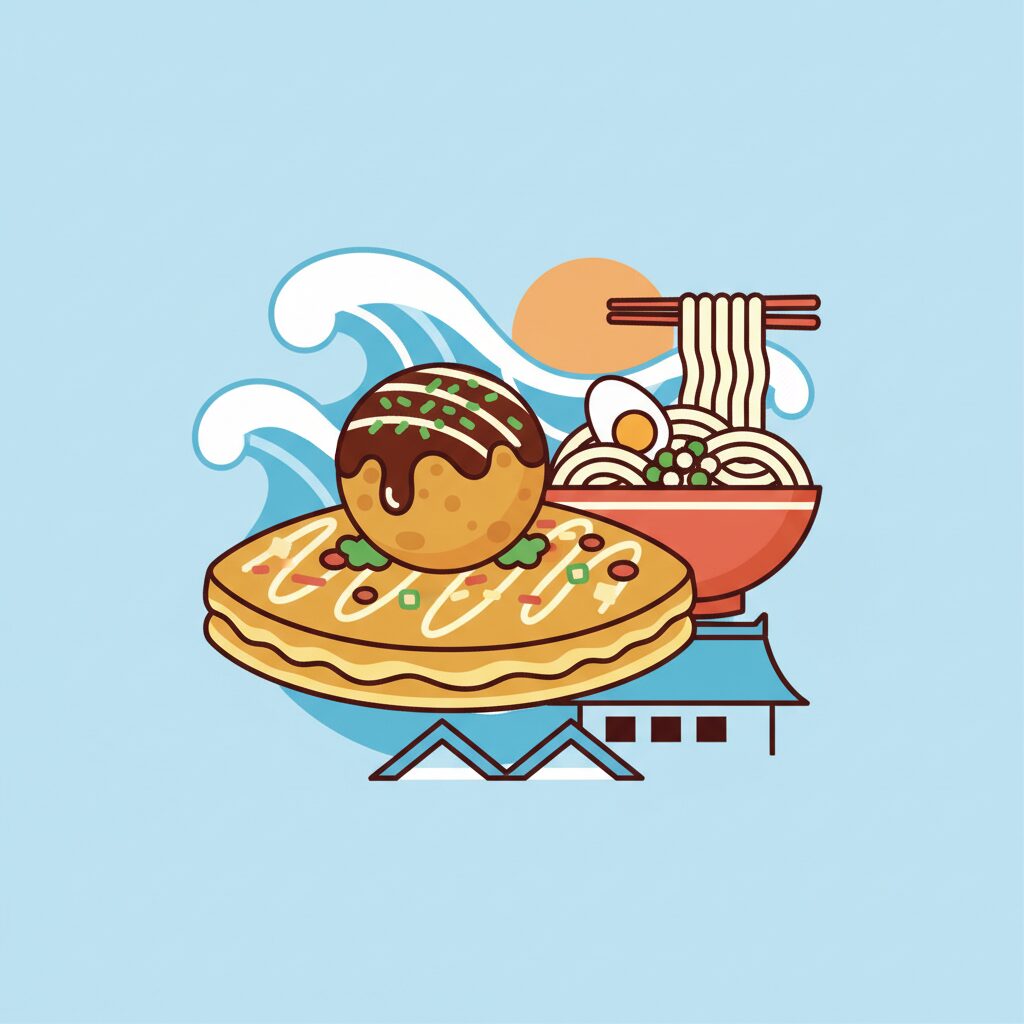
You see them everywhere. From the steaming food stalls tucked under the train tracks at Shin-Imamiya to the polished basement food halls of Umeda’s department stores, the little stands are a constant. Men and women, with practiced, almost frantic energy, pour a milky batter into cast-iron pans dimpled with perfect half-spheres. With two sharp picks, they flick and turn, flick and turn, until golden-brown orbs of dough, studded with octopus, emerge. This is takoyaki, the undisputed global ambassador of Osaka street food. For a tourist, it’s a must-try photo-op. For many a new foreign resident, it’s a delicious, if one-dimensional, symbol of the city. You might eat it, love it, and assume you’ve understood a core piece of Osaka. But that’s like looking at a single, perfect bonsai and thinking you understand the entire forest.
The real story of Osaka isn’t just in those octopus balls. It’s in the batter itself. It’s in the humble bag of flour that sits in every Osaka kitchen, right next to the soy sauce and rice. Welcome to the world of ‘konamon’ (粉もん), a term that literally translates to “flour things.” It’s a deceptively simple name for a sprawling culinary philosophy that is the true, beating heart of this city. It’s more than a category of food; it’s an economic principle, a social lubricant, and the secret code to understanding the Osakan psyche. While Tokyo might define itself by the clean, precise elegance of an Edomae sushi master, Osaka finds its soul in the sizzle of batter on a hot griddle, a messy, communal, and profoundly pragmatic art form. To live here, to truly get the rhythm of this place, you have to look past the takoyaki stand and understand the gospel of konamon. It’s the story of how simple flour and water built a culture of resilience, resourcefulness, and a joy that’s meant to be shared, loudly and with a full mouth.
This pragmatic, community-focused spirit is also evident in how individuals are working to revitalize local culture, as seen in a Kyoto cabbie’s ambitious project to rejuvenate the historic Gion district.
The Konamon Trinity: More Than Just Takoyaki
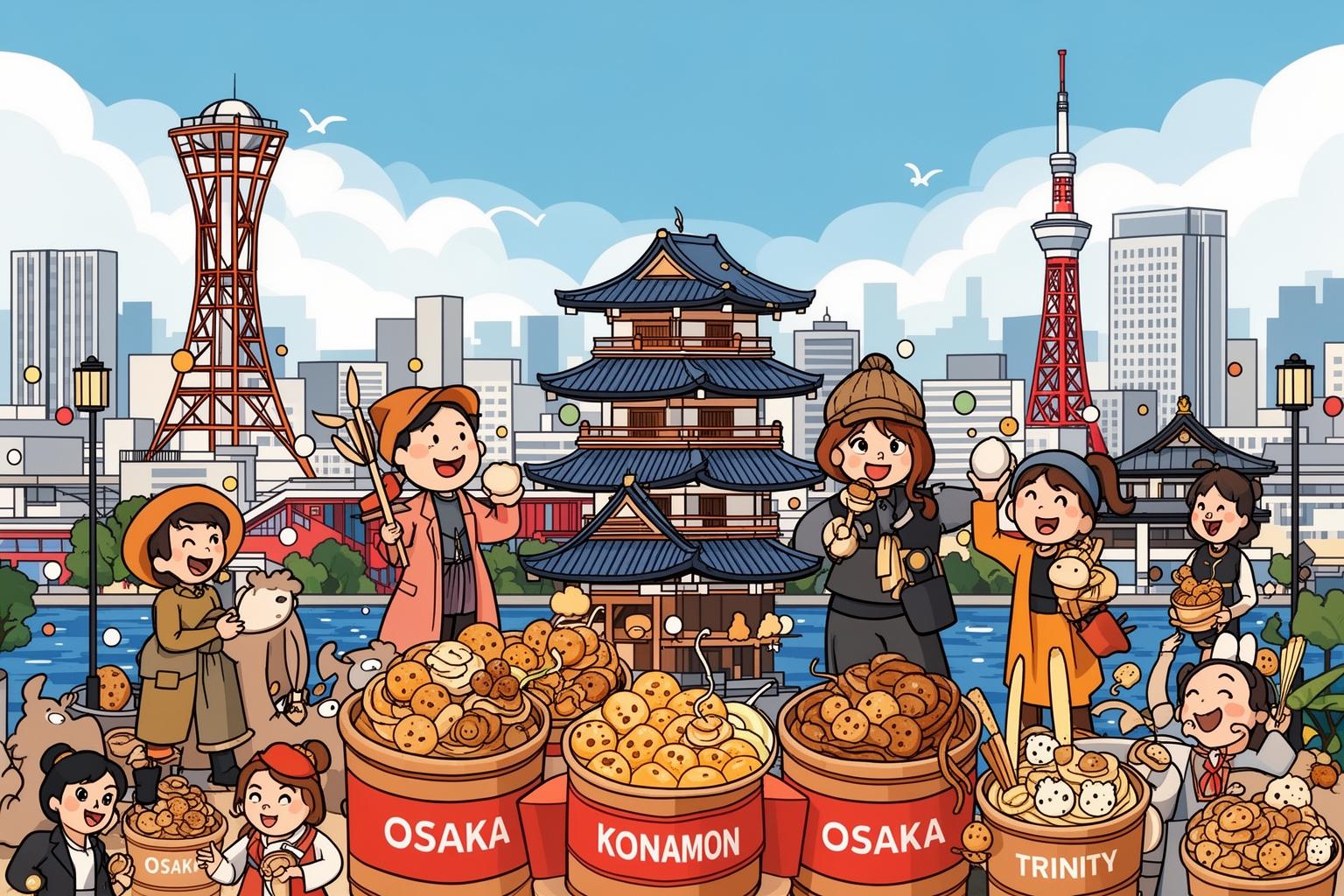
To begin your education, you need to understand the three fundamental pillars of the konamon faith. These dishes serve as the foundation for countless family dinners, weekend gatherings, and inexpensive nights out. Though distinct, they are tied together by the same core principles: affordability, heartiness, and endless customizability. Mastering the subtle differences between them is your first step from being a visitor to becoming an observer of everyday life.
Okonomiyaki: The Soul on a Griddle
Forget all you think you know about pancakes. Okonomiyaki, often loosely translated as a “Japanese savory pancake,” is a complete meal, a social event, and a canvas for personal creativity, all cooked on a flat-top iron griddle called a ‘teppan.’ The name itself reveals its nature: ‘okonomi’ means “how you like” or “what you like,” and ‘yaki’ means “grilled.” At its core, it’s a batter of flour, water, egg, and a mountain of shredded cabbage, but that’s only the beginning. From there, it’s a choose-your-own-adventure with pork belly strips, squid, shrimp, octopus, gooey mochi, melted cheese, kimchi—anything and everything can be added. This isn’t just variety; it reflects the Osakan spirit: resourceful and free of rigid rules, born from a “use what you’ve got” mentality. It’s the culinary opposite of a formal, multi-course ‘kaiseki’ dinner where every element is meticulously arranged. Okonomiyaki is a glorious, delicious mess.
The real experience happens in a local ‘okonomiyaki-ya,’ where a teppan is built right into your table. You’re given a bowl of raw ingredients and a pair of long chopsticks, and you take charge. The ritual begins: oil the griddle, pile the cabbage-and-batter mixture into a thick circle, layer pork strips on top, and wait. The air fills with sizzling sounds, the aroma of cooking cabbage and pork fat, and the lively chatter of surrounding tables. Then comes the moment of truth: the flip. Armed with two metal spatulas called ‘kote’ (or ‘hera’), you must summon the courage to slide them under the half-cooked pancake and turn it over in one swift, confident motion. A successful flip earns nods of approval from friends; a failed, splattered mess draws laughter. This shared moment of joint creation and potential mishap makes it much more than a meal—it’s a low-stakes team-building exercise fueled by beer. Once cooked, the artistry continues. A thick, sweet, tangy brown sauce, akin to Worcestershire but uniquely Japanese, is brushed on top. A lattice of creamy Kewpie mayonnaise follows. The final touch is a sprinkle of ‘aonori’ (green seaweed powder) and a generous handful of ‘katsuobushi’ (dried, shaved bonito flakes). The heat from the pancake causes the paper-thin flakes to curl and dance as if alive, adding a final flourish before you dig in. You don’t use chopsticks; instead, you cut off pieces with your kote and eat directly from the griddle, ensuring every bite is piping hot. This is food at its most interactive and communal.
Takoyaki: The Ambassador of Konamon
If okonomiyaki is the heart of a sit-down meal, takoyaki is the soul of the street and the star of the house party. Everyone knows it as the famous octopus ball, but its role in Osaka life runs much deeper. At its core, takoyaki is a simple batter, thinner than okonomiyaki’s, poured into a special cast-iron mold. A piece of boiled octopus (‘tako’) is dropped into each sphere, along with bits of pickled red ginger (‘beni shoga’) and crunchy tempura scraps (‘tenkasu’). The magic lies in the cooking. The vendor, a master of speed and dexterity, uses sharp metal picks to rapidly turn the half-cooked spheres, folding the edges in to form perfect balls. Watching them work is mesmerizing—a blur of motion that produces perfectly uniform, golden-brown orbs.
But the real magic happens at home. The most common social gathering among young people and families in Osaka is the ‘takopa’—a takoyaki party. Nearly every household owns a portable electric takoyaki maker. It’s Osaka’s version of a barbecue grill or fondue pot. Friends are invited over not for a finished meal, but to take part in the making. The host prepares the batter and an array of fillings. Classic octopus is always included, but the fun lies in experimentation—chunks of cheese, cocktail sausages, kimchi, corn, mochi—the possibilities are endless. One person pours the batter, another adds the fillings, and everyone takes turns mastering the flip. It’s chaotic, often messy, and incredibly fun. It’s a low-cost, low-pressure way to socialize. There’s no formal seating or pressure for polite conversation. The griddle is the focus. The activity itself generates energy and chatter. People gather around the table, beers in hand, shouting advice, laughing at mistakes, and grabbing cooked takoyaki as soon as it’s ready. This is where friendships are cemented. Being invited to a takopa means you’ve crossed from acquaintance to friend; it’s a glimpse into Osaka’s casual, unpretentious social core.
Yakisoba: The Everyday Hero
Yakisoba, or grilled noodles, is often the overlooked third member of the trio, frequently served alongside okonomiyaki. But on its own, it’s a workhorse of the konamon world. It represents the ultimate B-kyu gurume (B級グルメ), or “B-grade gourmet,” a cherished category of Japanese food that’s cheap, unpretentious, and irresistibly tasty. The dish features chewy, steamed wheat noodles stir-fried on the teppan with sliced pork, cabbage, and bean sprouts, all coated in the signature sweet and savory sauce. It’s fast, easy, and deeply satisfying.
Yakisoba is the scent of a Japanese summer festival. At any local matsuri or school event, you will find a massive teppan, often several meters long, with vendors cooking vast piles of yakisoba, steam and savory aroma wafting through the air. It’s served in simple plastic trays topped with a dollop of red pickled ginger. It’s the quintessential fuel for the crowds. At home, it’s the go-to weeknight dinner for busy parents. Packaged yakisoba kits, including fresh noodles and sauce packets, are a supermarket staple. It symbolizes the height of delicious pragmatism. Why invest time and money in a complex meal when you can have something this good, this fast? In some old-school eateries, there’s ‘modan-yaki,’ a glorious hybrid where yakisoba is cooked first and then layered inside or on top of an okonomiyaki, creating a carb-heavy masterpiece of textures and flavors. It perfectly embodies the Osaka mindset: if it’s good, more is better, especially if it’s affordable.
The Flour-Based Economy: Why Konamon is King
The fascination with konamon is no mere accident of taste. It directly stems from Osaka’s distinctive history as a merchant city, where pragmatism, value, and a sharp focus on cost-performance are ingrained in the local character. To truly grasp why a simple flour pancake became a cultural symbol, you need to understand the economic mindset that shaped this city.
The Pragmatism of a Merchant City
For centuries, Osaka earned the nickname ‘tenka no daidokoro’ (天下の台所), meaning “the nation’s kitchen.” It was the pivotal hub for Japan’s rice trade and goods distribution. This legacy created a city of merchants, shopkeepers, and artisans, unlike Edo (modern Tokyo), which was dominated by samurai and bureaucrats. This merchant culture fostered a distinct set of values: practicality over formality, substance over style, and above all, an acute awareness of value. An Osakan doesn’t just want something good—they want it at a good price. This attitude remains strong today. The city’s residents are famously savvy, and the idea of ‘cospa’ (a Japanese term for “cost performance”) is nearly sacred.
Konamon perfectly suits a city built on cospa. Its base ingredients—flour and water—are among the cheapest available, while cabbage, a key element, is affordable and in season year-round. From this simple foundation, you can create a hot, filling, endlessly adaptable meal. A small portion of pricey protein, like pork or squid, can be stretched to feed an entire family by layering it beneath heaps of cabbage and batter. This is economic brilliance cloaked in the form of a savory pancake. It’s how a city of hardworking people can eat well without overspending. This ties into Osaka’s famous saying ‘kuidaore’ (食い倒れ), often translated as “eat yourself into bankruptcy.” While outsiders may view this as mere gluttony, it’s really about maximizing culinary delight for your yen. It’s knowing you can enjoy a wide variety of delicious food until you’re full, precisely because it’s so affordable. In Osaka, eating well isn’t a privilege of the wealthy; it’s a democratic right made possible by konamon.
“Okan’s Taste”: Konamon as Home Cooking
Though konamon is found on every street corner, its true home is in the kitchen, overseen by the ‘Okan,’ the archetypal Osaka mother. Elsewhere in Japan, home-cooked comfort might be a well-grilled fish or a simmering pot of nikujaga; in Osaka, it’s the sizzle of the hot plate and the aroma of okonomiyaki sauce. Every family has its own secret recipe. Some Okans add grated ‘nagaimo’ (mountain yam) to create a fluffy batter. Others swear by a particular sauce brand or a secret spice blend. These recipes are handed down through generations, becoming a source of deep family pride.
The hot plate is a staple appliance in every Osaka home, as essential as the rice cooker. Weekend dinners often center around it. Families gather not to be served a finished dish but to cook it together. Children help mix the batter or attempt flipping the pancakes. This hands-on, somewhat chaotic process strengthens family bonds in a way a formal meal cannot. This domestic scene is vital to understanding konamon—it’s not just affordable restaurant fare; it’s comfort food filled with childhood nostalgia and family warmth. When an Osakan far from home feels homesick, it’s often their Okan’s okonomiyaki they crave— a flavor no restaurant, no matter how celebrated, can replicate.
The Art of the Deal and the Pleasure of Affordable Eats
The passion for cospa influences every facet of life in Osaka, sharply contrasting with Tokyo’s more brand-conscious and status-oriented culture. An Osakan will proudly recount the bargain they scored on a new appliance, delighting in haggling in a way that might seem improper in Tokyo. This spirit is most evident in Osaka’s bustling ‘shotengai’ (covered shopping arcades), such as Shinsaibashi-suji or Tenjinbashi-suji. These aren’t sleek, curated malls; they’re lively, noisy, and fiercely competitive environments where vendors shout their offers and prices are always up for negotiation.
Konamon fuels the shotengai. Nestled among shoe stores and pharmacies are small, often decades-old stands selling takoyaki for 400 yen or hearty okonomiyaki for 700 yen. This is food for the masses, designed to be eaten quickly, often standing, before returning to bargain hunting. Price is a point of pride— a takoyaki shop that raises prices without a solid reason will incur customers’ ire. This pressure fosters constant innovation within tight limits. How can your dish be tastier or more unique than the one next door without increasing cost? Perhaps you use a special dashi in your batter or make your sauce in-house. This fierce competition, driven by customers’ unwavering demand for value, keeps Osaka’s food culture vibrant, dynamic, and accessible to all.
The Social Fabric of Flour
Beyond economics, konamon serves as the adhesive that binds much of Osaka’s social life. The manner in which these dishes are prepared and enjoyed encourages a particular style of interaction—one that is loud, casual, and deeply communal. It dismantles the barriers of Japanese formality and promotes a more direct and open mode of communication that defines the city.
The Teppan as the Communal Table
The teppan is at the heart of this social interaction. Whether it’s the large griddle behind the counter where a chef performs for customers or the small one built into your table, the teppan acts as a gathering point. Unlike a traditional restaurant table, where diners are separated by plates and cutlery, the teppan is a shared space. You cook together, eat from the same surface, and continuously engage with the food and each other. The air is alive with the scrape of metal spatulas, the sizzle of batter, and the lively chatter that the noisy setting encourages. It’s difficult to be reserved or quiet in an okonomiyaki restaurant; the atmosphere pulls you into its vibrant energy.
This setting helps explain the stereotype of the “friendly Osakan.” The city’s beloved foods are designed for sharing and communal experience. Cooking your own okonomiyaki with friends demands communication, cooperation, and a readiness to laugh at oneself. It acts as an icebreaker embedded within the meal. This sharply contrasts many dining experiences in Tokyo, which can be quiet, introspective, and solitary. Think of the silent focus at a high-end sushi counter or the individual booths in a ramen chain. In Osaka, food is often an interactive sport, with the teppan as the playing field. This shared, hands-on experience builds connections and fosters the open, welcoming atmosphere the city is famous for.
The Great Rice Debate: A Cultural Divide
Nothing reveals the deep cultural identity tied to konamon quite like the great rice debate. Ask someone from Tokyo if they would eat okonomiyaki with a side of steamed white rice. They’ll likely respond with a mix of confusion and mild disgust. “Carbs on carbs? Why would anyone do that?” It contradicts their culinary logic. But in Osaka, it’s not just normal; it’s a classic pairing. Step into any local okonomiyaki restaurant, and you’ll find the ‘teishoku’ (set meal) option: one okonomiyaki, a bowl of rice, miso soup, and pickles. For an Osakan, this makes a perfectly balanced and complete meal.
The reasoning, once understood, is straightforward. In Osaka’s culinary world, rice is the staple carb, not the okonomiyaki. The okonomiyaki, with its savory fillings and bold, salty-sweet sauce, acts as the ‘okazu’—the main protein or vegetable dish meant to accompany the rice. The rice serves as a neutral backdrop that balances the intense flavors of the sauce-covered pancake. This fundamental difference in how a food item is classified is a playful yet meaningful cultural marker. It highlights the contrasting ways the two regions conceptualize food and meal composition. Understanding and even defending the “okonomiyaki with rice” combination signals that you’re beginning to think like a local. It’s a shibboleth that distinguishes insiders from outsiders, and Osakans enjoy good-naturedly debating their position. Embracing carbs with carbs is embracing Osaka.
The “Teishoku” Mentality
The idea of the ‘Okonomiyaki Teishoku’ deserves attention because it perfectly exemplifies the Osaka approach to food. The teishoku format is a Japanese standard for a balanced meal. By incorporating okonomiyaki into this structure, Osakans make a bold statement: this is not a snack. This is not junk food. This is a proper, legitimate meal, just as valid as a set of grilled fish or ginger pork. It elevates the humble flour pancake to the center of the dinner table. This is something you simply won’t find in Tokyo. In Kanto, okonomiyaki and its cousin, ‘monjayaki,’ are considered fun, communal snacks—foods to enjoy while drinking with friends, not the centerpiece of a structured meal. The existence of the Okonomiyaki Teishoku is a declaration of cultural pride. It affirms the central role of konamon in daily diet and celebrates a culinary logic the rest of Japan might not fully grasp, but one that makes perfect sense in the nation’s kitchen.
Beyond the Big Three: The Deep World of Konamon
Once you’ve mastered the holy trinity of okonomiyaki, takoyaki, and yakisoba, you’ll start to recognize the other, more subtle members of the konamon family. These dishes are equally cherished by locals and provide a deeper insight into the diversity and creativity of Osaka’s flour-based cuisine.
Ikayaki: The Pressed Squid Pancake
Make your way to the basement of the Hanshin Department Store in Umeda and join the never-ending line. You’re about to try one of Osaka’s most iconic and speedy snacks: Ikayaki. The name can be misleading. Elsewhere in Japan, ‘ika-yaki’ typically refers to a simple grilled squid on a stick. But in Osaka, it signifies something entirely different—a thin, chewy pancake made from a straightforward flour batter mixed with chopped squid. The batter is poured onto a special double-sided iron press, which clamps shut and cooks the pancake under high pressure in less than a minute. The result is a savory, slightly rubbery, and incredibly addictive snack, folded over and served in a piece of paper. It perfectly embodies the ‘pali-pali’ (hurry, hurry) culture of the city’s merchants. Hot, fast, affordable, and designed to be eaten on the go, the Hanshin stand is legendary—a finely tuned operation producing thousands of ikayaki daily for a devoted following.
Negiyaki: The Scallion Lover’s Delight
Negiyaki is the more refined, adult cousin of okonomiyaki. Originating from the famous Yamamoto restaurant in the Juso neighborhood, it offers a completely different flavor profile. Instead of heaps of cabbage, the star ingredient in negiyaki is a generous mound of finely chopped green onions (‘negi’), lending a sharper, fresher, and more aromatic taste. Additionally, it forgoes the thick, sweet okonomiyaki sauce, being seasoned instead with soy sauce and a squeeze of fresh lemon juice. The result is a lighter, more savory pancake that highlights the natural sweetness of the scallions. It is often filled with beef tendon (‘suji’) that has been slowly stewed in soy sauce until tender. For those who find traditional okonomiyaki too heavy or sweet, negiyaki is a revelation, demonstrating that konamon is not a one-dimensional concept but a versatile framework capable of producing dishes with remarkable subtlety and elegance.
Kushikatsu’s Batter: The Crispy Cousin
Although kushikatsu—deep-fried skewers of meat, seafood, and vegetables—may not be seen as a primary konamon dish, its batter (‘koromo’) is an essential and distinctive component that firmly places it in the flour family. The batter used for Osaka’s kushikatsu differs significantly from the flaky ‘panko’ breadcrumbs used for tonkatsu. It is a fine, thin batter made from flour and egg, resulting in a hard, crispy, and uniform shell when fried. This unique texture is purposely designed to absorb the thin, tangy dipping sauce that defines the dish. Eating kushikatsu in a classic Shinsekai neighborhood spot offers a lesson in Osaka’s social customs. Along the counter sits a large communal trough of the dark sauce with the cardinal rule clearly displayed: ‘nidozuke kinshi’ (二度漬け禁止), meaning no double-dipping! Once you’ve taken a bite, your skewer must not be dipped back into the shared sauce. This simple hygiene rule turns the meal into an entertaining game of strategy, revolving around a communal pot of sauce and the flour-based batter giving the food its signature crunch.
Udon and the Dashi Culture
Broadening the definition of konamon to include noodles opens another crucial chapter in Osaka cuisine: udon. While udon noodles are enjoyed nationwide, Osaka boasts its own distinctive style, defined not by the noodles but by the broth. Osaka’s udon broth is a masterpiece: a light, almost translucent golden liquid. Its flavor comes from high-quality ‘kombu’ (kelp) sourced from Hokkaido, providing a deep, savory, and complex umami. Combined with a light-colored soy sauce (‘usukuchi shoyu’), the broth is seasoned without overpowering the delicate kombu taste. This contrasts sharply with the darker, more opaque, and intensely salty broth of the Kanto region (Tokyo), which relies on bonito flakes and dark soy sauce. This difference reveals much about the culinary histories of these two cities. Osaka, the merchant capital, had access to the finest ingredients nationwide, leading its chefs to develop a refined palate that appreciated subtlety and the natural flavors of ingredients. The light dashi is a testament to this heritage. It was in Osaka that ‘kitsune udon,’ a simple dish of noodles topped with a large piece of sweet, fried tofu (‘o-age’), is believed to have originated—a perfect union of chewy flour noodles and the delicate, nuanced umami of the city’s signature broth.
How to Live the Konamon Life: A Resident’s Guide

Understanding konamon is one thing; truly living it is another. For any foreigner seeking to fully immerse themselves in Osaka’s daily life, embracing the culture centered around flour is essential. Here are some practical steps to get you started.
Your First “Takopa”: A Crucial Social Ritual
Eventually, if you make friends here, you’ll be invited to a takopa. Don’t decline this invitation. It marks an important milestone in friendship. To prepare, offer to bring something along. Beer is always a reliable choice, but to really make an impression, bring an intriguing filling to share. A block of Camembert cheese, some avocado, or even spicy chorizo will spark curiosity and enthusiasm. While you’re there, don’t hesitate to get involved. Help pour the batter or chop the ingredients. Most importantly, take a turn at flipping the takoyaki. Your first few attempts will almost certainly end in disaster—you’ll break them apart, burn one side, and create something more like a modern art sculpture than a perfect sphere. That’s all part of the fun. Your friends will laugh, offer tips, and demonstrate the technique. The goal isn’t perfection; it’s participation. This shared, slightly awkward act of creation is how bonds are forged in an Osaka living room.
Decoding the Supermarket Aisle
A visit to any Osaka supermarket reveals the deep domestic roots of konamon. Locate the flour aisle. It won’t just feature plain flour—instead, you’ll find large bags specifically labeled for okonomiyaki and takoyaki. These aren’t mere marketing tricks; they’re special blends often infused with dashi powder and other seasonings to guarantee flavorful and perfectly textured results. Nearby, you’ll find all the essential accompaniments: bags of tenkasu (tempura scraps) for crunch, aonori (seaweed powder), large squeeze bottles of okonomiyaki sauce and Kewpie mayonnaise, and packages of katsuobushi (bonito flakes). The generous shelf space dedicated to these items says everything about what people genuinely cook at home. Your mission, if you decide to accept it, is to get your own takoyaki pan or a versatile electric hot plate. These aren’t specialty products; they’re standard household items. Owning one signals that you’re more than a temporary visitor—you’re setting down roots.
Navigating the Local Okonomiyaki-ya
When you go out to eat okonomiyaki, you’ll find two main types of places: those where staff cook the dish on a large teppan and bring it to your table’s warming griddle, and those where you’re given raw ingredients to cook it yourself. While the first is safer, the second is far more rewarding. Don’t be intimidated. The first rule is to observe. Watch how the people at the next table, likely seasoned pros, handle the process. Notice how they mix the batter, shape the pancake, and most importantly, flip it. Staff are usually happy to assist struggling foreigners. A simple “sumimasen, tasukete kudasai” (excuse me, please help) will summon a server to demonstrate. Mastering the art of the perfect flip is a small but deeply satisfying rite of passage—a tiny victory connecting you to generations of Osakans gathered around a hot teppan, sharing food and laughter.
To truly understand Osaka, you must grasp its relationship with flour. Konamon is more than a set of dishes; it’s a philosophy. It’s the story of a city that values community over formality, substance over pretense, and conviviality above all else. It’s a cuisine that demands participation, bringing people together around a shared, sizzling griddle to make a glorious mess. It lives in the spirited debate over whether to pair rice with your pancake, the pride in a perfectly flipped takoyaki, and the comforting certainty that a hot, delicious, filling meal is never more than a few hundred yen away. So next time you see a takoyaki stand, look beyond the octopus. See centuries of merchant pragmatism, the warmth of the family kitchen, and the boisterous spirit of a city that built its identity on the humble, magical potential of flour and water. When you can do that, and perhaps find yourself craving a beer and an Okonomiyaki Teishoku after a long day, you’ll know—you’re no longer just living in Osaka. You’re becoming a part of it.








