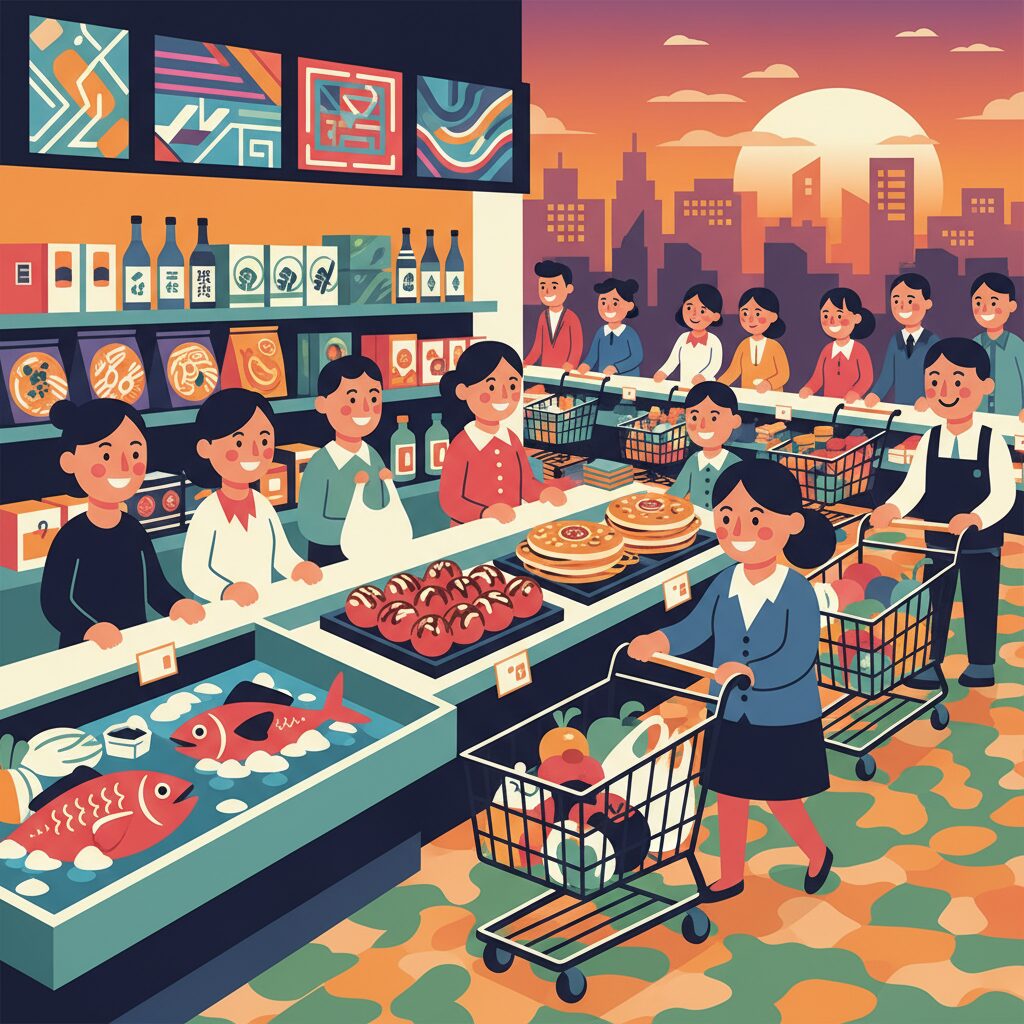
Step off the train in Osaka, walk past the gleaming department stores and tourist-choked arteries, and duck into the first neighborhood supermarket you see. Do it. Because if you really want to understand this city—its rhythm, its logic, its loud, beating heart—you won’t find it at the top of a skyscraper or in a centuries-old castle. You’ll find it under the fluorescent lights of a grocery store, somewhere between the mountain of discounted cabbage and the aisle dedicated entirely to brown sauces. Forget everything you know about the serene, orderly, whisper-quiet supermarkets of Tokyo. This isn’t that. This is a full-contact sport, a social club, and a nightly theater performance all rolled into one. It’s where Osaka’s famous friendliness gets real, where its obsession with a good deal becomes an art form, and where the unwritten rules of the city’s merchant soul are on full display. For a newcomer, it can feel like chaos. For a local, it’s just Tuesday. This is your guide to decoding the glorious, practical, and profoundly human world of the Osaka supermarket, the realest stage in town.
To truly understand this city’s rhythm, you might also be interested in how locals plan their spontaneous weekend trips to Kyoto, Kobe, and Nara.
The Holy Trinity of Osaka Supermarkets: Beyond the National Chains

Certainly, Osaka boasts the same national chains found throughout Japan—your AEONs, Lifes, and Ito-Yokados. These stores are clean, predictable, and completely lack the local character that defines the city. They are the grocery world’s equivalent of generic hotel chains: functional but forgettable. To truly grasp Osaka’s shopping culture, you need to explore the homegrown legends, the local chains intertwined with the cityscape just like Tsutenkaku Tower. At the heart of this scene is a holy trinity, each reflecting a distinct side of the Osakan spirit: the spectacle, the pragmatism, and the dependable community hub. These are Super Tamade, Gyomu Super, and Mandai.
Super Tamade: The Pachinko Parlor of Produce
Calling Super Tamade merely a grocery store is like calling a Las Vegas casino a card game venue—it’s a massive understatement. Tamade is an experience, a whirlwind of neon lights, loud jingles, and prices so shockingly low they seem like errors. It stands as arguably the most unabashedly Osakan institution you can visit. Many foreigners and even Japanese visitors from other regions step inside, are overwhelmed by the chaotic explosion of color and sound, and promptly leave—missing the essence completely.
A Symphony of Neon and Sensation
The first thing that overwhelms you is the light. Storefronts blaze with yellow and red signs, festooned with flashing bulbs reminiscent of pachinko parlors or Showa-era nightclubs. Tamade is anything but subtle. Inside, the sensory bombardment continues. The store’s relentlessly cheerful, custom jingle—a tune so memorable it lingers in your mind—blares at nearly painful volume. Every surface is covered with hand-drawn, fluorescent signs yelling today’s deals in bold, explosive characters—red, yellow, pink—with exclamation marks deployed like an army. It’s designed to jolt you awake, to scream, “LOOK! A BARGAIN!” The atmosphere isn’t serene or refined; it’s visually akin to a street vendor shouting in your ear. In Osaka, that’s not an insult—it’s smart business.
The Gospel of the 1-Yen Sale
Tamade is famed for its legendary loss leader campaigns, especially the “1-Yen Sale.” Yes, one yen. With a minimum spend (usually 1,000 yen), you can snag a carton of eggs, a pack of tofu, or a head of lettuce for less than a cent USD. This is more than a discount; it’s marketing brilliance that taps into the Osakan passion for deals that feel like a victory, as if you’ve outwitted the system. The queues for these sales are a neighborhood spectacle, attracting elderly grandmothers, students, and salarymen alike, all united in hunting down the ultimate bargain. This shared ritual creates an unexpected but powerful sense of community. The products on offer are a mixed bag: decent fresh produce sits alongside brand-name snacks nearing expiry, while towering displays of inexpensive bento boxes and fried foods form the store’s core. Quality varies, but that uncertainty adds to the fun. Tamade isn’t the place for organic kale; it’s for the thrill of the hunt.
What Tamade Reveals About Osaka’s Soul
Tamade is a living tribute to the Osaka merchant ethos. It’s loud, a bit flashy, and obsessively focused on value. Shopping here isn’t a chore—it’s entertainment. The neon lights and blaring music aren’t mere decoration; they’re integral to the performance. Found in working-class neighborhoods, it offers genuinely affordable food without the sterile or judgmental air of more upscale markets. It celebrates frugality (kechi) not as shameful but as smart and savvy living. Tamade doesn’t judge; it just wants to sell you a 50-yen croquette and make sure you enjoy the experience. It captures the raw, unfiltered, gloriously chaotic spirit of Osaka, all packed into a shopping bag.
Gyomu Super: The Temple of Bulk and Practicality
If Tamade is the city’s flamboyant showman, Gyomu Super (業務用スーパー, or “Business Supermarket”) is its pragmatic, no-nonsense engineer. The name is somewhat misleading. Though originally catering to restaurants and small businesses, it has become the go-to for families, savvy singles, and anyone wanting pantry stocking with military-grade efficiency. Entering a Gyomu Super is about scale: aisles are wider, ceilings loftier, and product sizes almost comically large.
More Than Just “For Business”
Forget small bottles of soy sauce—here you buy two-liter jugs. Frozen chicken isn’t in small trays but in two-kilogram bags resembling medicine balls. Flour, sugar, cooking oil—all come supersized. The store feels like a warehouse: concrete floors, steel racks, and goods stacked on wooden pallets reaching the ceiling. No frills, no music, no fancy displays. The design is pure function over form, reflecting a philosophy of cutting unnecessary costs to offer the lowest unit prices. Osaka’s practical spirit absolutely embraces this.
The Kechi Mindset in Action
Gyomu Super perfectly embodies the kechi ethos. Often mistranslated as “stingy” or “cheap,” kechi here is a badge of honor: frugality, resourcefulness, and smart spending. Why buy a small 300-yen bag of frozen gyoza when you can get fifty pieces for 600 yen? The math is clear. Osakan households with freezers consistently opt for bulk. Founded by merchant ancestors skilled in profit margins and cost efficiency, this practical wisdom persists today in Gyomu Super’s aisles. It’s about preparation, stocking up, and rejecting fancy packaging or brands when the store brand is equally good and cheaper.
An Unexpected International Hub
Surprisingly for foreigners, Gyomu Super boasts an extensive international food section. Serving restaurants, it imports a vast variety of products directly, cutting the middleman. Authentic Italian pasta, giant jars of German pickles, Belgian waffles, Thai green curry paste, Vietnamese pho noodles—all offered at prices that beat specialty import stores. This makes Gyomu Super indispensable for non-Japanese residents craving tastes of home. It quietly reflects Osaka’s legacy as a historic port and cultural crossroads, where global flavors are everyday affordable staples. It underscores a pragmatic mindset: if it’s good and inexpensive, origin doesn’t matter.
Mandai: The Reliable Heartbeat of the Neighborhood
Nestled between Tamade’s wild spectacle and Gyomu Super’s stark utility stands Mandai, perhaps the quintessential supermarket for average Osaka families. It strikes a dependable, solid middle ground: clean and well-lit, but not sterile; competitively priced with frequent sales, yet lacking Tamade’s chaotic treasure-hunt vibe. Here, you know where everything is, the staff is friendly, and quality is consistently reliable.
The Middle Ground Champion
Mandai excels at balance. Fresh produce, excellent selection of meat and fish, and highly competitive prices. Its daily and weekly specials are neighborhood conversation staples. You’ll often find people gathered by the entrance, poring over the sale flyer (chirashi) with scholarly focus. Mandai is the place for a standard weekly shop—the trusted store that has everything needed without straining your budget. It reflects everyday life in Osaka: a quiet, constant awareness of price and value woven into routine.
Private Brands and Public Trust
Like many modern supermarkets, Mandai invests heavily in private-label products offering good quality at lower prices. What’s striking is how readily Osaka shoppers embrace these store brands. Elsewhere, buyers might hesitate, preferring famous national brands. In Osaka, such hesitation seems foolish. If Mandai’s soy sauce tastes great and costs 50 yen less, it’s the smart choice. This is not viewed as compromise but savvy decision-making. This trust in the local supermarket’s value is foundational to the relationship between the store and its community. Mandai is more than a business—it’s a neighborhood partner, a reliable presence in daily life.
Reading the Aisles: How Shelves Tell the Story of Osaka
A supermarket serves as a mirror reflecting the tastes and traditions of the community it caters to. In Osaka, the aisles tell a distinctive story, one deeply embedded in the city’s culinary identity. Sections that might be minor afterthoughts in a Tokyo store become expansive domains here, showcasing the core elements of the local diet and culture.
The Altar of Konamono: Flour, Cabbage, and the Foundations of Flavor
Step into any Osaka supermarket, and you’ll inevitably encounter a massive, almost ceremonial display devoted to what locals call konamono, or “flour-based things.” This is the heartland of okonomiyaki, takoyaki, and negiyaki. The variety is astonishing. There aren’t just one or two types of flour; there are specialized flours for okonomiyaki and takoyaki, each with its own unique blend of dashi powder and leavening agents. Adjacent to the flour, you’ll find an array of essential ingredients: large bags of tenkasu (crunchy tempura bits), vivid pink packets of beni shoga (pickled red ginger), bottles of aonori (green seaweed powder), and, naturally, a towering pile of fresh cabbage. The prominence of this section is a constant reminder that in Osaka, these foods are not mere novelties or occasional treats—they are a fundamental part of home cooking, an affordable, satisfying, and delicious way to feed a family. The supermarket’s layout itself consistently reinforces this cultural identity.
The Deep Waters of Dashi: Osaka’s Umami Universe
While Tokyo’s flavor profile centers on the sharp, salty kick of soy sauce, Osaka’s revolves around the deep, complex, and mellow warmth of dashi. The dashi aisle in an Osaka supermarket holds profound significance—it’s truly a library of umami. You’ll discover an impressive variety of options, far surpassing the simple instant granules common elsewhere. There are bags of premium katsuobushi (bonito flakes) in various thicknesses suited to different uses, alongside long, elegant pieces of kombu (kelp) from distinct regions of Hokkaido, each boasting a unique flavor profile that connoisseurs discuss with the same reverence wine enthusiasts reserve for terroir. There are also convenient dashi packs combining bonito, sardine, mackerel, and kombu. This profound respect for dashi is the secret behind Osaka’s cuisine. It forms the subtle, savory backbone of everything from udon noodle soup to takoyaki batter. The supermarket offers not just ingredients but a palette of foundational flavors that shape the region’s culinary soul.
The Wall of Brown Sauce: A Local Obsession
Perhaps nothing stands out more to an outsider than the sauce aisle. In a Tokyo store, you might find a handful of choices for tonkatsu or yakisoba sauce. In Osaka, you encounter a veritable wall—a Great Wall of Brown Sauce. The variety is staggering. Dozens of okonomiyaki sauce brands vie for attention, each with its own loyal following. Some are sweeter, others spicier, some fruitier. Local names like Otafuku and Doro Sauce stand alongside smaller, artisanal producers. Then there are specialized takoyaki sauces, tonkatsu sauces, yakisoba sauces, and versatile multi-purpose sauces. This is not just product variety; it reflects a deeply rooted local passion. People in Osaka often hold strong opinions about their sauce, with families maintaining loyalty to a particular brand for generations. This aisle testifies to the notion that in Osaka, details matter. It’s not just “sauce”; it’s the sauce—the one that tastes like home.
The Human Theater: Shoppers, Staff, and the Unspoken Dance
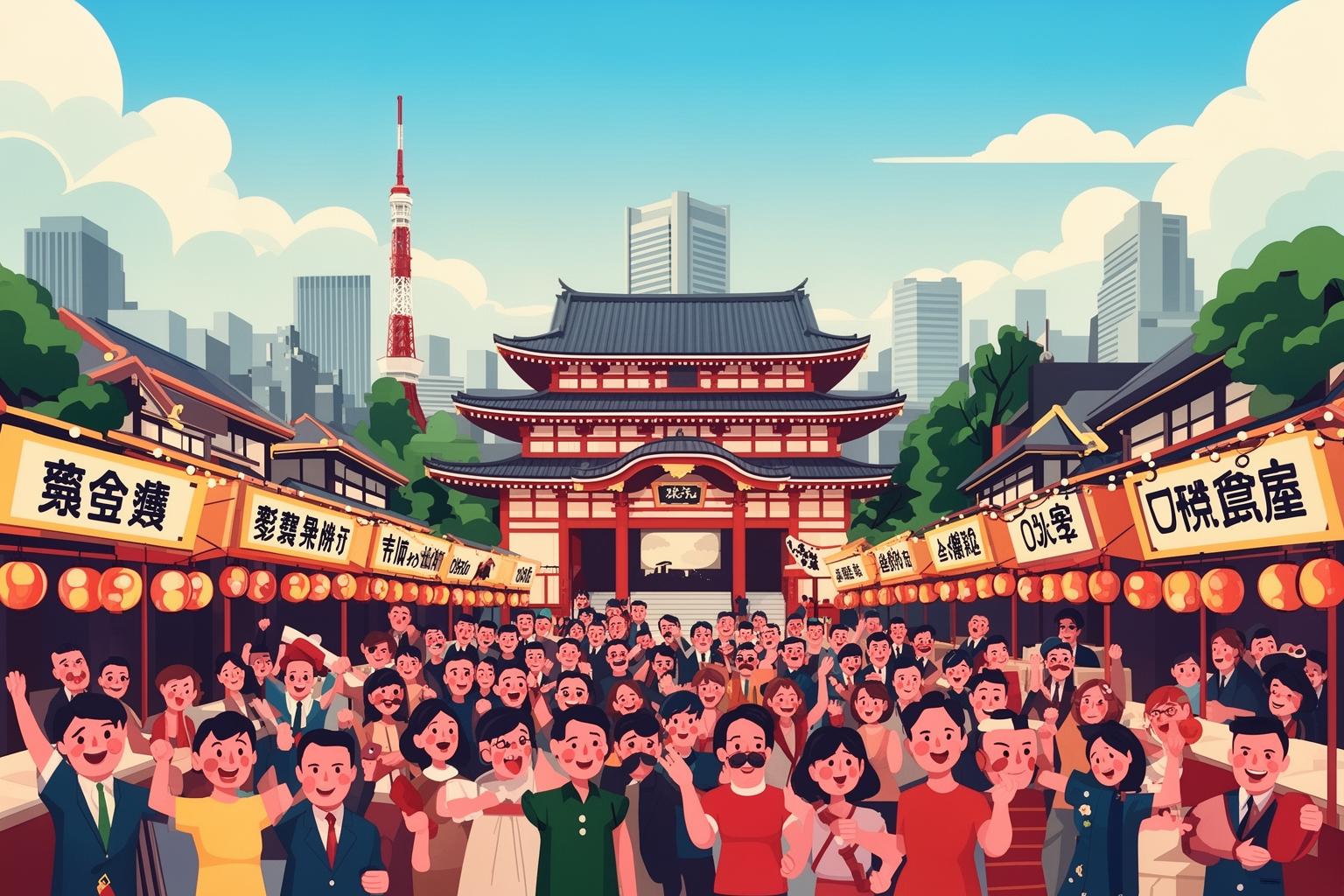
Beyond the products lining the shelves, what truly distinguishes the Osaka supermarket experience is the people. The store serves as a vibrant social hub, a stage where the neighborhood’s characters enact their daily roles. It’s a place of interaction, communication, and unwritten social rituals that can feel perplexing to those accustomed to the quiet, impersonal shopping typical of other large cities.
The Oba-chan Intelligence Agency: Masters of the Bargain
At the core of this human network are the oba-chan, the middle-aged and elderly women who reign supreme in the supermarket. They are not merely shoppers; they are strategists, analysts, and information brokers. They move with remarkable purpose and efficiency. They know the weekly sale cycles by heart, understand when the fish is freshest, and know exactly when discounted bread hits the shelves. They create an informal intelligence network, swapping tips and alerts about exceptional bargains with friends encountered in the aisles. Often offering unsolicited, yet wise, advice, they might appear beside you to suggest the best way to simmer a winter melon with pork or point out the mackerel with the clearest eyes at the fish counter. This isn’t nosiness; it’s an expression of a community-focused mindset. In a city that prizes practical knowledge, these women serve as resident experts, and the supermarket is their territory.
The Checkout Counter Confessional: Service with a Side of Conversation
The change in atmosphere is most evident at the checkout counter. In Tokyo, the process is a model of quiet, mechanical efficiency: scanned, paid, bagged. Minimal eye contact, minimal words. In Osaka, the checkout often turns into a conversation. The cashier, likely a long-time employee who knows half the customers by name, might comment on your purchases: “Ah, making oden tonight, huh? It’s getting chilly, isn’t it?” or “Oh, great deal on mushrooms today—you’re lucky!” They might ask about your family, share a snippet of local gossip, or crack a joke. This embodies the spirit of shobai (business) in Osaka, where transactions are more than money exchanged for goods; they’re chances to build relationships. This small-town warmth in the heart of a bustling metropolis is one of the most endearing and defining features of daily life here, transforming a mundane task into a moment of genuine human connection.
The Nightly Ritual: Hunting the Hangaku Sticker
As evening draws near, a quiet tension builds in the supermarket, especially around the prepared foods, bento, and fresh fish sections. This signals the start of one of Osaka’s beloved daily rituals: hunting for the hangaku (half-price) sticker. As items approach their sell-by time, a staff member appears with a pricing gun loaded with bright yellow stickers—20% off, 30% off, and the coveted 50% off. What follows is a captivating, unspoken dance. Shoppers, previously pretending to browse nearby, begin to slowly gather. It’s not a frantic scramble, but a game of strategic positioning and patience. Everyone respects invisible boundaries, but once the sticker goes on, it’s every shopper for themselves. Hands move quickly and deftly to claim the prize. Scoring a half-price premium sushi set or a high-quality bento is a small victory that yields outsized satisfaction. This isn’t necessarily driven by financial need; it’s the thrill of the chase and a deep cultural appreciation for minimizing waste and maximizing value. It’s a moment of shared, competitive, yet warmly communal triumph.
The Osaka Rules: Navigating the Social Currents
Like any unique culture, the Osaka supermarket follows a set of unwritten social rules. Grasping these can mean the difference between a smooth, enjoyable shopping trip and a frustrating one. These norms often sharply contrast with the formal etiquette found in other Japanese cities.
Aisles as Social Spaces, Not Mere Passageways
In Tokyo, stopping a shopping cart and blocking an aisle is a serious offense, usually met with silent, cold glares. The main goal is to keep things flowing efficiently. In Osaka, however, the aisle is often seen as an extension of the sidewalk or even a living room. It’s perfectly normal—and expected—for two neighbors who haven’t met since yesterday to stop their carts side-by-side and engage in a full conversation, effectively blocking the aisle. Nobody gets upset. People either wait patiently or politely say “sumimasen, toshite kudasai” (“excuse me, please let me through”) with a smile. The understanding is that the supermarket serves as a social space first and a retail space second. Community interaction takes precedence over individual efficiency. Pushing through or showing impatience is considered the real breach of etiquette here.
The Unspoken Rules of Bicycle Jenga
Outside almost every supermarket, you find another glimpse of Osaka life: the bicycle parking area. This is rarely an orderly row of racks. More often, it’s a chaotic, multi-layered tangle resembling a game of Jenga played with metal frames. Yet there’s an unspoken system within this disorder. You don’t just park your bike anywhere. You find a spot, and if you need to shift someone else’s bike slightly to fit, you do so carefully, making sure not to trap them in. It’s a dance of mutual respect. The ideal sign of a successful Osaka grocery trip is a mama-chari (mom-bike) with a child seat in the back, its front basket bursting with groceries, and extra bags teetering on the handlebars. It exemplifies the resourcefulness and balancing skills of the locals.
The Contradiction of Speed and Leisure
The social rhythm of an Osaka supermarket is full of contrasts. While long conversations in the aisles are welcome, the checkout line demands surprising urgency. People are friendly but intolerant of inefficiency. You’re expected to have your wallet, cash or card, and loyalty card ready the moment your total is announced. Hesitating to find change or searching for your wallet after everything is scanned will bring good-natured but clear pressure from those waiting behind you. After paying, you are expected to swiftly move your basket to the bagging counter to clear the way for the next customer. Social time belongs in the aisles; the checkout is business time. This paradox perfectly embodies the dual character of the Osaka merchant spirit: warm and personal in relationships, yet sharp and efficient in transactions.
Why It’s Not Tokyo: A Tale of Two Shopping Carts
The differences between shopping in Osaka and Tokyo go beyond just price or noise level. They reveal the fundamental divergence in the culture and priorities of Japan’s two largest cities. It’s a story of efficiency versus entertainment, curation versus abundance.
The Sound of Silence vs. The Roar of the Crowd
The most noticeable difference is auditory. A Tokyo supermarket, especially an upscale one like Kinokuniya or Seijo Ishii, is often as quiet as a church. The only sounds are the gentle hum of the refrigerators and the soft beeping of the scanners. Shopping is a private, meditative experience. An Osaka supermarket, by contrast, is a cacophony. There’s the store jingle, the shouted announcements of time-sensitive sales (taimu seru), the chatter of shoppers, and the friendly banter of the staff. It’s a lively, stimulating environment. This isn’t a drawback; it’s a feature. The noise is the sound of a vibrant market, filled with energy and human activity, which Osakans find comforting and exciting.
Curation vs. Cornucopia
Tokyo supermarkets often take pride in curation. They offer a carefully chosen range of high-quality, beautifully packaged products. The focus is on aesthetics and premium branding. Shopping there can feel like visiting a gallery. Osaka supermarkets, on the other hand, often emphasize cornucopia—an overwhelming abundance of choices and quantities. The aim is not to convey a curated lifestyle, but to present a vast warehouse of options at every price point. The displays are piled high, suggesting bounty and generosity. This reflects a more democratic and practical approach to consumption. It’s less about the image your groceries project and more about the practical value they provide.
Efficiency vs. Entertainment
Ultimately, the Tokyo model is designed for ruthless efficiency. The goal is to get customers in and out as quickly and smoothly as possible, minimizing friction and unnecessary interaction. Time is the ultimate luxury, and convenience is the highest virtue. In Osaka, the shopping experience itself is part of the appeal. It’s a form of entertainment. The bargain hunting, the social interactions, the lively atmosphere—these are all part of the enjoyment. It’s a place to linger, to see and be seen, to connect with the neighborhood’s pulse. It’s an acknowledgment that daily life shouldn’t just be efficient; it should also be enjoyable and, above all, human.
Final Thoughts: More Than Just a Grocery Run
Living in Osaka means learning to read its rhythms, and there’s no better guide than the local supermarket. It’s a place that teaches you the value of being smart with money, the way community is formed through small, everyday interactions, and how a bit of chaos can bring joy. It’s where the abstract ideas you hear about Osaka—its friendliness, down-to-earth nature, and merchant spirit—stop being clichés and become real. You see it in the grandmother helping a young mother reach something on the top shelf, hear it in the cashier’s laughter, and feel it in the collective excitement of the evening discount rush.
So next time you’re here, skip the immaculate, silent aisles of a department store basement and head to a Mandai, a Gyomu Super, or if you’re feeling adventurous, a Super Tamade. Grab a basket. Take your time. Listen to the conversations. Watch the nightly dance of the discount hunters. Buy a ridiculously cheap bento. You’ll leave with more than just groceries. You’ll leave with a genuine understanding of what keeps this city alive. You’ll have experienced a place that is not just a store, but a loud, proud, and wonderfully human reflection of Osaka itself.