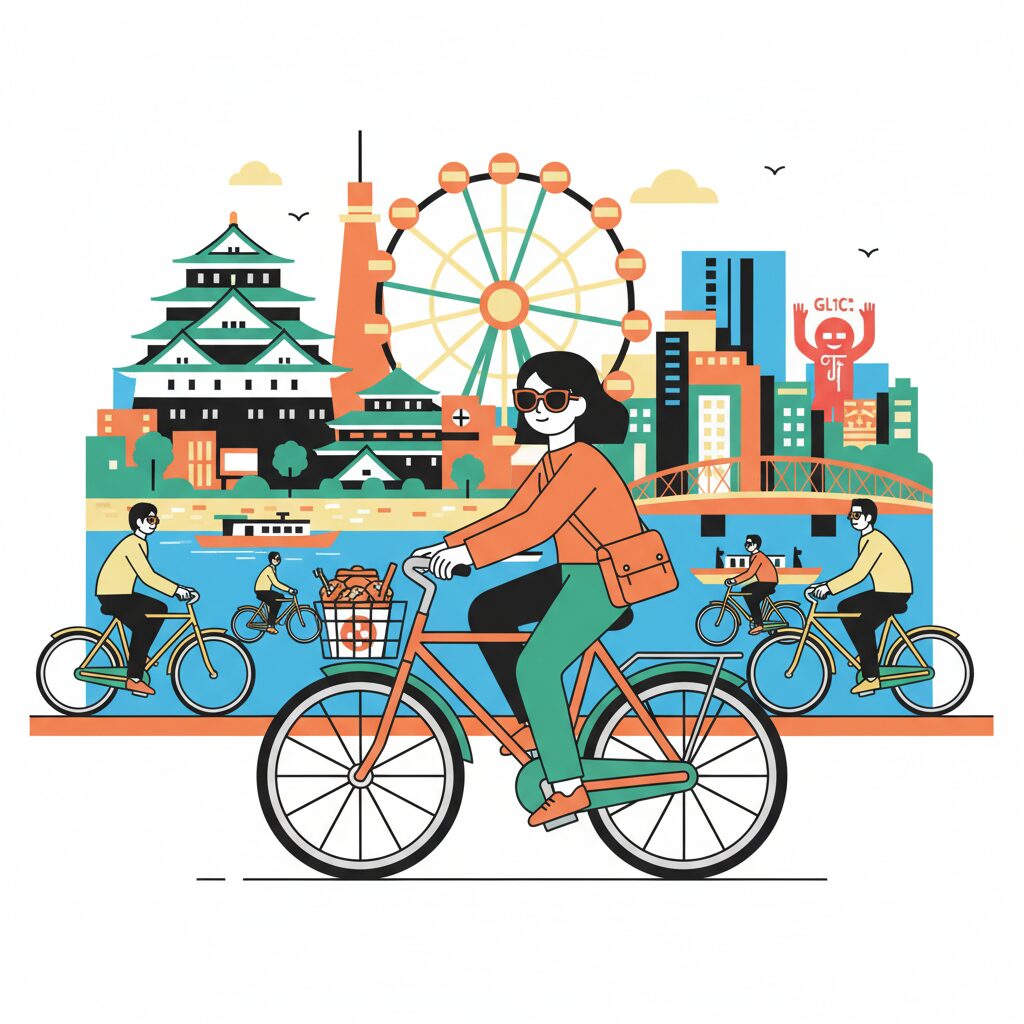
The first time you try to walk through an Osaka shopping arcade on a Saturday afternoon, you’ll feel it. It’s not the crush of the crowd, the wall of noise from the pachinko parlors, or the tantalizing smell of takoyaki. It’s a whisper of air on the back of your neck. A fleeting shadow in your peripheral vision. A soft whirring sound that cuts through the din. Before you can fully process it, a bicycle, laden with groceries and piloted by a woman with the serene focus of a fighter jet pilot, will glide past you with millimeters to spare. No bell, no warning, just a silent, fluid movement through a sea of people who part like the Red Sea. You’ll stop, heart hammering in your chest, and watch it disappear. You’ll look around for some sign of outrage, a shared glance of disbelief with a fellow pedestrian. You will find none. This is just… Osaka.
Welcome to the ‘Chari’ life. In Osaka, the bicycle—affectionately and universally known as ‘chari’ (チャリ)—is not merely a mode of transportation. It’s the lifeblood of the city. It’s a declaration of independence from the rigid timetables of the train system. It’s a personal mobility device that has shaped the very flow and rhythm of daily existence here. And for any foreigner trying to understand this city, learning to navigate the world of the chari is lesson number one in decoding the Osaka mindset. It’s a world governed less by the printed traffic laws and more by a complex, unspoken, and often contradictory set of rules that prioritize pragmatism, efficiency, and a healthy dose of what can only be described as controlled chaos. Forget what you learned in driver’s ed. Forget the orderly bike lanes of other countries, or even other Japanese cities. Here, the rules are written in the wind, and you learn them by feel, by observation, and by the occasional near-miss that teaches you more than any handbook ever could.
This isn’t a guide to the best cycling routes for tourists. This is a deep dive into the soul of the city, as seen from the saddle of a beat-up mamachari. It’s an attempt to explain the unwritten constitution that governs every sidewalk, every intersection, and every crowded train station plaza. It’s about understanding why an old man will pedal blithely through a red light without a second glance, why a mother with two children on her electric-assist bike is the undisputed queen of the pavement, and why the most terrifying thing on an Osaka street isn’t a truck, but a high school student on a bike, looking at their phone. This is Osaka life, in all its freewheeling, baffling, and ultimately efficient glory.
To truly understand the city’s unique rhythm, consider how this same pragmatic spirit of community and efficiency is reflected in the daily rituals of Osaka’s neighborhood sentō.
The Unspoken Hierarchy of the Sidewalk
The first and most fundamental truth of Osaka chari life is that the sidewalk is not a pedestrian sanctuary; it is a shared, contested, and ever-changing space. Officially, Japanese law dictates that bicycles should, in principle, use the roadway, reserving sidewalks for pedestrians. However, in Osaka, this rule is treated with the same casual disregard as a “no shirt, no shoes, no service” sign at a beachside ramen shack. Everyone knows the rule exists, but the reality on the ground has morphed into a completely different system—one based on a subtle and constantly shifting hierarchy.
At the top of this pyramid, ruling with an iron fist in a deceptively soft glove, is the ‘Mamachari’ Brigade. At the bottom, looking nervously over their shoulder, is the humble pedestrian. In between, there is a chaotic mix of every other type of cyclist, from university students on sleek road bikes to elderly men on ancient, rusted machines that seem held together by sheer willpower. Navigating this hierarchy is a continuous dance of assertion and deference, a silent negotiation that occurs hundreds of times daily.
The Pedestrian’s Perspective
Walking in Osaka requires developing a sixth sense. You learn to walk with your head on a swivel, ears tuned to the faintest whir of a wheel or the gentle ‘chirin’ of a bell. You learn to anticipate the impossible. A bike might appear from a blind corner at full speed or come up behind you silently like a ninja until it’s right on your heels. You master the ‘Osaka Sidestep’—an instinctive, split-second shuffle left or right to avoid a collision that seemed unavoidable moments before. It’s a city of near-misses. Amazingly, these near-misses rarely turn into actual collisions. There’s a shared, if unconscious, understanding that prevents the system from descending into chaos. The cyclist doesn’t want to hit you any more than you want to be hit. The challenge is that their idea of a ‘safe distance’ might be what you consider a hair’s breadth.
Within the covered shopping arcades, the ‘shotengai’, this dance intensifies. In places like Shinsaibashi-suji or Tenjinbashi-suji, thousands of pedestrians stop, start, window-shop, and mill about. Yet, through this dense, unpredictable human traffic, the chari flows like water. Cyclists weave through gaps that seem nonexistent, their movements economical and precise. A pedestrian who stops suddenly without looking behind is considered just as much at fault as a cyclist who doesn’t anticipate the stop. Mutual awareness is expected. You, the pedestrian, are part of this chaotic ballet, not merely a bystander. Complaining about it is like complaining about the summer humidity—pointless. This is simply how things are.
The only verbal cue you’ll hear is a soft, almost apologetic ‘sumimasen’ (excuse me) from behind. This isn’t a request for permission to pass but a statement of intent. It means ‘I am coming through; please make way.’ The correct response is to flatten yourself against a shop window and allow the chari to pass.
The Cyclist’s Perspective
Before condemning sidewalk-riding cyclists as lawless menaces, it’s important to understand their reasoning. Look at the roads in central Osaka: narrow and congested, crowded with buses, taxis, and delivery trucks all vying for space. Dedicated bike lanes are rare. For the average mamachari rider, the road feels like a death trap—loud, intimidating, and filled with multi-ton metal boxes driven by often just-as-impatient drivers. The sidewalk, by contrast, seems like the path of least resistance—safer, more direct, and more efficient.
This choice is rooted in the core Osaka mindset of ‘keizai-kouritsu’ (economic efficiency) and a general impatience known as ‘sekkachi’. Why take a longer, more dangerous route when a shorter, practical one is right there? The law feels abstract; the reality of making it to the supermarket and back before the kids come home is tangible. The sidewalk is simply the right tool for the job. The chance of getting a ticket is minimal compared to daily convenience. So, they adapt. They develop an extraordinary ability to judge speed and distance, read pedestrians’ body language, and navigate complex environments swiftly. They aren’t trying to be bullies; they are trying to accomplish tasks. In a city built on commerce and hustle, this utilitarian approach makes perfect sense.
The Infamous ‘Mamachari’ Brigade
Among cyclists, one group is supreme: mothers on their electric-assist mamachari. These are not just bicycles; they are urban assault vehicles. Typically, their setup includes a sturdy frame, a large front basket, a child seat on the back (sometimes another on the front), and a powerful electric motor that allows surprising acceleration. These bikes are heavy and wide, and when loaded with children and a week’s groceries, they move with the momentum of a small planet.
And the women who ride them are masters of their craft. They navigate crowded sidewalks with unshakeable confidence, their faces set in determined focus. They are on a mission dictated by the relentless schedules of school runs, daycare, shopping, and doctor’s appointments. Hesitation isn’t an option. They are the apex predators of the pavement. Other cyclists give them wide berth. Pedestrians learn to recognize the distinct hum of their electric motors and instinctively make way. There’s an unspoken respect for the mamachari rider. She is the household’s engine, the family logistics manager, and her bicycle is an indispensable tool. To block her progress is to disrupt the very fabric of daily neighborhood life. She has places to be, and the sidewalk is her domain.
Rules Are Suggestions, Results Are Everything
If you want to capture the difference between Osaka and Tokyo in a single image, stand at a pedestrian crossing with a traffic light. In Tokyo, when the light turns red, cyclists generally stop and wait patiently for green. They line up, sometimes neatly, waiting for the official signal. In Osaka, a red light is often seen as a ‘yield’ sign. An Osakan cyclist will approach the intersection, slow down, glance left and right, and if no cars are coming, they simply go through. Waiting for the light to change when the way is clear would waste precious seconds. It’s illogical.
This isn’t anarchy; it’s a philosophy. The rule (stop at red) is secondary to the outcome (cross safely and efficiently). This pragmatism—prioritizing results over rigid rules—is a hallmark of Osaka culture, rooted in its history as a merchant city. A merchant isn’t rewarded for following rules but for closing the deal. Similarly, an Osaka cyclist’s goal is to get from A to B. Rules serve as guidelines to help with that, and if a rule seems inefficient or unnecessary in a situation, it can be reinterpreted.
The Art of the ‘Kiken nai’ (It’s not dangerous) Judgment Call
Each time an Osakan cyclist rolls through a red light or weaves between pedestrians, they make a quick, subconscious risk assessment. They ask themselves, ‘Kiken nai ka?’ (Is it dangerous?). If no, they proceed. Their meaning of ‘kiken’ (danger) is highly subjective, shaped by years of experience. It’s a finely tuned sense of approaching car speeds, pedestrian movements, and tire grip. What looks reckless to outsiders is, to them, a carefully calculated, safe maneuver. They trust their judgment over a blanket rule set by some faceless bureaucrat far away.
This causes constant friction with people from other parts of Japan, especially Tokyo. For a Tokyoite, rules exist for a reason—to maintain order and predictability. For an Osakan, blindly following a rule that makes no sense in the moment is foolish. Why wait at an empty intersection late at night for a light change? It’s nonsensical. This core difference—rule-based order versus outcome-based pragmatism—is a key cultural divide between Japan’s two largest cities and plays out daily on the streets.
The Smartphone Zombie on Wheels
However, there is a dark flip side to this culture of individual judgment. The rise of smartphones has created a new, genuinely dangerous type of cyclist: the ‘sumaho-zombie.’ These riders pedal, often at high speed, with eyes glued to their phone screens, whether texting, scrolling social media, or watching videos. Their ‘kiken nai’ judgment is completely broken. They navigate by muscle memory alone—a danger to themselves and others.
Unlike the seasoned mamachari rider’s calculated risks, this behavior is universally condemned. It’s a frequent local news topic and subject of police warnings. Yet it endures. It signals a breakdown of the unwritten social contract. The traditional Osaka cyclist, despite bending rules, remains hyper-aware of their surroundings. The smartphone zombie is lost in their own world. They are the exception proving the rule: when individual judgment fails, the whole system of organized chaos becomes genuinely hazardous. They starkly remind us that the freedom of chari life depends on the rider’s vigilant attention to the shared environment.
The Umbrella Conundrum
During rainy season, you’ll see another act of casual defiance embodying Osaka’s spirit: the umbrella cyclist. Riding a bike while holding an umbrella (‘kasa-sashi unten’) is illegal in Japan. It’s a one-handed, unstable, and risky practice. In Osaka, it’s a way of life. When the rain falls, streets fill with cyclists, one hand on the handlebars, the other holding an umbrella high, gliding through the downpour like strange mechanical birds.
It’s an act of remarkable, if reckless, skill. They must steer, brake, and balance with one hand while controlling an umbrella that catches the wind like a sail. Objectively, it’s a bad idea. Yet from a practical Osaka perspective, it makes sense. The alternative is getting soaked. Ponchos are bulky and hot, walking takes too long. So, they accept the risk and master the technique. It’s the ultimate example of prioritizing immediate practical needs (staying dry) over abstract legal rules. It’s a testament to the city’s ingrained belief that where there’s a will—and a bit of daring—there’s a way.
Parking: The Urban Tetris Game
The journey on a chari is only half the story. The other half involves the ongoing, frustrating, and often strategic challenge of figuring out where to park once you reach your destination. Bicycle parking, or ‘churin,’ is a city-wide obsession and a daily source of drama. While modern buildings and train stations frequently offer large, official, paid parking lots (‘churinjo’), demand far exceeds supply. This shortage has led to a parallel world of illegal, or ‘guerrilla,’ parking, where sidewalks, railings, and any stray patch of concrete become part of a vast urban game of Tetris.
Walk toward any major train station like Umeda, Namba, or Tennoji, and you’ll witness it: a sea of bicycles. They are chained to guardrails, crammed tightly into designated zones so the ground is barely visible, and spilling onto surrounding sidewalks in a chaotic flood of metal and rubber. This isn’t simply a failure of urban planning; it highlights the chari’s essential role in city life. Everyone rides, so everyone needs a place to park. When official spots are full or inconvenient, people take matters into their own hands.
The Silver Armies of Impounded Bikes
The city’s response to this disorder is the occasional ‘sweep.’ Municipal workers, often dressed in silver uniforms, descend on trouble spots with flatbed trucks. They meticulously attach warning tags to illegally parked bikes, and after a grace period, return with bolt cutters. The bikes are cut loose and towed to vast, dismal impound lots situated on the outskirts of the city.
Having your bike impounded is a rite of passage for any long-term Osaka resident, and a thoroughly frustrating experience. First, you must locate where your bike was taken. Then you travel to the impound lot, always inconveniently located. You show your ID and the key to your bike’s lock, pay a fine (usually a few thousand yen), and endure a brief lecture from the staff. Only then can you retrieve your chari from a sprawling field of other unfortunate bikes. Although time-consuming and aggravating, this is a calculated risk people accept—balancing the chance of a sweep against the convenience of parking close to their destination. Sometimes convenience wins, and sometimes the silver army does.
The Unwritten Rules of ‘Churin’
Because the threat of impoundment looms constantly, a complex set of unwritten rules around illegal parking has emerged. It acts as a community-driven system for minimizing risk. For instance, parking for five minutes right in front of a convenience store while you pop inside is generally tolerated. Leaving your bike there all day is a violation likely to earn dirty looks or a call to the removal crews. Tucking your bike neatly into a forgotten corner or among other guerrilla-parked bikes is seen as more acceptable than blocking the middle of the sidewalk and impeding pedestrian flow.
There is a subtle art to it. You learn to read your surroundings. Are there “No Bicycle Parking” signs plastered everywhere? Is this a busy street likely to be targeted for a sweep? Or is it a quiet side road where a neatly parked bike will be overlooked? You learn how to make your bike look like it belongs—or at least look less of a nuisance than the bike next to it. This constant negotiation for space, blending individual need with tacit community agreement, is quintessential Osaka. To outsiders it may appear chaotic, but it follows its own pragmatic logic.
Apartment Living and the Bicycle Graveyard
Parking issues persist even at home. Most apartment buildings provide designated bicycle parking areas, but these are usually scenes of managed chaos. Racks are packed to capacity, and residents often park in the aisles, turning the area into an obstacle course. Over time, these spaces become bicycle graveyards. A bike with a flat tire may be left unrepaired and slowly left to rust. Another resident moves away, abandoning their old chari. Gradually, these neglected bikes—with flat tires, rusted chains, and faded registration stickers—pile up like skeletons, occupying valuable space. Occasionally, building management posts notices announcing a clean-out, offering owners a chance to reclaim their active bikes before abandoned ones are hauled off to the scrap heap. This is the circle of life, Osaka chari-style.
The Chari as an Extension of Self
To truly appreciate the importance of the chari, you must recognize that it is more than just a vehicle. For many Osakans, it represents an essential part of their identity and daily life. It offers a sense of freedom and independence that the rigid train and subway systems simply cannot provide. Your chari is always available, ready for you to explore your neighborhood, find hidden alleyways, and travel on your own timetable. It is a genuine personal vehicle, a dependable companion for everyday errands and adventures.
This intimate bond is evident in the bikes themselves. They are not generic products; they reflect their owners’ personalities and needs. They serve as canvases for personalization, vessels of memories, and silent partners in the rhythm of a life rooted locally.
Customization and Character
If you look closely at the bikes outside any supermarket, you will see a diverse cross-section of Osaka society. There are sleek, lightweight road bikes (‘roodo baiku’) favored by cycling enthusiasts, often featuring custom handlebars and advanced gear. There are sturdy, practical mamacharis, with baskets reinforced by extra nets for carrying groceries and frames decorated with stickers from local shops or popular children’s anime. You’ll find old, single-speed bikes handed down through generations, their paint faded and frames bearing the honorable marks of long use. Some owners add quirky bells, colorful streamers on the handlebars, or custom-made covers for seats and baskets. The bike’s condition and accessories tell a story about its owner’s life, values, and tastes. A well-used chari, even if aged and a little rusty, signals a life actively lived.
The Registration Sticker (防犯登録 – Bohan Toroku)
Despite the city’s relaxed vibe, there is one aspect of bureaucracy every cyclist takes seriously: the ‘bohan toroku,’ or anti-theft registration. When you purchase a new or used bicycle in Japan, you must register it with the police. The shop manages the paperwork, and a small, often orange or yellow, sticker bearing a unique registration number is attached to the frame. This sticker officially ties the bike to its owner.
This system is remarkably effective. While bicycle theft is relatively common, recovery rates are high thanks to registration. More importantly for daily life, it results in one of the most frequent—and initially surprising—interactions a foreigner might have with the police. It’s common for officers, especially at night, to stop cyclists for a routine check. They ask for ID and then radio in the number on the bohan toroku sticker to verify the bike isn’t stolen. The first time this happens, it can feel intimidating, as if you’ve done something wrong. But it’s a standard procedure—a moment where the city’s underlying order and rules suddenly become apparent. It’s a reminder that even within the lively world of the chari, a system is in place, and you are part of it.
The Social Radius
The most profound impact of the chari on life in Osaka is how it defines residents’ personal geography. Your ‘chari-ken’ (chari-sphere) is the area you can comfortably reach by bike, and for many, this radius encompasses their entire world. It determines which supermarket offers the best deals, which park is ideal for a weekend picnic, and which train station is most convenient. It connects neighborhoods in ways that train lines, which follow a hub-and-spoke pattern, cannot. With a chari, you can cut across the city grid, follow the canals, and explore the dense residential areas between major stations. This fosters a deep, ground-level familiarity with your surroundings.
This contrasts strikingly with life in Tokyo, where the world is often defined by the Yamanote Line and subway routes. In Tokyo, life revolves around train station hubs. In Osaka, life unfolds as a seamless network of bike-friendly paths. The city’s relatively flat terrain makes this possible. This bike-centric perspective nurtures a strong sense of local community. Your world is not just your closest station; it’s the entire area reachable within a 15 or 20-minute ride. The chari is the tool that transforms the vast metropolis of Osaka into a connected collection of villages.
The Dangers and the Consequences
It would be irresponsible to portray Osaka’s chari life in an entirely romantic light. The same free-spirited energy that makes the city so lively also renders it genuinely dangerous at times. Osaka consistently ranks at or near the top in Japan for bicycle-related accidents. The unwritten rules and mutual understanding that typically keep the system running can and do break down, sometimes with serious consequences.
This is the stark reality behind the smooth weaving and casual bending of rules. For every thousand graceful near-misses, there is one collision. For every pedestrian who steps aside in time, there is one who does not. As the city confronts this reality, the carefree attitude of the past is slowly but surely being tempered by a new sense of risk and responsibility.
Accidents Are Real
The most frequent conflicts occur between cyclists and pedestrians. An elderly person stepping out of a shop without looking, a child darting into the street, a cyclist speeding around a blind corner—these are the ingredients for disaster. Bicycle and car accidents are also common, often happening at intersections where a cyclist’s ‘kiken nai’ judgment turns out tragically wrong. The consequences can be severe. Japanese news frequently reports accidents where cyclists have caused serious injury or even death, resulting in criminal charges and massive civil lawsuits.
In response, there has been a significant cultural and legal shift in recent years. The realization that a cyclist could be liable for millions of yen in damages was a wake-up call. Consequently, many prefectures, including Osaka, have made bicycle liability insurance mandatory. This marked a major change, forcing a city full of casual cyclists to face the very real financial risks of their daily commute. The days of hopping on a bike without considering legal or financial consequences are officially over, even if the street riding habits have been slow to adapt.
The Police and Occasional Crackdowns
Although day-to-day enforcement of traffic laws for cyclists often seems lax, it’s a mistake to think there are no consequences. The Osaka Prefectural Police are known for their periodic and often unannounced crackdowns. You might turn a corner one evening to find a line of officers flagging down every cyclist without a light. They might set up a checkpoint near a busy intersection during morning rush hour, handing out warnings or tickets for riding with headphones, using a phone, or carrying a second person on the back (‘futari-nori’).
These crackdowns feel somewhat random, like a lottery of misfortune. You could ride without a light for 364 days a year without issue, only to be stopped on the 365th. Yet they serve a purpose. They are a periodic assertion of authority, a reminder that rules do exist and can be enforced at any time. This prevents the system from descending into chaos. It fosters a low-level anxiety that encourages a baseline of compliance. Most people turn their lights on at night, not out of fear of the dark, but to avoid the hassle of being stopped by the police. It’s another example of Osaka’s pragmatic approach: the motivation isn’t a deep respect for the law, but a practical desire to avoid trouble.
How to Survive and Thrive in the Osaka Chari-Verse
For someone new, the world of the Osaka chari can feel intimidating. It appears to be a chaotic free-for-all with no clear rules. However, once you grasp the underlying logic, you can not only survive but thrive. It involves letting go of your preconceived ideas about traffic laws and learning to tune into the city’s unique rhythm. It’s about becoming a participant in the dance rather than just an obstacle.
Choosing Your Steed
The first step is selecting the right bike. The classic mamachari is the unrivaled workhorse of Osaka—stable, comfortable, and equipped with a basket essential for grocery runs. An electric-assist model is a game-changer, especially if your daily route includes bridges or slight hills. If you plan to combine cycling with train travel, a lightweight folding bike might be a better option. For pure speed and exercise, a road bike works well, but its aggressive riding position and lack of a basket make it less practical for everyday errands.
Whatever you choose, invest in three key items: a powerful LED front light (the police are very strict about this), a sturdy lock (preferably two different types to deter thieves), and a bell. The bell acts as your voice on the sidewalk, a vital tool for communication.
Developing Your ‘Osaka Sense’
More important than any gear is cultivating your ‘Osaka Sense’—a heightened state of situational awareness. It’s about anticipating rather than merely reacting. When walking, expect a bike could come from any direction at any time. When cycling, keep your eyes ahead, predicting pedestrian movements. Is that person on their phone about to step off the curb? Will that child chase a ball into your path? Does that driver at the intersection see you?
It’s about making eye contact. A quick glance and nod shared with a driver or fellow cyclist forms a silent agreement: ‘I see you, you see me, and now we proceed without collision.’ It’s also about listening—filtering out city noise to focus on specific sounds: the whir of bike tires, the rumble of a truck, the chime of a train crossing. This sensory awareness is key to navigating safely.
When in Doubt, Walk It
Part of good Osaka Sense is knowing when not to ride. In crowded, tourist-heavy spots like Dotonbori at night or during festivals at local shrines, the most practical and respectful choice is to dismount and walk your bike. Forcing your way through a dense, immobile crowd breaches etiquette. It marks you as a novice or tourist. A true local knows the limits of the chari and when to assert their right to pass—and when to revert to pedestrian status. This seamless role-switching shows understanding of the social contract. Your convenience does not justify spoiling others’ experience. It’s a delicate but essential balance.
The Bell is Not a Horn
A note on the bell: using it is an art. In some parts of Japan, ringing your bell at pedestrians is considered very rude, akin to honking a car horn. In Osaka, it’s more functional, but its use is subtle. The bell is not a demand to move; it’s a polite announcement of your presence. A single, gentle ‘chirin’ from a reasonable distance is standard—it says, ‘Excuse me, I’m coming up behind you on your left.’ This gives the pedestrian a moment to notice and adjust. Repeated, frantic ringing signals impatience and is both rude and counterproductive. Mastering the single, subtle ‘chirin’ is one of the final steps to becoming a true chari master.
Ultimately, the chari is a perfect metaphor for Osaka itself. It may seem chaotic, unruly, or even a bit dangerous, but it operates on unwritten rules prioritizing efficiency and practical outcomes over strict legalism. Beneath the apparent chaos lies a surprisingly functional system—a dance of mutual understanding and shared purpose enabling millions to move through a dense city with remarkable freedom. Learning the ways of the chari is learning the city’s rhythm. It’s about more than just getting from point A to point B—it’s about recognizing that in Osaka, the straightest line is rarely a line at all. It’s a fluid, ever-changing path navigated with your wits, senses, and an unspoken agreement with everyone around you. Once you master it, you’re not just living in Osaka; you’re part of its relentless, beautiful, and chaotic flow.