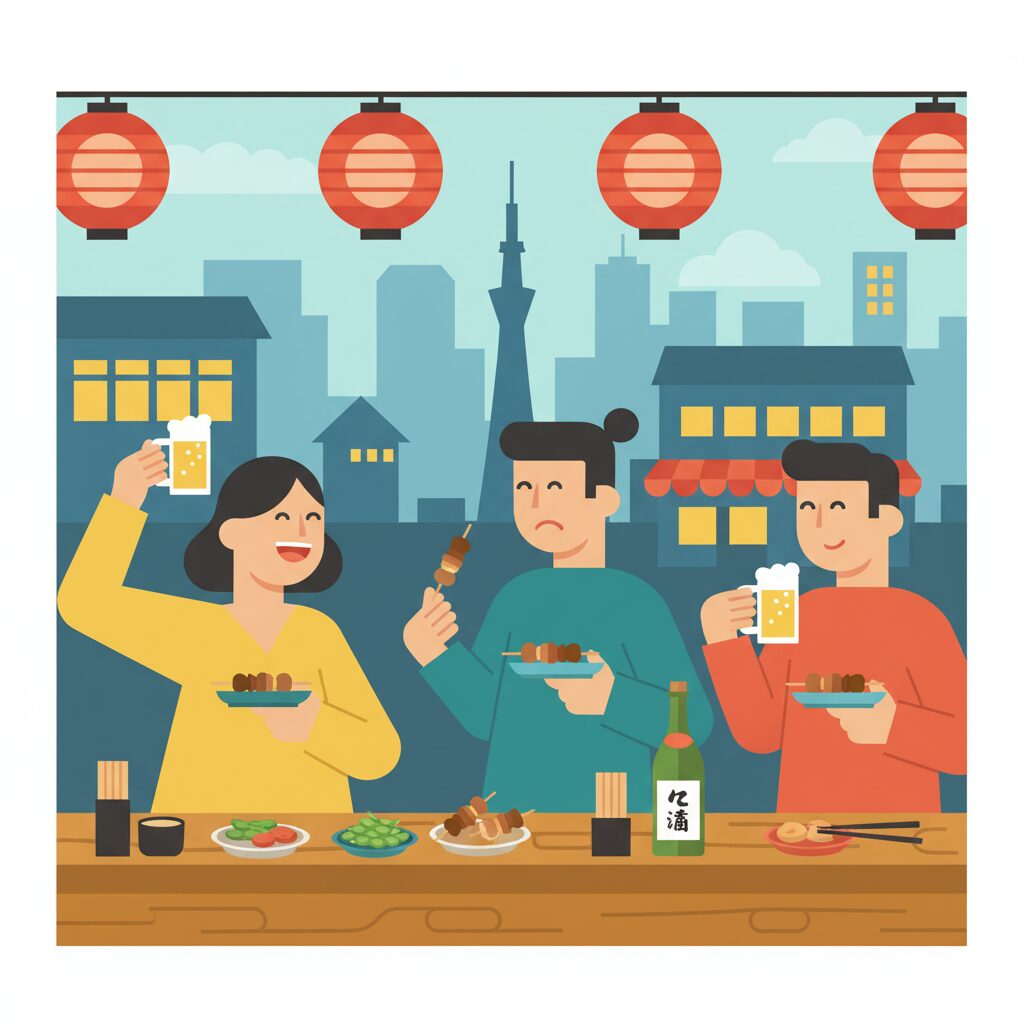
I still remember my first time. I was walking through the tangled, neon-soaked backstreets of Kyobashi, a neighborhood that always feels like it’s just getting its second wind after sunset. I passed restaurant after restaurant, but I was drawn to a place with no chairs. It was just a narrow counter, a haze of cigarette smoke and steam from a simmering pot, and a wall of sound—clinking glasses, gruff laughter, the staccato bark of orders. Men in suits with their ties loosened stood shoulder-to-shoulder with guys in construction uniforms. It was packed, loud, and utterly intimidating. My foreign brain, conditioned by the unspoken rules of personal space and quiet decorum, screamed, “Abort mission.” But my curiosity, the very thing that brought me to Osaka, whispered, “Just one drink. See what happens.”
That first encounter with a tachinomi, or standing bar, was a confusing whirlwind of sensory overload. I fumbled with my order, wasn’t sure where to put my money, and mostly just stood there, a silent observer in a sea of raucous camaraderie. It felt like I’d crashed a private party. But I was wrong. I hadn’t crashed a party; I had stumbled into Osaka’s public living room, its most democratic and misunderstood social institution. This isn’t just about cheap beer and quick snacks. The tachinomi is a microcosm of Osaka itself—pragmatic, efficient, a little rough around the edges, and far more welcoming than it first appears. It’s where the city’s social fabric is woven, one quick drink at a time. To understand the tachinomi is to understand the rhythm of daily life here, to decode the friendly but direct nature of its people, and to find a way into a community that thrives on spontaneity. Forget the formal, planned-out drinking sessions you might find in Tokyo. Here, social life happens in the margins, standing up. This is the real-world guide to navigating that world, a place where you can walk in a stranger and, if you play your cards right, walk out with a few new friends.
If you’re looking for a different kind of social experience outside the city, consider taking a weekend trip to Awaji Island for a change of pace.
The Tachinomi as Osaka’s Living Room
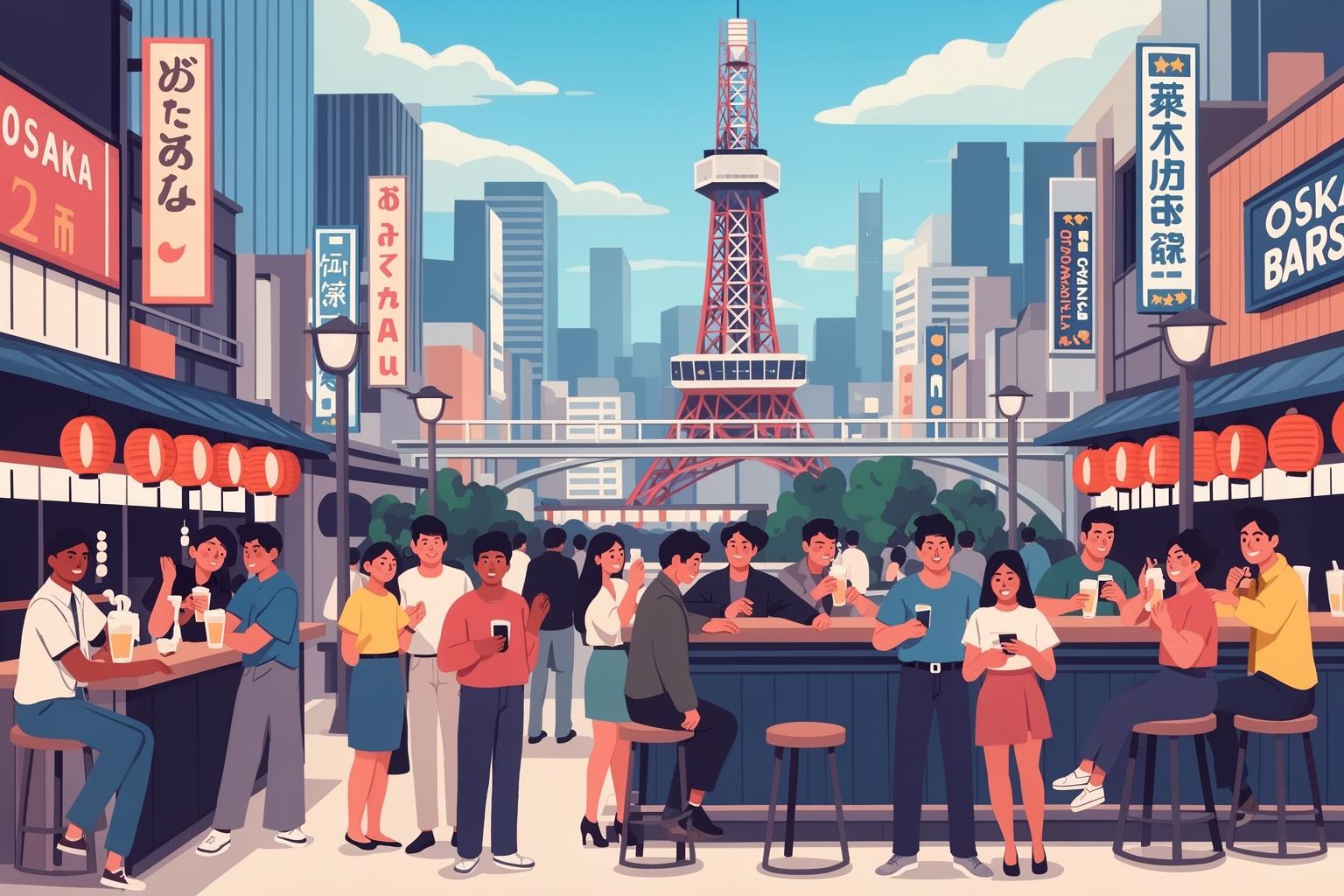
To truly understand the essence of an Osaka tachinomi, you first need to ask a simple question: Why are there no chairs? This isn’t due to oversight or merely a cost-saving tactic, though Osakans certainly value the latter. It reflects a philosophy. The lack of chairs shapes the entire experience. It indicates that this is a place of impermanence, a brief stop on the route from work to home, or between engagements. It’s the ideal spot for a “zero-kai,” the pre-party drink before the main event, or a “one for the road” after a long dinner. Comfort is not the goal. Efficiency is.
Why Stand? The Philosophy of Transience
Standing maintains high energy and keeps people moving. In a city known for its emphasis on speed and practicality—where people stand on the right side of the escalator to let hurried passengers pass on the left—the tachinomi physically embodies this mindset. It’s designed for quick turnover. You come in, have a beer and a couple of skewers, and then leave. The entire interaction might last just twenty minutes. This fleeting quality is exactly what makes it so socially accessible. There’s no big commitment. You don’t need to worry about being stuck in a long, awkward conversation or feeling pressured to drink for hours. The very structure offers a natural exit.
This sharply contrasts with the seated culture of a typical izakaya. There, you claim a territory—your table, your space, your group. The social energy is contained. In a tachinomi, the space flows. People shift, make room for newcomers, and form temporary social circles around the counter. This physical fluidity fosters social flexibility. Since everyone is just passing through, the barrier to interaction is very low. You’re all temporary occupants of the same small space, and that shared context often sparks connection. The standing format is the great equalizer; salaryman, student, or tradesperson, everyone shares the same vertical plane and the same counter space for a brief part of their evening.
A Different Kind of “Friendly”
The cliché says, “Osaka people are friendly.” It’s true, but “friendly” is a vague word. It doesn’t capture the particular character of Osakan social interaction. It’s not the polite, reserved friendliness found elsewhere in Japan. It’s a direct, engaging, and sometimes meddlesome friendliness—rooted in curiosity and a lack of pretense. And nowhere is this clearer than in a tachinomi.
In a Tokyo bar, starting a conversation with a stranger can be seen as a social faux pas. People usually keep to themselves or their party. Privacy is respected. In an Osaka tachinomi, the reverse is true. Silence can feel more uncomfortable than speaking. The communal space invites interaction. Your food is visible, your drink is visible, and so are you. It’s not unusual for the person next to you to comment on your order. “Oh, the doteyaki here is the best, nice choice.” Or, “First time here? You have to try the sashimi.” This isn’t intrusive; it’s welcoming. It’s a way of folding you into the temporary community of the bar.
This is the crucial difference. In many cultures, friendliness means respecting boundaries. In Osaka, it often means cheerfully crossing them. It comes from shared experience, not nosiness. They see you enjoying the same space, food, and beer, and assume a baseline of connection. This is why strangers might debate the latest Hanshin Tigers game, complain about their bosses, or recommend other bars as if they were old friends. The tachinomi isn’t a place you go with friends; it’s a place you go to be among people, any of whom might become a friend for the next fifteen minutes.
Reading the Room: The Unspoken Rules of Engagement
Though tachinomi are casual, they function according to a complex set of unwritten rules. This social etiquette acts as an invisible grammar that keeps the whole system running smoothly. For foreigners, it can be the most challenging part to grasp, since no one will explain it explicitly. You must learn by watching, making small mistakes, and gradually tuning into the rhythm of the space. Understanding these subtle signals distinguishes a mere tourist at the counter from an engaged participant in the culture.
The Art of Entering and Finding Your Spot
Your first challenge begins at the entrance. You don’t simply walk in and take a spot—that would be too bold. Instead, you gently slide the door open, peek inside, and try to catch the eye of the taisho (the master, usually the male owner/chef) or the mama-san (the female equivalent). A quick nod and holding up one finger to signal you’re alone usually suffices. They’ll scan the busy counter and, with a nod or chin gesture, point you toward a narrow available space. You then perform the tachinomi shuffle: a discreet “sumimasen” (excuse me) as you squeeze into your spot.
Personal space here is quite different. You will be shoulder-to-shoulder, sometimes literally pressed together. Your personal bubble shrinks to your body’s width. This isn’t rude; it’s essential to the experience. This close proximity acts as social glue. It’s impossible to ignore those next to you, so you might as well acknowledge them. Once settled, claim your spot with your drink and first plate. The counter is a stage, and everyone has a front-row seat. The best spots are often at the corners, offering some stability, or right in front of the taisho, where you can watch their skill and easily chat.
Ordering 101: Speed and Simplicity
Tachinomi moves at a brisk pace, especially when ordering. You need to act quickly. This is no place to study the handwritten menu on the wall for minutes at a time. The cardinal rule is “Toriaezu, biru”—”Beer, for now.” This secures a drink in your hand and signals you’re ready to join in. While sipping, you can see what others are enjoying and plan your next order.
Many traditional tachinomi operate on a cash-on-delivery system called kyasshu on. A small tray or basket is placed before you. Drop a few thousand-yen bills into it. When you order, the staff will take the exact amount from the tray, often giving change immediately. This exemplifies Osaka’s efficiency. There’s no waiting for a bill at the end or doing complex math. When your funds run out or you’re ready to leave, you simply go. This system highlights the bar’s transient nature; your financial exchange is as fleeting as your presence.
Keep your orders straightforward. The menu centers on quickly prepared items: grilled skewers (kushiyaki), fried skewers (kushikatsu), simmered dishes like beef sinew stew (doteyaki), or pre-prepared small plates (obanzai). Avoid substitutions or complicated requests. Trust the process. The taisho has been perfecting these dishes for decades. Pointing at what your neighbor is eating and saying “Are, kudasai” (“That one, please”) is entirely acceptable and often appreciated.
The Social Contract: How to Talk to Strangers (and When Not To)
Starting a conversation is an art. Begin by reading the room. Is the person next to you absorbed in their phone or a newspaper? Best to respect their space. Are they looking around, making eye contact with staff, or watching the TV? That’s an opener. A situational comment is the easiest way in: “It’s really packed tonight, huh?” Or if a baseball game is on: “Ah, the Tigers are losing again.” Food is always a safe, excellent topic: “That looks delicious. What’s it called?”
Once conversation starts, keep it light. This isn’t a therapy session but a brief, pleasant exchange. Stick to universal topics: sports, weather, work in broad terms, and especially Osaka’s food and drink. Asking for recommendations works well: “I’m new here. Know any good spots nearby?” Osakans love sharing their culinary knowledge. This question can turn a quick chat into a detailed neighborhood food map.
There are a few key taboos. One is insisting on treating others. Though generous, tachinomi culture relies on each person paying their own small, manageable tab. Buying a drink for a new acquaintance is fine, but covering their entire night can create unwanted obligation, clashing with the casual, no-strings vibe. Another is knowing when to leave. The charm of tachinomi is the clean exit. When the talk fades or you finish your last bite, that’s your signal. A simple “Well, I’m heading out” (O-saki ni shitsurei shimasu), with a nod to friends and staff, is enough. No lengthy goodbyes. Just as you arrived, you quietly slip back into the night.
Tachinomi vs. The World: An Osaka-Tokyo Deep Dive

To fully appreciate the distinctive social role of the tachinomi, it is helpful to directly contrast it with Tokyo’s predominant drinking culture. At first glance, both an izakaya and a tachinomi serve alcohol and small dishes. However, their underlying philosophies, social interactions, and the urban cultures they embody are vastly different. This comparison highlights a fundamental distinction between life in Osaka and life in Tokyo.
Tokyo’s Izakaya Culture: The Group Focus
Consider a typical night out in Tokyo, which usually starts with a reservation. You head to a particular izakaya with a specific group of people—colleagues, classmates, or friends. You are seated at a table, often in a private room or behind partitions. The social energy of the evening is concentrated inward, directed solely at your group, with the aim of strengthening existing relationships. Interaction with other tables is uncommon and may even be viewed as intrusive.
The experience is quite structured. Typically, there is a two-hour seating limit. Ordering may involve a set course menu or a hurried effort to decide what to share. The evening ends with the familiar ritual of splitting the bill. The izakaya is a destination, a planned occasion focused on the comfort and privacy of the pre-arranged group.
Osaka’s Tachinomi: The Individual as the Social Unit
Conversely, the Osaka tachinomi works on a different principle. The primary customer is the individual. It is one of the few social venues in Japan where coming alone is not only accepted but often preferred. No reservation is necessary. No group is required. All you need is yourself and a bit of money.
Here, social energy extends outward. The entire bar acts as one large, loosely connected group. Conversations flow along the counter, with people joining and leaving as they wish. The goal is not to reinforce existing ties but to form new, temporary ones. This space promotes chance encounters and spontaneous connections, reflecting a more open, fluid, and individualistic approach to socializing. In Tokyo, your social life tends to be shaped by the groups to which you belong. In Osaka, you have greater freedom to define it moment by moment in a setting like a tachinomi.
Common Foreign Misunderstandings
This core difference often leads to misconceptions among foreigners. One is dismissing a tachinomi as merely a “dive bar.” Although unpretentious, these places embody tremendous pride and professionalism. The taisho is more than a bartender—they are a skilled chef, an expert in efficiency, and the curator of the bar’s vibe. The food, while simple, is frequently of outstanding quality, prepared with fresh ingredients and years of experience. It’s affordable but certainly not low-grade.
Another misunderstanding is assuming the lively atmosphere means patrons are there just to get drunk. While drinking is central, the culture emphasizes a quick, sharp buzz rather than prolonged intoxication. The fast turnover and food focus help keep this in balance. It’s a spirited social ritual, not a chaotic free-for-all. There is an unspoken, shared understanding of limits.
The most important misconception, however, is misreading the local friendliness. When a stranger strikes up a conversation in an Osaka tachinomi, they almost certainly aren’t trying to sell you something or exploit you. They are simply being… Osakan. Curiosity and a wish to connect are what motivate them. They notice a new face and genuinely want to know more: “Where are you from?” “What do you do in Osaka?” “Do you like baseball?” These are not intrusive questions, but invitations. Embracing these invitations without suspicion is the key to unlocking the true social experience of these places.
Navigating the Landscape: A Field Guide to Osaka Tachinomi Archetypes
Not all tachinomi are created equal. They form a diverse ecosystem, with different types suited to various neighborhoods and clientele. Learning to identify these archetypes will help you pick the perfect bar to match your mood and comfort level. For instance, a newcomer might want to avoid the grizzled veteran’s haunt on their first visit. Here’s a brief guide to the different kinds.
The Showa-Era Relic
You’ll recognize this one by its scent: a warm, comforting aroma of dashi broth and aged wood. The counter is worn smooth from decades of elbows resting upon it. The walls are yellowed with time and smoke, adorned with handwritten paper menus that have faded over the years. The taisho is a quiet, weathered man who moves with a practiced economy of motion shaped by half a century behind the same counter. The clientele consists mostly of regulars—older men who have frequented the place since their youth. They each have their designated spots and usual orders. As a newcomer, you are a rarity here. The best approach is one of respect. Find your place, order a simple drink along with the house specialty—likely doteyaki or oden—and remain quiet. Listen. Observe. If one of the old-timers speaks to you, it means you’ve been accepted into their sacred space. These bars are the living archives of Osaka’s soul, located in places like Shinsekai or the back alleys of Kyobashi.
The Modern, “Stylish” Tachinomi
This represents the new wave. Instead of wood, you’ll find polished concrete and stainless steel. Instead of handwritten menus, chalkboards display craft beer, natural wine, or a curated selection of premium sakes. The food is more inventive—think smoked mackerel paired with potato salad, or Italian-inspired small plates. The crowd is younger, with a more balanced mix of men and women. The atmosphere leans less toward grizzled camaraderie and more toward a shared appreciation of quality food and drink. These bars are much less intimidating for beginners. The staff tend to be younger and more willing to explain the menu. The social rules are more relaxed. You’ll find these thriving in neighborhoods like Fukushima and Ura-Namba, offering an accessible entry point into the tachinomi scene for a new generation.
The Market-Adjacent Specialist
These are working bars for working people, often clustered near Osaka’s central markets or deep within the city’s many shotengai (covered shopping arcades). Their identity is closely tied to their location. Near a fish market, expect sashimi or tempura tachinomi serving incredibly fresh seafood at unbeatable prices. In meat-packing areas, you’ll find outstanding horumon (offal) skewers. The vibe is fast-paced and functional. Patrons come during lunch breaks or after long shifts. You eat, you drink, and you leave. The emphasis is on the product. Conversation takes a back seat to savoring the perfect piece of tuna or a freshly fried prawn. This is tachinomi boiled down to its practical essence.
The Chain Tachinomi
Typically found near major train stations, these are the most accessible but least atmospheric of the varieties. They are brightly lit, with standardized plastic menus and a predictable selection of drinks and food. They resemble a fast-food version of the standing bar. While they lack the charm and sense of community found in independent establishments, they serve an important purpose. They provide a zero-risk training ground. The barrier to entry is virtually non-existent. You can walk in, practice ordering, get accustomed to the rhythm of eating and drinking while standing, and leave without needing to navigate any complex social codes. They offer a safe space to build your confidence before venturing into the more authentic, rewarding—and sometimes intimidating—world of the true tachinomi.
Beyond the Beer: What Tachinomi Teach Us About Living in Osaka
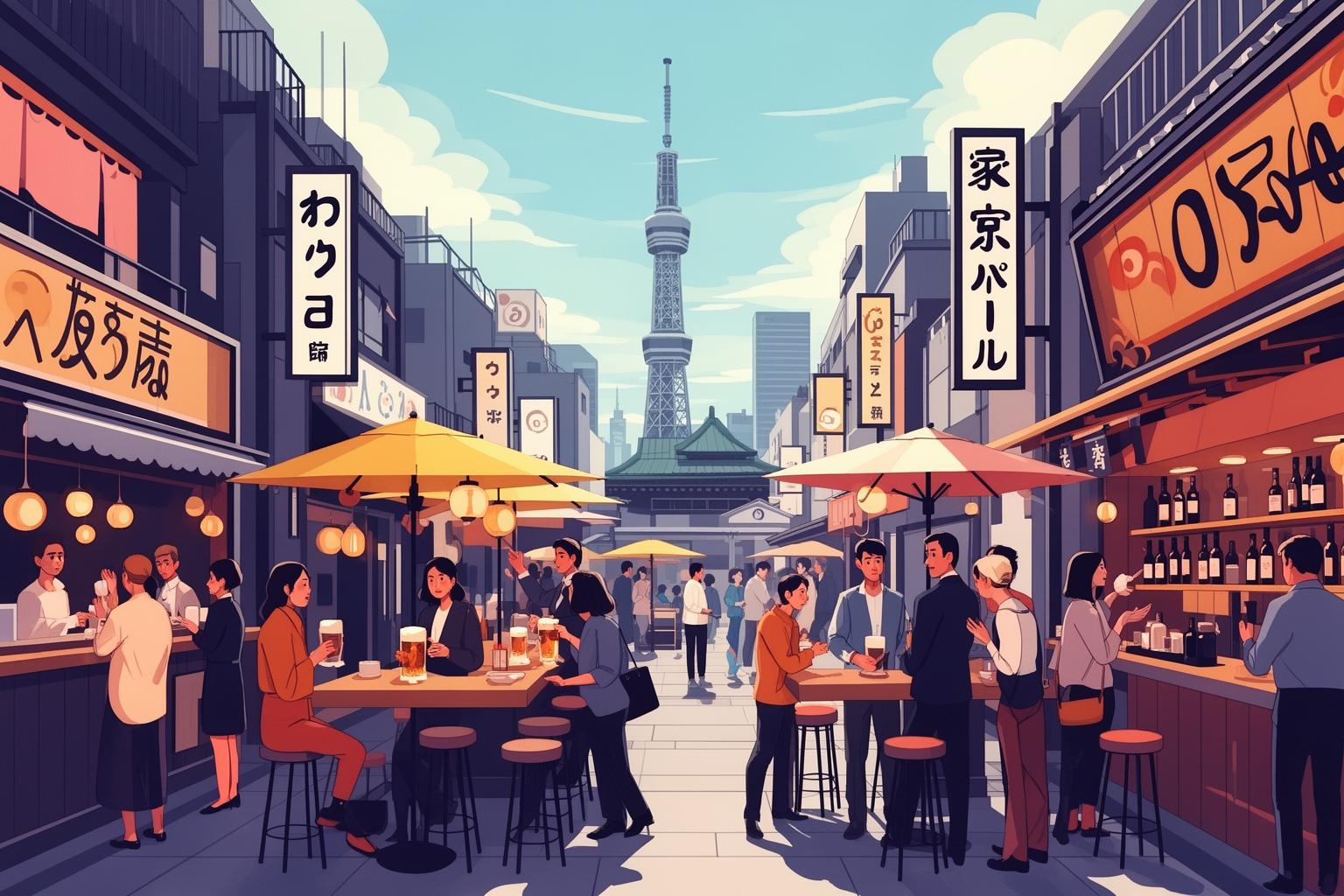
The tachinomi is more than just a drinking spot—it’s a cultural classroom. Pay close attention, and it will reveal some of the most essential lessons about Osaka’s mindset, values, and what makes this city so uniquely livable. Here, the city’s abstract ideals of pragmatism and community transform into tangible, everyday experiences.
The Economics of Happiness
There’s a concept called senbero, which literally means “1,000 yen drunk.” It’s the skill of enjoying a pleasant buzz and a few snacks for about ten dollars. The tachinomi is the sacred ground of senbero. This goes beyond frugality; it’s a philosophy of accessible enjoyment. It embodies the deeply rooted Osakan belief that good times shouldn’t be a luxury, nor require elaborate planning or a hefty wallet. Happiness should be available any day of the week, for just a few coins in your pocket.
This stands in stark contrast to the status-driven consumption found in other major cities. In Osaka, little social capital is gained from frequenting the priciest, most exclusive bars. True prestige lies in knowing the best, most delicious, and most affordable places. The tachinomi democratically opens socializing to everyone, regardless of income, providing a spot to relax, connect, and feel part of a community. It’s a daily affirmation that the best things in life are often not just free, but also wonderfully inexpensive.
The Beauty of the Third Place
Sociologists emphasize the importance of the “third place”—a setting that is neither home (the first place) nor work (the second place). These third places anchor community life, encouraging creative interaction and fostering a sense of belonging. The tachinomi is the quintessential Osakan third place. For many people living in small apartments, it serves as a public living room, an extension of their private space.
It acts as a pressure valve for the stresses of work and family obligations. It’s a space where you can momentarily shed your professional or domestic roles and simply be a person among others. This network of accessible, informal gathering spots greatly contributes to Osaka’s celebrated livability. It builds community on a micro-level, one counter at a time. It nurtures the feeling that even in a vast metropolis, you’re never truly alone. There’s always a light on, with a seat at the counter waiting for you somewhere.
A Final Toast to Spontaneity
If there is one profound lesson the tachinomi imparts, it is the value of spontaneity. These are not places you plan; they are places you stumble upon. They reward taking a different route home, following an unexpected impulse, or embracing the unplanned moment. They stand against the overly scheduled, optimized life.
Living in Osaka, you come to realize that the best experiences often catch you by surprise—a conversation with a stranger that leads to a favorite new ramen spot, or a quick drink that evolves into an evening of laughter with people whose names you may forget tomorrow. The tachinomi embodies this spirit. It’s a space that cannot be fully appreciated through a screen or guidebook—it demands your presence and rewards your participation. So the next time you see that warm glow spilling from a narrow doorway, don’t just pass by. Take a breath, slide open the door, and find your place. Order a beer. You’re not just having a drink; you’re joining the living, breathing culture of Osaka.