The first time you slide onto a stool at a proper, old-school Izakaya in Osaka, deep in the labyrinthine alleys of Namba or under the rumbling train tracks in Tenma, you’ll feel it. It’s not the warmth of the sake or the smoky kiss of grilled yakitori. It’s the sound. A wall of sound, a cacophony of conversation that doesn’t ebb and flow like polite chatter but crashes and roars like a friendly storm. You’ll hear a loud declaration from a man at the end of the counter, followed by what sounds like a sharp rebuke from the bar master, which is then met with a wave of uproarious laughter from everyone within earshot. It’s fast, it’s loud, and to the uninitiated ear, it can sound like everyone is constantly arguing. You might find yourself shrinking into your seat, wondering if you’ve stumbled into a private party or a public dispute. You haven’t. You’ve just found the beating heart of Osaka’s social life, a nightly performance powered by a conversational engine known as boke-tsukkomi.
This isn’t just about telling jokes. It’s a fundamental part of the city’s dialectic, a social glue that binds strangers and strengthens friendships. Forget the reserved, deferential image of Japanese communication you might have in your head. Here, conversation is a contact sport, a playful dance of setup and punchline, of absurd statements and witty retorts. Understanding this rhythm is the key to unlocking the city. It’s the difference between observing Osaka from behind a pane of glass and stepping through the door to join the party. This isn’t a guide to comedy clubs; it’s a survival manual for the social safari of an Osaka bar, a lesson in how to listen, what to say, and why the sharpest insult is often the warmest welcome. Before we dive into the verbal acrobatics, let’s get our bearings. The entire city is a stage for this unique brand of interaction, but the Izakayas are where the curtain rises every single night.
Once you’ve mastered the art of the retort, you’ll find that navigating other aspects of daily life in the city, like Osaka’s unique train etiquette, becomes a much more intuitive and engaging experience.
The Boke-Tsukkomi Engine: More Than Just Jokes
At its heart, Osaka’s lively banter is founded on a two-part structure, a concept borrowed from manzai, Japanese stand-up comedy, which was refined and popularized right here. These two roles are the boke and the tsukkomi. Think of them as the two gears that keep the engine of conversation running. Without both, the machine grinds to a halt. Grasping this dynamic pair is the essential first step to understanding the city’s distinctive social code. It’s not about formal comedy; it’s about using comedy’s framework to foster connection, show affection, and make everyday moments a little more entertaining.
Breaking Down the Duo: The Fool and the Straight Man
The boke (ボケ) is the fool, the joker, the one who initiates the joke. Being the boke isn’t about genuine ignorance. It’s a skillful, deliberate act of saying something absurd, exaggerated, out of place, or simply incorrect. It’s a verbal pitch, thrown into the conversation expecting someone to hit it back. A boke might look at a tiny plate of pickles and say, “Wow, a feast! This will feed my family for a week!” Or complain about perfect weather, “Ugh, another sunny day. So boring. I was hoping for a typhoon.” This isn’t a factual claim; it’s an invitation. A lonely boke left unanswered is one of the most awkward silences you can experience in Osaka—a joke ignored, a high-five missed.
Then comes the tsukkomi (ツッコミ), the straight man, who delivers the punchline. The tsukkomi’s role is to spot the boke’s absurdity and call it out quickly and sharply. When someone proclaims the pickles a feast, the tsukkomi shoots back, “For a family of ants, maybe!” When another complains about the sun, the tsukkomi retorts, “Go back inside then, vampire!” The classic and ubiquitous tsukkomi you’ll hear numerous times daily is 「なんでやねん!」(Nande yanen!), roughly meaning “Why?!” or “What the hell are you talking about?!” This response is vital. It acknowledges the boke, signaling, “I heard your ridiculous statement, recognize it as a joke, and I’m playing along.” Timing is everything. A good boke-tsukkomi exchange is like a quick jab-jab-cross—fast, precise, and perfectly timed.
Why It’s Not Rude (But a Sign of Friendship)
For those used to the more reserved communication styles elsewhere in Japan, especially Tokyo, this can feel startling. In a culture that often values indirectness (tatemae, one’s public face) and avoids confrontation, the tsukkomi can sound harsh, dismissive, or rude. Directly pointing out someone’s foolish statement might seem like a social mistake. But in Osaka, the opposite is true. The worst insult to a boke is to ignore it or, even worse, take it seriously. If someone says, “I’m so good at my job, the president will probably give me the company,” and you respond with a polite “Oh, really? What makes you say that?”—you’ve killed the conversation. You’ve failed the test. The proper response is a sharp “You? They wouldn’t even give you the key to the bathroom!”
A tsukkomi is an expression of intimacy. It signals comfort and understanding. It shows you’re paying attention, on the same wavelength, and that you care enough to engage in this verbal sparring. It’s a shortcut to friendship. While Tokyo conversations build rapport through gentle agreement and shared observations, Osaka discussions create it through playful opposition and shared laughter. It’s a rapid-fire way to establish equality, where no one needs to stand on ceremony. It’s the sound of friendship forming in real-time, over inexpensive beer and grilled chicken hearts.
Your Field Guide to Izakaya Banter: Reading the Room
Entering a local izakaya feels like stepping onto a stage already in the middle of a performance. The cast is set: the weathered owner behind the counter, the usual regulars settled on their favorite stools, and the simmering pot of oden releasing steam into the air. To navigate this environment, you must learn to recognize the key players and grasp the language—both spoken and unspoken—that keeps the scene flowing. It’s less about having perfect vocabulary and more about sensing the room’s rhythm.
The Master of the House: The Taisho’s Role
The central figure in any small, local izakaya is the taisho (master) or mama-san (female owner). They are much more than mere cook and bartender. They act as director, conductor, and often the lead character in the evening’s performance. A skilled taisho knows their customers well—their jobs, families, and especially their sense of humor. They often serve as the main source of boke, using their position to gently tease patrons and stir up lively conversations. For example, when a young salaryman arrives, the taisho might call out, “Oh, look who it is! Finally decided to do some real work today?” This isn’t a criticism but a warm welcome—an opening for the salaryman to reply with his own tsukkomi, such as, “I’ve been working hard to make money to spend it all here on your overpriced edamame!” Laughter follows, the ice breaks, and the taisho sets the tone. If the master is playful and quick-witted, the whole bar reflects that mood. They are the gatekeepers of the atmosphere, and gaining their favor means being treated not just as a customer, but as part of the temporary family that forms nightly around the counter.
The Language of the Counter: Common Tsukkomi Phrases and When to Use Them
While “Nande yanen!” is the quintessential Osaka catchphrase, the tsukkomi repertoire is broad and varied. Learning a few key expressions will help you understand the flow of conversation and prepare you for your first foray into the playful exchange. The key lies in the tone; these phrases are almost always delivered with laughter and a smile that softens the apparent sharpness of the words.
「アホか!」 (Aho ka!): Literally, “Are you an idiot?!” While it may sound harsh, in Osaka it’s often a term of affection—a verbal pat on the back. It’s used when someone says something particularly silly or obvious. For instance, if a friend complains about the cold while only wearing a t-shirt in winter, saying “Aho ka! Go put on a jacket!” is a perfectly normal, even caring response. It’s the verbal equivalent of a playful nudge.
「やかましいわ!」 (Yakamashii wa!): Meaning “You’re too loud!” or “Be quiet!” This phrase is used when someone’s boke goes over the top or boasts wildly. If someone nearby tells an exaggerated story about catching a fish the size of a car, a well-timed “Yakamashii wa!” from the taisho is the perfect way to tone them down, much to everyone’s amusement.
「知らんけど」(Shiran kedo): Known as the ultimate conversational cheat code in Osaka, it means “…but I don’t really know though.” This magical phrase can be added to nearly any statement, instantly releasing the speaker from responsibility for its truth. It allows someone to offer a wild opinion, questionable advice, or a bold prediction without risk. “You should definitely quit your job and become a street performer. You’d make millions. Shiran kedo.” It blends confidence with self-deprecation, humorously implying, “Here’s my thought, but don’t blame me if it’s totally wrong.”
「ほんまかいな?」(Honma kai na?): A gentler, more curious tsukkomi meaning “Is that really true?” or “Are you serious?” It’s ideal for beginners because it’s less confrontational, expressing doubt while inviting the boke either to double down on their absurd claim or admit they’re joking. It keeps the conversation moving without demanding a sharp comeback.
The Physicality of Tsukkomi
Sometimes, words alone don’t suffice. You will often see a tsukkomi accompanied by a light, open-handed tap, usually on the shoulder or top of the head. This gesture is borrowed from manzai comedy, where the straight man lightly strikes the fool with a paper fan. In real life, this is reserved for people with close relationships. It’s a physical exclamation mark. As a foreigner, it’s best to observe this but not try to imitate it, as it requires a nuanced understanding of social context to avoid offending. However, recognizing this gesture is important—when you see an older man gently tap his friend’s head after a silly remark, you’re witnessing a deep expression of Osaka-style friendship.
From Spectator to Participant: Your First Tsukkomi
For months, you might be content to simply sit and listen, a smiling observer soaking up the verbal tennis match. But eventually, the urge to join in will surface. The moment will arrive when a perfectly juicy boke floats in the air, directed right at you. The barman slides you a beer topped with a huge, overflowing head of foam and says, “Here you go, fifty percent extra, just for you!” The regulars glance your way, a sparkle in their eyes. The silence is your signal. What do you do? This is the moment of truth.
The Fear of Getting It Wrong
Let’s be honest: it’s intimidating. Your Japanese might not be flawless. You worry your timing will be off, your pronunciation awkward. What if you try to be funny but come across as rude? What if you misread the tone and look foolish? These concerns are all valid. But here’s the secret: in Osaka, a failed attempt at a tsukkomi is often just as funny as a successful one. The fact that you, the foreigner, are even trying to join the game is charming. It shows you’re making an effort to connect on their terms. A clumsy “Nande yanen!” that comes a second too late will likely be met with warm, encouraging laughter. They’re not laughing at you; they’re laughing with you, celebrating that you’re in on the joke. The biggest mistake isn’t failing; it’s not trying at all.
Finding Your Opening: Spotting the Boke in the Wild
Before you can deliver a tsukkomi, you need to learn to spot a boke. Train your ear to catch the tell-tale signs. Is someone exaggerating wildly? (“I was so busy today, I didn’t even have time to breathe!”) Are they being hilariously self-deprecating? (“My singing is so bad, cats run away when I start.”) Are they stating something obviously, comically untrue? (“This cheap convenience store wine is better than anything from France.”) These aren’t facts; they’re offerings—conversational gifts wrapped in absurdity, waiting for you to unwrap them with a sharp retort. The more time you spend in these settings, the more your boke-detector will sharpen. You’ll start to spot them everywhere, not just in bars, but in all corners of daily life.
Your Beginner’s Toolkit: Safe and Effective Retorts
You don’t need to come out swinging with a perfectly delivered “Aho ka!” on your first try. There are beginner-friendly tsukkomi that are safe, effective, and will do the job. When the barman hands you that foamy beer, you have choices.
The Simple Question: A smiling, incredulous “Honma kai na?” (“Really?”) is a great starting point. It’s non-aggressive and shows you get the joke.
The Exaggerated Reaction: Sometimes, no words are needed. A loud, drawn-out “Ehhhhhhhh?!” paired with wide eyes and a laugh is a universal sign that you find the situation ridiculous. It’s a non-verbal tsukkomi.
The Repeat-Back: One of the easiest and most effective techniques is to isolate the most absurd part of the boke and repeat it back as a question. To the barman, you could point at the foam and say with a grin, “This is the extra part?” It shows you’re engaged and playing along, without needing complex grammar.
Remember, your goal isn’t to win a comedy award. Your goal is to complete the social circuit. Laughing, smiling, and showing in any way that you understood the humor is, in itself, a successful tsukkomi. It tells the boke, “Message received.” And with that simple act, you’ve begun to cross the invisible line from outsider to participant.
The Tokyo-Osaka Divide: Why This Doesn’t Fly Everywhere
It’s important to recognize that this conversational style is a regional specialty. What counts as friendly banter in Osaka can be interpreted very differently just a few hundred kilometers away in Tokyo. Many misunderstandings and stereotypes about Osakans—that they’re loud, brash, or lack manners—originate from this fundamental difference in communication style. Attempting to engage a quiet Tokyo bartender with a loud tsukkomi will likely result in confused silence and subtle concern.
Communication as Transaction vs. Communication as Entertainment
Generally speaking, communication in Tokyo tends to be more transactional. The main objective is often a clear, efficient, and polite exchange of information. There is a strong focus on maintaining harmony, reading the air (kuuki wo yomu), and respecting personal space, both physical and conversational. Small talk is more restrained, usually revolving around neutral topics like the weather or the seasons. In this context, conversation serves as a means to an end.
In Osaka, by contrast, communication often functions as entertainment in itself. Sharing information is secondary to the aim of enjoying the interaction. The conversation is not just a tool—it’s the main event. This is why Osakans have a reputation for being talkative and curious. They’re not necessarily prying; they’re searching for an opening, a detail they can use to launch a round of boke-tsukkomi. The story takes precedence over literal facts. An Osakan describing their commute won’t simply say, “The train was crowded.” Instead, they might say, “The train was so packed, I think I came out two inches shorter! They should charge by the square centimeter!” They are performing, not merely reporting.
The Misunderstanding of “Aho” and “Baka”
This cultural gap is most apparent in the use of two simple words for “idiot”: aho and baka. In Osaka and the Kansai region, 「アホ」 (aho) is the preferred term. Used among friends or acquaintances, it acts as a lighthearted, almost affectionate tease. It’s like a friendly nudge. 「もう、アホやな〜」 (“Geez, you’re such a goofball”) is a common expression that carries a warm, familial tone.
In Tokyo and the Kanto region, however, 「バカ」 (baka) is more common, and aho carries a much stronger, genuinely insulting edge. Calling someone from Tokyo “aho” can be seen as a serious insult, implying a deep lack of intelligence. Conversely, if an Osakan is called “baka,” it can feel unusually formal and distant, as though the speaker is truly angry. Numerous stories exist of Osakans moving to Tokyo and accidentally offending colleagues by attempting friendly rapport with “Aho ka!” only to be met with stony silence. It’s a powerful linguistic lesson: the same word can be a hug in one city and a slap in another.
Tsukkomi Beyond the Bar: Seeing It in Daily Life
This conversational dance isn’t limited to the glowing red lanterns of izakayas. Once you learn to identify the pattern of boke and tsukkomi, you’ll notice it everywhere. It is woven into the fabric of daily life in Osaka, turning ordinary errands into chances for brief moments of human connection and humor. The whole city is a stage, and every resident a potential comedic partner.
At the Supermarket Checkout
Next time you’re waiting in line at a neighborhood supermarket in places like Shinsaibashi or Tenjinbashi-suji, pay close attention. The exchange between the cashier—often a middle-aged woman, or obachan—and the regular customers is a lesson in everyday banter. The obachan might scan a basket filled with instant noodles and beer and say with a sigh, “Trying to win a prize for the unhealthiest diet? Your mother would be ashamed!” This is classic boke—a playful intrusion into the customer’s life. The customer, without hesitation, counters with a tsukkomi: “This is my secret training regimen! I’m preparing for a marathon of sitting on my couch.” This brief two-second exchange forms a complete manzai routine. It costs nothing, yet it brightens an otherwise dull transaction and strengthens their community bond.
Haggling (or “Pretending to Haggle”) in the Shotengai
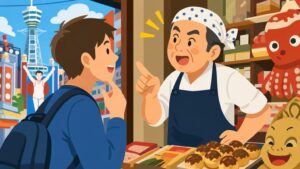
Stroll through any of Osaka’s sprawling covered shopping arcades, or shotengai. The air buzzes with vendors’ calls and shoppers’ chatter. While serious price negotiation isn’t as common as in some cultures, a style of performative haggling exists that is pure boke-tsukkomi. It’s less about the money and more about the relationship. A fishmonger might hold up a sea bream and proclaim, “This fish is so fresh, it will swim to your house by itself!” The shopper might examine it and reply, “For that price, it better cook itself and wash the dishes too!” The vendor laughs, knocks a trivial 50 yen off, or throws in extra ginger, and the deal is done. Both parties leave smiling. This transaction isn’t merely commercial; it’s social. They connect, share a laugh, and play their parts in a cherished Osaka ritual.
Even on the Train
While public transportation in Tokyo is often marked by library-like silence, the atmosphere in Osaka can be more relaxed. It’s not a constant party, but the distance between strangers feels thinner. An elderly woman might notice you fanning yourself on a hot day and say, “You’re going to blow yourself all the way to Kyoto if you’re not careful!” It’s a small boke, inviting a quick, friendly exchange. A simple laugh and nod serve as tsukkomi, but a verbal comeback like, “It’s either that or melt into a puddle right here!” is even better received. These moments are brief, small but perfect examples of the city’s default mode: open, engaged, and ready for a bit of fun.
The Deeper Meaning: Why Osaka is Built on Banter
This distinctive communication style is no coincidence. It directly reflects Osaka’s rich and extensive history as Japan’s commercial hub. For centuries, this city was home to merchants, traders, and artisans. Unlike the strict, hierarchical samurai society characterizing Edo (present-day Tokyo), Osaka’s culture was molded by the marketplace. In business, success relied not on one’s birthright but on the ability to build trust, form relationships, and negotiate deals swiftly and effectively. Humor has always been, and continues to be, the ultimate tool for this.
Formal, polite language creates distance; it acts as a barrier. In contrast, the rapid-fire exchange of boke and tsukkomi is meant to break down those barriers as quickly as possible. It serves as a way of testing the waters, saying, “Let’s drop the formalities and reveal who you really are.” This culture values showing one’s true self, or honne, more openly, using humor as social lubricant to ease that directness. A shared laugh is the quickest route to mutual understanding and trust—a principle that holds true both at the corporate negotiating table and the corner takoyaki stand.
This is why the cliché “Osaka people are friendly” is both accurate and misleading. Their friendliness isn’t passive or gentle; it’s an active, engaging, and sometimes challenging form of interaction. They are not just friendly to you; they invite you to be friendly, clever, and funny with them. The wall of sound you first encounter in a local izakaya is not meant to exclude you. It’s a signal, broadcasting the city’s frequency. The nonstop banter is a subtle challenge, an open-ended question: “Are you one of us? Can you keep up? Do you understand?”
Learning to throw back a simple retort, to catch a boke and return it with a smile, is more than a language skill. It is the act of tuning into that frequency. It marks the moment you accept an invitation that has always been there. It is the moment you stop being a tourist or temporary resident and begin, just for a moment, to feel truly part of the beautiful, chaotic, and hilarious performance that is everyday life in Osaka.