
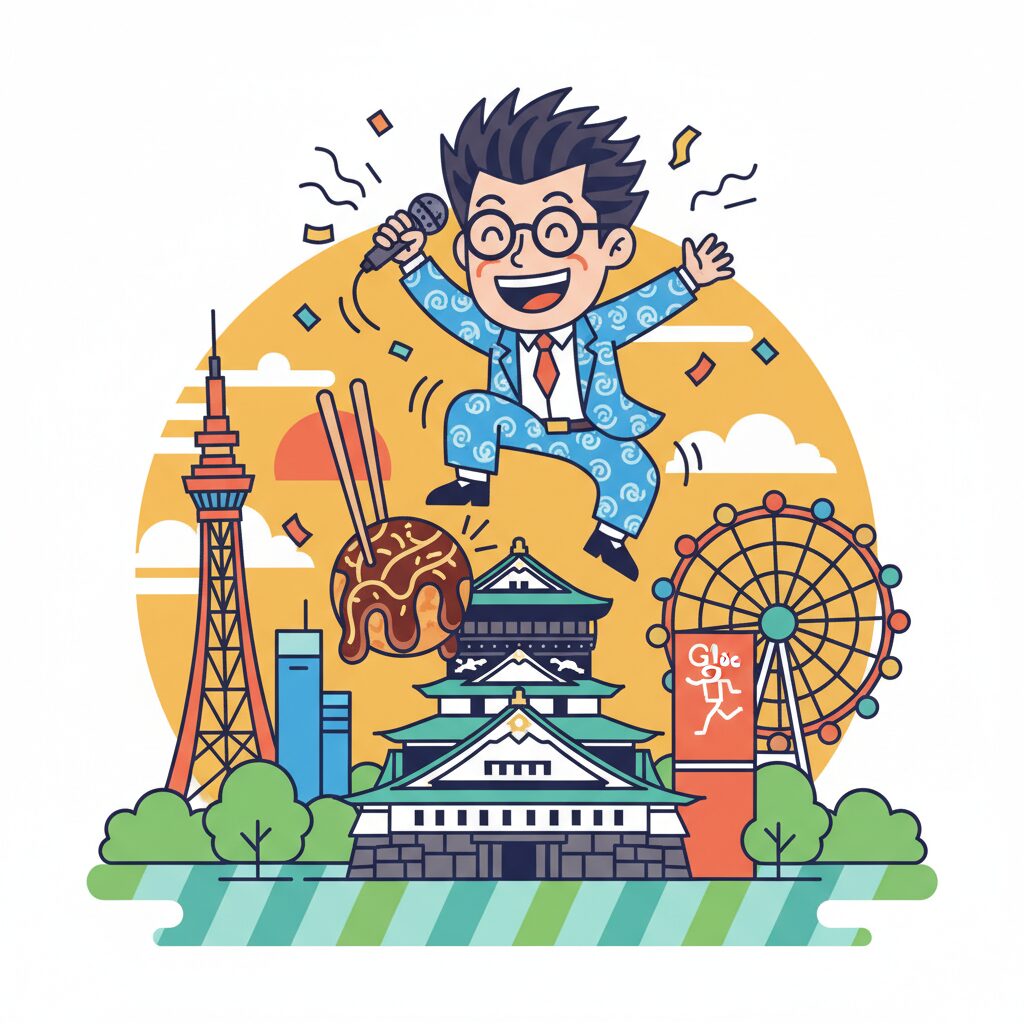
You’ve just moved to Osaka. You’re at a local supermarket in Tenma, trying to decide which brand of soy sauce to buy. An elderly woman running the register, who you’ve never spoken to before, catches your eye. She points to the expensive, artisanal bottle in your hand, then to the generic store brand, and says with a perfectly straight face, “If you buy that one, you’ll be too fancy for the rest of us. We won’t be able to talk to you.” You pause, confused for a second, before she breaks into a wide, crinkling grin. You’ve just had your first lesson in Osaka’s most fundamental language: humor. This isn’t just a city of famous comedians and grand theaters; it’s a place where comedy is the very fabric of daily life, the operating system for social interaction. It’s a stark contrast to the quiet, reserved image of Japan often portrayed abroad, and it can be one of the most confusing, yet ultimately rewarding, aspects of living here.
For many foreigners, Japan is synonymous with politeness, indirectness, and a certain social distance. Tokyo, in many ways, embodies this. Conversations are often measured, service is impeccably formal, and social harmony is maintained by not rocking the boat. Then there’s Osaka. Here, harmony is achieved through a different method: breaking down walls with a shared laugh. A joke from a stranger isn’t an intrusion; it’s an invitation. A playful jab from a colleague isn’t an insult; it’s a sign of affection. This article is your decoder ring. It’s not about where to see a comedy show, but how to understand the show that’s happening all around you, every single day, on the streets, in the shops, and in the offices of this vibrant, noisy, and hilarious city. At the heart of this culture is a spirit that is perhaps best symbolized by its most famous comedy institution, the Namba Grand Kagetsu theater, the epicenter from which this city’s unique comedic energy radiates.
This everyday humor is a form of social currency, much like the famous Osaka ‘Ame-chan’ culture where small gestures build community.
The Punchline is the Point: Rethinking Conversation
In much of the world, a story follows a linear sequence of events. You recount what happened, from beginning to end, to convey information. In Osaka, a story without an `ochi`—a punchline or clever twist at the conclusion—is seen as a failure. It’s like serving a meal without the main dish. The purpose of conversation there is not just to exchange facts; it’s to collaboratively create an entertaining experience. This fundamental difference in communication style takes many newcomers, including Japanese people from other regions, a long time to fully understand.
Imagine telling a coworker about your morning commute. A typical, information-focused report might sound like this: “The train was really crowded this morning. I had to wait for the next one, so I was a few minutes late.” It’s straightforward, clear, and in Tokyo, it would be perfectly acceptable communication. In Osaka, that story is a dead end. It offers nothing for your conversational partner to latch onto. An Osakan, telling the same story, instinctively seeks the `ochi`. They might say, “The train was so packed this morning, I was squeezed up against this old guy who was reading a newspaper. The train lurched, and for a second, my face was pressed right into the stock market page. For a brief moment, I was richer than I’ll ever be!”
Do you see the difference? The second version is not just about being late; it’s a mini-performance. It includes a setup, a bit of drama, and a punchline. Your listener is rewarded with a chuckle for their attention. This expectation to entertain is ingrained from childhood. Children in Osaka learn to tell stories with flair, to find humor in everyday frustrations, and to captivate their audience. It’s a form of social currency. Being `omoroi` (interesting, funny) is a high compliment, often valued more than being serious or intelligent. This can be daunting for foreigners. You may feel like you’re constantly performing, that every story needs to be crafted into a comedic act. The key is not to become a professional comedian overnight. It’s to realize that when an Osakan asks, “What did you do this weekend?”, they’re not just inquiring about your schedule. They’re offering a stage, a subtle invitation to share something amusing, relatable, or absurd. The story about how you tried cooking a new dish and nearly set off the fire alarm is far more engaging in conversation than simply saying, “I stayed home and watched a movie.” The `ochi` doesn’t have to be a perfect joke; it just needs to show you understand that the goal is shared enjoyment, not mere information exchange.
Are You the Funny One or the Straight Man? The Boke & Tsukkomi Dynamic
The most prominent and fundamental structure of Japanese comedy, especially the `manzai` style that Osaka is renowned for, is the interaction between the `boke` and the `tsukkomi`. The `boke` is the funny character—the airhead who says or does something ridiculous, absurd, or out of place. The `tsukkomi` is the straight man, the one who points out the absurdity with a sharp, witty comeback, grounding the conversation and creating the humor. What many foreigners often overlook is that this isn’t merely a theatrical device; it is the core framework for the majority of social interactions in Osaka.
More Than Just a Comedy Routine
This dynamic unfolds constantly in everyday life. It’s a conversational dance that people fall into effortlessly. You’ll notice it between friends, family members, coworkers, and even between shopkeepers and customers. The `boke` deliberately introduces a small, harmless absurdity, and the `tsukkomi`’s role is to nudge it back into place. This call-and-response rhythm is the heartbeat of communication in Osaka.
Imagine you’re out for lunch with a friend. Your friend, gazing at a picture of a gigantic ramen bowl on the menu, says with wide-eyed sincerity, “I think I could finish that in five minutes.” That’s the `boke`. They’ve just thrown a comedic line into the air. A non-Osakan might respond literally: “No, you couldn’t; that’s huge.” But the `tsukkomi` reply is sharper and more playful: “Five minutes? The hospital would need ten just to prepare the stomach pump. Don’t be ridiculous.” The classic `tsukkomi` often comes with a light, open-palmed tap on the arm or shoulder, accompanied by the iconic Osaka phrase, `Nandeyanen!` (loosely meaning “Why the heck?!” or “What are you talking about?!”). This isn’t aggression; it’s punctuation—a comedic exclamation point completing the sentence.
You’ll see this everywhere. A butcher might hold up a piece of chicken and say, “This chicken was so happy, it practically flew into the shop itself!” (`boke`). The customer’s expected response is something like, “If it was that happy, maybe I should let it go. Give me the grumpy-looking one instead.” (`tsukkomi`). This back-and-forth turns a routine transaction into a moment of human connection. It affirms a shared understanding of the world and a shared willingness to bend its rules for a moment of fun.
Finding Your Place in the Conversation
For foreigners, the idea of joining this fast-paced banter can be intimidating. There’s worry about saying the wrong thing, about your Japanese not being quick enough, or simply not being funny enough. Here’s the secret: you don’t have to be the star. In fact, being a good `tsukkomi` is often easier and more socially appreciated for a newcomer than trying to play a clever `boke`.
Your main role is to recognize when the ball is tossed to you. When your coworker claims they could run a marathon tomorrow without any training, they’re not seeking a serious discussion about their fitness—they’re playing `boke`. Your job is simply to acknowledge the joke. You can do this with a simple phrase like `Muri muri!` (No way, impossible!) or `Aho ka!` (Are you an idiot?), said with a laugh. Tone is everything. As long as you’re smiling, these phrases are terms of endearment—a sign that you understand the game.
Learning to spot the `boke` is a skill. It’s in the slight exaggeration of a statement, the sparkle in someone’s eye, or the deliberate misstatement of a well-known fact. Once you tune in, you’ll realize it’s happening all the time. Your landlord, noticing the rain about to start, might say, “Perfect day for laundry, isn’t it?” He’s not serious; he’s being a `boke`. A simple laugh and “Definitely not!” is the perfect `tsukkomi`. Playing your part shows that you’re not just living in Osaka; you’re beginning to understand it. You’re participating in the culture, not merely observing it.
“You Shot Me With Your Finger Gun”: Physical and Non-Verbal Humor
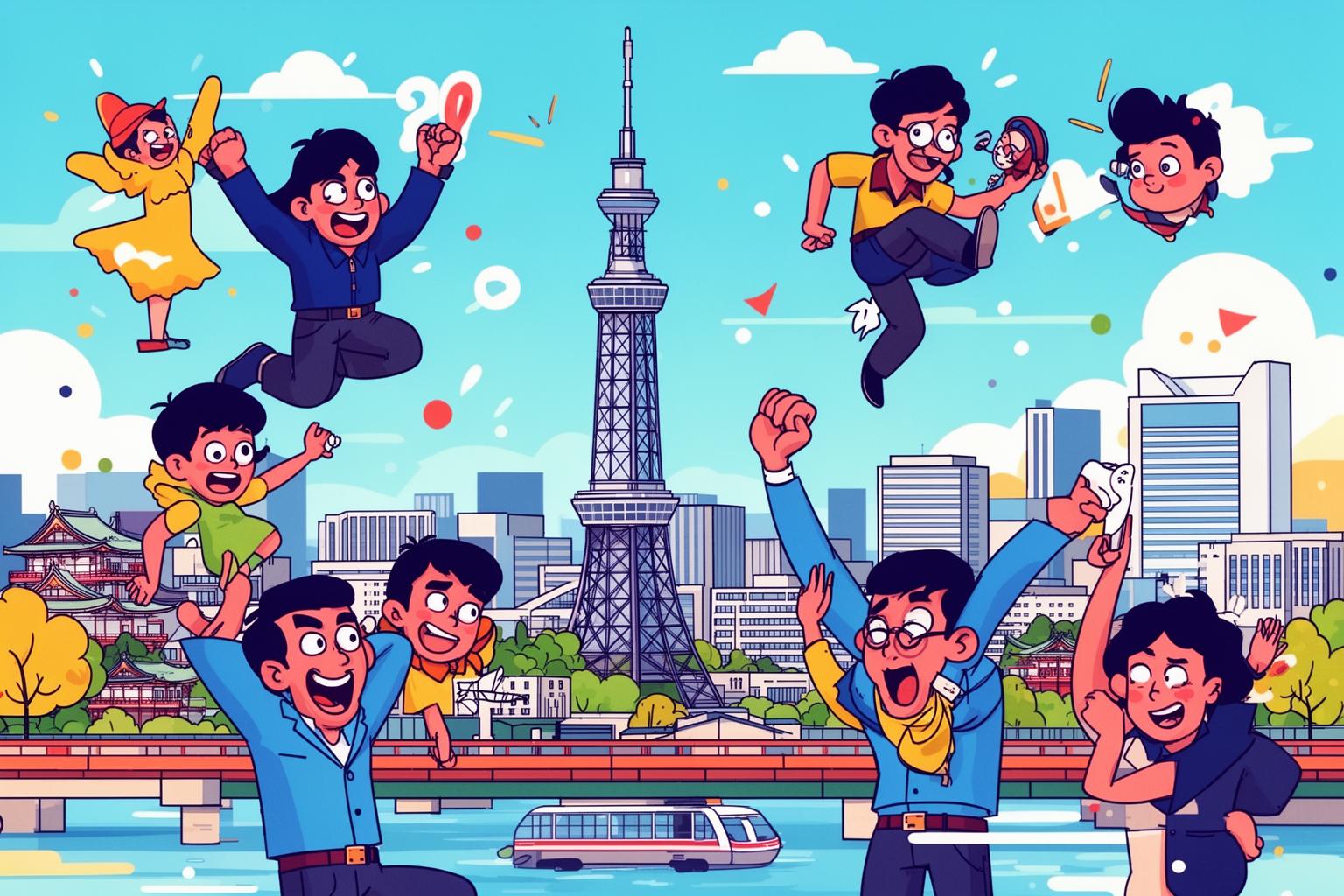
Osaka’s humor goes beyond words; it is deeply physical and expressive. While conversations in Tokyo might be marked by subtle nods and minimal gestures, interactions in Osaka often feel like a full-body performance. People use their faces, hands, and entire posture to convey a story or joke. This physicality may be surprising at first but is a crucial aspect of the city’s communication style.
The most iconic and initially puzzling example is the finger-gun gesture. It can occur at any moment, with anyone. You might be paying for groceries when the middle-aged woman at the register makes eye contact, points her fingers like a pistol at you, and mouths “Bang!” What are you supposed to do? This is a classic Osaka pop quiz. The right response is to engage: clutch your chest, pretend to be mortally wounded, and stagger back with a pained look—or return fire with your own finger gun. The worst response is to stare blankly or ignore it.
Though it seems silly, this gesture is a powerful social tool. It acts as an immediate, non-verbal test of your willingness to play along. By dramatically “dying,” you signal, “I’m on your wavelength. I don’t take myself too seriously. We can connect.” This brief, shared moment of absurdity instantly breaks down barriers between strangers. It’s Osaka’s version of a friendly nod, amplified with theatrical flair.
Beyond the finger gun, you’ll notice a general increase in expressiveness during everyday storytelling. When someone describes a delicious meal, they might close their eyes, make a blissful face, and touch their cheek in the `oishii` gesture. When recounting frustration, they won’t just say it was annoying; they’ll throw up their hands, slump their shoulders dramatically, and sigh `Akan waaa` (“It’s hopelessss”). These aren’t mere mannerisms; they are vital to the narrative, adding color, emotion, and—most importantly—entertainment. For foreigners used to more restrained body language, it can seem like overacting, but in Osaka, this is simply effective communication. Telling a story without facial expressions and gestures is like mumbling—a dull, lifeless version of what could be a vibrant performance. Embracing more physicality—using your hands, being more expressive with your face—can significantly help you connect with those around you.
Walking the Tightrope: Understanding `Ijiri` (Playful Teasing)
This is likely the single most challenging aspect of Osaka’s humor culture for foreigners to understand. `Ijiri`, or playful teasing, forms a key part of social interaction here, but the boundary between it and a genuine insult can feel alarmingly thin. For example, you might proudly wear a new, brightly colored sweater to work, only for a colleague to say, “Whoa, so bright! I need sunglasses to look at you!” In many cultures, this would come across as a rude, passive-aggressive remark. In Osaka, however, it’s very likely a sign of affection—an invitation to join in the banter.
Affection Disguised as Insult
At its core, `ijiri` is about building connection. By gently teasing someone, you show that you notice them, feel comfortable enough to break formal politeness, and consider them part of the in-group. Silence and excessive politeness tend to be reserved for strangers and superiors, while teasing is meant for friends. The logic might seem counterintuitive but is essential: if someone is teasing you, it often means they like and feel close to you.
The targets of `ijiri` are usually minor, insignificant things—your clothing choice, a big appetite, a clumsy moment, or a quirky personality trait. It rarely touches on deep insecurities or truly sensitive issues. A friend teasing you about how much sugar you put in your coffee isn’t really criticizing your diet; they’re simply using it as a jumping-off point for a joke. The proper response isn’t to get defensive or explain your love for sweet coffee but to deliver a comeback. For example, saying, “I need the energy to deal with you!” is a perfect way to return the play. This shifts the moment from a potential insult into a fun, verbal tennis match.
For foreigners, this can be tricky. You might be teased for your Japanese pronunciation, your height, or your unfamiliarity with local customs. Though it’s almost always done with a smile and good intentions, it can feel personal. The key is to pay attention to the context. Are they smiling? Is the group laughing with you, not at you? Is the subject lighthearted? If so, you’re very likely in the middle of a friendly `ijiri` exchange. It tests your good nature and your ability to not take yourself too seriously—qualities highly valued in Osaka.
The Unspoken Rules of the Game
Though it may seem chaotic, there are unspoken rules that distinguish `ijiri` from genuine bullying (`ijime`). First, it’s reciprocal—a person who dished out `ijiri` should be able to take it as well. It’s a two-way street. Second, it involves punching sideways, not down. You tease peers or, in some cases, even gently poke fun at your boss over harmless traits, like their fondness for golf. However, you don’t tease someone who is clearly in a subordinate or vulnerable position. Third and most important, it requires a good response. This is part of the social contract: the teaser opens the door, and the teased person’s job is to reply with a witty `tsukkomi` retort. A clever comeback, even a self-deprecating one, makes the exchange enjoyable for everyone. If you respond with genuine anger or withdraw, the game ends awkwardly. This doesn’t mean you need to tolerate things that make you uncomfortable, but understanding the intent behind `ijiri` can help you see it not as an attack, but as a clumsy yet affectionate gesture.
The Merchant’s Wit: Humor as a Business Strategy
To understand why humor is so deeply woven into Osaka’s character, you need to examine its history. Unlike Tokyo, which developed as the political and military center for the samurai class, Osaka thrived as a city of merchants, known as `shonin`. In the lively, competitive markets of a city once called the “nation’s kitchen,” rank or status carried little weight. Success depended on your wit, personality, and ability to quickly form connections. Humor became the essential tool for this.
A clever, humorous merchant could draw a crowd, ease a doubtful customer, and foster the kind of personal loyalty that ensured repeat business. A joke or witty exchange was as valuable as a bargain. This tradition is very much alive today, especially in Osaka’s many `shotengai` (covered shopping arcades) like Shinsaibashi-suji or Tenjinbashi-suji. Here, customer service isn’t the formal, deferential bowing typical of Tokyo department stores. Instead, it’s a lively, personal, and often humorous performance.
The fruit seller won’t merely hand you an apple; he’ll hold it up and proclaim, “This apple’s so sweet, it’ll knock your teeth out! You’ll owe me for saving your dental bills!” The woman selling `takoyaki` might notice your hesitation and shout, “Don’t think, just eat! Life’s too short for bad takoyaki, and mine’s the best!” This isn’t just about selling goods. It’s about crafting an experience. It’s about making customers feel recognized—not as walking wallets, but as individuals, potential friends, and participants in a brief comedic exchange.
This merchant culture also sheds light on Osakans’ fondness for bargains and the ritual of haggling, often carried out with a sense of humor. The phrase `Chotto makete-` (“Can you give me a little discount?”) isn’t a demand but the opening gambit of a playful negotiation. The shopkeeper might clutch their heart in mock distress, saying, “A discount? You’ll bankrupt me! My children will go shoeless!” You’re expected to play along, perhaps by feigning tears. After some rounds of this friendly performance, they’ll probably knock a hundred yen off with a wink and a “Don’t tell anyone I did this for you.” The discount itself is secondary; the real reward is the interaction. In Osaka, a good deal isn’t just about money saved; it’s about the story you get to share afterward. This contrasts sharply with the Tokyo consumer experience, where the price is fixed, and transactions aim to be efficient and smooth. In Osaka, a little friction and banter are all part of the fun.
How to “Speak” Osaka: A Practical Guide for Residents
So, you understand the theory: you know about the `ochi`, the `boke` and `tsukkomi`, and the `ijiri`. But how do you actually put this into practice without feeling like an awkward imposter? The good news is that no one expects you to instantly become a master of `manzai`. The key is to be a good audience and an engaged participant, not necessarily the main comedian.
Don’t Force It, Just React
The most important advice is to relax and learn to appreciate the humor around you. Your first task isn’t to make jokes, but to recognize them. When the old man at the ramen shop tells you that eating his gyoza will make you live to 150, he’s playing the `boke`. He doesn’t need a clever, perfectly crafted comeback from you. A hearty laugh, a smile, and a simple `Honma ka?` (“Really?”) is more than enough. It shows you get the joke and appreciate the effort. Reacting is participating. By being a responsive audience, you become part of the comedic flow. Over time, as you grow more comfortable, your own witty responses will come more naturally. Don’t rush it—just enjoy the moment and applaud when it feels right.
The Power of Self-Deprecation
One of the simplest and most effective ways to try out Osaka-style humor is through self-deprecation. Poking fun at your own small mistakes or flaws is a great icebreaker. It shows you’re humble, approachable, and don’t take yourself too seriously—all qualities highly valued here. If you struggle to open a package, you can laugh and say, “Wow, this is smarter than I am.” If you trip on the sidewalk, a quick comeback like “Just practicing my new dance move!” can turn embarrassment into shared laughter. When you make a mistake in Japanese, don’t get embarrassed. Laugh it off and say something like, “My Japanese is still a baby.” People will instantly warm up to you. This kind of vulnerability is a strength in Osaka’s social scene—it signals you’re comfortable being human and encourages others to be the same around you.
Learn a Few Key Phrases
You don’t need an extensive vocabulary to join in. A few well-timed phrases in Osaka dialect (`Osaka-ben`) can show you’re part of the joke. `Nandeyanen!` is a versatile `tsukkomi`, perfect for reacting to any absurd situation. `Meccha omoshiroyan!` (“That’s hilarious!”) is a nice way to praise someone’s story. `Akan wa` (“It’s no good” or “This is hopeless”), delivered with a dramatic sigh, makes a perfect humorous response to minor annoyances. Using these phrases, even with a foreign accent, often comes off as charming and endearing. It shows you’re making an effort to engage with local culture on its own terms. Don’t worry about perfect pronunciation—the effort itself is what counts, and it will almost always earn you a smile and, likely, another joke.
Living in Osaka is like an immersive course in communication. It teaches you that laughter is not just a reaction but a proactive tool for building community. It’s a city that defies the stereotype of reserved Japan, inviting you to leave your inhibitions behind. It can be loud, chaotic, and confusing at times. But it’s also a place of extraordinary warmth, where sharing a laugh with a stranger can instantly make you feel at home. Mastering the nuances of Osaka’s humor is a lifelong journey, but one filled with everyday joy and connection. It’s about learning that the punchline isn’t just at the story’s end—in Osaka, the punchline is the whole point of telling it.








