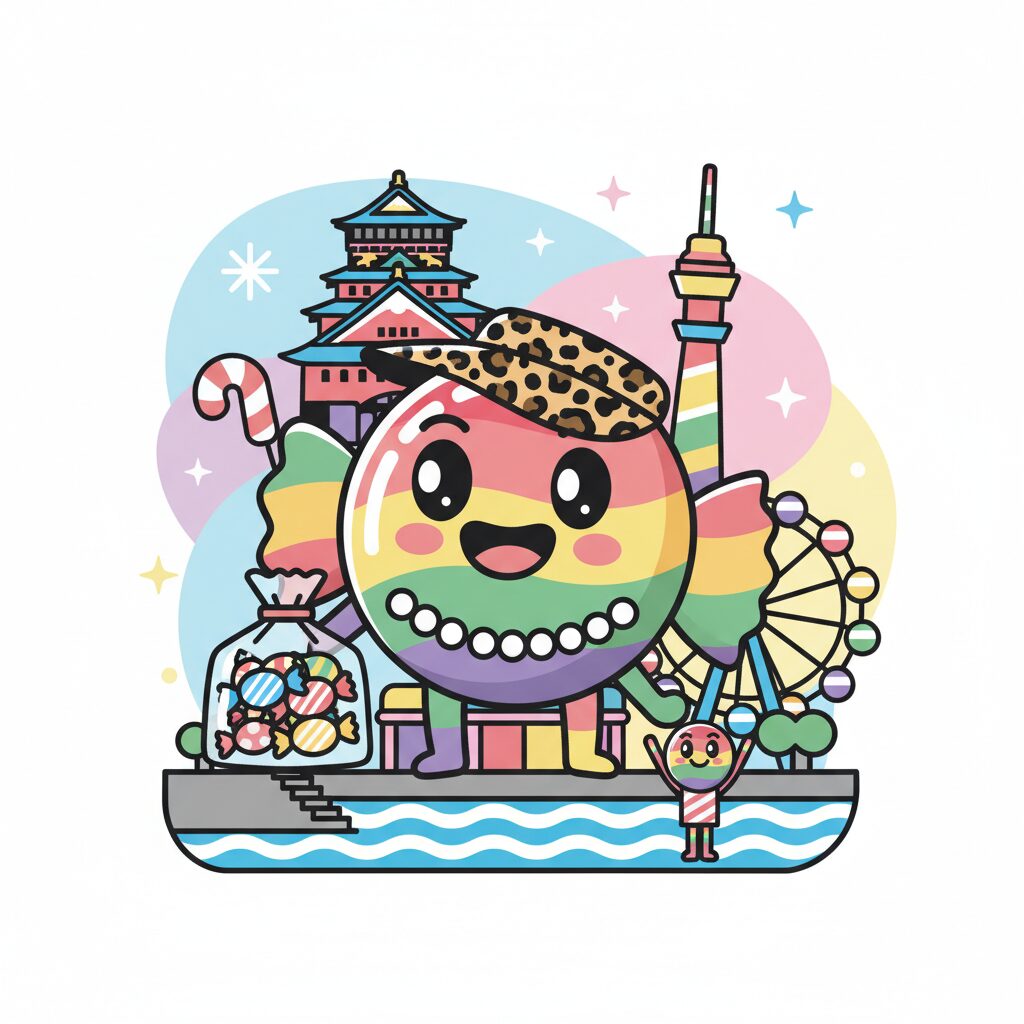
It happened on a crowded Hankyu train, heading toward Umeda. My toddler, a creature of pure, unadulterated impulse, decided that the exact midpoint of our journey was the perfect time to stage a protest against the fundamental laws of physics that kept him confined in my arms. His screams weren’t just loud; they felt architectural, threatening to vibrate the very rivets of the train car loose. Faces, previously locked in the stoic neutrality of a Japanese commute, turned. I felt the familiar hot flush of parental shame creep up my neck. I tried shushing, I tried bouncing, I tried the silent, pleading look that says, I swear he’s normally an angel. Nothing worked. Then, a hand appeared in my peripheral vision. It was a wrinkled hand, adorned with a few sensible rings, and in its palm rested a small, brightly colored, cellophane-wrapped candy. Attached to the hand was a woman, probably in her late sixties, with a tightly permed dome of hair and a leopard-print blouse that radiated a kind of cheerful, unapologetic energy. She didn’t say much, just a gruff but not unkind, “Hai, bozu, kore tabe” (Here, little guy, eat this). My son, momentarily stunned into silence by this new stimulus, took the candy. The crisis was averted. The woman gave a short, satisfied nod, as if she’d just solved a complex engineering problem, and went back to looking out the window. My mumbled, flustered “arigatou gozaimasu” barely registered. This was my first real baptism into the world of ame-chan, Osaka’s unofficial social currency. It wasn’t just a piece of candy. It was a message: “I see you. I get it. We’re all in this together. Now let’s have some peace and quiet.”
For anyone moving to or living in Osaka, especially coming from a Western country or even from other parts of Japan, this tiny, sugary gesture can be baffling. It’s an unsolicited gift from a complete stranger, often given to your child, breaking a dozen unspoken rules we’re taught about personal space and stranger danger. But to understand the ame-chan, you have to understand the city itself. This isn’t just about being friendly, a label so often slapped onto Osaka that it’s lost all meaning. It’s about a deeply ingrained philosophy of pragmatic, proactive community management. It’s a social lubricant, a conversation starter, a miniature peace treaty, and a diagnostic tool for figuring out the city’s unique rhythm. Osaka operates on a different frequency, a wavelength of direct, efficient, and surprisingly intimate public interaction, and the humble ame-chan is its calling card. This city isn’t a museum of quiet traditions; it’s a living, breathing, and sometimes very loud organism. To navigate it, you need to learn the local language, and that language is often spoken in candy.
To truly grasp this unique rhythm, it’s helpful to also explore Osaka’s distinct sense of humor, another key aspect of the city’s social fabric.
The Anatomy of an `Ame-chan` Encounter

To those unfamiliar, it’s simply a piece of hard candy. However, in Osaka, an ame-chan is a multifaceted cultural symbol, rich with nuance and unspoken significance. You’re not merely given a candy; you engage in a ritual. Analyzing this small exchange reveals much about the city’s character, social structures, and distinctive approach to public life. It’s essentially an entire sociological study wrapped in crinkly plastic.
More Than Just Candy: Understanding the “-chan”
First, consider the name itself. In standard Japanese, candy is ame. The magic lies in the suffix “-chan.” It’s a diminutive, a term of affection typically reserved for children, close friends, or endearing things. By calling it ame-chan, the speaker instantly infantilizes the candy, giving it a feeling of familiarity, warmth, and harmlessness. It’s not a formal gift; it’s a casual, almost insignificant little item. This linguistic nuance is crucial. It immediately lowers the social stakes. Accepting an ame might feel like accepting a formal present, which in Japan carries expectations of reciprocity (okaeshi). But accepting an ame-chan? That’s akin to accepting a wink or a friendly tap on the shoulder. It’s a brief gesture, free from heavy obligation. The “-chan” signals that this is a low-pressure exchange, designed to smooth social interactions rather than create debt. It’s a clever linguistic invention enabling easy, frictionless exchanges between strangers. It says, “This is no big deal, so just take it, and we can both move on, feeling a little more connected than before.”
The Usual Suspects: A Candy Connoisseur’s Guide
The type of candy also plays a role in the code. This isn’t about gourmet or artisanal sweets. The classic ame-chan is almost always a hard candy, individually wrapped, and shelf-stable enough to last months in a handbag. There are a few common types you’ll encounter.
Kuro-ame (Black Sugar Candy)
This is the original, the heavyweight champion of the ame-chan world. Made from unrefined black sugar (kurozato), it offers a deep, rich, slightly savory flavor that evokes nostalgia and a hint of medicinal taste. It’s the kind of candy your grandmother might have given you. When an Osakan obachan (older woman) hands you a kuro-ame, it feels like an offering of pure tradition. It’s a dependable, straightforward candy for a city known for its no-nonsense character.
Fruit Drops
These colorful, translucent hard candies come in simple fruit flavors: lemon, strawberry, orange, melon. They’re the workhorses of the ame-chan economy—cheerful, widely appealing, safe for nearly every palate. This candy is often chosen to soothe a child or break the ice with another parent at the park. It’s a gesture of pure, uncomplicated sweetness— a small pop of color and flavor to brighten a dull moment.
Nodo-ame (Throat Drops)
Often infused with menthol, eucalyptus, or herbal extracts, these represent the practical choice. Is someone coughing on the train? Is the air dry? A nodo-ame is more than a treat; it’s a remedy. This exemplifies Osaka practicality: identifying a small immediate problem and handing out a tiny, effective solution. Giving a nodo-ame is an act of thoughtful kindness, a way of saying, “I notice your discomfort, and here’s something that might help.” It’s less about indulgence and more about functional care.
The common thread is that none of these candies are status symbols. They’re inexpensive, common, and utilitarian. The value lies not in the candy itself, but in the act of giving it. It’s a democratic form of generosity available to all.
The Giver: Profile of the Osaka `Obachan`
While anyone can, in theory, hand out ame-chan, the practice is most famously associated with the Osaka obachan. She’s a cultural icon, a force of nature often decked out in vibrant colors, animal prints, and comfy shoes. To assume she’s a frail, retiring grandmother would be a serious mistake. The Osaka obachan is the community’s CEO—pragmatic, resourceful, and possessing social confidence that could rival global leaders.
Her handbag is no mere accessory; it’s a mobile command center and urban survival kit. Nestled within it, alongside her wallet, tissues, a foldable shopping bag, and perhaps some hand sanitizer, lies the ever-present stash of ame-chan. She distributes them with the casual authority of a doctor writing a prescription. She’s seen it all and knows that a small piece of sugar, delivered at just the right moment, can calm a tantrum, spark a friendship, or make a boring wait at the bus stop more tolerable.
Her motivation isn’t sentimental—it’s highly practical. A screaming child disrupts public peace (wa). A bored child is a potential source of future disturbance. A quiet, happily sucking candy child restores harmony. Hence, the most efficient route to public harmony is through a direct application of ame-chan. This is social engineering carried out with warmth and complete lack of pretense. She’s not asking permission; she’s addressing a community issue where you and your child happen to be the center. It’s a gesture that is at once deeply caring and ruthlessly efficient— a perfect embodiment of the Osaka spirit.
The Unspoken Language of a Sugar Cube
Grasping ame-chan culture means looking beyond the candy itself and learning to interpret the intention behind it. Each piece of candy serves as a sentence in an unspoken dialogue, a means of conveying complex social ideas without uttering a word. It acts as social lubrication that helps this vast, bustling city run smoothly, one small, sweet exchange at a time. The candy is the medium, but the message centers on connection, empathy, and shared responsibility for public space.
The Social Lubricant: Why It Works
In many cultures, and certainly elsewhere in Japan, initiating contact with a stranger is a delicate matter requiring a reason or pretext—you don’t simply start a conversation at the bus stop. In Osaka, ame-chan provides that pretext. It’s an ideal icebreaker because it’s a tangible, non-threatening gesture that creates a fleeting bond between two people. The simple act of giving and receiving opens a brief opportunity for communication.
This exchange unfolds like a miniature three-act play. Act I: The Offer. A hand extends with candy, eye contact is made, and a silent question is posed: “Are you open to this interaction?” Act II: The Acceptance. You take the candy and respond with thanks (arigatou, sumimasen), signaling your willingness to engage. Act III: The Aftermath. With the portal open, a short conversation may follow—about the weather, a cute child, or the bus delay—or often the interaction ends there with a nod and smile. No further words are necessary. The gesture fulfills its purpose, turning two strangers into individuals sharing a brief, positive moment. It quietly reshapes the boundaries of public space, making it feel less like a gathering of isolated people and more like a shared living room.
Breaking the Silence on the Train
The commuter train epitomizes Japanese social norms: a space of strict silence and anonymity where people avoid eye contact and retreat into phones, books, or their own thoughts. Here, ame-chan acts as a gentle form of rebellion. I once observed an elderly man and woman, strangers, sitting opposite each other on an almost empty train. The woman was searching her purse; the man watched for a moment, then pulled two kuro-ame from his pocket and offered one across the aisle. “Hitotsu, douzo” (“Here, have one”), he said. Her face lit up with a wide smile. She accepted, thanked him, and they quickly engaged in lively conversation for the remainder of the journey. The candy was the key that unlocked the silence, a permit to connect and a simple excuse to bridge the gap social convention placed between them. It quietly said, “I know we’re not supposed to talk, but let’s talk anyway.”
The Child Pacifier Protocol
As my initial experience showed, this is among the most common and practical uses of ame-chan. A crying child on public transportation or in a quiet store causes significant stress for parents, who feel the weight of public disapproval and silent judgment. When a stranger offers an ame-chan, it conveys multiple layers of meaning. On the surface, it’s a tool to calm the child, but beneath that, it speaks to the parent: “We’ve all been through this. It’s okay. Don’t be embarrassed. Here’s a little help.” It’s an act of solidarity that immediately eases the parent’s anxiety, turning glares of annoyance into moments of collective support. The giver is not just soothing the child but comforting the parent, reassuring them they are not alone. It’s a deep gesture of communal empathy, delivered in the most unassuming form.
A Token of Gratitude and Apology
Ame-chan also serves as a modest currency for small social debts. Someone holds a door for you? Offering an ame-chan is a more personal and memorable thank you than a mere nod. Accidentally bump into someone a bit too hard? Presenting an ame-chan with a quick “gomen nasai” (I’m sorry) can smooth over the minor mistake. It’s a way of acknowledging a social imbalance and promptly making amends. In a culture that highly values harmony and avoiding burdening others, having a means to quickly resolve these small social tensions is invaluable. It keeps the atmosphere light and forgiving—a way to say, “No hard feelings,” through a sweet, edible apology that costs little but carries substantial social significance.
Osaka vs. The World: A Tale of Two Cities (and Some Candy)
To fully understand the importance of ame-chan culture, it’s crucial to see it in contrast. This custom is more than just a quirky local habit; it serves as a strong indicator of how Osaka’s social fabric differs from that of Tokyo and many Western cities. It is a daily expression of the city’s values: prioritizing community over anonymity, favoring practical solutions over strict formality, and embracing direct engagement with those around you.
The Tokyo Contrast: A Study in Public Anonymity
Spend a week in Tokyo, then a week in Osaka, and the difference in public atmosphere is striking. Tokyo operates with smooth, efficient, and often silent precision. People move through public spaces with a kind of graceful, practiced indifference toward one another. The social contract in Tokyo centers on non-interference: respecting others by giving them space and not imposing your presence, noise, or problems on them. Anonymity is a form of politeness. Offering candy to a stranger’s crying child on the Yamanote Line in Tokyo would be rare and, for some, somewhat surprising. The parent might feel confused or even cautious rather than grateful. The general attitude would be to politely ignore the situation, allowing the parent to manage their private matter in public.
In Osaka, the social contract differs. It is based on mutual, proactive engagement. Public space is viewed as a shared resource, and thus, its atmosphere is a shared responsibility. A crying child is not only the parent’s problem but also a community concern, a disruption to collective peace that anyone has the right—and possibly the duty—to help resolve. The ame-chan is the tool for this intervention. It physically embodies the belief that minding your own business is not always the most considerate choice. While this can feel intrusive to outsiders, for Osakans, it is the very essence of community. Tokyo’s politeness is subtractive (avoid bothering others), whereas Osaka’s politeness is often additive (actively engage with and assist others).
What Foreigners Get Wrong: It’s Not Bribery, It’s Connection
One of the biggest challenges for foreigners is interpreting the intention behind the act. In many Western cultures, a stranger offering candy to a child immediately raises alarms, triggering years of “stranger danger” conditioning. It’s easy to view the gesture with suspicion. Is this person trying to get something? Is it a bribe to quiet the child? Or a passive-aggressive complaint about the noise?
While a desire for quiet is part of it, framing this as bribery or a complaint misses the point completely. The main motivation is connection and communal problem-solving. The gesture assumes shared trust and community safety. The obachan offering candy is not a threat; she presents herself as a fellow caregiver, a surrogate grandmother for a brief moment. She trusts you won’t be offended, and you’re expected to trust her good intentions. This reflects a profound cultural difference. The act presupposes a society where public spaces are safe and where people, especially the older generation, can be trusted to have the community’s best interests at heart. It’s not a transaction; it’s a reaffirmation that you belong to a collective that looks out for its members, even in small ways.
Mastering the `Ame-chan` Etiquette
For a foreign resident, navigating the world of ame-chan can feel like learning a new dance. You need to learn the steps, grasp the rhythm, and know when to lead and when to follow. It’s a skill developed through observation and participation. While there are no strict written rules, there is a clear etiquette—an unspoken set of expectations governing these sweet exchanges. Mastering it is an essential step in shifting from feeling like a visitor in Osaka to truly feeling at home.
The Art of Receiving
When you or your child are offered an ame-chan, the key is to accept it graciously. Refusing might be seen as rejecting the gesture of connection itself, potentially causing mild social discomfort. Think of it less as simply accepting a piece of candy and more as accepting a compliment or a kind gesture.
- Acknowledge and Thank: A genuine smile, a slight bow, and a clear “Arigatou gozaimasu” (Thank you very much) are the usual polite responses. Sometimes you might hear “Sumimasen,” which literally means “excuse me” but here conveys a sense of “Oh, you shouldn’t have, thank you for your kindness.” Both responses are perfectly appropriate.
- Accept the Candy Physically: Even if you or your child don’t plan to eat it, you should still take the candy. This completes the social ritual. You can quietly keep it for later. The act of receiving is what truly matters.
- Don’t Overdo It: There’s no need for an elaborate or overly enthusiastic expression of thanks. The gesture is intended to be casual, and your response should match that tone. A simple, warm acknowledgment is sufficient to close the exchange smoothly.
Accepting an ame-chan signals that you understand and appreciate the local culture. It’s a small way of saying, “I’m with you. I understand. Thank you for including me.”
To Give or Not to Give: A Foreigner’s Dilemma
This is the more advanced stage. Once you feel comfortable receiving, you might wonder if it’s appropriate to start giving. Can a foreigner take on the role of distributor? The answer is cautiously yes, but it demands careful reading of the situation.
It’s not just a matter of filling your pockets with candy and handing it out. The act is deeply connected to the identity of the Osaka obachan, so for a younger person or a foreigner, the context must be just right. It works best where a clear, temporary bond has already been established. For example, if you’ve been chatting with another parent at the playground for a few minutes and their child becomes fussy, offering an ame-chan would feel like a natural extension of that friendly connection. Or if you’re standing in a long line next to someone and you’ve already exchanged a few words about the wait, offering candy can be a gesture of shared experience.
Randomly giving candy to a stranger on a silent train, however, might not be received the same way as it would if an obachan did it. Your gesture could be misunderstood as odd or even intrusive. The key is to remember that the candy is not the point; it’s a means to foster a connection that is already forming. Use it to reinforce weak ties, not to create them from scratch. It’s a subtle skill, and it’s wise to proceed cautiously until you feel well attuned to the local social cues.
A Note for Parents: Stranger Danger vs. Community Care
This is perhaps the most difficult aspect for parents from Western cultures. The notion of your child accepting candy from a stranger is often seen as a major safety risk. In Osaka, however, you need to adjust this instinct. It calls for a mental shift from viewing strangers as potential threats to seeing them as potential members of your extended community.
It’s important to recognize that Japan, and Osaka in particular, operates on a very different level of public safety and social trust. The person offering the candy is almost certainly a well-meaning local engaging in a cherished cultural practice. They see your child not as an isolated individual, but as a child of the community. In this way, they are exercising a shared responsibility for the child’s well-being and behavior at that moment. Of course, parents must use their own judgment and continue to teach their children about safety. Yet in the specific case of an elderly woman offering a sealed, commercially produced hard candy in broad daylight, the risk is extremely low, and the social cost of a firm refusal can be quite high. The best approach is usually to accept the candy on your child’s behalf, express warm thanks to the giver, and then decide later if and when your child should eat it. It’s a balancing act between your cultural background and the realities of your new environment.
Beyond the Wrapper: The Philosophy of Practicality
The ame-chan phenomenon is far from being a mere isolated quirk. It stands as the most visible expression of a much deeper cultural mindset that shapes Osaka. To view it simply as a charming custom is to overlook the profound philosophies of pragmatism, reciprocity, and community that form its foundation. This is a city forged by merchants rather than samurai, and that heritage of practical, results-driven thinking permeates all facets of everyday life—even down to its candy.
`Gourishugi`: The Essence of Osaka’s Pragmatism
There is a Japanese term, gourishugi, meaning rationalism or pragmatism. Although it exists across Japan, it holds a unique, almost revered, place in Osaka. The city’s culture is famously less fixated on formality, ceremony, and maintaining a flawless surface appearance (tatemae) than other regions are. Instead, it emphasizes the bottom line: the most efficient route to the desired result (honne). The ame-chan exemplifies gourishugi in its purest form.
What is the issue? A child is crying. What is the intended outcome? A quiet child and a tranquil public environment. What is the simplest, most cost-effective, and impactful solution? A 10-yen candy. This solution sidesteps complicated social negotiations, prevents confrontation, and resolves the problem in seconds. It epitomizes practical thinking. The same logic influences business deals, conversations, and how people give directions on the street (often by directly pointing and saying “go straight, turn there, bang!”). This efficiency-driven approach may seem blunt to outsiders but is beloved by locals. The ame-chan serves as a daily reminder that in Osaka, the smartest answer is often the simplest one.
The Spirit of `Omake`: Japan’s Culture of “A Little Extra”
Ame-chan is also closely related to omake culture. Omake means “a little extra” or a bonus. It’s the free toy inside a cereal box, the extra side dish a restaurant owner provides without charge, or the baker adding an additional bread roll to your bag. While found throughout Japan, omake has a unique and lively presence in Osaka, reflecting its merchant heritage. It centers on fostering relationships and customer loyalty through small acts of generosity, essentially saying, “Thank you for your patronage; here’s a little something to show my appreciation.”
The ame-chan represents the street-level, non-commercial form of omake. It’s a small extra kindness, a bonus of human connection offered with no expectation of anything in return. It operates on the same principle: a modest, low-cost gesture can generate substantial goodwill and reinforce social bonds. It sustains a cycle of generosity. The person who accepted an ame-chan to quiet their child on a train today might be the one offering helpful directions to a lost tourist tomorrow. It’s a way to pay it forward, keeping the city’s social capital account well in the black.
Building a City One Candy at a Time
Ultimately, the ame-chan serves as a tool for community building. Each exchange acts as a single thread, and over time, millions of these threads weave together to form a strong, resilient, interconnected social fabric. It’s a continuous, low-level process affirming that you are not alone. You are noticed. Your struggles are acknowledged. Your presence is recognized. In the vast anonymity of a modern metropolis, where isolation can easily set in, these small interactions act as anchors. They root you in your immediate surroundings and connect you with those who share them. It is a potent antidote to urban loneliness. The city of Osaka is not constructed solely from concrete and steel; it is built from millions of tiny, daily acts of care and consideration, with the ame-chan as its most iconic and sweetest building block.
The Future of a Sweet Tradition
In a rapidly changing Japan, marked by shifting demographics and evolving social norms, it’s reasonable to question the longevity of a custom like this. Is the ame-chan a relic from a bygone era, a tradition destined to disappear with the generation that upholds it? Or is the underlying spirit adaptable enough to endure in the 21st century? The answer, much like Osaka itself, is complex, a bit messy, and ultimately hopeful.
Is the Flame Fading? `Ame-chan` in the 21st Century
It’s clear that you’re less likely to see a 25-year-old pulling out a bag of hard candy than a 75-year-old. While younger generations in Osaka still embody the city’s characteristic openness and directness, they may not observe the ame-chan ritual in its traditional form. They grew up in a different Japan, one more influenced by global norms of privacy and individualism. Additionally, greater awareness of allergies and dietary restrictions can make people more reluctant to offer food to a stranger’s child.
However, declaring the tradition dead or dying would be inaccurate. The practice remains very much alive, especially in the city’s sprawling shotengai (covered shopping arcades), local neighborhoods, and on public transport. The obachan community continues to be a formidable presence. More importantly, even if the physical candy becomes less common, the philosophy behind it—the spirit of proactive, friendly intervention—persists. It is deeply ingrained in Osaka’s DNA.
The New `Ame-chan`: How the Spirit Endures
The ame-chan of the future might not always be candy. What endures is the spirit of the gesture, which takes new forms.
- It could be a young person spotting an elderly woman struggling with a heavy bag up the station stairs and quickly helping without being asked.
- It might be a shopkeeper noticing you’re drenched from a sudden downpour and offering a free towel to dry off.
- It could be the person beside you at a ramen counter silently passing the spice jar when they see you searching for it.
- It might be a group of teenagers seeing you, a foreigner, confused by a complicated ticket machine and cheerfully guiding you through the process.
These are all contemporary expressions of the ame-chan. They are unsolicited acts of practical kindness that bridge the gap between strangers and strengthen community bonds. The medium has changed, but the message remains: “I see you. We’re in this together. Let me help.” The instinct to connect, solve problems directly, and treat the city as a shared home remains the hallmark of Osaka’s people.
Living the `Ame-chan` Life
For anyone looking to settle in Osaka, understanding the ame-chan goes beyond mere cultural trivia. It serves as a practical guide for living here. It encourages you to adjust your expectations regarding public space and personal boundaries. It asks you to be a bit more open, more attentive, and more ready to engage with those around you.
Embracing the Interruptions
Life in Osaka is filled with interruptions. A stranger might comment on your baby. An elderly man may ask where you’re from. The woman at the checkout could launch into a full conversation about the daikon radish you’re buying. At first, this can seem unsettling. But these are not interruptions; they are invitations—ame-chan in spoken form. Embracing them means welcoming the casual, spontaneous, and sometimes chaotic human aspect of the city. It means recognizing that efficiency in Osaka isn’t about avoiding human interaction but making that interaction as direct and sincere as possible.
Finding Your Place in the Public Living Room
In the end, the ame-chan culture teaches that public space in Osaka isn’t a cold, in-between area of private destinations. Instead, it’s a communal living room—a place where you’re expected to be conscious of others, contribute to the general vibe, and take part in the small dramas of everyday life. The candy symbolizes this philosophy. It’s a small token of warmth passed between people, a reminder that even in a city of millions, you belong to a community. Taking the candy, and eventually grasping the meaning behind it, marks a rite of passage. It’s the moment you stop being just an observer of Osaka’s intriguing customs and begin to become part of the city’s sweet, lively, and deeply human social fabric.