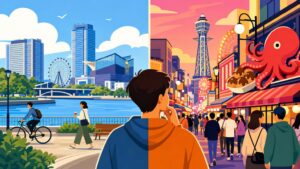
Walk into any izakaya in Osaka, strike up a conversation, and eventually, the question will surface. It’s as fundamental to this city’s identity as takoyaki or the Hanshin Tigers. “So, are you a Kita person, or a Minami person?” On the surface, it’s a simple geographical query. Kita, meaning ‘north,’ refers to the sleek, corporate district centered around Umeda Station. Minami, ‘south,’ is the chaotic, neon-drenched playground of Namba and Shinsaibashi. But the question runs far deeper than a subway map. It’s a cultural litmus test, a probe into your personality, your priorities, and your very soul. It’s asking, in which Osaka do you choose to live? For the traveler, this is a fun rivalry, a convenient way to categorize experiences. Umeda for sophisticated shopping, Namba for street food and spectacle. But for a resident, for someone trying to build a life here, this dichotomy is both a foundational truth and a grand oversimplification. The stereotypes are just the flashy storefronts; the reality of daily life lies in the quiet residential streets just behind them, in the morning commute, in the search for a decent supermarket, in the feeling you get when you step off the train after a long day and say, “I’m home.” This isn’t a guide to picking a weekend haunt. This is a deep dive into the rhythms, the mentalities, and the unspoken rules of Osaka’s two great poles, designed to help you understand where your life fits best. Forget the tourist highlights for a moment. We’re talking about the fabric of everyday existence, the subtle differences that shape your routine, your social circle, and your understanding of what it truly means to be an Osakan. The choice between Kita and Minami isn’t just about where you lay your head. It’s about the frequency you tune into, the current you swim in. And understanding that difference is the first step to truly making this city your own.
To truly settle into your chosen neighborhood, understanding the local customs, such as the proper way to handle your garbage disposal, is just as important as the location itself.
The Grand Deception: Why Tourist Stereotypes Fail Residents

The fundamental error foreigners make when thinking about Osaka is taking the Kita versus Minami divide at face value. They see images of the Umeda Sky Building and assume “business district.” They see the Glico Running Man in Dotonbori and think “party town.” While not entirely inaccurate, these visuals are theatrical sets, carefully arranged for consumption. They reveal nothing about the price of avocados, the noise level on a Tuesday night, or the personality of the elderly woman who runs the corner tobacco shop. For a resident, these postcard images are hurdles to overcome, not destinations to treasure. Your life isn’t lived in the main plaza of Grand Front Osaka or directly beneath the giant crab sign of Kani Doraku. It’s lived in the spaces in between. The stereotypes serve as a language for tourists, a shorthand. To truly live here, you must become fluent in the local dialect of neighborhood subtleties.
Kita’s Polished Facade
The narrative everyone shares about Kita is one of sophistication and order. Umeda is Osaka’s attempt at speaking Tokyo’s language. It’s a landscape of gleaming glass towers, wide, immaculate boulevards, and the revered halls of Japan’s most prestigious department stores: Hankyu, Hanshin, and Daimaru. The atmosphere here feels different—more controlled, more perfumed. People move with a brisk, purposeful pace, their footsteps echoing a rhythm of appointments and train schedules. This is the core of Kansai’s corporate world, a place of commerce where deals are whispered over expensive bento boxes.
But this reality is a concentrated illusion, largely limited to the square kilometer surrounding the labyrinthine Osaka-Umeda Station complex. To live “in” Umeda is a misnomer; nobody truly resides in the commercial core. Instead, you live adjacent to it, in one of its many satellite neighborhoods, and that’s where the polished facade starts to crack, revealing a far richer, more textured reality. A ten-minute walk northeast brings you to Nakazakicho, a preserved Showa-era quarter of narrow lanes, vintage clothing shops, and independent coffee houses in weathered wooden buildings. It’s a bohemian enclave resisting the corporate gloss next door. Head west, and you arrive in Fukushima, a district that has blossomed into one of Osaka’s most thrilling culinary scenes. Here, the streets are narrow, packed with tiny Michelin-recognized restaurants and standing-room-only wine bars, the air rich with the scent of grilled unagi and simmering dashi. To the east lies Tenma, home to Japan’s longest shopping arcade and a sprawling, chaotic market scene where the energy rivals—or perhaps even surpasses—that of Minami.
The experience of Kita for residents is not the monolithic, sterile setting of the stereotype. It’s a life of strategic choices, selecting which of these unique sub-neighborhoods will be your refuge, your “local,” while enjoying the unparalleled convenience of the Umeda hub. The mindset of Kita, however, remains largely transactional. The central hub is a place of purpose. You go there to catch a train to Kyoto, attend a meeting, or buy a specific suit from a particular store. It’s an environment built on efficiency, not serendipity. Social interactions are more formal, spaces more defined. Living here means your daily routine constantly shifts between the purposeful energy of the core and the distinctive character of your selected residential pocket. Your local supermarket is unlikely to be a sprawling, cheap suburban store. It’s more likely the depachika—the dazzling, sprawling food hall in the basement of a department store. While a paradise for food lovers, it’s an intimidating, pricey place to buy your weekly milk, bread, and eggs. It’s a place for special treats or gourmet meals, not for mundane Tuesday night shopping. This is the central tension of life in Kita: balancing world-class convenience with the simple, practical demands of everyday living.
Minami’s Chaotic Heart
If Kita is Osaka in a tailored suit, Minami is Osaka in leopard-print pajamas, laughing loudly with a can of cheap chu-hai in hand. The stereotype is one of glorious, unrelenting chaos. Namba is the city’s id, unleashed. It’s the visual and auditory assault of Dotonbori’s neon-soaked canal, the shoulder-to-shoulder crush of the Shinsaibashi-suji shopping arcade, the rebellious youth fashion of Amerikamura, and the gritty, lantern-lit alleys of Hozenji Yokocho. It is, by all accounts, the “real” Osaka—loud, unpretentious, and unapologetically commercial.
For residents, this stereotype is both a source of pride and a daily challenge. The chaos is real, but like Kita, it’s remarkably contained. The river of tourists and revelers flows along very specific channels. Step one block off the main drag, and the noise drops sharply. The sensory overload fades, replaced by the sounds of a functioning, breathing neighborhood. West of the main Namba station is Horie, a district transformed into a hub of trendy furniture stores, hip cafes, and upscale boutiques, with a distinctly calmer and more fashionable vibe. East past Kuromon Market—part tourist draw, part genuine high-quality grocer—lie residential areas with temples, small parks, and local shotengai (shopping arcades) serving the people who actually live there. Even the iconic Namba Parks complex serves as a deliberate contrast to the surrounding frenzy; its terraced, canyon-like architecture is filled with trees and open spaces, offering a place to decompress just steps from the busiest intersections.
The prevailing mentality in Minami differs fundamentally from that of Kita. It’s experiential, not transactional. It’s a place made for wandering, for getting lost, for happy accidents. The energy doesn’t demand purpose; it invites participation. You might set out with a plan to visit one spot, but the dense stimuli and labyrinthine streets and arcades will inevitably lead you somewhere else. This spirit of spontaneity permeates daily life. A quick grocery run can turn into an impromptu chat with a shop owner, leading to a recommendation for a new ramen place, culminating in sharing a drink with a stranger at the counter. Life here is less planned, more fluid. Living near Namba means your senses are constantly engaged. The boundary between your quiet apartment and the vibrant street life is thin. This can be exhilarating for some and utterly exhausting for others. Your local supermarket is more likely the legendary Super Tamade, a palace of neon lights, blaring jingles, and surprisingly low prices. Shopping there isn’t a peaceful experience; it’s a full-contact sport, a cultural immersion into Osaka’s obsession with scoring a great deal. It’s the opposite of the curated elegance of a depachika, perfectly encapsulating the difference in daily life between the city’s two poles.
The Commuter’s Calculus: Navigating the Urban Web
Beyond the cultural atmosphere and social scenes, the single most important factor in your daily life in Osaka will be your commute. The city is defined by its train lines, and the nature of your existence is closely tied to the station you consider your own. Kita and Minami are not just centers of commerce and culture; they are monumental transportation hubs, each with a distinct sphere of influence that governs the flow of millions of people and shapes the very mental map of the Kansai region.
Umeda: The Undisputed Hub
To grasp Umeda, you must first appreciate the vast scale of its transportation infrastructure. The interconnected complex of Osaka Station (serving JR lines) and Umeda Station (serving Hankyu, Hanshin, and the subway) is more than just a station; it’s an underground city, a multi-layered maze of platforms, tunnels, shops, and restaurants. It is, without exaggeration, the beating heart of Western Japan’s entire rail network. From here, the JR lines extend outward, offering direct, rapid connections to Kyoto’s cultural capital, the port city of Kobe, and far beyond. The private railway giants, Hankyu and Hanshin, each have their own grand termini here, commanding corridors of commuter towns reaching towards the mountains and the sea. Adding the city’s main subway artery, the Midosuji Line, along with the Tanimachi and Yotsubashi lines, creates a hub of unmatched connectivity.
This transit dominance deeply influences the lives of those living nearby. If your work involves frequent meetings in Kyoto, or your social circle is centered around friends in Kobe, residing along a line that feeds directly into Umeda is not just convenient—it’s essential. It turns a multi-leg, hour-long trip into a straightforward direct route. Navigating the daily commute through Umeda station becomes an acquired skill, a choreographed dance of avoiding crowds, finding unmarked shortcuts between lines, and timing your walk to perfectly meet arriving trains. You learn to read the flow of people, moving with the morning rush and swimming against the evening tide.
This centralization is a key distinction between Osaka and Tokyo. Tokyo’s vastness is managed by a decentralized system of major hubs—Shinjuku, Shibuya, Tokyo Station, Ikebukuro—each serving specific functions and areas. Osaka, by contrast, channels most of its inter-city traffic through one dominant hub. This fosters a shared urban awareness. The first question an Osakan asks when considering where to live, work, or visit is almost always, “How’s the access to Umeda?” The station becomes the primary reference point for all distances and travel times. The downside of this grand efficiency is its overwhelming scale. During peak hours, the main concourses flood with people, a place of intense, focused energy that can feel impersonal and stressful. For many residents, Umeda Station is a place to pass through as quickly as possible—a functional gateway rather than a pleasant destination. Your local life orbits this massive sun, benefiting from its gravitational pull but maintaining a safe distance from its scorching heat.
Namba: The Southern Fortress
Namba is an entirely different entity. It’s not a single station but a cluster that has grown over time: Nankai Railway’s grand, classical terminal; the underground hubs of the Kintetsu and Hanshin lines (which confusingly share a station named Osaka-Namba); JR Namba station, tucked away on the western edge; and the Namba subway station, a vital stop on three lines. Though it lacks Umeda’s singular, monolithic presence, Namba’s strength as a transportation hub is equally significant, with a distinct geographic focus.
Namba’s trump card is the Nankai Railway. This is the primary and fastest rail link to Kansai International Airport (KIX). The iconic “Rapi:t” express train, with its retro-futuristic blue design, symbolizes the city’s connection to the world. For anyone whose work or life involves regular international travel, living near Namba is a game-changer. An early morning flight ceases to be a logistical headache; it’s a simple, stress-free 40-minute train ride away. This link establishes Namba as the gateway to and from the south. The Nankai lines also stretch down into Wakayama Prefecture, while the Kintetsu lines provide the most direct route to the ancient capital of Nara and further into the Kii Peninsula.
For locals, navigating Namba station’s complex is a unique challenge. It feels less like one vast space and more like a sprawling, interconnected maze. It feels older, more organic, and perhaps a bit more chaotic than Umeda’s sleek corridors. Yet it also feels more intimate. There are more hidden corners, quirky shops, and stand-up noodle bars tucked away in unexpected spots. The underground Namba Walk shopping street carries a distinctly local, Showa-era vibe that contrasts sharply with Umeda’s modern, airy malls. Life around Namba feels anchored to the city itself and points south. The Midosuji Line provides seamless access to Umeda, but the psychological center of gravity is different. You feel less tied to the broader Kansai business corridor of Kyoto-Osaka-Kobe and more connected to the heart of Osaka City, with the airport serving as your personal escape hatch. Choosing between the two hubs often boils down to one simple question: Is your life centered more on domestic inter-city travel, or on international flights and the southern half of the region?
The Anatomy of a Neighborhood: Groceries, Green Space, and Going Out

Your connection to a city is formed not through iconic landmarks, but through the small, repeated routines of everyday life. It’s the walk to the supermarket, the patch of grass where you read a book, the local bar where the owner knows your name. In these ordinary moments, the true characters of Kita and Minami emerge. They are two distinctly different living environments, each offering its own advantages and compromises.
Life Around Umeda: Structured and Segmented
Living in the Kita area means adjusting to a lifestyle where different activities are neatly divided. Your home life, shopping, and socializing often take place in separate, distinct areas.
Shopping
The area around Umeda Station is a retail haven for fashion, luxury items, and electronics. However, when it comes to everyday essentials, it can feel like a food desert. The question of “Where do you buy a liter of milk and a bag of onions?” is a genuine one. The answer rarely involves the grand department stores unless you’re willing to pay a premium for beautifully packaged, artisanal products at a depachika. For practical grocery shopping, residents in Umeda’s orbit typically visit supermarkets in nearby residential neighborhoods. Those west of the station might choose the Life supermarket in Fukushima or the discount-oriented Gyomu Super, while those to the east often walk or bike to the expansive market in Tenma. Grocery shopping is a planned, purposeful outing rather than a spontaneous errand. It demands a mindset that distinguishes ‘shopping’ for pleasure in department stores from the task-focused mission of buying groceries at a specific store.
Green Space
In Umeda’s dense concrete core, green space is a rare treasure. It exists, but it is a destination. To the south, between Umeda and the business hub of Honmachi, lies the splendid Utsubo Park, a long, rectangular oasis famed for its rose garden. To the east is Ogimachi Park, a family-friendly area with a large playground. The most significant green space nearby is Nakanoshima, the river island separating Kita from Minami. Its waterfront park is a beautifully maintained area ideal for lunchtime strolls or weekend picnics. However, these are not places you happen upon casually. They are intentional destinations you plan to visit. Accessing nature requires effort—a conscious decision to step away from the commercial core. Life in Kita involves seeking out green spaces rather than having them integrated into your immediate environment.
Nightlife
Umeda’s nightlife mirrors its corporate nature: abundant, high-quality, and highly segmented. You don’t just ‘go out in Umeda’; you go out in a specific neighborhood with a clear purpose. For upscale client dinners and business entertainment, you head to Kitashinchi, a district of exclusive clubs, refined sushi bars, and hostess clubs. For a lively, budget-friendly night with colleagues, you dive into Higashidori Shotengai, a covered arcade packed with chain izakayas and karaoke spots. For a more refined, food-centric evening, you visit Fukushima, hopping between natural wine bars, yakitori experts, and inventive Italian restaurants. The social life here is organized and destination-focused. You pick a restaurant, make a reservation, and meet your friends there. While variety abounds, there is less room for spontaneous bar-hopping or serendipitous discoveries. The night is planned, structured, and executed with the same efficiency as the workday.
Life Around Namba: Integrated and Spontaneous
In contrast to Kita’s segmentation, life in Minami is marked by a lively, intertwined mix of all aspects of living. The boundaries between residential, commercial, and entertainment areas are constantly blurred.
Shopping
In Minami, supermarkets are not destinations; they are part of the everyday scenery. The iconic Super Tamade, with its flashy neon signs and 24-hour hours, is a landmark for bargain hunters. Beyond Tamade, plenty of other chains—Life, Kohyo, and Gyomu Super—are tucked into residential streets just a block or two from main tourist hotspots. You might browse vintage records in Amerikamura one moment and buy discounted tofu the next. Kuromon Ichiba Market, despite its tourist focus, still serves locals as a top-quality source for seafood and produce. This integration means shopping is woven seamlessly into daily life. You pick up what you need en route home from the station or as you head out to meet friends. It’s a natural, fluid element of living, not a separate, scheduled chore.
Green Space
Minami isn’t known for grand, open parks like Kita is. Its urban landscape is too dense and chaotic. Yet it offers green space of a different kind. Namba Parks exemplifies this, a striking architectural marvel that incorporates a multi-level rooftop garden into a shopping mall, creating a man-made canyon filled with trees and waterfalls in the city center. Tranquility can also be found in smaller, unexpected spots. Namba Yasaka Shrine, famous for its enormous lion head stage, is a surprising, surreal oasis of calm just a short walk from the bustle of Dotonbori. Small neighborhood parks and temple grounds are scattered throughout, providing brief respites. Green in Minami is less about vast lawns and more about these occasional encounters with nature and spirituality amid urban chaos.
Nightlife
This is where Minami truly flourishes. Its nightlife is a sprawling, interconnected ecosystem that encourages exploration and rewards curiosity. It stands in stark contrast to Kita’s orderly scene. A night out in Minami is a journey. You might start with pre-dinner drinks at a tiny standing bar in Ura Namba’s crowded alleys—a foodie haven full of dozens of specialized eateries. From there, you could wander to Hozenji Yokocho, a charming stone-paved lane that feels like stepping back in time, for a traditional meal. After dinner, your options multiply: dive into a punk rock bar in Amerikamura, find an elegant cocktail lounge in Shinsaibashi, or stumble upon a hidden DJ bar in a back alley. District boundaries blur, and the joy lies in moving around and discovering new places. It’s a social scene founded on serendipity. Here, the stereotype of ‘friendly Osaka’ comes to life. The small, crowded bars encourage interaction—it’s common to strike up conversations with strangers, share a round, and end the night with new friends. The night is not a plan to be followed but an adventure to be embraced.
The Cultural Frequency: Who You’ll Meet and What You’ll Hear
A city is ultimately defined by its people. The architecture and infrastructure serve merely as the backdrop, while the residents are the performers who breathe life into it. The crowds filling Kita and Minami differ markedly—not only in their attire but in their energy, pace, and manner of speech. Living in one area or the other means immersing yourself in a distinct social and cultural rhythm.
Umeda’s Crowd: The Kansai Professional
Spend a day watching the stream of people moving through the Umeda station complex, and a clear image takes shape. This is the realm of the Kansai professional. You’ll notice more suits and tailored dresses, leather briefcases and designer handbags. The fashion is chic, elegant, and brand-conscious—mirroring the goods on offer in nearby department stores. It’s a style that conveys success, ambition, and adherence to corporate and social norms. The general atmosphere is purposeful. People are en route to something important: a client meeting, a branch office, or a reservation at an upscale restaurant. The pace is swift and focused. Conversations you overhear tend to revolve around business plans, weekend getaways, or upcoming projects rather than idle chatter. It is the sound of a region’s economic engine in motion.
Even the language mirrors this mood. While the accent remains distinctly Osaka-ben, it often sounds like a more polished, standardized variation. In business contexts or upscale shops, you’ll hear a dialect that has softened its rough edges—a “kote-kote” (thick) Osaka accent with its tie straightened and hair neatly combed. It’s Osaka packaged for a professional audience, a dialect that effortlessly switches between local familiarity and pan-Japanese business etiquette.
What foreigners often misconstrue is that this refinement signals coldness or a lack of the renowned Osaka spirit. They mistake the surface similarities to a Tokyo business district like Marunouchi and assume the people behave alike. This is incorrect. The Osaka traits of directness, humor, and pragmatism remain very much alive, just governed by a different set of social rules. A business meeting in Umeda is still more likely to start with a joke and include more laughter and frank talk than its Tokyo equivalent. The humor here is drier, the interactions somewhat more reserved than in the lively south. The Kita professional remains Osakan at heart; they simply express it with a different lexicon.
Namba’s Crowd: The Osaka Spectrum
While Umeda is a curated showcase, Namba is a vast, vibrant anthology of every character Osaka has to offer. The crowd here forms a colorful, dynamic cross-section of the entire social spectrum. In Amerikamura, teenagers sport wildly expressive, avant-garde street fashion that breaks every convention. In the Shinsaibashi arcade, families, tourists, and elderly couples jostle for space. In Ura Namba’s backstreets, tattooed chefs, local shopkeepers, and lively groups of friends cram into tiny bars. It’s a place where everyone—from the high-fashion enthusiast in Horie to the working-class grandfather playing shogi in the park—shares the same space. Fashion is less about conforming to professional standards and more about expressing personal identity. It’s bolder, more individualistic, and often more playful.
The energy is tangible. It’s loud, vibrant, and refreshingly unpretentious. People aren’t just passing through en route somewhere else; they are fully present—to eat, shop, laugh, and experience the city at its most alive. The distinction between work and play is blurred. The man grilling your okonomiyaki passionately isn’t merely a service worker; he’s a performer, a key figure in the street’s ongoing theater. The shop girl shouting “Irasshaimase!” isn’t just greeting customers; she’s adding to the area’s ever-present, high-energy soundtrack.
This is the stronghold of thick, unfiltered Osaka-ben. The dialect here is quick, witty, and unabashedly direct. It’s the language of bargaining, friendly teasing, and spinning a good tale. For anyone seeking the city’s authentic character in its purest form, it is music to the ears. Living here means daily immersion in this raw, vibrant culture. Your neighbors are more likely small business owners, musicians, or multi-generational families than corporate salarymen. It is a community that prizes personality over polish, where fitting in means standing out. To thrive here, you must be willing to engage, participate in the chaos, and embrace the beautiful, messy, human energy that defines it.
Making the Choice: A Framework for Your Osaka Life

The debate between Kita and Minami is a helpful starting point, but ultimately, it’s a false dilemma. Your life in Osaka won’t be limited to just one district, as the city is too interconnected and accessible for that. Still, where you choose to establish your roots will profoundly influence the texture of your everyday life. It’s not about picking the “better” area, but selecting the one that suits you best—your work, your lifestyle, and your personality.
Choose Umeda and Its Satellites If…
You should lean toward the Kita area if your life requires structure, connectivity, and a certain level of polish. If your work or personal activities involve regular travel via the Shinkansen or to key Kansai cities such as Kyoto and Kobe, the unmatched convenience of the Umeda hub is a compelling reason. It will save you countless hours and logistical challenges. This area is also perfect for those who like a clear distinction between the bustle of a central business district and the calm of a residential neighborhood. You can work or shop in the energetic core, then retreat to the relative peace of places like Nakatsu or the gourmet haven of Fukushima. If your ideal social life includes planned dinners at excellent restaurants, cocktails at sophisticated bars, and attending events at major cultural venues, Kita’s organized and destination-focused scene will suit you well. It offers a predictable, high-quality urban experience for those who value order and efficiency.
Choose Namba and Its Surroundings If…
You should consider Minami if your spirit longs for energy, spontaneity, and rich cultural immersion. If you travel internationally often, the direct and easy access to Kansai Airport via the Nankai line is a major perk. This area is for those who thrive on a certain level of chaos and unpredictability, who want to live in a neighborhood that feels lively and buzzing around the clock. If you want to be immersed in the quintessential, “kote-kote” Osaka culture—the food, the language, the people—then this is your base. Your social life here will be less about reservations and more about serendipitous discoveries: finding a hidden bar, making friends with strangers at a takoyaki stand, and letting the night take you where it will. If you want your daily routine to feel like an adventure, blurring the lines between your apartment and the vibrant street, Namba’s dynamic, integrated scene is the perfect fit.
The Real Answer: The Midosuji Line
After all the discussion about north versus south, here is the ultimate truth about Osaka: the real city isn’t just Kita or Minami; it’s the Midosuji Line. This single subway line is the city’s backbone, the essential artery connecting all major hubs. It runs from Shin-Osaka (the Shinkansen station) in the north, straight through Umeda, past the business districts of Yodoyabashi and Honmachi, through Shinsaibashi and Namba, and continues to Tennoji, another key southern hub.
For many Osaka residents, the smartest strategy is not to choose a side but to live somewhere along this vital line. Neighborhoods like Nishinakajima-Minamigata (just north of Umeda), Honmachi or Shinsaibashi (in the heart of the city), or Daikokucho (just south of Namba) offer more affordable rents and a genuinely residential atmosphere, while keeping both Kita and Minami within a 5-to-15-minute subway ride. Living on the Midosuji Line eliminates the “versus” question. You don’t have to be exclusively a Kita person or a Minami person. You can enjoy both. You can spend your afternoon shopping in sophisticated Umeda, then savor street food in lively Namba for dinner—all with minimal effort.
This practical, efficient approach embodies the true Osaka mindset. The rivalry is an entertaining cultural story, a way to define identities. But when it comes to the realities of daily life, Osakans are pragmatic. They prioritize convenience and access above all else. The ultimate aim isn’t to pledge loyalty to one neighborhood but to position yourself to take advantage of everything the entire city offers. The question is not whether you prefer the sleek towers of the north or the neon-lit alleys of the south. The real question is: How close are you to a Midosuji Line station?