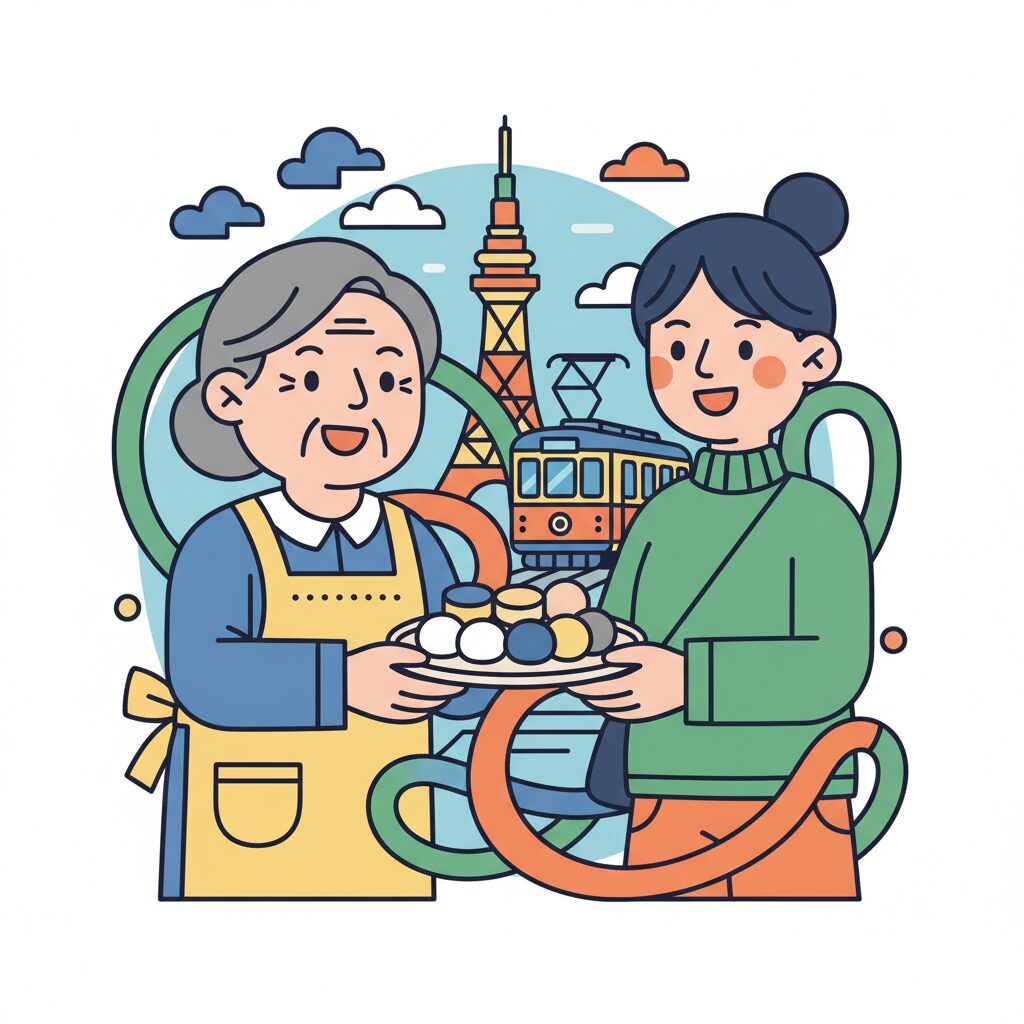
You’re standing in a supermarket aisle, maybe in Tennoji or somewhere deep in Namba, just trying to decide between two brands of soy sauce. You’re minding your own business. Suddenly, a tiny woman with a perm the color of lavender appears at your elbow. She taps the bottle in your hand. “Ah, ah, not that one,” she says in a thick, rhythmic Osaka dialect. “This one over here is cheaper today. And it’s better for nimono, you know, simmered dishes. That one’s too salty.” She doesn’t wait for a thank you. She just nods, satisfied with her good deed for the day, and shuffles off toward the daikon radishes. You’re left standing there, slightly stunned, holding the “correct” bottle of soy sauce. Welcome to Osaka. You’ve just been a recipient of ‘osekkai’.
This isn’t an isolated incident. This is the city’s cultural pulse. If Tokyo is a meticulously arranged symphony of polite distances and unspoken rules, Osaka is a free-form jazz session—loud, improvisational, and everyone’s invited to join in. ‘Osekkai’ is the name of that tune. Directly translated, it means ‘meddlesome’ or ‘nosy’. And on the surface, that’s exactly what it feels like. It’s unsolicited advice, public corrections, and personal questions from complete strangers. For anyone coming from a culture where minding your own business is a golden rule, or even from other parts of Japan where maintaining a respectful distance is paramount, ‘osekkai’ can feel jarring, intrusive, even rude. But to misunderstand ‘osekkai’ is to misunderstand the fundamental operating system of Osaka itself. This isn’t about being nosy; it’s about a radical, proactive form of community care. It’s a city’s way of saying, “I see you, and we’re all in this together.” Before we dive into the beautiful chaos, let’s get our bearings.
This spirit of spontaneous connection extends beyond the supermarket aisle to the city’s vibrant coffee stand culture, where impromptu conversations are a way of life.
The Anatomy of Osaka’s Meddlesome Kindness
To truly understand what ‘osekkai’ means, you need to break it down. It’s a complex phenomenon, combining genuine concern, an intense dislike of inefficiency, and a communication style that favors directness over politeness. It’s a philosophy embedded in everyday interactions, and grasping its elements is essential for both surviving and thriving here.
Beyond Just ‘Friendly’: It’s Proactive Help
The term ‘friendly’ is often casually applied to Osaka, but it’s an oversimplification. It doesn’t capture the active nature of Osaka’s kindness. Friendliness is passive—it might be a smile, a polite nod, or holding a door open. ‘Osekkai’ is active. It’s a verb. It means spotting a problem and stepping in to fix it, whether you’ve been asked or not. It’s a social norm where residents are deputized to assist one another in a loud and direct way.
Picture yourself waiting for a friend beneath the iconic Glico running man sign in Dotonbori. It’s November, and the cold wind off the canal catches you off guard. You shiver slightly. In Tokyo, countless passersby might notice you’re cold and think, “That person looks chilly,” then keep walking, feeling it’s not their place to intervene. In Osaka, an ‘obachan’ (a familiar, often affectionate term for an older woman) is likely to stop, scrutinize your outfit, and say, “Anata, sonoジャンパー usui de! Kaze hiku de, honma!” — “Hey, your jacket is too thin! You’re going to catch a cold, seriously!” She might even gesture as if zipping up your collar for you. Her remark isn’t a critique of your fashion choices—it’s a warning driven by sincere concern. She sees someone who might get sick, and her social instinct compels her to speak up.
This proactive behavior comes from a community-oriented mindset in which everyone’s well-being is a shared responsibility. The psychological distance between ‘me’ and ‘you’ is very small. Your problem—whether being cold, looking lost, or picking the wrong soy sauce—becomes for a moment their problem. And in Osaka, problems are meant to be addressed promptly and efficiently.
The Thin Line Between Caring and Criticizing
Let’s be honest. For many newcomers, this unsolicited attention can feel less like care and more like criticism. The ‘osekkai’ approach is not known for subtlety. It’s blunt, straightforward, and completely lacks the linguistic cushions and formal courtesies that characterize much of Japanese communication elsewhere.
Imagine you’re struggling to parallel park your car on a narrow street in Shinsaibashi. Suddenly, a shopkeeper emerges with his arms crossed, shouting directions: “Motto migi, motto! Aaaa, chigau, hidari ni kire!” — “More right, more! No, wrong, turn left!” He isn’t trying to embarrass you over your parking skills. He wants to avoid a traffic jam and stop you from damaging your car. He’s addressing a practical problem in real time. The goal is efficiency, not a gentle driving lesson.
This is the key misunderstanding. Western cultures, and even other parts of Japan, often interpret unsolicited advice as a criticism of competence. If someone tells you how to park, you might hear, “You don’t know how to park.” In Osaka, the message is, “Let’s get this car parked so everyone can move on with their day.” The focus is on the result, not on your feelings about the process. The intention is almost always positive, but the delivery can be rough. Understanding ‘osekkai’ means learning to separate the intent (“I want to help you”) from the blunt, unsolicited way it’s expressed.
‘Osekkai’ in the Wild: A Field Guide to Osaka Interactions
Once you know what to look for, you’ll notice ‘osekkai’ everywhere: in train stations, shopping arcades, and tiny standing-room-only bars. It’s the city’s ambient sound, a constant buzz of communal involvement. Here are some classic encounters you’re likely to come across.
The Shotengai Saviors
The ‘shotengai’, traditional covered shopping arcades, are the natural domain of the ‘osekkai’ expert. Places like Tenjinbashisuji Shotengai, the longest in Japan, or Kuromon Ichiba Market, form ecosystems centered on human interaction, where the rules of engagement differ.
While buying vegetables, the stall owner might stop you from bagging three onions. “Three? What are you making?” You answer, “Curry.” She replies, “Ah, for curry, two is enough. But you need better potatoes. Not those ones, these ones—they hold their shape better.” She’s not just upselling; she’s quality-controlling your meal. A bad dinner reflects poorly on her vegetables and, by extension, the entire shotengai. Your culinary success is her success.
Or picture this: you’re choosing between two cuts of tuna. The fishmonger, a man with forearms like Popeye and a voice that could cut through a storm, leans over the counter. “Oi, 兄ちゃん (niichan—big brother)! For sashimi tonight, this one. Yesterday’s was good, but this came in this morning. The other’s better for grilling tomorrow.” This is insider knowledge, a shared expertise. In a chain supermarket, you’re just a shopper; in an Osaka shotengai, you’re a neighbor, and neighbors don’t let neighbors eat second-rate tuna.
The Umeda Station Navigators
Osaka’s train stations—especially the maze-like dungeons of Umeda and Namba—are prime ‘osekkai’ zones. Looking confused over a train map is like raising a distress signal. In Tokyo, you might stand there for twenty minutes, lost, while people politely flow around you; they don’t want to assume you need help or embarrass you by implying you’re lost.
In Umeda, you won’t last more than ninety seconds. Someone—a salaryman on his way home, a student, a grandmother—will stop and ask, “Doko iku n?” — “Where you goin’?” This isn’t a tentative “Are you lost?” but a direct demand meant to solve your problem. You say, “Kobe,” and they point decisively: “Ah, Kobe. Hankyu line. Over there. Track 7. Go, go!” They might even grab your arm and physically turn you the right way. There’s urgency here, a sense that your confusion disrupts the natural order and must be fixed immediately. This isn’t about heroism; it’s about restoring system efficiency. A lost tourist is a bottleneck in human traffic. Helping you helps everyone.
The Culinary Cohorts
Food is the religion of Osaka, and ‘osekkai’ its gospel. When dining out, everyone has opinions and is eager to share them. In a tiny okonomiyaki joint, the owner might watch you cook on the tabletop griddle. If your technique falters, he’ll come over, take the spatulas from your hands and say, “No, no, like this! Don’t press it down, you’ll make it tough!” He’s not criticizing your skills; he’s defending the honor of his dish. He wants you to experience his okonomiyaki as it was meant to be enjoyed.
This extends to your fellow diners. At an izakaya, the man next to you at the counter might lean over and point at the menu with his chopsticks: “The doteyaki (beef sinew stew) here is the best in the city. You have to get it. And get a beer, not a highball. It goes better with doteyaki.” This isn’t a suggestion but a command from a local authority. By choosing to eat there, you’ve joined a temporary community, and its members look out for one another. They want to ensure newcomers have the best experience possible, which in Osaka means enjoying the best food available.
The Cultural Roots of ‘Osekkai’: Why Osaka Is This Way
This behavior didn’t simply emerge out of nowhere; it is the result of centuries of history, economics, and a distinct approach to comedy and communication. Osaka’s character was shaped by its commercial roots and softened by a love of humor, forming a culture fundamentally different from Tokyo’s samurai-influenced ethos.
The Merchant City Mentality: ‘Shonin no Machi’
For centuries, while Tokyo (formerly Edo) was the realm of samurai and bureaucrats, Osaka was known as the ‘shonin no machi’—the city of merchants. It served as Japan’s commercial hub, where rice and goods from across the country were gathered, stored, and traded. This history has deeply influenced the city’s collective mindset. In samurai culture, protocol, hierarchy, and saving face are paramount. In contrast, a merchant culture prioritizes building relationships, direct negotiation, and above all, striking a good deal.
The merchant spirit is pragmatic and centered on human interaction. Business was conducted face-to-face, relying on trust and quick-witted exchange. Haggling was not only accepted but expected. This fostered a communication style that is direct, transparent, and somewhat theatrical. Barriers between strangers had to be lowered for commerce to thrive. This mentality has been passed down through generations. The modern Osakan’s habit of speaking frankly to strangers about practical matters directly descends from merchants who needed to quickly establish rapport with new customers to close sales. ‘Osekkai’ functions socially like sound business practice: caring for your community builds loyalty and improves life for everyone. It’s a spiritual return on investment.
Comedy, Communication, and the Art of the ‘Tsukkomi’
Understanding Osaka is impossible without grasping ‘manzai’, the traditional stand-up comedy style that pulses through the city’s lifeblood. Manzai pairs consist of a ‘boke’ (the silly, air-headed one who says absurd things) and a ‘tsukkomi’ (the sharp, straight man who corrects him, often with a quick smack on the head). This dynamic goes beyond comedy; it reflects everyday communication in Osaka. The culture thrives on a call-and-response rhythm of absurdity and correction.
Every conversation offers a chance to take on the role of ‘boke’ or ‘tsukkomi’. When someone makes a silly mistake or says something illogical, it becomes a social duty for someone else to act as the ‘tsukkomi’, humorously and exaggeratedly pointing out the error. ‘Osekkai’ is essentially a real-life ‘tsukkomi’. The person offering unsolicited advice spots a ‘boke’ moment happening—you, about to purchase overpriced soy sauce; you, wearing a light jacket on a cold day; you, boarding the wrong train. They feel compelled by culture to step in and correct you. “Boke! That’s the wrong platform!” It’s a form of engagement, a way of joining the city’s ongoing, public comedy show. It’s fundamentally interactive. Rejecting it is like missing your cue on stage—only causing confusion.
The Tokyo Counterpoint: The Castle Town vs. The Market
The sharp contrast with Tokyo highlights what makes Osaka distinctive. Tokyo’s culture originates from its past as a castle town and shogunate seat—a city of warriors and officials where social order, hierarchy, and strict codes of conduct maintained stability. Politeness was expressed by keeping distance, not invading others’ space, and using multiple layers of formal, indirect language. The highest respect was shown by leaving others alone.
Osaka, the market town, developed a contrasting philosophy. Politeness was shown through engagement. Demonstrating care meant speaking up, offering assistance, and treating everyone like a potential customer or distant relative. A silent, detached person was not considered polite but was labeled ‘mizu kusai’—cold, distant, and unwelcoming. This fundamental historical difference explains why the same action can be perceived so differently in each city. In Tokyo, quietly informing a stranger their bag is open is a minor social breach, often whispered discreetly. In Osaka, you’re more likely to hear a loud voice across the train: “Obachan! Your bag’s open! Your wallet’s gonna fall out!” The aim is not to embarrass but to resolve the situation efficiently, with a dash of public drama.
How to Survive and Thrive in an ‘Osekkai’ World
So, you’re living in Osaka and have become a magnet for well-meaning but intrusive advice. How do you deal with it? Resisting is pointless, and taking offense only wastes your energy. The key is to understand the unspoken rules and develop a set of responses. It’s about learning to navigate this chaotic local dance.
The Golden Rule: Always Assume Good Intentions
This is the most essential mindset. Almost all the time, ‘osekkai’ stems from a genuine desire to help. The person isn’t trying to insult your intelligence, criticize your decisions, or assert control. They’re driven by a cultural instinct to be helpful. If you can reframe the interaction in your mind before responding, it will change everything. Don’t interpret it as, “You’re doing it wrong.” Instead hear, “I want to make sure you have the best experience and avoid trouble.” The lavender-haired lady in the supermarket wasn’t calling you a bad shopper; she wanted to share wisdom to improve your meal. The man directing your parking wasn’t implying you’re a bad driver; he was trying to prevent an accident. Embracing this principle is your best defense against frustration.
Your ‘Osekkai’ Response Toolkit: Smile, Thank, and Agree
When confronted with a sudden burst of ‘osekkai’, no elaborate speech is necessary. A simple three-step response works in nearly every situation.
First, smile. A warm, sincere smile instantly signals that you welcome their comment as friendly, not confrontational. It diffuses any awkwardness and acknowledges their effort.
Second, thank them. A clear, genuinely enthusiastic “Arigatou gozaimasu!” (Thank you very much!) is ideal. This recognizes their help and shows appreciation for the intention behind it.
Third, agree or acknowledge their advice. This step closes the social exchange. Phrases like “Hontou desu ka?” (Oh, really?), followed by “Wakarimashita, sou shimasu” (I see, I’ll do that) work like magic. You don’t actually have to follow their advice, but by verbally validating it, you make them feel heard and respected. The interaction is complete. They’ve offered help, and you’ve graciously accepted it. Everyone can move on, honor intact.
Trying to argue, explain why you’re doing things differently (“Oh, I actually prefer this saltier soy sauce”), or ignoring them will only create confusion. They may increase their efforts, thinking you didn’t understand. Going with the flow is the more graceful and peaceful option.
Learning to Appreciate the Connection
With time, ‘osekkai’ can move from irritation to something you actually appreciate, even cherish. It’s a constant reminder that you are not invisible. In the overwhelming anonymity of large cities, there’s something deeply comforting about living in a place where strangers take responsibility for each other.
That moment when an old man at the bus stop warns you your bus is running late, or when the woman at the takoyaki stand gives you an extra piece for free because “you look hungry” — these moments are spontaneous acts of kindness. They are threads of human connection woven into the urban fabric. ‘Osekkai’ is the voice of a city that refuses to let its citizens go unnoticed. It’s sometimes loud, occasionally awkward, but fundamentally a sincere expression of a community that, in its own unique way, is always looking out for you.
The Human-Sized Heartbeat of the City

Living in Osaka teaches you to let go. You must release your personal space bubble, your need to be right, and your expectation that strangers will mind their own business. In return, you get to live in a city with a vibrant, unmistakable heartbeat. ‘Osekkai’ is that heartbeat. It’s the daily rhythm, the evidence that beneath the concrete and neon, this place is built on a foundation of human connections.
It’s messy. It’s loud. It’s sometimes inconvenient. But it is never, ever cold. The meddlesome kindness of Osakans ensures that you will never truly be alone here. Someone is always watching, ready to step in and help, whether you asked or not. And once you start to see it not as an intrusion but as an embrace, you’ll have discovered the true soul of this magnificent, maddening, and deeply caring city.