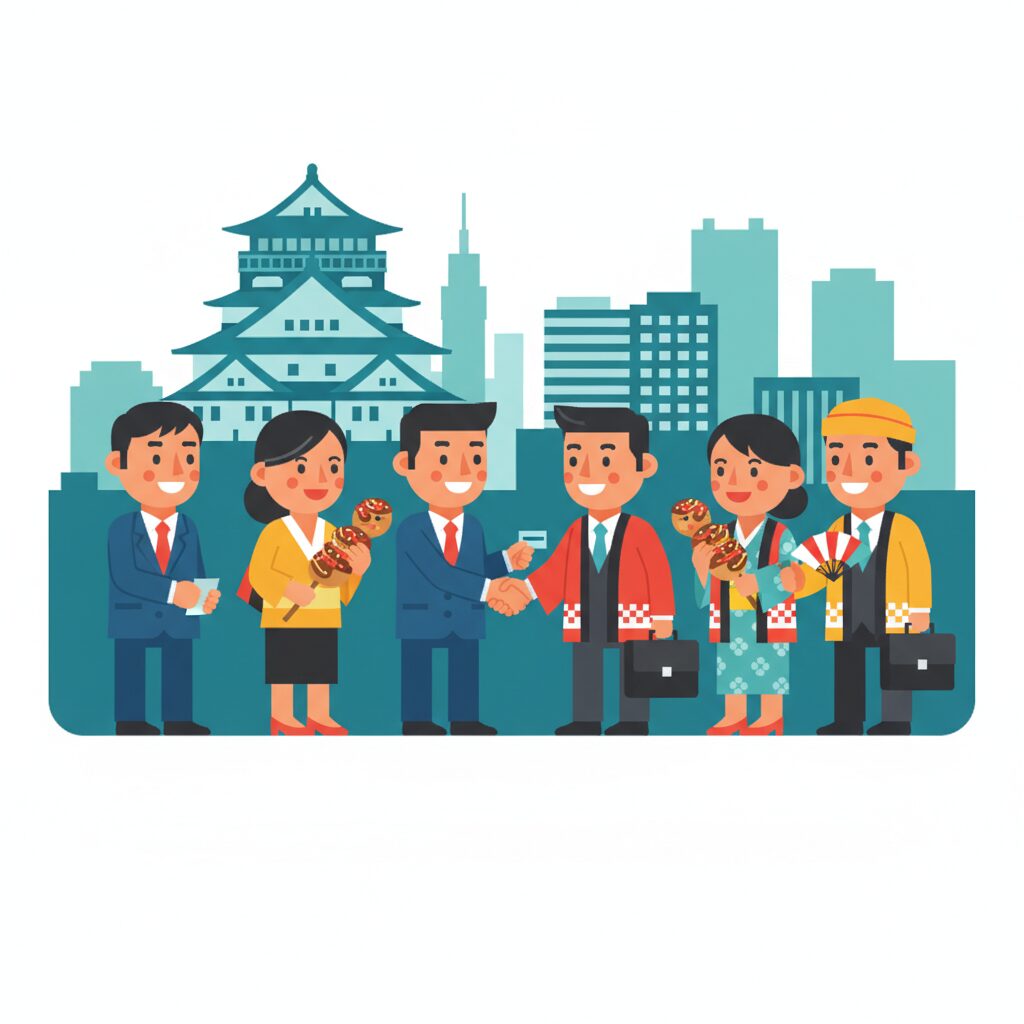
Your first business meeting in Osaka. You’ve prepped for this. You’ve read the books, the ones that paint Japanese business as a silent ballet of subtle nods, endless bows, and unspoken consensus. You expect hushed tones, rigid formality, and a decision-making process that moves at a glacial pace. You walk into the room, ready for the ritual. And then your Osaka counterpart slaps you good-naturedly on the back, laughs, and opens with, “So! Are ya makin’ any money?” The room erupts in a low chuckle. The script you memorized just flew out the window. The air isn’t thick with formality; it’s buzzing with a raw, kinetic energy. It’s direct. It’s personal. It’s loud. And it feels less like a boardroom and more like a bustling marketplace.
Welcome to business in Osaka, where the ancient soul of the merchant, the akindo (商人), still dictates the rhythm of the deal. This isn’t Tokyo. The unspoken rules you thought you knew about Japan get a rewrite here. In this city, built on trade and not titles, the samurai’s code of stoic duty is replaced by the merchant’s creed of pragmatic, profitable, and deeply human connection. This is the Akindo Seishin (商人気質), the Spirit of the Merchant, and it’s the invisible software running everything from multinational negotiations in Umeda skyscrapers to the price of takoyaki in a Namba back-alley. Understanding this spirit is the key to not just surviving but thriving in Osaka. It’s about learning to see business not as a sterile transaction, but as a lively, challenging, and ultimately rewarding human dance. It’s about understanding why a joke can be more powerful than a PowerPoint slide, and why a shared drink can be more binding than a legal contract.
This direct and personal approach is deeply connected to the city’s unique sense of community, where even seemingly nosy behavior is often a sign of genuine care, as explored in our article on Osaka’s ‘osekkai’ culture.
What is the ‘Akindo Spirit’? More Than Just Selling Stuff
To outsiders, the term ‘merchant spirit’ may evoke images of greedy capitalists relentlessly pursuing profit. But in Osaka, this perception is far from accurate. The Akindo Spirit represents a nuanced philosophy, a way of life refined through centuries of commerce. It combines sharp-witted pragmatism, unwavering integrity, and a deep appreciation for human connection. It emphasizes not what you sell, but how you sell it—how you cultivate relationships and conduct yourself within a community grounded in trade. It’s a deeply embedded cultural DNA that values long-term prosperity over short-term gains, understanding that these goals often conflict. To truly appreciate it, you must look back at how Osaka evolved into the city it is today.
The Historical Roots: From ‘Japan’s Kitchen’ to a Merchant Metropolis
History holds significance throughout Japan, but in Osaka, its presence is especially palpable. The city’s identity wasn’t shaped in imperial courts or on shogunate battlefields; it was forged in the marketplace. During the Edo Period (1603-1868), while Edo (modern-day Tokyo) served as the political and military capital, Osaka was recognized as the tenka no daidokoro—the Nation’s Kitchen. It functioned as the central hub for Japan’s rice trade, and by extension, its economy. Feudal lords from across the country sent their rice harvests to Osaka, where it was stored, traded, and converted into cash. This created a unique social hierarchy: in Tokyo, samurai stood atop the pyramid, but in Osaka, merchants were the undisputed rulers. Their influence stemmed from wealth rather than lineage. They were innovators, financiers, and risk-takers, even launching the world’s first futures market at the Dojima Rice Exchange and designing complex financial instruments long before Wall Street. This history fostered a culture that prized business savvy, rational thought, and a healthy skepticism of rigid authority. Respect came from the best ideas, the smartest deals, and the most dependable partners—not from ancestral names.
The Three Pillars of Akindo: Shobai, Shin’yo, and Ningenmi
To grasp the Akindo Spirit fully, one must understand its three fundamental pillars. These aren’t mere abstract ideals; they are living principles encountered daily in Osaka—from buying goods at a small shop to negotiating high-stakes corporate deals. They are the unseen forces guiding behavior and shaping expectations.
Shobai (商売): The Art and Game of Business
Shobai means business or trade in Japanese, but in Osaka, it carries a richer, more vibrant significance. It is not a dry or academic term. Shobai is a craft, a performance, even a game. It encompasses the thrill of pursuit, the satisfaction of a clever deal, and the joy of delivering real value. Osaka merchants do not merely conduct business—they engage in shobai. For example, a shopkeeper in the Shinsaibashi-suji arcade playfully interacts with customers, combining humor with skillful salesmanship. They’re not just selling products; they’re creating experiences and forging fleeting connections. This approach fosters creativity, adaptability, and a relentless focus on practical results. Osaka businesspeople love solving problems and prioritize the questions, “Does this work? Does it make sense? Does it add value?” They view negotiation not as conflict, but as a collaborative puzzle.
Shin’yo (信用): The Bedrock of Trust
If shobai is the energy propelling Osaka’s businesses, shin’yo is their solid foundation. Translated as trust, credit, or reputation, shin’yo is the city’s most precious currency. While contracts matter, a person’s word and reputation for reliability and honesty are paramount. For centuries, Osaka deals were often sealed with a handshake because the parties’ shin’yo was unquestioned. This tradition continues today. Your ability to fulfill promises, act transparently, and behave with integrity is constantly—and often subtly—assessed. Building shin’yo requires time and consistency, demonstrated through reliability and long-term commitment. A single breach can cause severe and lasting damage that’s hard to mend. Consequently, relationships are crucial. Business partners want to know you—the individual—before entering into a deal. They need to trust that you value your personal reputation as much as immediate profits.
Ningenmi (人間味): The Essential Human Touch
Perhaps the most distinctive and often misunderstood element of the Akindo Spirit is ningenmi, meaning ‘human-ness’ or ‘human touch.’ It embodies the warmth, empathy, humor, and personality that Osakans bring into their professional lives. This explains why Osaka people are stereotypically seen as friendly—it’s not merely a personality trait, but a deliberate business tactic. In a culture that prizes shin’yo, trust cannot be built with an impersonal corporation; it must be established with a person. Ningenmi breaks down formal barriers to reveal the individual behind the business card. It’s the casual conversations about baseball, self-deprecating humor, and genuine inquiries about one’s family. It involves vulnerability and forming bonds based on mutual respect and affection. While a Tokyo businessman might view such personal talk as unprofessional and inefficient, an Osaka businessman sees it as the most effective way to build the shin’yo essential for successful shobai. Without ningenmi, you’re just a number on a spreadsheet; with it, you’re a valued partner.
The Akindo Spirit in Action: Navigating Osaka’s Business Etiquette
Grasping the philosophy is one thing; identifying and navigating it during an actual meeting is quite another. The Akindo Spirit reveals itself through a distinctive communication style and ritual set that may feel startling if you’re anticipating the Tokyo norm. Yet once you catch the rhythm, you’ll see it follows a clear and practical logic. It’s a system crafted for efficiency, clarity, and fostering lasting, profitable relationships.
“Moukarimakka?” – The Unofficial Business Greeting
Nothing captures the Osaka mindset better than its famous greeting: “Moukarimakka?” (儲かりまっか?), which literally means “Are you making a profit?” The typical, almost automatic, response is “Bochi bochi denna” (ぼちぼちでんな), translating to “So-so, can’t complain.” For outsiders or even Tokyo natives, hearing this can be surprising. Discussing profit so openly can seem extremely blunt, even rude. But this is a complete misinterpretation. “Moukarimakka?” isn’t a literal inquiry into your finances; it’s a cultural handshake. It serves as a warm-up, an icebreaker that says, “We’re both in the world of shobai. We share the same goals and challenges. Let’s talk.” It instantly creates common ground and an easy, business-focused rapport. Offering a serious, detailed financial report in reply would be as odd as giving a full medical history when asked, “How are you?” The key is to smile, respond with the standard “bochi bochi,” and bounce the question back. It’s the opening move in the Osaka business dance.
The Art of Negotiation: It’s a Dance, Not a Duel
Negotiations in Osaka exemplify the Akindo Spirit. They’re rarely the adversarial, zero-sum contests seen in some Western cultures, nor are they the endlessly indirect, consensus-driven sessions typical of traditional Tokyo businesses. Osaka negotiations are dynamic, collaborative processes aimed at reaching mutually beneficial outcomes—a sweet spot where everyone feels they’ve secured a good deal. This requires a unique blend of directness, flexibility, and relational savvy.
Getting to the Point (But Not Too Quickly)
One of the most refreshing traits of Osaka business is its focus on efficiency. People value their time and dislike vague, roundabout conversations that lead nowhere. They want to get down to brass tacks. Still, a crucial warm-up period exists. You can’t just walk in and lay a spreadsheet on the table. The first five to fifteen minutes of any meeting are dedicated to ningenmi. This is when rapport is built. The chat might be about the latest Hanshin Tigers game, the weather, a new nearby restaurant, or a lighthearted joke about commuting. This isn’t wasted time; it’s the meeting’s most vital part. It establishes a human connection and builds a foundation of shin’yo. Once that connection forms, the shift to business can be swift and direct. The mood changes, laptops open, and the focus sharpens. The ability to fluidly switch between warm, personal interaction and hard-nosed business acumen is a key Osaka skill.
Haggling is Expected, Even Respected
This highlights one of the biggest cultural gaps with Tokyo. In much of Japan, the quoted price is final. Questioning it may seem disrespectful, suggesting the seller is unfair. In Osaka, the initial price is often just the opening offer. Haggling, or nebiki koushou (値引き交渉), is not only accepted but expected. It signals that you’re a serious, savvy businessperson aware of a yen’s value. Accepting the first price without discussion can ironically be seen as naïve or disengaged. Yet the process is not about aggressive confrontation—it’s a polite, reasoned conversation. You don’t say, “Your price is crazy!” You say, “This is a bit beyond our budget. Is there room to move?” or “We’re very interested but were hoping for something closer to X. Can we work together toward that?” The aim is to frame it as a cooperative effort to find a figure that suits both parties. This shows respect for your counterpart and honors your own bottom line—a core Akindo Spirit principle.
The Power of the “Omake” (A Little Something Extra)
Sometimes the price is fixed, but the negotiation isn’t over. This is where Osaka’s unique concept of omake (おまけ) comes into play. Omake means a bonus, a freebie, something extra added to sweeten the deal. It’s a powerful tool both to close negotiations and build goodwill. If a supplier can’t lower their unit price, they might offer free delivery, extended warranty, or throw in a few additional units at no cost. While the monetary value of the omake may be small, its psychological effect is significant. It makes the buyer feel valued and as if they’ve gained something extra. For the seller, it’s a low-cost way to build shin’yo and secure a long-term partnership. When negotiation stalls on price, consider shifting the dialogue: “I understand the price is firm, but could we include X service as part of the deal?” This shows flexibility and emphasizes value over mere cost—an approach any true akindo will respect.
Common Misunderstandings for Foreigners
Navigating this distinctive culture is sure to bring moments of confusion. The mix of humor, straightforwardness, and deeply rooted relational customs can be challenging for newcomers. Recognizing these common points of friction can help prevent misreading cues and enable you to form stronger, more genuine connections with your Osaka counterparts.
Misunderstanding #1: “They’re just joking, not serious.”
Osaka is Japan’s comedy capital. Humor, wit, and self-deprecation are embedded in everyday communication, including the business world. Meetings may be filled with jokes, teasing, and laughter. For foreigners used to a more reserved and formal business setting, this can be quite perplexing. You might question whether your counterparts are taking matters seriously or acting unprofessionally. This is a critical misunderstanding. In Osaka, humor is a strategic tool. It fosters ningenmi, eases tension during tough negotiations, and creates a positive, cooperative environment. It indicates confidence and intelligence. However, when topics shift to numbers, deadlines, and quality control, Osaka businesspeople are among Japan’s most detail-oriented and exacting. The humor serves as a lubricant, not the driving force. Embrace the laughter, join in if you feel at ease, but never lose sight of the sharp, business-focused mindset beneath the playful surface.
Misunderstanding #2: “Their directness is impolite.”
Japan is well known for its indirect communication, the subtle dance between tatemae (public face) and honne (true feelings). People learn to “read the air” and interpret meaning from what is left unsaid. Then you encounter Osaka. An Osaka business partner is more likely to say plainly, “That price is too high,” “We can’t meet that deadline,” or “I don’t think that idea will work.” For someone accustomed to traditional Japanese etiquette, this may seem blunt, confrontational, or even rude. But it’s important to shift your perspective. In the Akindo Spirit, wasting time is the ultimate disrespect. Avoiding clear answers on a deal-breaker issue is seen as dishonest and inefficient. This directness is actually a form of respect, honoring your time and intelligence by providing honest feedback to either resolve the issue or move on quickly. It reflects the pure pragmatism of the merchant. Their intention is not to offend but to reach a practical resolution as swiftly as possible.
Misunderstanding #3: “Building relationships feels unproductive.”
In much of the fast-paced Western business world, time equals money and efficiency reigns supreme. The thought of spending hours at a nomikai (drinking party) or a long dinner with a potential client before discussing the main business can seem like a huge waste of time. You might think, “Let’s just have a one-hour meeting, sign the deal, and get back to work.” This approach doesn’t work in Osaka. Here, the relationship is the work. That lengthy dinner isn’t merely a prelude to negotiation; it is the negotiation. It’s where the true due diligence takes place. Are you a good person? Are you trustworthy? Do you share our values? Can we engage in a genuine conversation with you? These questions are answered over beers and plates of yakitori. The shin’yo and ningenmi built in these informal moments are what enable formal business to proceed. View these social commitments not as burdens, but as vital investments in your success in Osaka.
Osaka vs. Tokyo: A Tale of Two Business Cultures
The rivalry between Osaka and Tokyo defines much of Japan’s dynamic, and it is most clearly seen in their distinct business cultures. Grasping these differences is essential for anyone working in both cities. They represent two separate ecosystems, each governed by its own survival and success principles, forged through centuries of divergent history.
The Samurai vs. The Merchant
This remains the classic and most fitting analogy. Tokyo’s business culture stems from the samurai bureaucracy of the Edo Shogunate, characterized by hierarchy, formality, and a strong focus on process, protocol, and harmony. Decisions are reached by consensus, often through the slow, careful ringi-sei procedure, requiring everyone’s approval. Risk avoidance is paramount. The organization takes precedence, and the individual functions as a part of the larger machine. On the other hand, Osaka, known as the merchant city, follows a different logic. It has a flatter hierarchy and embraces a more informal, egalitarian culture. Outcomes matter more than processes. Good ideas can come from anyone, and if profitable, they will be pursued. Osakans are known for their willingness to take calculated risks. Individual skill, ingenuity, and relationships are highly valued. In Tokyo, you adhere to the rules; in Osaka, you look for the angle.
Speed and Decision-Making
This philosophical divide creates a significant difference in business pace. In Tokyo, a meeting might end with an ambiguous “We will take this back and discuss it internally,” marking the beginning of the prolonged ringi process, which can last for weeks or even months. The final decision-maker is often unclear. Conversely, in Osaka, decision-making authority is frequently delegated lower down the chain, meaning you are more likely to meet with the person who can definitively say “yes” or “no.” The culture prizes speed and decisiveness. A common Osaka saying, “kangaeru furi shite, honto wa yaranai tsumori yaろ,” roughly meaning “You’re pretending to think it over but have no intention of doing it, right?” reflects this mindset. Osakans prefer a quick “no” over a slow, ambiguous “maybe.” If they approve an idea and the numbers add up, decisions often come with surprising and refreshing speed.
The Role of Money
As highlighted by the phrase “Moukarimakka?”, attitudes toward money differ fundamentally. In Tokyo, money is treated seriously and somewhat privately, with open discussions of costs and profits sometimes viewed as inappropriate. The emphasis is on the bigger vision, brand image, and long-term strategy. In Osaka, money is simply part of everyday conversation. People are openly and proudly cost-conscious. Securing a good deal, or being otoku (お得 – obtaining good value), is a point of pride across all levels, from housewives to CEOs. This doesn’t imply stinginess but rather rationality. They expect value for their yen. This pragmatic approach permeates business dealings. When pitching in Osaka, focus on the value proposition: how the offer will save money or boost profits. Be direct and transparent about financial benefits. Your Osaka counterpart will respect the clarity and appreciate your emphasis on what truly matters in shobai.
Practical Tips for Thriving in Osaka’s Business World
Adapting to the Akindo Spirit isn’t about altering your personality. It’s about modifying your approach and appreciating the cultural context. It means learning the steps to the local dance so you can move confidently and foster genuine, lasting partnerships. Here are some practical tips to help you succeed.
Embrace the Banter
Don’t be a stone wall. When your Osaka counterpart begins with a joke or a friendly question, engage with them. Smile, laugh, and reveal a bit of your own personality. You don’t need to be a professional comedian, but demonstrating a sense of humor and not taking yourself too seriously goes a long way in building ningenmi. Learning a few simple phrases in the local dialect, Osaka-ben, can be an excellent icebreaker and a sign of respect for the local culture. A simple “Mokari makka?” from you will almost certainly elicit a warm laugh and instant rapport.
Do Your Homework, But Be Flexible
Enter every negotiation fully prepared. Know your numbers, your costs, your ideal outcome, and your absolute walk-away point. The casual atmosphere is no excuse for careless preparation. Your Osaka counterparts will be razor-sharp on the details and expect you to be too. However, hold your positions with flexibility. Be ready to give and take. Listen carefully to their needs and be prepared to suggest creative solutions. Remember, the objective isn’t to win a battle of wills but to collaboratively build a deal that benefits both parties.
Build Your Network
In Osaka, more than anywhere else in Japan, who you know can be just as important as what you know. A warm introduction from a trusted mutual contact is worth more than a dozen cold calls. Invest time in networking. Accept invitations for drinks. Attend industry events. Make connections. The personal trust built within a strong network forms the ultimate foundation for shin’yo. Your network is your safety net during tough times and your launchpad for new opportunities. These relationships are your most valuable asset in the city.
Understand the Logic of “Win-Win”
The best Akindo are masters of the win-win deal. They understand that a transaction where one party feels they lost is a bad deal in the long term, as it eliminates any chance of future business. Always frame your negotiations around mutual benefit. Explain how your proposal helps them achieve their goals. Show that you care about their success, not just your own profit. An attitude of “Let’s make a great deal together” will always be more effective than “This is what I want, take it or leave it.” The goal is for both parties to leave the table feeling satisfied, respected, and eager to collaborate again.
Pay Attention to the Details
Don’t let the informal style mislead you into thinking professionalism doesn’t matter. It matters greatly, just in a different way. While the emphasis might be less on formal protocol, it is intensely focused on reliability. Be punctual for meetings. Send follow-up emails promptly. If you promise to deliver something by a certain date, deliver it. Your word is your bond. The casual banter and friendly relationships all rest on the assumption that you are a capable, reliable professional. Upholding your commitments is the ultimate way to build and maintain shin’yo. Failing to do so is the fastest way to be excluded from the Osaka business community.
Living and working in Osaka is an immersion into a culture that is as pragmatic as it is personable, as shrewd as it is warm-hearted. The Akindo Spirit is not a historical relic; it’s the city’s living, breathing operating system. It shapes the marketplace’s frantic energy, the sharp calculations of corporate deals, and the easy laughter shared over drinks after work. It’s a culture that rewards authenticity, resilience, and genuine interest in others. For a foreigner willing to look beyond surface-level stereotypes of Japan and embrace this dynamic spirit, Osaka offers more than just business opportunities. It offers a chance to connect with the raw, vibrant, and deeply human heart of Japanese commerce, to learn that the best deals are built not merely on numbers and contracts, but on trust, mutual respect, and shared laughter. Master this, and you won’t just be doing business in Osaka—you’ll truly belong.