
Osaka. The name itself crackles with energy, a neon-drenched symphony of sizzling takoyaki, endless shopping arcades, and a playful, irreverent spirit that pulses from the heart of the Kansai region. It’s a city that rushes forward, a whirlwind of modernity and delightful chaos. You can spend days lost in the electric dream of Dotonbori, hunting for the latest anime figures in Den Den Town, or eating your way through the culinary wonderland that is the Kuromon Ichiba Market. Yet, nestled just a stone’s throw from this vibrant contemporary hustle, lies a gateway to another world. A world of profound emotion, exquisite artistry, and stories that have echoed through centuries. This is the world of Bunraku, Japan’s traditional puppet theatre, and its grandest stage is here, at the National Bunraku Theatre in Osaka. To step inside is to quiet the modern noise and listen to the very soul of Japan, spoken through wood, silk, and song. Forget everything you think you know about puppetry; this is not a children’s show. This is epic drama, heartbreaking tragedy, and breathtaking beauty, a cultural treasure so significant it has been recognized by UNESCO as a Masterpiece of the Oral and Intangible Heritage of Humanity. It’s an art form that requires three hearts to beat as one, a trinity of performance that breathes life into the inanimate and makes audiences weep for figures carved from wood. For any traveler seeking to connect with the deep cultural currents that flow beneath Japan’s dazzling surface, a visit to this theatre isn’t just a recommendation; it’s an essential pilgrimage into the heart of Japanese storytelling.
While the world of Bunraku offers a profound cultural experience, you can also discover the city’s modern soul through its vibrant street food scene, like the iconic Okonomiyaki found in the Juso district.
The Magic Unveiled: What is Bunraku?
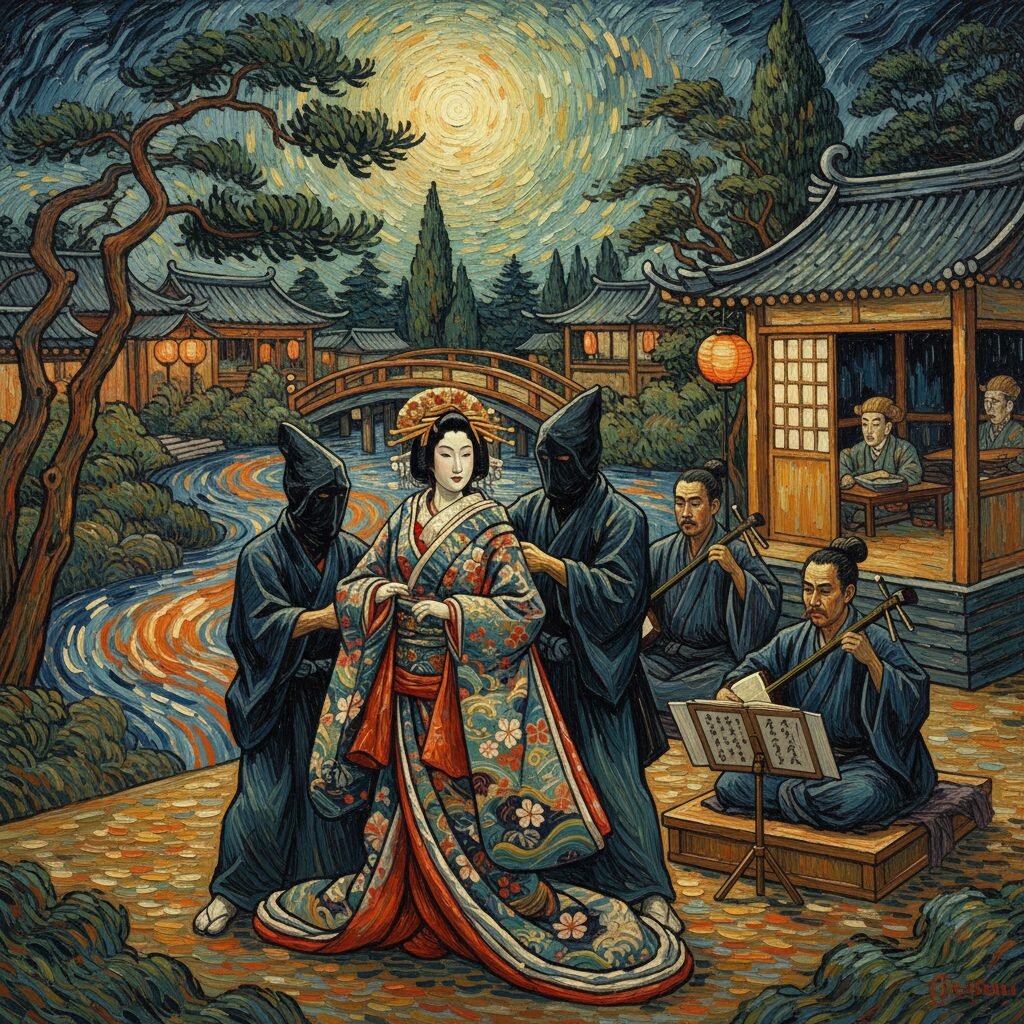
Before you settle into your seat in the plush, silent auditorium, it’s helpful to grasp the intricate alchemy behind the magic on stage. Bunraku is not a single performance but a harmonious collaboration of three distinct artistic disciplines, collectively known as the San-gyo (the three professions). Each is a world of skill in itself, but together they merge to create a fourth dimension of pure, unadulterated storytelling. This structure has been refined over more than three hundred years, forming a perfect triangle of performative genius. To truly appreciate Bunraku is to recognize the interplay and mastery of each of its core components, each representing a lifetime of study for its practitioners.
The Ningyo: Beyond Mere Puppets
The first thing that will catch your eye are the puppets, the ningyo. They are magnificent, roughly two-thirds life-size, lending them a substantial, believable presence on stage. Their costumes are miniature marvels of textile art, crafted from rich brocades and dyed silks that reflect each character’s social status and personality. Yet the true soul lies in the head, the kashira. Each head is a hand-carved sculpture, a masterpiece of expressive potential. These are not static masks; through clever internal mechanisms, their eyes can blink and shift, their mouths can open and close, and even their eyebrows can subtly rise or fall to convey surprise or worry. The level of detail is astonishing. Hundreds of different heads exist, each designed to represent a specific archetype: the virtuous young maiden, the grizzled warrior, the jealous villain, the comic relief. The bodies beneath the robes are simpler, often wooden frames draped in cloth, yet in the hands of the masters, they move with an eerie, captivating grace. They are not merely dolls being manipulated; they are vessels, ready to be imbued with life, emotion, and destiny by the artists who control them.
The Tayu: The Voice of Every Soul
Seated on a special rotating platform beside the stage, called the yuka, is the chanter, or Tayu. This storyteller is the emotional core of the entire performance. The Tayu does more than narrate the story; he becomes it. Using a powerful, guttural vocal technique that resonates from the depths of the abdomen (hara), he assumes every role. He is the weeping heroine, the booming samurai, the cackling demon, and the wise old man, often shifting between them within a single breath. He speaks dialogue, narrates scenes, and expresses the unspoken inner thoughts of each character on stage. It is an Olympic-level feat of vocal endurance and emotional nuance. His voice rises to heart-wrenching crescendos of grief, then falls to conspiratorial whispers. He doesn’t just tell the story; he makes you feel it deeply. The text he recites from, the maruhon script, is literary art itself, rich with poetic language and complex human drama. The Tayu’s performance is a raw, visceral experience that transcends language. Even without understanding a word, the sheer emotional power of his delivery is universally felt.
The Shamisen: The Drama’s Heartbeat
Kneeling beside the Tayu is the shamisen player. This is not the delicate, light-toned shamisen you might hear elsewhere. This is the futo-zao shamisen, a larger instrument with a deeper, more resonant voice, sometimes strikingly percussive. The shamisen player does more than provide background music; he is the conductor of the play’s emotional rhythm. The music itself becomes a character, a force shaping the entire experience. A sharp, powerful strum can signal a shocking revelation or a decisive sword strike. A low, melancholy melody can evoke falling snow or a character’s inner despair. The shamisen mirrors the Tayu’s chanting, punctuating his words and underscoring emotional peaks and valleys. It can imitate the sound of rain, the rush of wind, or the frantic beating of a lover’s heart. The music and voice engage in a constant, dynamic dialogue, weaving a soundscape as vital to the storytelling as the puppets’ movements on stage. The silence between the notes often carries as much power as the music itself, creating a tension that holds the audience spellbound.
The Three-Man Weave: The Art of the Puppeteers
Now, shift your focus back to the stage and the figures dressed in black who silently glide behind the vividly adorned puppets. This is perhaps the most distinctive and captivating feature of Bunraku: the three-person puppeteering system. Each main puppet is operated by a team of three highly skilled puppeteers, the ningyozukai, who must move in perfect, unspoken harmony. Their ability to act as one unified entity is the result of decades of rigorous, hierarchical training, a silent language of breath and subtle physical signals.
The lead puppeteer, the omozukai, is the master of the group. He is the only one whose face is usually visible, a mark of his esteemed status. He controls the puppet’s head with his left hand through a series of triggers inside the torso, and operates the puppet’s right arm and hand with his own right arm. He determines the core emotion and intention of the character. The second puppeteer, the hidarizukai, devotes himself entirely to moving the puppet’s left arm. He must perfectly mirror the omozukai’s intentions, making the left arm move naturally and in harmony with the right. The third puppeteer, the ashizukai, holds the lowest rank and controls the feet. For female puppets, whose feet are hidden beneath long kimonos, the ashizukai creates the illusion of movement and posture by manipulating the hem of the robe. Their collaboration must be so seamless and flawless that the three separate operators vanish, leaving only a single living, breathing character on stage.
The path to becoming an omozukai demands extraordinary dedication. The saying goes, “Ten years for the feet, ten years for the left arm.” A puppeteer spends a decade mastering realistic walking, running, and kneeling movements as the ashizukai. Only after this can they advance to the left arm, where they spend another ten years perfecting intricate gestures and expressions. Finally, after about twenty years of devoted, anonymous training behind the scenes, they may earn the privilege to control the head and right arm. This lengthy apprenticeship creates a profound sense of unity and discipline. When you watch them perform, you witness not just a show but the culmination of a lifetime’s work. At first, you notice the puppeteers clad in black robes and hoods (kurogo). Yet as the drama progresses, a strange and wonderful phenomenon occurs. Your brain begins to filter them out. The black-clad figures fade into the background, and your focus narrows until all you can see is the puppet, animated with astonishing and deeply moving realism.
Stepping into the Theatre: Your First Bunraku Experience in Osaka
Experiencing a traditional Japanese art form for the first time can be intimidating, but the National Bunraku Theatre warmly welcomes international visitors. The building itself is a striking example of modern Japanese architecture—clean and elegant, yet incorporating traditional design elements that create an atmosphere of refined culture. The lobby before a performance exudes a quiet, respectful anticipation. Visitors stroll around, admiring displays of ornate puppet heads or buying bento boxes to enjoy during the lengthy intermissions. There’s a palpable sense of occasion and a shared reverence for the art about to be performed.
For newcomers, the most essential tool is the earphone guide. Available for a small rental fee in the lobby, these guides unlock the richness of the narrative. They offer real-time, high-quality English translations of dialogue and narration, along with explanations of cultural context, character motivations, and key plot points. Far from a simple translation, it provides expert commentary that highlights subtle gestures and musical cues you might otherwise miss. Using the guide transforms the experience from a beautiful yet potentially confusing visual spectacle into a deeply engaging and emotionally powerful drama.
Another great option for beginners is the single-act ticket, or Maku-mi-seki. Full Bunraku performances can last four hours or more, which may be a considerable commitment. The Maku-mi-seki lets you purchase a more affordable ticket for just one act of the play, usually lasting between 45 minutes and an hour and a half. These tickets typically go on sale at the box office the day of the performance and are located in the upper levels. This is an ideal way to sample the art without investing too much time or money. It’s a taste that will likely leave you eager for the full experience. Also, consider buying the English program, which offers a detailed synopsis, a cast of characters, and beautiful photos that make a wonderful souvenir of your visit.
Inside the auditorium, the stage is an engineering marvel. It includes trap doors and elevators for dramatic entrances and exits, plus a massive revolving platform (mawari-butai) for seamless scene changes. Take note of the yuka to your right, where the Tayu and shamisen player perform. Their visibility is intentional; you are meant to see the sweat on the Tayu’s brow and the intense focus of the musician. This is all part of the performance, a tribute to the human effort behind this extraordinary art form.
A Journey Through a Story: What to Watch For
Bunraku plays, known as joruri, frequently draw upon Japan’s rich history and feudal-era literature. The narratives are generally grand and tragic, centered on timeless themes of love versus duty (giri and ninjo), honor, sacrifice, and the harshness of fate. These stories do not move quickly; they unfold at a deliberate, poetic pace, allowing emotions to build gradually and intensely. The key is to settle into this rhythm and let the story wash over you. Instead of searching for action, seek out emotion, which is expressed through the smallest details.
Notice the puppet’s head—a slight downward tilt can express a profound sadness. Observe the hands—a female puppet delicately raising a sleeve to her face to conceal a tear is more moving than any loud sob. Puppeteers can even create the illusion of breathing, with the subtle rise and fall of the puppets’ shoulders. These tiny, hyper-realistic movements showcase the true artistry. They are the strokes that craft a complete emotional portrait.
Let yourself be captivated by the harmony of the San-gyo. There will be moments when the Tayu releases a wrenching cry of despair, and precisely at that moment, the shamisen strikes a dissonant, jarring chord as the puppet collapses to the floor in a heap of silk. It is in these moments of perfect synchronization that Bunraku’s power is fully revealed. Close your eyes for a minute or two during the performance. Without the visual element, you can concentrate solely on the soundscape—the raw, emotional tapestry woven by the Tayu’s voice and shamisen strings. You will experience the story on a more primal, deeper level.
While many stories are tragic, some plays include moments of comedy and breathtaking spectacle. Battle scenes may involve dozens of puppets, and ghost stories often use inventive stagecraft to produce supernatural effects. Each performance is a journey, and the emotional payoff for the patient viewer is profound.
Beyond the Stage: The Neighborhood and Practical Tips
The National Bunraku Theatre is ideally located for a full day of exploring Osaka. Situated in the Chuo Ward, it sits right next to Nippombashi Station, which is served by two subway lines and the Kintetsu Railway line. This convenient location places you within easy walking distance of some of Osaka’s most famous neighborhoods. Before a matinee show, take a ten-minute walk to Kuromon Ichiba Market, famously known as “Osaka’s Kitchen.” There, you can browse aisles filled with fresh seafood, sizzling wagyu skewers, and colorful produce. It’s an excellent spot to enjoy a casual, delicious lunch and fully experience the lively local food culture.
After an evening performance, you’re just a short walk from the dazzling neon-lit district of Dotonbori. Let the theatre’s quiet atmosphere give way to the vibrant sensory overload of this canal-side entertainment area. This sharp contrast perfectly showcases the dual character of Osaka. Take a photo with the iconic Glico Running Man sign, then dive into one of the thousands of local eateries for a classic Osaka dinner like okonomiyaki or kushikatsu. Nearby is Den Den Town, Osaka’s electronics and anime district, offering another side of Japanese culture alongside the traditional arts.
Booking tickets for performances is easy. The theatre’s official website typically features an English section where you can check schedules and purchase tickets online in advance, which is highly recommended, particularly for popular shows or weekend performances. Alternatively, tickets can be bought directly at the theatre’s box office. The dress code is generally smart casual; formal attire is unnecessary but looking presentable is appreciated. As with most performances, photography and recording are strictly prohibited once the curtain rises. During intermissions, which can be quite lengthy, it’s customary to enjoy a drink or a bento box in the lobby or designated dining areas, making the entire experience relaxed and refined.
A Living Tradition, Not a Museum Piece
It is essential to recognize that Bunraku is not a static artifact from the past, kept under glass for tourists. It is a living, breathing, and evolving art form. While the classic plays from the 17th and 18th centuries remain the foundation of the repertoire, new works continue to be created, and contemporary themes are occasionally explored. The government actively supports the training of new generations of Tayu, shamisen players, and puppeteers to ensure these invaluable skills are preserved over time. The performers on stage belong to an unbroken lineage of masters and apprentices stretching back centuries. When you watch a performance, you are not merely seeing a play; you are witnessing the preservation and continuation of a vital part of the world’s cultural heritage. Although the themes of the plays are set in a bygone era, they remain universal. The struggles of love, the burden of responsibility, and the pain of loss are as relevant now as they were three hundred years ago. The emotional honesty of Bunraku can feel more genuine and powerful than many contemporary forms of entertainment precisely because it is so fundamental and deeply human.
Your journey into the world of Bunraku in Osaka is more than just a theatrical experience. It is a chance to slow down, to listen carefully, and to feel profoundly. It is an act of cultural immersion that connects you to Japan’s historical and emotional core. You will leave the theater transformed. The frenetic energy of the Osaka streets will sound different. You will carry with you the echo of the Tayu’s voice, the mournful twang of the shamisen, and the unforgettable image of a wooden puppet, brought to life by three masters, shedding a silent, perfect tear. This memory will remain with you long after the neon lights of Dotonbori have faded, a soulful thread forever linking you to the extraordinary city of Osaka.