As a Tokyo event planner, I live and breathe a city that runs on precision. Every minute is scheduled, every interaction follows a script, and public space is a silent stage where everyone knows their role. We build our lives in the vertical canyons of Shinjuku and Shibuya, finding our fun in curated experiences and themed cafes. When I moved to our company’s Osaka branch, I thought I was prepared. I’d done the tourist circuit: the electric shock of Dotonbori’s neon signs, the savory bliss of takoyaki from a street stall, the towering presence of Osaka Castle. I thought I understood the city. I was wrong.
What I had seen was Osaka’s highlight reel, the explosive, vibrant personality it shows to the world. But daily life, I soon realized, was something else entirely. It was a language I didn’t speak, a rhythm I couldn’t find. My Tokyo sensibilities were constantly being tripped up. The directness of my colleagues felt jarring, the volume on the subway felt like a violation, the casual way strangers interacted felt like a social code I hadn’t been given. People kept telling me, “Osaka is friendly,” but that felt too simple. It wasn’t just friendliness; it was a fundamental difference in the operating system of the city. To really understand it, I knew I had to get out of the central loop of Umeda, Namba, and Shinsaibashi. I needed to see where Osaka lived, not just where it performed.
So, on a whim one Saturday morning, I decided to head south. Not to the famous temples of Kyoto or the deer-filled parks of Nara, but to a place a local colleague mentioned off-handedly as a good spot for a chill weekend: Kishiwada Cancan Bayside Mall. An outlet mall. It sounded profoundly ordinary, which was exactly what I was looking for. No tourists, no guidebooks, just a regular place for regular people. My goal wasn’t to shop for bargains, but to shop for answers. I wanted to see if, in the aisles of a discount store and on the edge of Osaka Bay, I could finally start to understand the soul of this complicated, contradictory, and utterly captivating city.
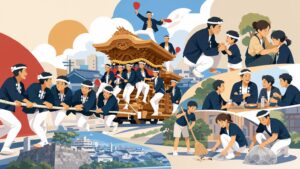
While exploring the everyday life of Kishiwada, I was reminded that the city’s true character is often found in its deep-rooted traditions, such as the intense social hierarchy and lifelong bonds forged within Kishiwada’s Danjiri teams.
The Nankai Line Express: A Journey Through Osaka’s Layers
From Urban Grid to Coastal Haze
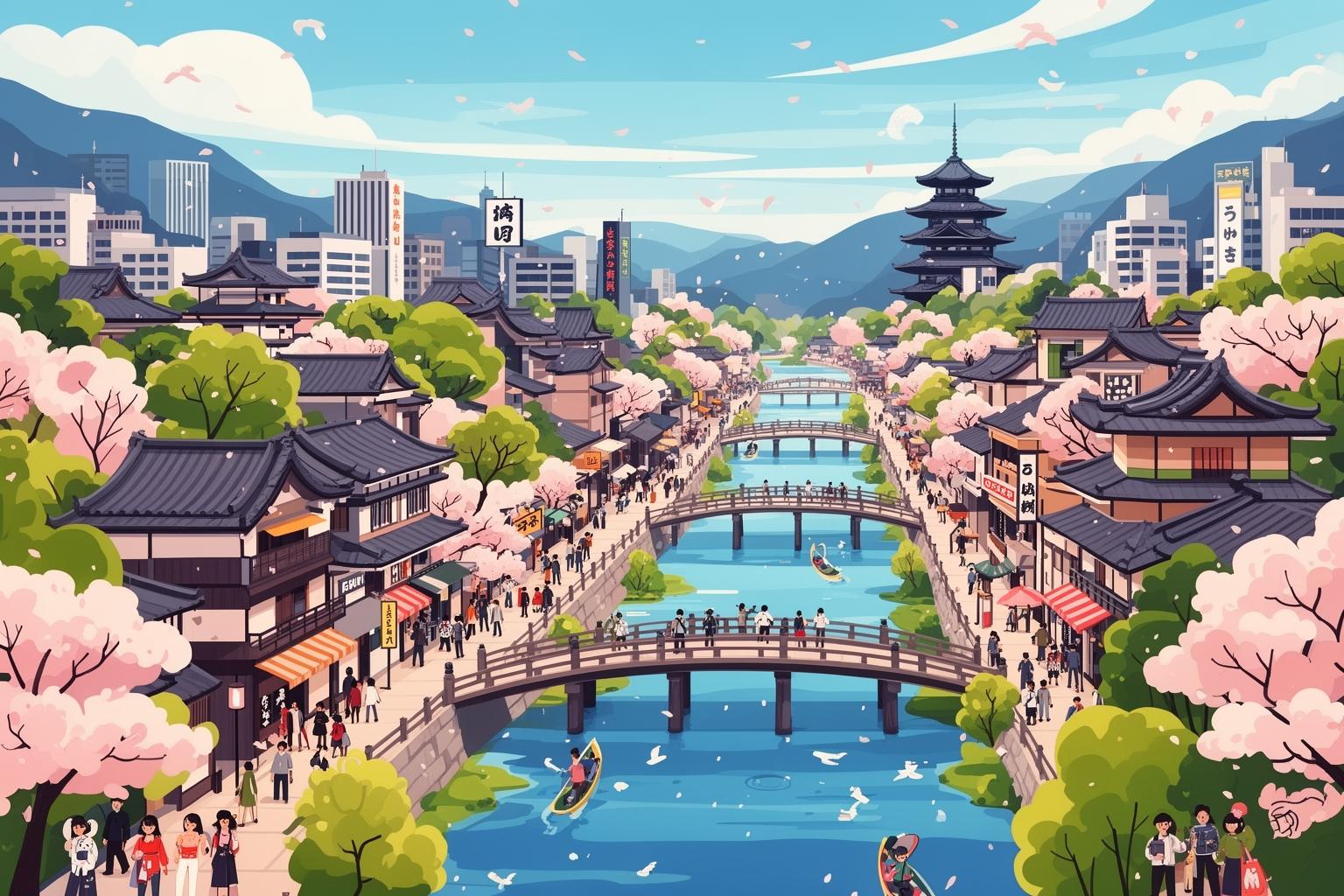
My journey began at Namba Station, the chaotic southern heart of Osaka. Boarding the Nankai Line express train bound for Wakayama felt like a deliberate act of departure. In Tokyo, a train ride is a passage through a void. You get on, gaze at your phone, then get off. The scenery blurs into concrete and steel, each station nearly indistinguishable from the last. The train is a sterile tube designed solely for efficient human movement. But the Nankai Line felt different from the moment I stepped aboard. The seats were covered in plush, deep green velvet, somewhat worn and old-fashioned. The train itself seemed to have character.
As we left the station, the city began to peel away in distinct, unglamorous layers. The dense cluster of high-rises around Namba gave way to the tight, two-story houses of Tengachaya and Sumiyoshi. Then appeared the sprawling industrial zones of Sakai—a landscape of smokestacks, warehouses, and the skeletal frames of enormous cranes. This wasn’t the curated, picturesque Japan seen on postcards. This was the city’s engine room, the working coast that has powered Kansai for centuries. In Tokyo, the city feels like it ends abruptly. Here, it simply slowly dissolves into something else. The hard lines of the urban grid softened, the air through the windows carried a faint, salty tang, and the sky seemed to open up, a vast, pale blue canvas stretching over the hazy horizon of Osaka Bay. You could sense the geography shifting your state of mind. The farther south we traveled, the more my shoulders eased from their default Tokyo-dweller hunch.
The Soundtrack of the Commute
What truly distinguished the journey was the sound. A Tokyo train carriage during off-peak hours is a library of silence, broken only by the rhythmic clatter of wheels and automated station announcements. Phone calls are a cardinal sin. Loud conversations are unthinkable. Here, on the Nankai Line, the carriage buzzed with sound. It wasn’t rude or obnoxious; it was simply… human. Two women in their sixties, dressed in vibrant, patterned blouses, laughed uproariously at a story, their Kansai-ben dialect flowing like a melodic, tumbling river of words. Across the aisle, a young couple animatedly planned their day at the mall, pointing at a map on their phone. A father patiently explained the names of passing stations to his young son.
My Tokyo conditioning screamed This is wrong! Public space is for quiet contemplation! But as I watched and listened, I realized I was witnessing a fundamental cultural difference. In Tokyo, a rigid wall separates private life from public persona. You perform a role in public—the quiet commuter, the polite pedestrian. In Osaka, that wall is permeable, nearly non-existent. Life isn’t something you pause when you leave your home. It spills out into the streets, the shops, and yes, the train carriages. The conversations weren’t performances; they were the genuine, unfiltered soundtrack of a community in motion. What a foreigner might mistake for a lack of consideration is actually a sign of a city that sees public space as a shared living room rather than a sterile corridor between private destinations. It’s a city that lives its life out loud.
Arrival in Kishiwada: Where the Festival Spirit Meets the Sea Breeze
More Than Just a Station
As I stepped off the train at Kishiwada Station, the atmosphere shifted immediately. This was not a sleek, modern transit hub built for anonymous efficiency. The station carried a strong sense of place, with history etched into its architecture. And you could sense something else in the air—a fierce, unapologetic local pride. Before this trip, my only knowledge of Kishiwada came from a documentary about its famous festival, the Kishiwada Danjiri Matsuri.
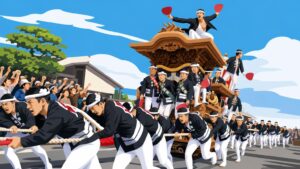
It’s a wild, chaotic, and genuinely dangerous event where teams of men from different neighborhoods race massive, ornate wooden floats—the danjiri—at breakneck speeds through narrow streets. It’s a spectacle of raw energy, incredible skill, and intense community bonding. You don’t have to witness the festival to feel its influence. That spirit—a mix of passionate intensity, deep-rooted connection to neighborhood and tradition, and a certain disdain for gentle moderation—is the cultural engine running quietly beneath the surface of this town. It sheds light on the directness of the people and the absence of pretense. This is a place that values strength, skill, and community above polite, surface-level harmony. It stands in stark contrast to the smooth, frictionless social façade of Tokyo. This is a city rich in texture.
The “Cancan” Mall: An Un-Tokyo Approach to Leisure
A short walk from the station brought me to the Kishiwada Cancan Bayside Mall. The name itself is purely Osaka—onomatopoeic, playful, and a bit whimsical. The mall defied my expectations. In Tokyo, shopping malls are typically enclosed fortresses—climate-controlled boxes designed to shield you from the outside world and funnel you past as many storefronts as possible. They are masterful commercial engines, often built vertically atop train stations to maximize every square inch of valuable space.
By contrast, the Cancan mall was sprawling, horizontal, and divided into two parts—one side for outlets, the other housing a cinema and supermarket—stretching along the waterfront. The architecture was open and airy, with wide walkways, outdoor plazas, and a massive wooden deck facing Osaka Bay. The sea wasn’t merely a scenic backdrop; it was the central organizing theme of the entire complex. Its design seemed to say, “Yes, there are shops here, but that’s not the sole reason you’ve come.” It was created not just for shopping, but for lingering—a destination, a public space where the community could gather, breathe, and simply be. This simple design choice revealed a deeper philosophy—one where efficiency yields to the quality of experience and connection to nature.
The Art of the Deal: Deconstructing Osaka’s Commercial Heart
Shopping as a Social Interaction
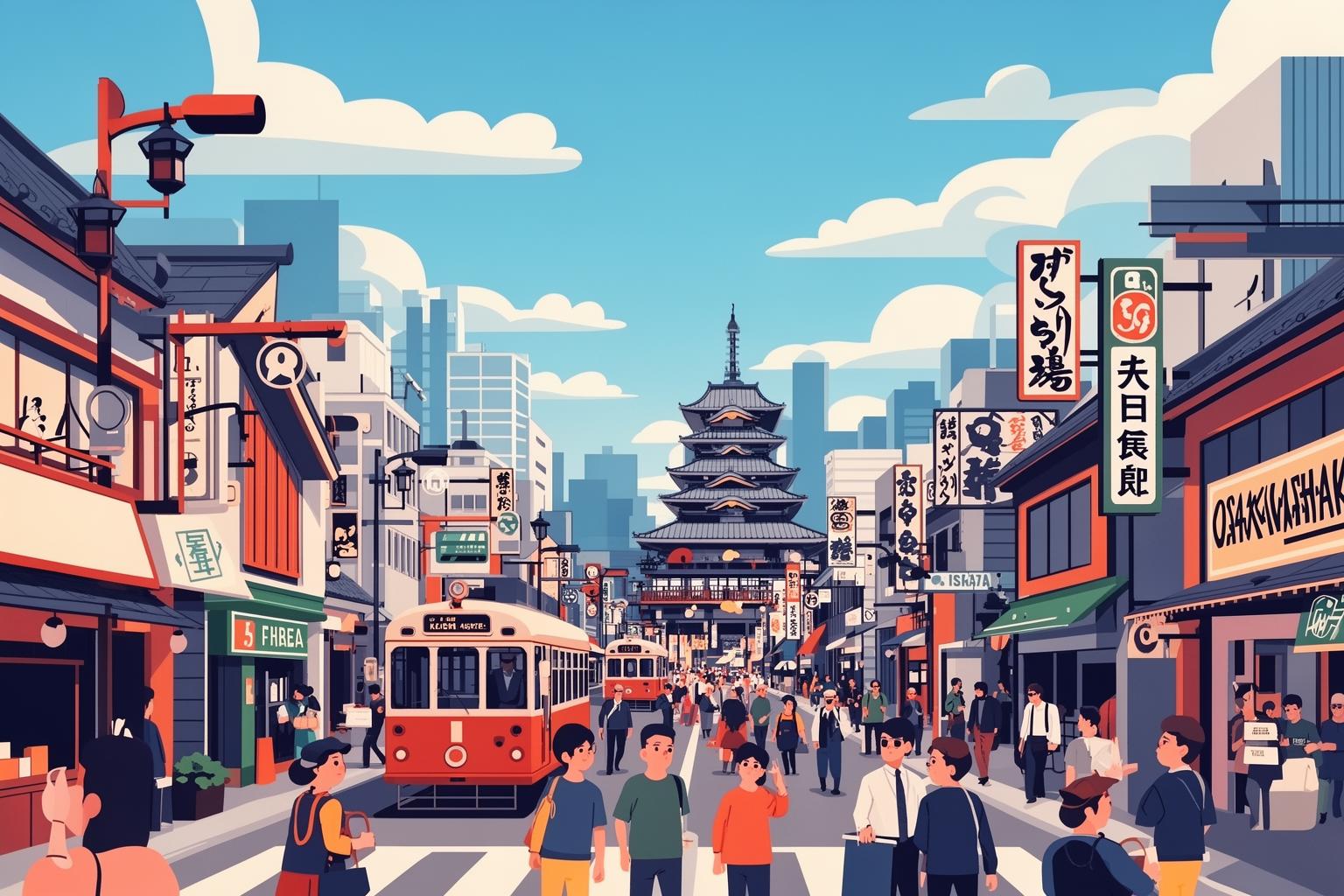
I wandered into a major brand’s outlet store, supposedly looking for a light jacket. In a similar store in Tokyo, the experience would be predictable. A staff member would greet me with a distant, high-pitched, formal “Irasshaimase!” then follow me silently, appearing only if I looked lost or asked for help. The interaction would be governed by a strict manual of polite, deferential service.
Here, it was entirely different. A middle-aged female employee with a short, stylish haircut and a warm smile noticed me browsing. Instead of a formal greeting, she came right over and said in a friendly, casual tone, “Nanka sagashiteru?” (Lookin’ for somethin’?). It was direct, informal, and instantly disarming. I mentioned jackets. Her eyes brightened. “Ah, jackets! We got some real good ones in. This one here,” she said, pulling a beige trench coat off the rack, “is a classic, but honestly? The color’s a bit boring for you. You can do better.”
I was momentarily taken aback. In Tokyo, a sales assistant would never offer such a direct, personal opinion—it would be considered presumptuous, even rude. Their role is to support the customer’s choice, not to challenge it. But here, her honesty wasn’t rude; it was a sign of engagement. She wasn’t just a clerk; she was a collaborator. “Now this one,” she said, grabbing a navy blue bomber jacket, “this has character. Meccha niau omou wa.” (I think this would look super good on you). We spent the next ten minutes in lively conversation, not just about jackets, but about where I was from, my thoughts on Osaka, and her lunch recommendations. The transaction became a dialogue. This is the merchant DNA of Osaka in action. A sale isn’t simply a clinical exchange of goods for money; it’s the start of a relationship, however brief. What foreigners often take for pushiness is actually an invitation to connect on a human level.
The Language of Value
The entire interaction was infused with vocabulary that celebrated cleverness and worth. When I finally chose the navy jacket, she glanced at the price tag and made a little sucking-in-of-breath sound. “Hmm, a bit pricey, huh? Wait a moment.” She disappeared briefly and then returned. “My manager isn’t looking. We can do a little benkyou on this one for you.” Benkyou suru, literally “to study,” is Osaka slang for giving a discount. It transforms the act of lowering a price from a simple markdown into a gesture of goodwill—a sign that she’s on my side, helping me get the best deal possible.
This obsession with value is a core part of the Osaka mindset. It’s often stereotyped as stinginess or cheapness, but that’s a fundamental misunderstanding. It’s not about spending as little money as possible; it’s about getting the maximum value for every yen spent. Wasting money on an overpriced item is seen as foolish, a mark of being a sucker. Securing a good deal—whether through negotiation, clever shopping, or a friendly discount—is a source of great satisfaction and a story to proudly share with friends. It’s a game everyone knows the rules to. This is why discussions about money are much more open here than elsewhere in Japan. It’s not taboo; it’s a shared passion.
The Family Budget Meeting in Aisle Three
This drama of value was unfolding throughout the mall. I sat on a bench, watching a multi-generational family—grandmother, mother, father, and young son—in a lively, yet cheerful, debate in front of a sporting goods store. The boy wanted an expensive new pair of basketball shoes. The father seemed ready to agree. The mother was skeptical, pointing at the scuffed but still usable sneakers the boy already had. Yet, the final word appeared to belong to the grandmother.
She picked up one of the coveted shoes, examined it, squeezed the sole, and launched into a rapid-fire interrogation of the father, her voice full of authority and theatrical flair. It was a public display of family decision-making. In Tokyo, such a discussion would happen in hushed tones, if at all publicly. Here, it was a vibrant, open forum. Everyone had a voice, and the final decision would be reached collectively through debate and compromise. This scene perfectly embodied the iconic “Osaka Obachan.” Far from the stereotype of a sweet old lady, the matriarch in Osaka is often a formidable figure—pragmatic, financially savvy, and the ultimate arbiter of the family budget. This interaction wasn’t conflict; it was the family functioning as a unit, teaching the younger generation the vital lesson of value in real time.
Life on the Waterfront: Beyond the Shopping Bags
The View from the Deck
After completing my retail ethnography, I bought a can of coffee and settled on the expansive wooden deck overlooking the bay. This, I realized, was the mall’s true centerpiece. Shopping was merely the introduction. The deck was alive with people, yet it never felt congested. There was a pervasive sense of calm and openness. A young couple sat silently on a bench, gazing out at the water as the afternoon sun sparkled on its surface. Nearby, a group of high school students laughed and shared snacks. Further along, a man patiently taught his toddler to ride a tiny bicycle. In the distance, the impossibly long, slender bridge to Kansai International Airport (KIX) stretched across the water, with airplanes resembling silver toys as they descended for landing.
The sea is central to Osaka’s identity. It’s a city founded on trade, a gateway to the wider world. That connection is tangibly felt here. This isn’t the manicured, inaccessible waterfront of Tokyo Bay, lined with sterile skyscrapers and elevated highways. This is a working, breathing coastline. The air carried the scent of salt mixed faintly with industrial brine. It was a view that felt sincere and authentic. For the people here, this space clearly serves as a vital escape valve. In Tokyo, finding mental space often means seeking out a perfectly manicured garden or a quiet, minimalist cafe—carefully curated settings meant for contemplation. Here, the escape was simpler and deeper: an open stretch of water and sky. It’s a reminder that life in Osaka isn’t merely about the frenetic energy of the city core; it’s also about having access to this raw, natural beauty just steps away.
The Unspoken Rules of Relaxation
What struck me most was what people weren’t doing. Few were glued to their phones. There was no rush, no pressure to be productive or to move on to the next task. People were simply present, absorbing the atmosphere. They were practicing an art known in the Kansai dialect as boratto suru. It’s a phrase that’s hard to translate precisely. It roughly means “to space out,” “to chill,” or “to just hang around aimlessly.”
In Tokyo’s hyper-efficient culture, aimlessness is nearly a sin. Time is a resource to be optimized. A free afternoon is a block to be filled with activities. Boratto suru is the exact opposite. It’s the deliberate choice to do nothing in particular, to let the mind wander, to simply exist in a place without a goal. Watching the families and couples on that deck, I realized this wasn’t laziness; it was a cherished form of mental self-care. It’s integral to the work-life balance in this region. The ability to fully switch off and enjoy the simple pleasure of a sea breeze is a skill, one many Osakans have mastered. This is the reality of daily life for so many here. It’s not a nonstop party in Dotonbori; it’s the quiet moments of peace found in everyday places.
An Honest Meal: What the Food Court Reveals
No Pretense, All Flavor
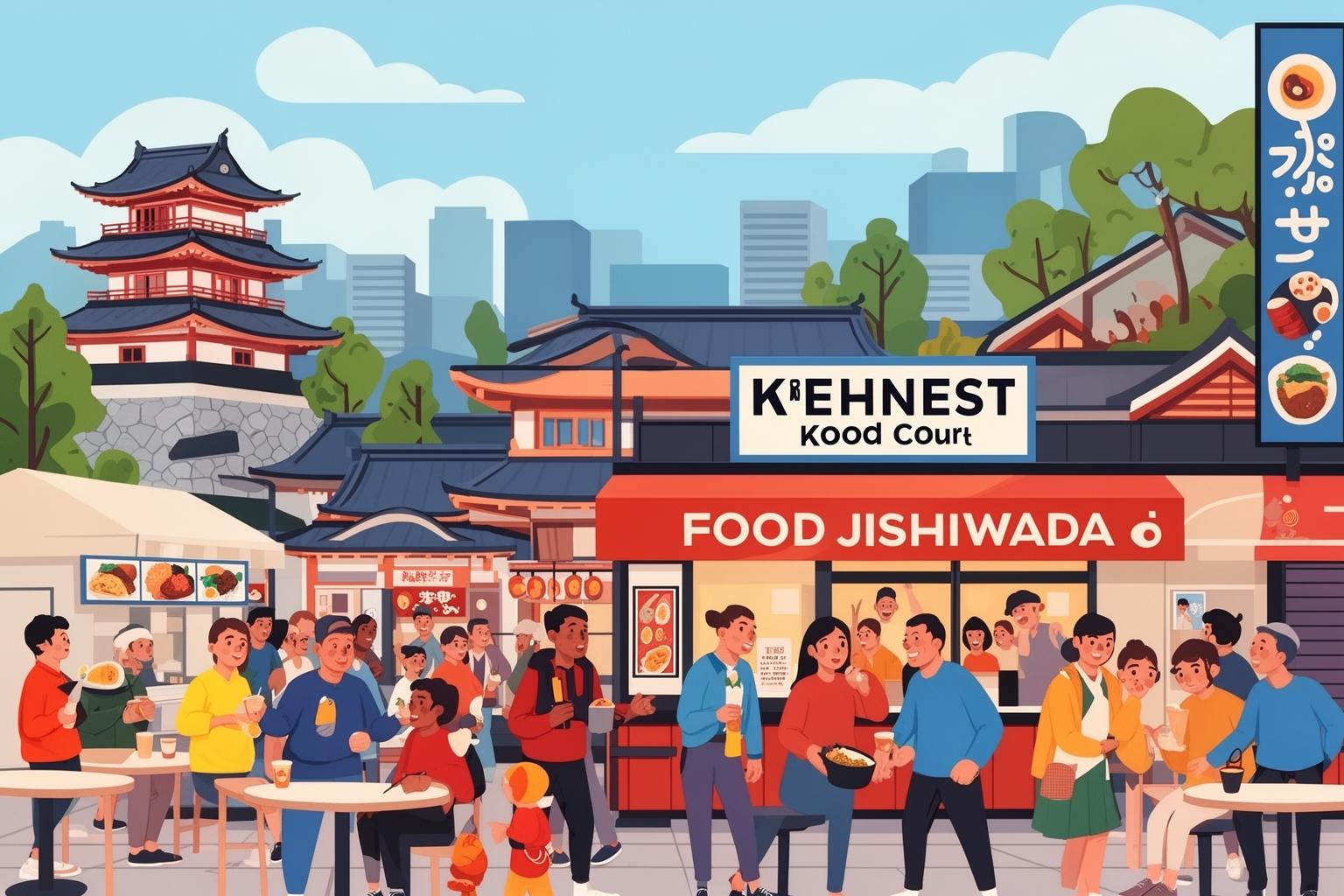
Feeling hungry, I made my way to the food court in the adjacent building. In Japan, a food court often serves as a reliable indicator of local tastes. In recent years, Tokyo food courts have become showcases for trendy, Instagram-worthy dishes like gourmet burgers, Taiwanese bubble tea, and elaborate soufflé pancakes. Here, however, the choices were a lineup of Kansai comfort food staples. There was a Sanuki udon shop with long queues for its thick, chewy noodles in a savory dashi broth. Another stall offered takoyaki and okonomiyaki, sizzling on a large iron griddle. There was also a hearty curry rice vendor and a classic ramen stand.
The message was clear: this wasn’t food as fashion, but food as fuel, comfort, and an essential pleasure. The guiding principles were umai (delicious), hayai (fast), and yasui (affordable)—a philosophy of practical simplicity. Good food shouldn’t be complicated or pretentious; it should be honest, flavorful, and accessible. I opted for a simple bowl of kake udon with a side of tempura. The noodles were firm, the broth richly savory with kombu and bonito flavors, and the tempura perfectly crisp. It was a modest meal, but prepared with confidence and care, reflecting a deep respect for the food. In its own way, it embodied the local character: straightforward, unpretentious, and deeply satisfying.
Sharing Tables, Sharing Space
The food court was crowded, making it tough to find an empty table. This is where another subtle but meaningful cultural difference emerged. In Tokyo, people usually wait awkwardly for an entire table to clear before sitting. Asking to share a table with someone already sitting alone often feels like a major social intrusion. Here, the etiquette was different. I watched a man in work clothes approach a table where a woman sat alone, give a slight nod, and ask, “Koko, ee desu ka?” (Is this seat okay?). She nodded without looking up from her phone, and he sat down. Just like that.
The invisible personal buffer is smaller in Osaka. The tolerance for what counts as an intrusion is higher. This isn’t because people are rude or insensitive to personal space; rather, the default mindset is more communal. Sharing a table with a stranger isn’t a significant social encounter but a practical solution to a common issue, handled with minimal fuss. This small interaction perfectly captures the “friendliness” people often mention. It’s not about grand, extroverted gestures; it’s about the countless small ways the social fabric is woven to be more flexible, practical, and open to casual, low-stakes connections that shape daily life.
The Ride Home: Processing the Senshu Vibe
A Different Kind of Tired
On the Nankai Line train heading back to Namba, the setting sun stretched long shadows across the industrial coastline, bathing it in hues of orange and purple. The carriage had grown quieter, now filled with shoppers and families making their way home. I felt tired, but it was a different kind of fatigue than what I usually experienced after a weekend in Tokyo. A weekend in Tokyo typically left me mentally drained, overstimulated by the pressure to see and do everything. This was a pleasant, physical tiredness — the kind that settles in after a long walk by the sea. My mind felt clearer, as if the sea breeze had swept away some of the mental clutter.
South Osaka’s Lesson
My visit to an ordinary outlet mall in Kishiwada taught me more about Osaka than any guidebook ever could. I realized that the city I had struggled to understand wasn’t just a louder, brasher version of Tokyo. It was a place rooted in a completely different set of values. It valued practicality over appearance, connection over formality, and community spirit over individual restraint. The wild energy of the Danjiri festival, the shrewdness of the merchant bargaining for a discount, the quiet joy of a family watching the sea—all came from the same cultural source.
Osaka’s brashness isn’t aggression; it’s a form of honesty. Its focus on value isn’t stinginess; it’s practical wisdom. Its noise isn’t chaos; it’s the vibrant sound of life being lived fully and openly. This city doesn’t hide its working parts or soften its rough edges. It reveals itself as it is: a proud, pragmatic, and deeply human port town shaped by the sea, the market, and the unbreakable bonds of community. As the train pulled into the bright lights of Namba, I felt as if I were returning from a different country—a country I was finally beginning to understand.