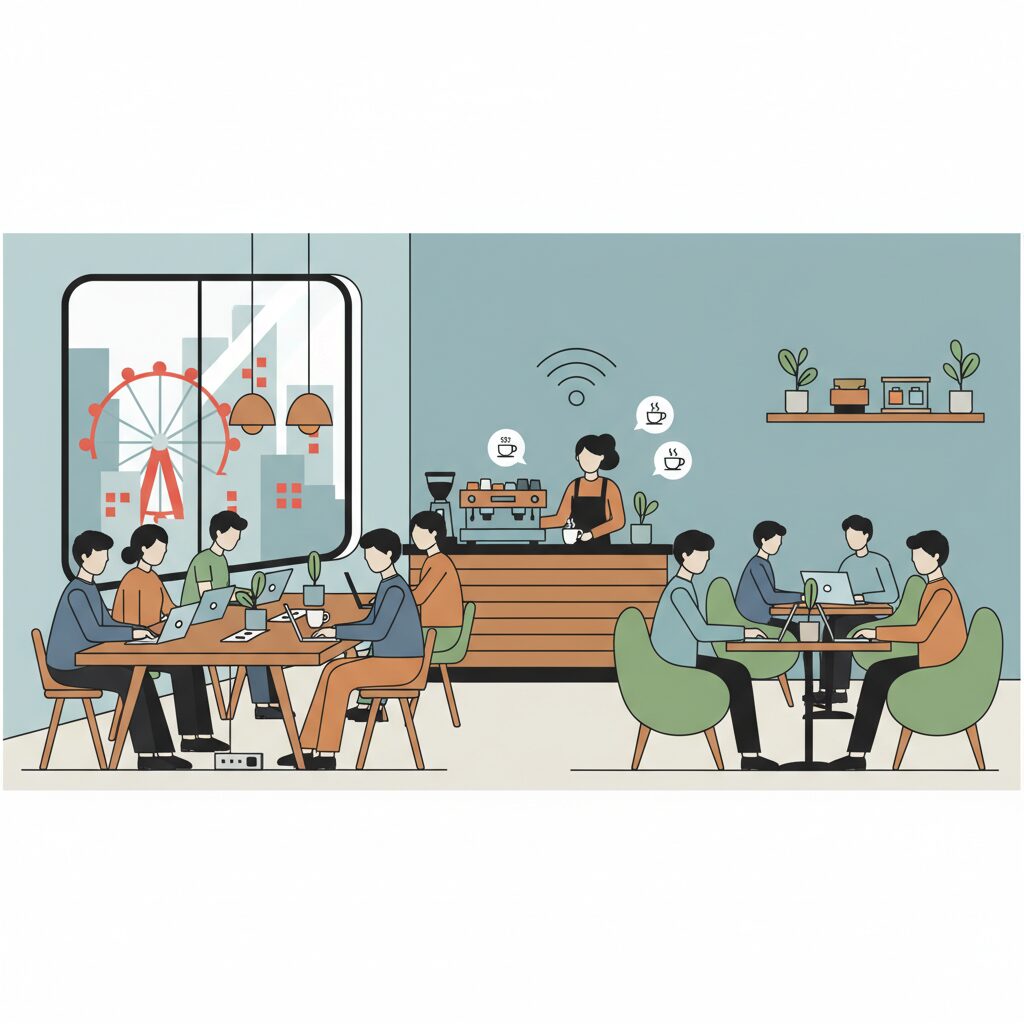
So you’ve landed in Osaka. You’ve found an apartment, you’ve navigated the subway, you’ve eaten takoyaki until you swore you’d never eat again, and then you ate some more. Now, the rhythm of daily life is setting in, and you need a place. A place to work, to think, to simply exist outside your apartment walls. You’ve got your laptop, you’ve got a deadline, and you walk into a promising-looking cafe in Namba. You order a coffee, find a small table, and open your screen. An hour passes. The coffee is gone. You feel a gaze. It’s not hostile, not exactly. It’s just…aware. The owner is wiping down the counter, but their eyes seem to have a sixth sense for the liquid level in your cup. You start to feel a strange, unspoken pressure. Should you order something else? Are you taking up valuable space? In Tokyo, you could sit for four hours and become part of the furniture, invisible. Here, you feel seen. Very, very seen.
Welcome to the invisible transaction at the heart of Osaka’s public spaces. This feeling isn’t your imagination, and it’s not inhospitality. It’s the city’s cultural DNA expressing itself in a cup of coffee and a rented chair. It’s the spirit of the merchant, the shōnin konjō, a pragmatic, centuries-old mindset that sees everything—even relaxation—through a lens of value, fairness, and mutual understanding. In Osaka, a cafe isn’t just a cafe. It’s a piece of real estate, a business, a stage for a daily dance of commerce and community that is completely different from the polite anonymity of Tokyo or the service-at-all-costs model of many Western cities. To understand Osaka’s cafes and coworking spaces is to understand the soul of the city itself: a place where relationships are built on a foundation of clear, honest exchange, and where community isn’t a fluffy ideal, but something you earn, one transaction at a time. This is your guide to decoding that dance, to understanding the price of a seat, and to finding your own rhythm in the merchant city’s vibrant, and very practical, third spaces.
To truly grasp this unique dynamic, it’s essential to explore the deep roots of Osaka’s kissaten culture.
The Unspoken Contract: “Are You Paying Rent for That Seat?”
To truly understand Osaka, you need to recognize that space is a valuable commodity. Every square meter of a shop floor serves a purpose, which is fundamentally linked to generating revenue. This isn’t a cold, heartless calculation; it’s the core principle of a city built by merchants, for merchants. When you buy a 450-yen cup of coffee, you’re not just purchasing the beans and hot water—you’re effectively entering a temporary lease for the chair you’re sitting on and the table holding your laptop. The coffee price covers both the drink and a socially accepted amount of “seat time.” This subtlety is often where cultural misunderstandings arise for many foreigners.
Deconstructing the Kissaten Experience
Let’s begin with the traditional Japanese coffee house, the kissaten. These dimly lit, wood-accented establishments are often run by an aging “Master,” where time seems to slow down. They aren’t built for digital nomads. The high-backed velvet chairs and small round tables encourage conversation, reading a newspaper, or enjoying a quiet moment of reflection between business dealings. The coffee, though pricier at around 600 yen, is all-inclusive—it pays for the drink, the atmosphere, and the right to occupy the space for a reasonable time—typically forty-five minutes to an hour. The unspoken understanding is clear: your visit has a specific, limited purpose. Setting up a mobile office with an external mouse and keyboard would strongly violate this agreement. You might receive a pointed glance, a subtle cough, or the check placed decisively on your table.
Now, contrast this with a modern chain café like Doutor or Tully’s. These venues are ostensibly designed for longer stays, equipped with power outlets, Wi-Fi, and a more utilitarian, anonymous design. Yet, the Osaka merchant spirit remains palpable. You’ll see high school students studying for exams, their tables littered with textbooks, and salarymen typing out emails. Still, there’s a subtle rhythm to turnover. During peak lunch hours from noon to 2 PM, staying too long is considered poor etiquette. The space is reserved for customers purchasing food, which yields a higher-value transaction for the business.
I once witnessed this agreement enforced with candid Osaka directness in a small, family-run café near Tennoji. It was a busy Saturday afternoon, and a young man had been sitting with an empty iced coffee glass for more than two hours, absorbed in his phone. The owner, a woman in her sixties with an unwavering, no-nonsense expression, approached. Without whispering or causing a scene, she said in a voice neither angry nor apologetic, “O-nii-san, it’s getting crowded. Another drink, or maybe time to go?” It wasn’t a suggestion but a clear, business-to-customer communication. The young man, unfazed, immediately packed up and left with a quick “Sumimasen” (Excuse me). In Tokyo, staff might have allowed him to stay all day, silently resenting him while maintaining impeccable politeness. Potential conflict would be avoided at all costs. In Osaka, business is business. The exchange was honest: you used your rental time, now either renew or leave. Everyone understands the rules because, in a way, they’re all playing the same game.
The “Mōkarimakka?” Mindset in Action
This interaction perfectly exemplifies the Mōkarimakka? mindset. This iconic Osaka greeting, literally meaning “Are you making a profit?”, is a cultural hallmark. Visitors might mistake it for a rude, intrusive question about personal finances, but its true meaning is closer to “How’s business?” or “How’s the hustle?” It reflects a shared reality: everyone is here to earn a living. It signals solidarity among merchants, acknowledging the daily struggle and success in commerce.
When you sit in a café, you are on the receiving end of this greeting. The owner is trying to mōkaru. Your seat represents their inventory. This doesn’t signify greed—it marks them as businesspeople in a city of businesspeople. The social contract rests on respecting that hustle. As a customer, you’re expected to be a discerning consumer aware of value. You receive a clean space, a quality product, and a brief respite. The owner earns a fair price for goods and services, including temporary use of their property. It’s a mutually beneficial relationship, not a one-sided service.
This approach marks a fundamental shift from the Tokyo-centric concept of omotenashi—selfless, anticipatory hospitality. Tokyo’s hospitality typically prioritizes the customer’s comfort above all, sometimes at the expense of business efficiency, treating customers as revered guests who should never be inconvenienced. In Osaka, you are considered a respected business partner. The relationship is more balanced and straightforward. Good service is provided because it makes good business sense, not from a cultural imperative to be overly deferential. Customers are expected to honor the terms of their implicit rental agreement. Foreigners unfamiliar with this may perceive Osakans as blunt or money-focused, but in truth, they are simply transparent in a way Tokyo’s layered politeness seldom permits.
“Kosupa” is King: The Search for Value-Driven Workspaces
The merchant mindset goes beyond the owner’s profit; it is equally, if not more, concerned with the customer’s perception of value. In Osaka, the guiding principle behind any purchase—from a bowl of udon to a monthly workspace subscription—is kosupa. This widely used term, a blend of “cost performance,” represents the ultimate goal for Osaka consumers. It is a nuanced assessment that balances price against quality, quantity, and overall benefit. Kosupa doesn’t mean being cheap. A 300-yen coffee is poor kosupa if it tastes bad, is served in a dirty cup, and has no Wi-Fi. Conversely, a 1,500-yen lunch set offers excellent kosupa if it includes a main dish, rice, soup, pickles, a drink, dessert, and lets you linger for an hour afterward to finish your work. Osakans possess an almost uncanny ability to detect good kosupa.
Why Cheap Isn’t the Whole Story
This unyielding pursuit of value shapes the entire ecosystem of cafes and workspaces. In Tokyo, some cafes are famous mainly for their minimalist design or Instagram-worthy latte art, even if the coffee is mediocre and overpriced. People pay for the brand, image, and experience of being in a trendy location. While Osaka certainly has stylish spots, substance almost always trumps style. The most cherished local venues are those that offer unmatched kosupa.
Consider the culture of “morning service” (mōningu sābisu), which is more common and generous in Osaka than in Tokyo. Many independent cafes offer a thick slice of toast and a boiled egg free with a coffee ordered before 11 AM. The shop isn’t losing money; it’s making a strategic investment by attracting customers during typically slow hours and building loyalty. For the customer, the kosupa is outstanding. A full breakfast comes for the price of a drink. It’s an ideal merchant-to-consumer exchange where both sides benefit.
This value-driven approach extends to lunch specials as well. In business districts like Yodoyabashi or Honmachi, cafes fiercely compete by offering 800-yen lunch sets that are surprisingly large and tasty. It’s not just about food; it’s about providing a valuable respite during the workday. The cafe that delivers the best combination of price, quality, and a comfortable atmosphere to unwind will win the daily local lunch crowd. The emphasis is on providing a tangible, measurable advantage. You don’t sell an “atmosphere” in Osaka; you sell a great meal at a fair price, with a pleasant environment as a given.
The Rise of the Hyper-Specific Coworking Space
The kosupa-driven philosophy clearly explains why Osaka’s coworking scene has developed differently from Tokyo’s. Tokyo boasts numerous large, polished, brand-name coworking spaces that market a lifestyle of “community” and “collaboration” at a steep monthly price. Osaka’s market, in contrast, is more fragmented, practical, and skeptical of such vague promises.
Osakan freelancers and startup founders immediately apply the kosupa test to a 50,000-yen monthly hot desk fee with free beer: “How many hours will I actually use it? Do I really want the free beer? Can I get community for free just by talking to people?” The merchant instinct is to break down the offering and pay only for what’s essential.
The Pay-by-the-Minute Model
This thinking has given rise to a clever, distinctly Osakan model: the time-based cafe or coworking space. These venues charge you precisely for the time you spend there, often in 10- or 15-minute increments. An entry fee of a few hundred yen grants unlimited access to a drink bar offering coffee, tea, and juice. Then the timer starts. You use the Wi-Fi, power outlets, and quiet booths, and when you finish, you pay only for the exact time consumed. This approach offers complete transactional transparency. There are no vague promises of networking or synergy. The value proposition is straightforward: you need a place to work, we provide it, and you pay for your actual use. It’s a model built on pure utility and fairness, perfectly reflecting the local mindset. No waste, no paying for unnecessary services. This is kosupa perfected.
The Community-as-a-Bonus Model
When coworking spaces in Osaka emphasize community, it’s framed as a practical, tangible benefit rather than an aspirational lifestyle perk. Many niche spaces focus on particular industries—a hub for graphic designers with high-end printers, a workspace for web developers with multiple monitors at each desk, or a workshop for craftspeople with shared tools. People come for concrete resources that will help their business mōkaru, not vague promises of “meeting interesting people.” The community that emerges is a valuable byproduct, not the main product. You come for specialized equipment and end up receiving project advice from your neighbor. This organic networking is valuable precisely because it is rooted in a shared professional context. The community provides a measurable return on investment, enhancing the monthly fee’s kosupa. While foreign entrepreneurs may be attracted to the flashier, more social media-savvy spaces in Tokyo, they often find more practical support and a grounded network in Osaka’s focused, no-nonsense hubs.
Community, Osaka-Style: Transactional, Not Sentimental
This brings us to one of the most significant paradoxes and sources of confusion for newcomers: the nature of community in Osaka. The city is renowned for its warm, outgoing people who eagerly start conversations with strangers. Yet, as we’ve observed, the daily life dynamics are fundamentally transactional. How can a culture be both highly commercial and deeply communal at the same time? The explanation is that in Osaka, these two aspects coexist. Community is not founded on abstract sentimentality; it is formed through repeated, dependable, and mutually beneficial exchanges.
“This is My Place. Who Are You?”
Let’s return to the local café. When you move from a one-time visitor to a regular—a jōren—you cross an invisible boundary. The owner’s initial, subtle evaluation of you as merely a paying customer shifts. They begin greeting you with a more personal “Maido!” (a merchant’s way of saying “Thanks for your business!”). They remember your usual order. They ask questions like, “Where are you from? What do you do? Do you live nearby?”
This isn’t just casual chatter. It’s a gentle but purposeful process of inclusion. The owner acts as the gatekeeper of their small community, the group of other jōren who have earned their place as well. They’re determining who you are and where you belong. Are you a reliable customer? Yes—you’ve demonstrated that through your regular visits. Are you a positive presence? Do you respect the space and other regulars? By involving you in conversation, they weave you into the social fabric of the café. Once you’re “in,” the rewards are substantial. They might reserve your favorite seat if they expect you. They might introduce you to another regular in a similar profession. “Ah, Mori-san, this is John-san. He’s also a writer! You two should talk.”
This community is powerful, yet it is earned rather than given freely. Your entry ticket was loyalty and respect for the commercial nature of the place. You supported their business, and in return, they offer you a sense of belonging. It’s a community with a distinct foundation. This can seem unusual to foreigners used to communities forming around shared hobbies or beliefs. In Osaka, community can be just as strongly built on a mutual appreciation for good coffee and fair dealings.
The Tokyo vs. Osaka Social Contract
The contrast with Tokyo is clear and instructive. You can be a regular at a Tokyo café for five years—going daily, ordering the same thing, sitting in the same seat. The staff will always be polite and provide impeccable service. But they will rarely, if ever, initiate personal conversation. You remain “customer-sama.” The social contract in Tokyo is grounded in maintaining respectful, professional distance. Anonymity is a service in itself; it gives you the freedom to exist without social demands. For many, this is a relief. It’s clean, simple, and requires nothing from you besides payment.
In Osaka, that kind of sustained anonymity in a local spot is nearly impossible. The owner will talk to you. Other customers might as well. The social contract is participatory. To refuse engagement would be considered cold or odd. A foreigner might misread this as nosiness or intrusion. They might interpret Tokyo’s professional distance as genuine kindness, and Osaka’s direct interaction as a form of interrogation. But these are simply two different ways of operating in public life. Tokyo favors smooth, frictionless anonymity. Osaka emphasizes direct, transparent relationship-building, even within commercial settings.
I have a friend from the U.S. who moved from Tokyo to Osaka. In his Tokyo neighborhood, he lived next to the same family for three years without ever learning their names. They exchanged polite bows and “konnichiwa,” and that was it. Within two weeks of moving to his Osaka apartment, his neighbor knocked on his door, handed him a box of oranges, and asked if he wanted to join the local neighborhood watch committee. Initially overwhelmed, he soon understood this was the city’s way of saying, “Welcome. We see you. Now, what’s your story?” This is the Osaka way: community through active, acknowledged presence.
Navigating the Landscape: A Practical Guide for the Foreign Resident
Grasping the theory is one thing, but embodying it is quite another. How do you, as a foreign resident, successfully navigate this distinct cultural landscape? How do you discover your ideal spot and become a valued member of a local cafe community without constantly feeling like you’re crossing some unwritten boundary?
Reading the Room: How to Avoid (Subtle) Expulsion
The essential skill to develop is situational awareness—the ability to “read the air” (kūki o yomu). Before sitting down, take a moment to gauge the environment. Is it a tiny, ten-seat kissaten run by a solitary elderly owner? This isn’t the place for a marathon work session. Treat it like a short-term rental: savor your coffee, read a chapter of your book, and move on. Is it a large, two-story chain coffee shop in a major station like Umeda? The rules here are much more relaxed. These venues are designed for volume and longer stays. Your individual impact on turnover is minimal.
When uncertain, stick to the one-drink-per-ninety-minutes guideline. If you’re staying for an extended period, ordering a second item—another coffee, a slice of cake—after an hour and a half sends a clear message to the owner that you understand and respect the unspoken agreement. It says, “I recognize that I am using your valuable space, and I’m happy to continue paying rent for it.” This small gesture can turn you from a potential “camper” into a welcomed, long-term customer.
And finally, never underestimate the power of simple pleasantries, which carry extra weight in Osaka’s direct culture. A sincere “Oishikatta, gochisousama deshita!” (“That was delicious, thank you for the meal!”) to the owner as you leave makes a significant difference. It concludes the transaction on a note of personal gratitude. It shows you’re not just an anonymous consumer but someone who appreciated the service. These small human touches accumulate, building your reputation as a “good customer” worth having around.
Finding Your Niche: From Gritty Shotengai to Sleek Kitahama
Osaka is far from monolithic. The merchant mindset varies based on each neighborhood’s purpose and character. Finding your place means aligning your needs with the neighborhood’s specialty.
Nakazakicho: North of Umeda, this area is a labyrinth of narrow alleys filled with beautifully preserved old Japanese houses converted into quirky cafes, galleries, and vintage shops. Here, the transaction is about more than just coffee; you’re paying for a unique, artistic atmosphere. The kosupa calculation includes the aesthetic experience. Lingering is generally more accepted since you are, in a way, part of the scenery. It’s a spot for creative inspiration, not intense productivity.
Tenjinbashisuji Shotengai: Japan’s longest covered shopping arcade—a miles-long corridor of commerce. The cafes here are brief stops. They cater to weary shoppers needing a quick, affordable caffeine boost and a place to rest for twenty minutes. They specialize in high-volume, low-margin business. Expect speed, efficiency, and no frills. Don’t even consider opening a laptop during peak hours.
Kitahama and Yodoyabashi: Osaka’s financial core, a district of corporate headquarters and sleek office towers. The cafes along the river are elegant, catering to a professional clientele. They are designed for business meetings, client lunches, and solo workers seeking a refined, functional environment. Prices are higher, but the kosupa comes from the premium location, reliable Wi-Fi, and an atmosphere conducive to focus. The community here shares professional ambition.
America-mura: The youth fashion and culture hub near Shinsaibashi. Cafes here are loud, trendy, and designed to be noticed. The value lies in a photogenic backdrop for social media and a place to hang out with friends. The transaction is about buying into a scene, a particular brand of cool. It’s a space for socializing, not quiet work.
The Power of Being a “Jōren” (Regular)
Ultimately, the most rewarding way to experience Osaka’s cafe and work culture is to find a place—just one or two—and commit to becoming a regular. Don’t jump from one trendy spot to another. Find a place whose atmosphere, offerings, and owner’s philosophy resonate with you. Maybe it’s a quiet kissaten with superb hand-drip coffee, or a lively neighborhood cafe with a fantastic lunch set. Visit consistently. Try different menu items. Make eye contact with the staff. Engage in small talk when the chance arises.
This is how you transcend the simple customer-vendor dynamic. This is how you begin to build your own small community in a metropolis of millions. The payoff is profound. You stop being a faceless foreigner and become “John-san from America who takes his coffee black.” You gain a third place that feels like an extension of your home. You get an anchor in your neighborhood. You might receive free snacks, insider city tips, or an invitation to a local festival. You build a genuine, tangible connection to where you live. This is the ultimate reward in a merchant city—it’s a community you don’t just find but create, one honest, respectful, mutually beneficial transaction at a time.