
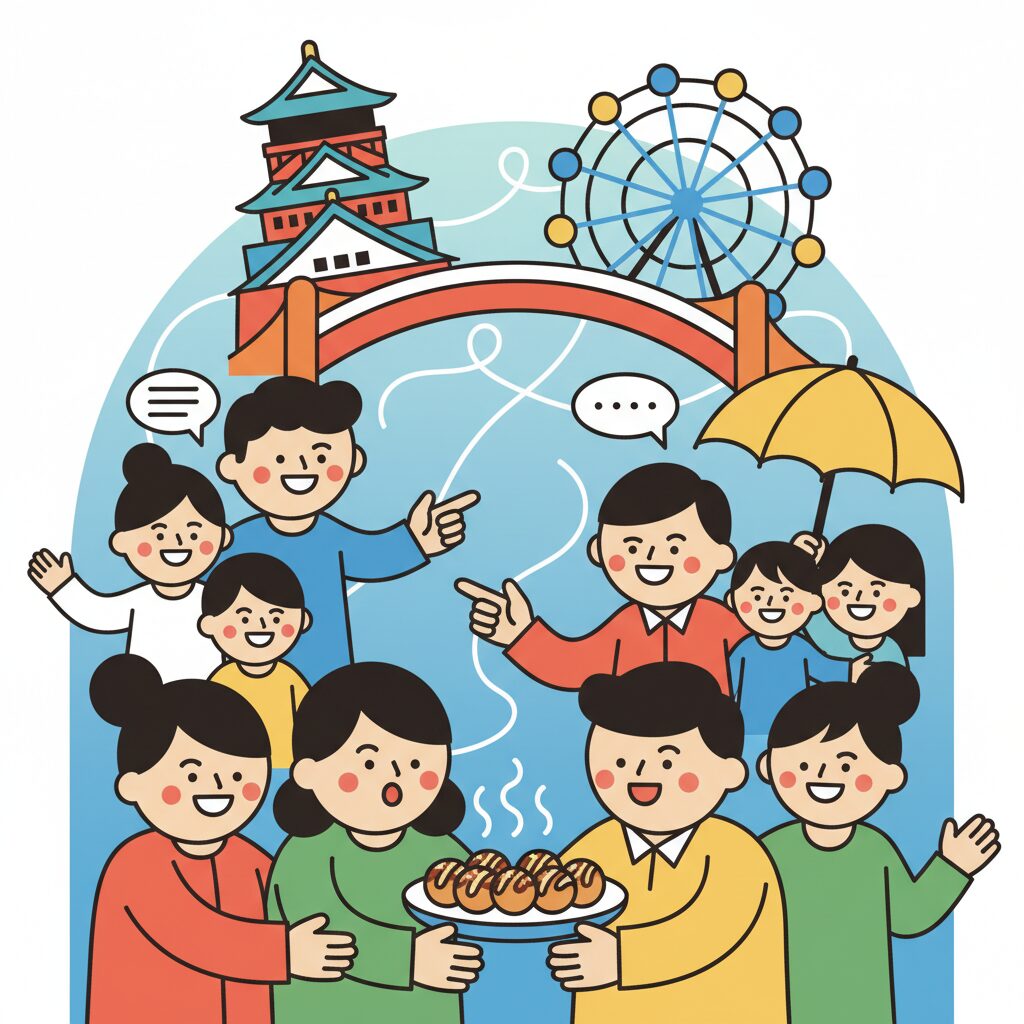
It happened on a Tuesday. A perfectly normal, forgettable Tuesday in the thick of Osaka’s humid summer. I was standing on the Midosuji Line platform at Umeda Station, a chaotic symphony of footsteps, announcements, and the distant rumble of an approaching train. I was minding my own business, scrolling through my phone, feeling anonymous in the crowd. That’s when I felt a sharp tap on my shoulder. I turned to see a woman, probably in her late sixties, with a perm that could withstand a typhoon and a leopard-print blouse that screamed pure, unapologetic Naniwa spirit. She pointed a determined finger at my tote bag. My first thought was panic. Did I drop my wallet? Is my bag unzipped? She didn’t say a word. Instead, she reached out, grabbed the two straps of my bag, and expertly retied the sloppy knot I had made that morning, pulling it tight with a satisfied “Yoshi!” (Alright!). She then gave me a firm nod, a look that said “There. Now it won’t fall apart,” and turned back to face the tracks as if nothing had happened. The entire interaction lasted ten seconds. I was left bewildered, slightly violated, and… strangely cared for. I hadn’t asked for help. I didn’t think I needed help. But in her eyes, a problem existed, and she, as a citizen of this city, had a civic duty to fix it. That, my friends, was my formal introduction to the untranslatable, unavoidable, and utterly Osakan concept of ‘Osekkai’.
To live in Osaka is to be on the receiving end of ‘Osekkai’. There’s no escaping it. The word is often translated as “meddlesome” or “officious,” but that doesn’t capture the nuance. It’s not malicious. It’s not meant to be intrusive, even though it often is. ‘Osekkai’ is kindness that refuses to mind its own business. It’s a proactive, unsolicited helpfulness that operates on the assumption that we are all in this together, and if your metaphorical shoelace is untied, it’s everyone’s problem until it’s fixed. This is a profound departure from the Japan many foreigners envision, the land of quiet reservation, indirect communication, and immense respect for personal boundaries. That Japan largely exists, but you’ll find it more in Tokyo, where politeness is often defined by a respectful, detached silence. In Osaka, politeness is engagement. Silence in the face of a correctable flaw can be seen as cold and uncaring. This fundamental difference in social philosophy is one of the biggest culture shocks for anyone moving from another part of Japan, or indeed the world, to this vibrant, noisy, and perpetually meddling city. This isn’t a tourist guide to Osaka Castle; this is a field guide to the hearts and minds of the people who make this city tick, a deep dive into the beautiful, frustrating, and hilarious reality of their ‘Osekkai’ soul.
This proactive, unsolicited helpfulness is a direct reflection of the city’s deep-rooted Akindo merchant spirit, which values practical action and community engagement over detached observation.
The Anatomy of ‘Osekkai’: What Does It Actually Look Like?
‘Osekkai’ is not a single, uniform idea. It appears in countless small ways throughout a typical day in Osaka. It covers a range of behaviors, from quietly helpful to surprisingly intrusive. To truly grasp it, you need to break it down into its familiar archetypes—the recurring personalities in the daily life theater of Osaka. These are not just one-time encounters; they are behavioral patterns you’ll repeatedly witness on train platforms, in supermarkets, and along quiet residential streets. It’s the city’s social fabric in motion, weaving itself into your daily moments, whether you welcome it or not.
The Public Space Corrector
This is perhaps the most frequent type of ‘Osekkai’ you’ll meet. The Public Space Corrector acts as a guardian of small details, enforcing unspoken social efficiencies. Their goal is to make sure you and those around you move through life without any minor, awkward, or inconvenient flaws. They are why you rarely stroll through Osaka with your shirt tag showing. Somebody, a complete stranger, will approach from behind, casually tuck it in, pat your back, and say “Na, kore” (“Here, this”) before you even realize what just happened.
Imagine this: you’re at Tennoji Station, struggling with the ticket machine. You’re not lost, simply pausing to read the English instructions. Suddenly, a hand appears in your peripheral vision, belonging to a lively old man in a flat cap. He doesn’t ask if you want help. He immediately starts pressing the buttons for you, narrating his moves in fast Kansai-ben. “First here, then this one, see? Easy!” After completing the purchase, he grabs your ticket as it pops out and hands it to you with a proud smile. You feel grateful but also a bit like a child whose shoelaces have just been tied for them. His intention wasn’t to belittle but to smooth the process, prevent a line from forming, and fix a tiny public snag. He noticed a problem—possible inefficiency—and resolved it. Your personal autonomy in the matter was secondary.
This role covers fashion, posture, and general demeanor as well. I once sat on a bench in Nakanoshima Park when a middle-aged woman paused her walk to tell me my posture was poor and that I would damage my back in the future. She then demonstrated the correct way to sit, back straight, shoulders back, before continuing on. There was no judgment in her tone, just straightforward, practical advice presented as a public service announcement. These correctors serve as the city’s living quality-control system. They fix loose threads, point out dropped gloves, and alert you to smudges on your face with the same urgency as an emergency. It’s a world where minor personal details are considered a communal concern.
The Unsolicited Life Coach
Stepping up the intimacy scale, we find the Unsolicited Life Coach. This ‘Osekkai’ type goes beyond physical corrections to comment on your choices and lifestyle. They are the shopkeepers, taxi drivers, bartenders, and fellow customers who feel compelled to advise you on how you should be living, one small decision at a time. The advice is always well-meaning, but it assumes that you are, by default, doing things incorrectly.
Enter a local vegetable stand in Kuromon Market and pick up a daikon radish. The owner, likely selling produce since before your birth, might scrutinize your choice and say, “Ah, what dish is that for? If you’re making oden, you need the thick part. For a salad, the top is better. You’re not just going to boil it plain, are you? Add a bit of rice to the water to cut the bitterness.” Suddenly, your simple purchase turns into a cooking lesson and a gentle cross-examination. Saying “I’m just experimenting” won’t cut it. You’ll be given a full recipe, filled with warnings and encouragement. You leave not only with a daikon but with a culinary mission.
This extends beyond markets. Once, on a taxi ride from Namba to my apartment, the driver heard my broken Japanese and launched into a 20-minute lecture about how I, as a young man living alone in Japan, should find a good Japanese wife. He listed the virtues of local women, suggested dating spots, and even critiqued my neighborhood as “not ideal for serious relationships.” He wasn’t creepy; in his mind, he was mentoring a clueless foreigner. This is ‘Osekkai’ as social nurturing. These life coaches see it as their duty to share their accumulated wisdom, be it about cooking, romance, or curing a cold. They aim to improve your life, one unsolicited tip at a time.
The Community Watchdog
Operating at a neighborhood level, this archetype can be the most surprising for foreigners used to urban anonymity. The Community Watchdog is the neighbor, local shop owner, or retiree who spends their days closely observing the street’s subtle rhythms. Their ‘Osekkai’ stems from a strong sense of place and communal responsibility. They know who lives where, when people head off to work, and, most importantly, when something is out of place. Although it can feel like surveillance, it’s intended as security.
Forgetting to put out your garbage on the right day is a major offense in Japan, but in Osaka, it becomes a public matter. Rather than finding your bag left at home, you may receive a knock on the door. “Miller-san,” your neighbor might say, holding your burnable trash, “Today’s plastics day. Burnable is tomorrow. You’ll get used to it!” It’s a correction and an act of welcome. They’re teaching you the rules, integrating you into the community’s system. They watch out for you and the neighborhood.
This watchful presence can feel comforting or intrusive, depending on your view. If you haven’t left your apartment in a few days, the woman at the corner shop might ask with genuine concern, “Are you okay? I was a bit worried not seeing you!” It’s a human-scale security network no high-tech device can replace. Yet, it also means your comings and goings are noted. Having a friend stay overnight might prompt a curious, “You had company last night?” the following morning. It’s rarely accusatory, more of a social checklist update. For privacy lovers, this can feel stifling. But for those who embrace it, it’s proof that you’re not just a tenant but an active member of a vigilant, caring community.
Why Osaka? The Historical and Cultural Roots of ‘Osekkai’
This widespread culture of meddling isn’t coincidental. It didn’t emerge from nowhere. ‘Osekkai’ reflects Osaka’s distinctive history—a city shaped not by austere samurai and bureaucrats, but by lively merchants, clever artisans, and practical deal-makers. To grasp why a stranger might straighten your collar, you need to understand the centuries of commerce and humor that forged the city’s character. Unlike Edo’s (now Tokyo) rigid, hierarchical power system, Osaka developed organically, driven by rice trade, commerce, and relentless energy.
The Merchant City Mentality (Akinai no Machi)
For centuries, Osaka was known as the “Kitchen of the Nation” (Tenka no Daidokoro), the commercial hub of Japan where rice was gathered, stored, and traded from all over the country. This fostered a powerful merchant class, the chonin, which was an anomaly in a samurai-led society. While Edo’s samurai prized decorum, hierarchy, and stoicism, Osaka’s merchants cherished communication, relationships, and negotiation skills.
In this context, business was intensely personal. Success hinged on trust, rapport, and a broad network. One had to be direct, engaging, and sometimes a little loud to make a deal and build a reputation. This attitude spilled out from the market into everyday life, blurring the lines between customer and neighbor. Taking a genuine interest in the welfare of clients and community members wasn’t just polite; it was smart business. ‘Osekkai’ embodies this commercial spirit—an everyday form of hyper-proactive customer service. When someone offers unsolicited advice, they’re, in effect, treating you like a valued customer in Osaka’s grand marketplace, investing in a social bond and ensuring all is well, since a thriving community fuels prosperity. The city’s motto might as well be “A closed mouth gathers no sales.” This outlook endorses—indeed demands—the directness that Tokyoites might find impolite.
Humor as a Social Lubricant (Warai no Bunka)
Talking about Osaka inevitably involves comedy. The city is the birthplace of Japanese stand-up, especially manzai, a two-person style featuring a funny man (boke) and a straight man (tsukkomi). Central to manzai is the tsukkomi’s role of catching the boke’s mistakes or absurdities, often with a light slap or witty retort. This public correction drives the humor as the audience laughs not just at the joke, but at witnessing a flaw exposed and answered.
This comedic sense permeates daily conversation in Osaka. ‘Osekkai’ often comes with theatricality and humor, a kind of performance. When the obachan retied my bag, it was a quick, silent punchline. When a fishmonger critiques how you slice sashimi, it might be accompanied by a dramatic sigh and a playful wink. They create a moment of manzai mid-day, casting you as the temporary boke and themselves as the wise tsukkomi. This transforms what could be an awkward correction into shared laughter and connection, softening the interaction and changing intrusion into a caring gesture. Getting upset at ‘Osekkai’ misses the point—you’re meant to laugh at your mistake, thank your brief comedy partner, and move on. It’s a social lubricant that keeps the city running smoothly with maximum warmth and minimal conflict.
A Tale of Two Cities: ‘Osekkai’ vs. Tokyo’s Detached Politeness
The contrast between Osaka and Tokyo highlights this history vividly. The two cities represent opposite ends of Japan’s social spectrum. If Tokyo is known for quiet, efficient tact, Osaka embodies noisy, chaotic humanity. Their public interaction styles differ fundamentally.
Picture a foreigner on a crowded Tokyo train, struggling to read a complicated station map. The typical Tokyo response is polite avoidance—avoiding eye contact to spare embarrassment. Intervening would be seen as intrusive, violating unspoken rules to mind one’s own business. Respect here means allowing others space to solve their problems, a reserved politeness shaped by a samurai culture valuing honor and face-saving.
Now imagine the same foreigner on the Osaka Loop Line. Confusion barely registers before someone leans in. “Doko ikitai no?” (“Where do you want to go?”) Before long, others join, arguing about transfer points, pointing at the map, and giving enthusiastic, if sometimes conflicting, advice. It becomes an impromptu team effort to solve the problem. It’s loud, a bit chaotic, and completely shatters personal space, yet it’s highly effective and deeply welcoming. In Osaka, letting someone struggle quietly is rude—cold (‘tsumetai’ or ‘reitan’). True kindness (‘shinsetsu’) requires action and meddling. This difference defines the divide: in Tokyo, you are an anonymous individual granted privacy; in Osaka, you are a temporary team member, and the team takes care of its own.
Navigating ‘Osekkai’: A Foreigner’s Survival Guide
Understanding the origins of ‘Osekkai’ is one thing; figuring out how to live with it daily is another. For many foreigners, especially those from cultures that highly value individualism and personal space, the constant flow of corrections and advice can be annoying. It can feel condescending, as if the entire city believes you’re incapable of tying your own shoes. The key to not only surviving but thriving in Osaka is learning to decode the intention behind the behavior and equipping yourself with a set of graceful responses. It’s less about defense and more about mastering a new kind of social dance.
Reading the Intention, Not Just the Action
This is the most essential skill to develop. Before reacting, take a breath and remember: 99.9% of the time, ‘Osekkai’ isn’t an attack. It’s not a judgment on your character or intelligence. It’s a gesture of care, albeit awkward by Western standards. That stranger telling you to zip up your jacket isn’t calling you foolish; they’re genuinely worried you might catch a cold. The shopkeeper critiquing your dinner plans isn’t trying to control you; they want you to enjoy the best meal possible. They’re offering their expertise as a gift.
‘Osekkai’ is a sign of inclusion. When people stop meddling, that’s when you should worry. Silence and distance often mean you’re being treated as an outsider, a ‘gaijin’ to be handled with formal, cautious politeness. The moment an elderly man scolds you for holding your chopsticks incorrectly, you’ve arrived. You’re no longer a fragile outsider to be treated delicately. You are now part of Osaka’s messy, interconnected ecosystem, worthy of correction and advice just like everyone else. Viewing the action through this lens of intention can transform an irritating intrusion into a surprisingly heartwarming affirmation of your place in the city.
The Art of the Graceful Response
Your reaction to an act of ‘Osekkai’ shapes the entire social interaction. Becoming defensive or annoyed is like trying to argue with the rain; it’s pointless and only makes you unhappy. The aim is to acknowledge the gesture, maintain social harmony (‘wa’), and move forward. There are a few key strategies depending on the situation.
For most encounters—the tag-tucking, bag-tying, shoelace-pointing—the best response is a bright smile and a cheerful, slightly surprised thank you. A simple “Ah, hontou da! Arigatou gozaimasu!” (“Oh, you’re right! Thank you very much!”) works wonders. Adding a small laugh at your own expense shows you’re a good sport and understand the playful nature of the interaction. You have accepted their ‘tsukkomi’ with grace. This completes the social circuit, makes the other person feel good for helping, and allows everyone to continue their day positively.
What about when the advice is unwelcome or simply wrong? Suppose someone insists you take a different, slower train route. Don’t argue the facts. Don’t pull out your phone to show them the Hyperdia app. This isn’t a debate. The content of the advice matters less than the act of giving it. Simply smile, nod, and say, “Naruhodo, sou nan desu ne. Benkyou ni narimasu. Arigatou!” (“I see, is that so. I’ve learned something. Thank you!”). This acknowledges their expertise without obliging you to follow their suggestion. You thank them for the lesson and then proceed with your original plan. It’s a polite fiction that preserves harmony. You’re responding to the kindness, not the information.
If the ‘Osekkai’ ventures into territory that feels genuinely too personal—persistent questions about your salary, visa status, or why you aren’t married yet—a slightly firmer but still polite approach is needed. You can use the classic Japanese strategy of vagueness (‘aimai’). A gentle laugh and a phrase like “Iya, chotto sore wa…” (“Well, that’s a little…”) trailing off can signal discomfort. A more direct but still soft option is a simple, “Daijoubu desu, arigatou.” (“I’m okay, thank you.”). The key is keeping your tone light and friendly. A harsh shutdown will come across as aggressive and confusing. Your goal is gently to redirect the conversation, not to build a wall.
The Upside of Meddling: Finding the Gold in ‘Osekkai’
It’s easy to dismiss ‘Osekkai’ as merely a cultural quirk to tolerate—just a daily irritation in an otherwise wonderful city. But to do so is to overlook the profound beauty at its heart. This culture of meddling, with all its boundary-crossing tendencies, fosters a social environment that offers incredible, and increasingly rare, benefits. Once you shift your perspective, you begin to see ‘Osekkai’ not as a nuisance, but as a gift. It serves as the engine of a strong, informal support system and a shortcut to genuinely feeling connected to the place you call home.
A Built-In Social Safety Net
In the vast anonymity of most modern megacities, it’s frighteningly easy to become invisible. You might fall on a crowded street and have people walk past, assuming someone else will help. That’s much less likely in Osaka. The same instinct that prompts someone to fix your hair also motivates them to assist you in real trouble. The ‘Osekkai’ culture encourages heightened public awareness. People simply pay closer attention to one another.
This results in a real sense of security. If you look lost and are studying a map, someone will offer assistance. If you drop your groceries, hands immediately appear to help you gather them. If an elderly person seems unsteady, someone will offer a seat or an arm. It’s a crowdsourced safety net made up of countless small acts of observation and intervention. While this constant low-level vigilance might feel intrusive when all is well, it proves invaluable when you’re sick, vulnerable, or in crisis. In a world where social isolation is increasingly common, Osaka’s culture of mandatory engagement can be a powerful remedy.
The Fast Track to Belonging
For foreigners in Japan, one of the biggest hurdles is breaking through the wall of polite reserve and forming genuine connections. In Tokyo, you could live for years without ever speaking to your neighbors. You’re met with perfect, impenetrable politeness, which can feel like a deliberate distance. ‘Osekkai’ tears down that barrier. It bulldozes through formalities and pulls you—willing or not—into the community.
Receiving ‘Osekkai’ is a rite of passage. It signals that you’re no longer seen as a temporary visitor, but as a functioning—and therefore correctable—member of society. The unsolicited advice, the public corrections, the nosy questions—these are all forms of dialogue and invitations to engage. The conversations may be awkward or unconventional, but they are conversations nonetheless. The old man telling you you’re using the wrong soy sauce for your fish opens the door for you to ask about his recommendations. The woman questioning your garbage-sorting might, the next week, share some of her home-cooked stew. Each act of meddling is a potential thread of connection, and following them allows you to weave yourself into the local fabric far more quickly and deeply than waiting politely to be invited in.
Unexpected Friendships and Free Lessons
Embrace ‘Osekkai,’ and Osaka becomes your city-wide classroom. Every interaction is a chance to learn something new. You pick up practical life skills—the best way to clean a fish, the secret to perfect dashi, a shortcut to the post office. You receive constant, immersive lessons in natural, colloquial Japanese, especially the vibrant Kansai dialect, which textbooks never teach. Your pronunciation will be corrected, your vocabulary refined, and your understanding of local culture deepened with each encounter.
More importantly, these interactions plant the seeds of unexpected relationships. The gruff butcher who always comments on your purchases might slip you an extra piece of meat for free one day. The owner of the tiny coffee shop who gave you love-life advice could become a trusted confidant. ‘Osekkai’ is the Osakan way of saying, “I see you. I’m paying attention to you. You are part of my world.” Through these small, repeated, meddlesome exchanges, acquaintances turn into familiar faces, and familiar faces become friends. It transforms a city of strangers into a network of people who, for better or worse, look out for one another.
Embracing the Chaos: A Final Word on the ‘Osekkai’ Mindset
Living in Osaka requires you to recalibrate your social compass. You need to learn to gauge politeness not by distance, but by engagement. You must realize that a caring community isn’t always a quiet one. ‘Osekkai’ is the city’s pulse—a bit irregular, a little too loud, yet undeniably alive and warm. It is the chaotic, human static that fills the spaces between people, turning a group of individuals into a community.
It embodies a key trade-off. In Osaka, you give up a degree of privacy and personal autonomy that many other cultures hold dear. In exchange, you gain a community that is attentive, interactive, and deeply invested in its members. You trade the cool comfort of anonymity for the messy, complicated, and often hilarious warmth of belonging. There will be days when the constant flow of advice feels overwhelming. There will be moments when you wish people would simply mind their own business. But there will also be days when a stranger’s small act of meddlesome kindness—adjusting your scarf, helping with a heavy bag, or making you laugh with a ridiculous piece of advice—reaffirms your choice to live in this impossible, wonderful city.
Ultimately, to love Osaka is to embrace ‘Osekkai’. It means accepting that the hand patting down your unruly collar is also the hand that will catch you if you fall. It’s about recognizing the genuine affection beneath the sometimes abrasive exterior. Life here isn’t always neat and tidy, and social boundaries are definitely blurrier than elsewhere. But it is real, vibrant, and never, ever boring. That is the frustrating, beautiful truth of life embraced by Osaka’s meddlesome heart.








