
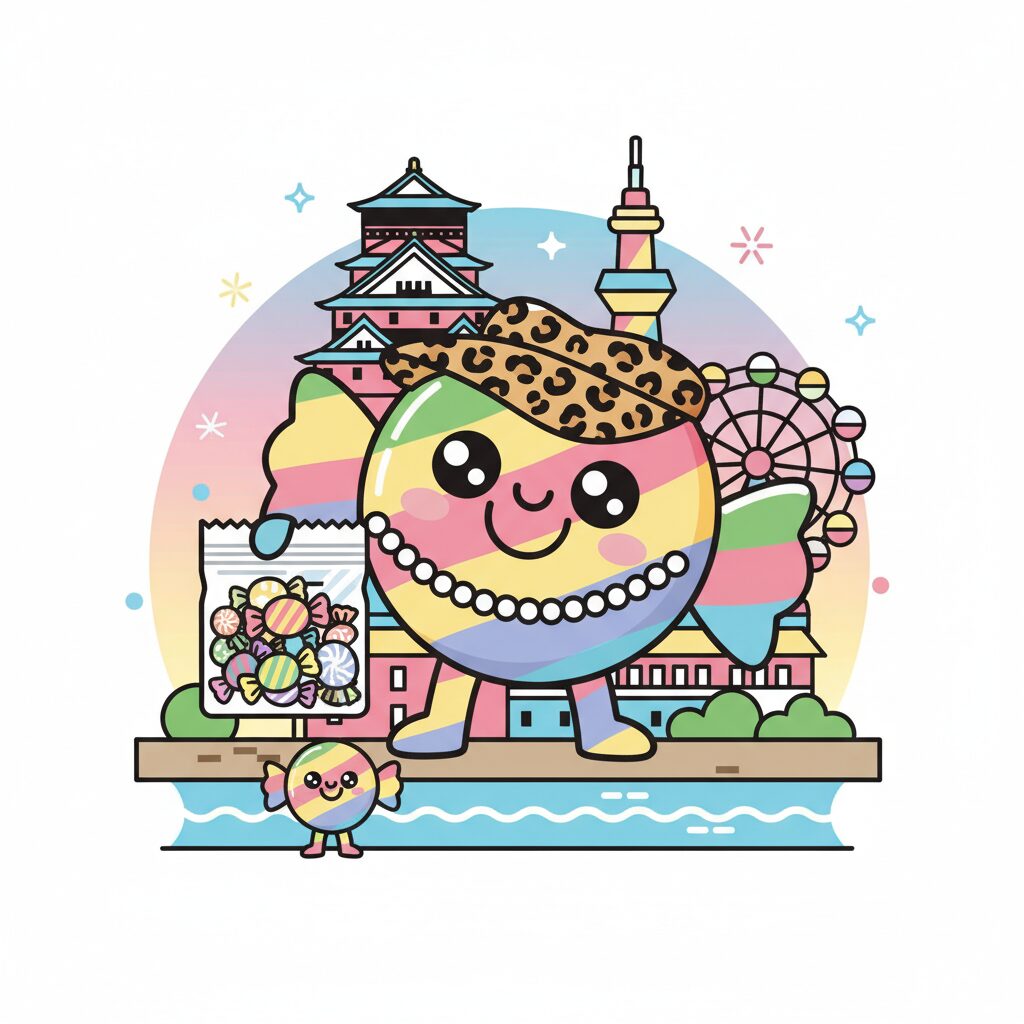
You’re on a train, maybe the Midosuji Line, swaying with the rhythm of the city. It’s crowded, a typical afternoon. An older woman, with a handbag that’s seen a few decades and hair a shade of purple you’ll come to recognize as a local signature, catches your eye. She rummages in her bag, past a wallet, a foldable fan, and a small pouch. Her hand emerges. She leans in, not with a question, but with an offering: a small, brightly wrapped hard candy. Your mind races. Is this a test? A scam? Some elaborate social ritual you’re about to fail? You’re a foreigner living in Osaka, you’ve learned the train etiquette, you separate your trash meticulously, but this isn’t in the manual. You take it, bow slightly, and mutter a thank you. She just nods, a small smile on her face, and turns back to her window. You’re left holding the candy, a tiny mystery in your palm. Welcome to one of the most fundamental, yet unwritten, rules of Osaka life. You’ve just had your first encounter with ‘ame-chan’ culture.
This isn’t just about candy. Forget tourist guides that talk about castles and street food for a moment. This small, sugary transaction is your key to understanding the city’s soul. It’s a password into the real Osaka, the one that operates on a completely different social frequency from the rest of Japan. It’s a gesture that seems tiny, almost insignificant, but it’s loaded with the history, humor, and humanity of this merchant city. To dismiss it as a weird quirk is to miss the point entirely. The ame-chan is a piece of communication, an economic theory, and a social philosophy all wrapped in crinkly plastic. It’s the city’s heartbeat, offered from one stranger to another, and learning its language will change how you experience every interaction here, from the local shotengai to the crowded train car.
This gesture of ‘ame-chan’ culture is a perfect example of the pragmatic and human-centric merchant spirit that defines Osaka’s approach to life and business.
More Than Just Sugar: What ‘Ame-chan’ Really Means
Let’s clarify one thing. The “-chan” suffix in Japanese is a term of affection, commonly used for children, close friends, or pets. So it’s not just “ame” (candy), it’s “ame-chan,” meaning little candy. This linguistic detail is your initial hint. The gesture is inherently warm, familiar, and informal. It immediately lowers the social barrier between two people, shifting them from formal strangers to individuals sharing a moment. It’s an attempt to create a small, temporary bubble of community within the vast, impersonal urban environment. When an Osakan offers you an ame-chan, they’re signaling that for the next thirty seconds, the strict social rules of Japan are set aside.
The Anatomy of the Gesture
The ritual is elegantly simple. The giver is most often an “obachan,” an older woman, who is the undisputed master of this cultural custom. However, you’ll also see it from “ojisan” (older men), particularly shopkeepers or taxi drivers. The recipient can be anyone. A weary mother with a fussy child. A student stressed before an exam. A salaryman exhaling after a hard day. Or you, the foreigner, appearing a bit lost or overwhelmed. Timing is crucial. It happens during a lull, a shared moment of boredom, a minor inconvenience, or a flicker of mutual understanding. It’s a bridge across a silent divide.
The candy itself is part of the code. This isn’t about gourmet chocolates or fancy imported treats. The classic ame-chan is a modest, utilitarian hard candy. Think Kuro-ame (a rich, dark candy made from Okinawan black sugar), Nodo-ame (a soothing throat lozenge often with herbal flavors), or a simple fruit drop. These choices reflect pure Osaka pragmatism. They are inexpensive to buy in bulk, don’t melt in a purse during humid summers, last a long time, and provide a small, satisfying burst of energy. The medium is the message, and here the message is not “I’m trying to impress you with my wealth,” but “Here’s a small, practical comfort.”
The Language Without Words
In a culture where direct communication is often veiled by layers of politeness and subtlety, the ame-chan is a tool of striking clarity. It’s a versatile social lubricant that can convey many different meanings depending on context, all understood instantly.
As an icebreaker, it’s unmatched. In a long line at the ward office, a shared sigh followed by offering an ame-chan is an open invitation: “This is tedious, isn’t it? Let’s share the complaint.” It’s a non-verbal “hello,” a way to initiate conversation without the awkwardness of a direct approach.
It’s a thank you. If you give up your seat on the train or help someone pick up dropped belongings, you might receive an ame-chan in return. It’s a gesture that says, “Your kindness is recognized and appreciated,” more warmly and personally than a formal bow.
It’s an apology. If someone bumps into you too hard, an outstretched hand with an ame-chan silently says, “My bad, we’re good.” It smooths over minor irritations of city life quickly and without fuss.
Most poignantly, it’s a gesture of solidarity. When a baby starts crying on a quiet bus, tension mounts. In Tokyo, people might subtly put in earbuds or look away. In Osaka, an obachan is likely to lean over to the flustered mother and offer an ame-chan. Not for the baby, but for the mom. The unspoken message is profound: “I see you. I’ve been there. You’re doing well. Don’t mind the stares.” It’s a moment of pure, unfiltered human connection.
The Osaka ‘Obachan’: Keepers of the Candy Flame
To grasp ame-chan culture, you must first understand its central figure: the Osaka obachan. She is a cultural powerhouse, a living embodiment of the city’s spirit. Foreign media and even other Japanese often reduce her to a stereotype: loud, outspoken women in leopard-print tops with permed hair, speeding around on bicycles. While these visual clichés do exist, they only scratch the surface of a much deeper identity.
Decoding the Leopard Print
The stereotype exists for a reason, but it’s not about poor taste. The leopard print, the bright colors, the bold patterns—they serve as a statement. In much of Japan, there’s social pressure, especially on women, to become more reserved and unobtrusive with age. The Osaka obachan’s style is a powerful rejection of that notion. It’s a declaration of presence: “I am here. I am not fading into the background. I have an opinion, and you’re likely going to hear it.” It signals confidence, authenticity, and an unapologetic engagement with the world. She dresses not to please others but to please herself. This same confidence enables her to break social norms and offer candy to strangers without hesitation.
The Bottomless Handbag: An Arsenal of Practicality
The obachan’s handbag is legendary—a mobile command center, a Mary Poppins-like portal of preparedness. If you were to excavate one, you’d uncover layers of history and practicality. Naturally, you’d find a generous supply of various ame-chan, neatly stored in a small pouch. But you’d also find tissue packets, a “tenugui” or small towel for wiping hands or sweat, a foldable shopping bag (“eco-bag”), a small bottle of hand sanitizer, perhaps a tiny sewing kit for emergency repairs, band-aids, a coin purse heavy with 100-yen coins for vending machines, and a well-used notebook full of phone numbers.
This isn’t mere clutter; it’s a mindset. It’s a philosophy of readiness. The obachan is prepared for any minor urban crisis, both for herself and those around her. The ame-chan is simply the most public-facing tool in this kit. It’s designed for outreach, social upkeep, and smoothing the edges of daily life. Her bag is a microcosm of her community role: she is the prepared one, the caretaker, the fixer of small problems before they escalate. The ame-chan is her first responder’s tool for social emergencies.
A Tale of Two Cities: Why This Doesn’t Fly in Tokyo
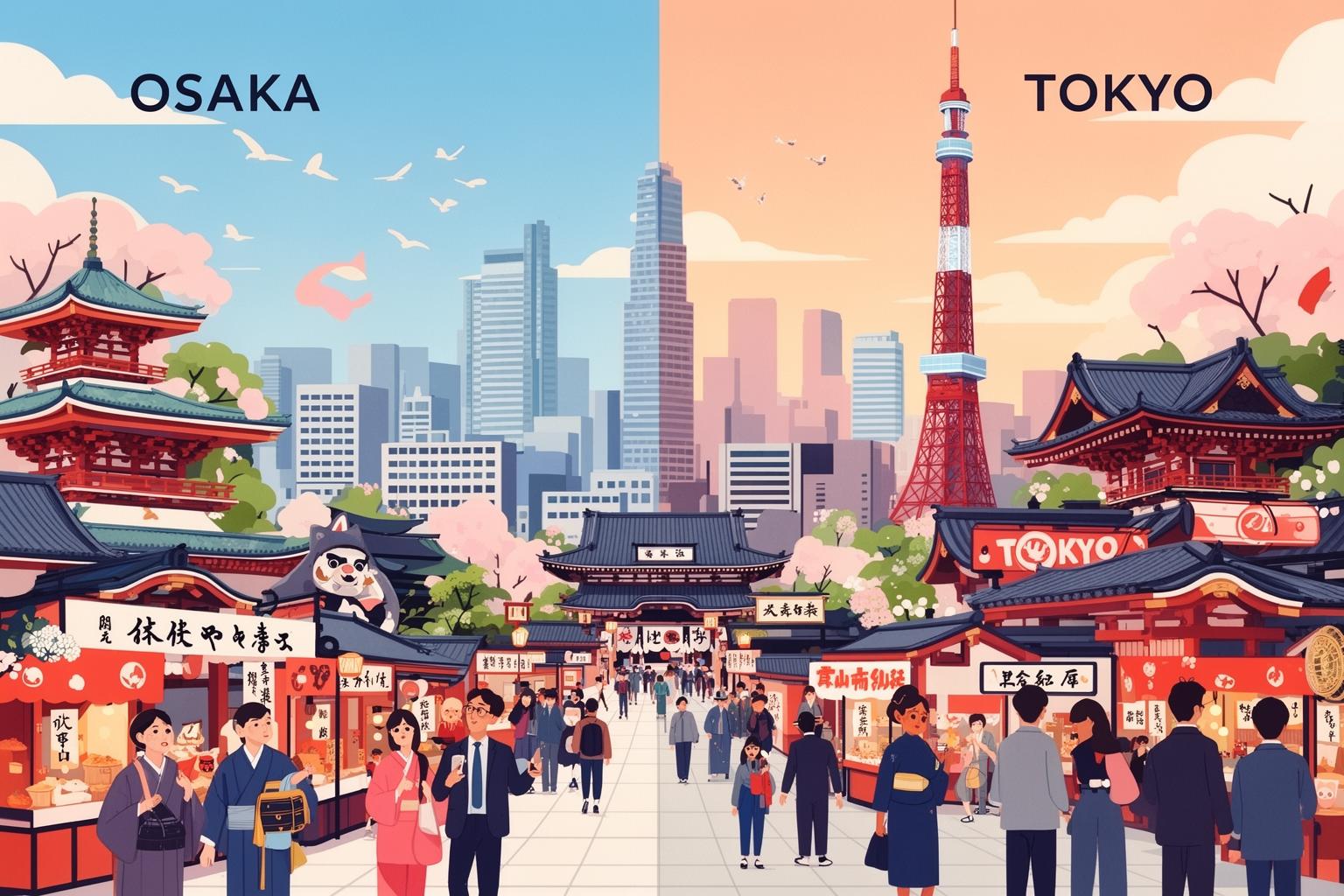
To truly understand how distinctive this culture is, you need to engage in a thought experiment. Picture this very scenario on the Yamanote Line in Tokyo, the city’s busiest and most iconic train loop. An elderly woman offers a piece of candy to a young professional. The response would be strikingly different. It could range from a polite but firm refusal (“Iie, kekko desu,” No, thank you), to confusion, or even outright suspicion. Why is this stranger giving me something? What do they want? Is it safe?
The Tokyo Bubble: A Culture of Non-Interference
Tokyo, despite all its marvels, functions on a social contract of polite anonymity. With millions of people packed into a confined space, the key rule of public etiquette is to minimize any imposition on others. You lower your voice on the train. You avoid eye contact. You maintain a personal bubble. This is not coldness; rather, it is a highly efficient system that ensures smooth, frictionless coexistence. In this setting, an unsolicited gift from a stranger, no matter how small, breaches protocol. It breaks the bubble. It creates an unwanted social obligation, compelling a reaction and engagement when the default is mutual, respectful disengagement.
From the Tokyo perspective, the Osaka ame-chan gesture can seem intrusive, overly familiar, and frankly, a little odd. It violates the unspoken rule of leaving each other alone. It forces an interaction that is neither expected nor, in many cases, desired. The city’s energy is turned inward, focused on efficiency and order. Public spaces serve as transit points, not venues for spontaneous socializing with strangers.
The Osaka Connection: A Culture of Engagement
Osaka’s social contract was penned with a different approach. The city was shaped not by samurai and bureaucrats, but by merchants, traders, and artisans. For centuries, it has been Japan’s economic powerhouse, known as the “nation’s kitchen” (tenka no daidokoro). In a merchant culture, your success hinges on your ability to connect with others. You must talk, build rapport, haggle, joke, and persuade. Silence does not move inventory. A reserved, distant attitude does not seal a deal. This “shonin” (merchant) spirit is ingrained in the city’s character.
This history fostered a culture that values directness, humor, and a degree of playful intrusion. People converse with one another. They ask questions. They comment on the weather, the price of vegetables, or the performance of the Hanshin Tigers baseball team. It’s a city of extroverts, where engaging with your surroundings is customary. The ame-chan fits naturally into this context. It is a small gesture of goodwill, a low-risk investment in social capital. It is the modern heir to the free sample handed out by shopkeepers—a small act to initiate a potential relationship. It’s a form of business, but the business is human connection itself.
The Unspoken Rules: Your Guide to Receiving (and Giving)
So, you’re back on that train, candy in hand. Now what? Understanding the basics of ame-chan culture makes navigating it simple. It’s not a complicated tea ceremony; rather, it’s a straightforward exchange of goodwill. But knowing the proper etiquette will help you feel less like a confused outsider and more like someone involved.
How to React When You’re Offered an Ame-chan
First and foremost: relax. This is a positive gesture. The person offering it has, for a brief moment, included you in their immediate community. It’s a compliment.
The appropriate response is easy. A smile is crucial. Make eye contact. A slight bow or nod shows respect. Pair this with a polite “Arigato gozaimasu” (Thank you). You may also hear “Sumimasen,” which can be confusing as it often means “Excuse me” or “Sorry.” In this context, however, it’s a very polite way of saying thank you, carrying the nuance of “Thank you for going to the trouble for me.”
Refusing is perfectly acceptable. Maybe you don’t like candy, or you’re watching your sugar intake. The key is to be gentle and polite. Don’t recoil as if offered poison. Simply smile, give a small bow with your hands slightly extended, and say, “Iie, kekko desu” (No, I’m fine) or “Okimochi dake itadakimasu” (I will accept the thought/sentiment). The giver won’t be offended. They usually have a whole bag of ame-chan and will likely just offer the next person. The act of offering is as important as accepting.
The Social Context is Everything
Notice where these exchanges occur. Ame-chan culture is most common in what can be called “third places”—spaces that are neither home nor work. The local shotengai (covered shopping arcade) is prime territory. Waiting in line at the bank, post office, or doctor’s office are also common spots. Public transportation, especially during off-peak hours on local lines, is another key location. These are all places where people share a temporary micro-community during moments of public waiting.
You’re far less likely to see this in the quiet, formal environment of an upscale department store in Umeda or in a minimalist coffee shop. It’s a grassroots phenomenon, part of everyday neighborhood life. It belongs to spaces where ordinary people go about their daily routines.
Level Up: Should a Foreigner Carry Ame-chan?
This is an advanced step in Osaka living. After receiving a few times, you might wonder: should I start carrying some myself? The answer is yes, but with qualifications. It can be a great way to connect and show that you’re not just an observer but an active participant in the culture.
However, it requires social awareness. The gesture is interpreted differently depending on who offers it. An obachan giving candy is seen as nurturing and natural. A young foreign man doing the same, in the wrong context, could be misunderstood. The key is to begin modestly and in safe, reciprocal situations. The friendly woman at the local fruit stand who always gives you a little extra? Offer her an ame-chan someday. The elderly man you see regularly at the bus stop? A perfect choice. Use it to acknowledge and strengthen existing, even if brief, relationships. It’s a gesture that says, “I see you. I’m part of this neighborhood too.” Do it right, and you’ll gain a new level of acceptance and warmth from your community.
Beyond the Wrapper: What Ame-chan Teaches Us About Osaka
This modest piece of candy serves as a lens through which the entire social fabric of Osaka comes into clearer view. It uncovers a set of core values that define the city and distinguish it from the rest of Japan. It represents more than just a habit; it embodies a unique urban philosophy.
Pragmatism over Formality
Osaka is a city that prioritizes what works. It maintains a healthy skepticism toward empty rituals and unnecessary formality. Why engage in a long, formal greeting when a small piece of candy can establish a positive connection much faster? The ame-chan is the ultimate social shortcut. It’s efficient, inexpensive, and effective. This pragmatic, results-focused mindset stems directly from the merchant culture, where time is money and strong relationships are invaluable. The city operates on a type of social common sense that feels refreshingly straightforward compared to more rigid social systems.
A Different Kind of Politeness
The typical image of Japanese politeness involves deep bows, honorific language, and maintaining respectful distance. Osaka doesn’t reject this, but it adds its own distinctive touch. Courtesy here often centers on inclusion, warmth, and direct engagement. It’s an active kindness. Instead of being polite by leaving you alone, an Osakan may show politeness by making sure you’re included. They might ask about your background, crack a joke to ease tension, or, indeed, offer you a piece of candy.
For outsiders, especially those from Tokyo or Western cultures that prioritize personal space, this can initially seem intrusive or nosy. Yet the intent almost always stems from generosity. It’s an effort to welcome you, acknowledge your presence, and make life feel a bit less anonymous and more human. It represents the difference between politeness as a defensive barrier and politeness as an open door.
The Shrinking Candy Pouch? The Future of Ame-chan
It’s a fair question: Is this culture fading? Undeniably, it is a tradition most closely associated with the older generation. You’re less likely to encounter a 20-year-old university student handing out candy on the train. The demands of modern life, the rise of smartphones as time fillers, and evolving social norms have all had an impact.
But to claim the culture is dying is to miss the essence. The form may be changing, but the spirit remains. The core principles of ame-chan culture—the willingness to engage, the humor, the directness, and fundamental warmth—persist among younger Osakans. It may not appear as a physical piece of candy, but it shows in the easy banter with shopkeepers, strangers collaborating to help lost tourists, or conversations sparked at a standing bar over shared takoyaki.
The ame-chan is a symbol—a tangible fragment of a much larger cultural iceberg. The candy itself might one day become a relic, a nostalgic memory of the Showa-era obachan. Yet the philosophy it embodies—that a small, unexpected act of kindness can make a big city feel like a small town, that we are all just people sharing a space and moment—remains the heart and soul of Osaka. And that isn’t going anywhere.








