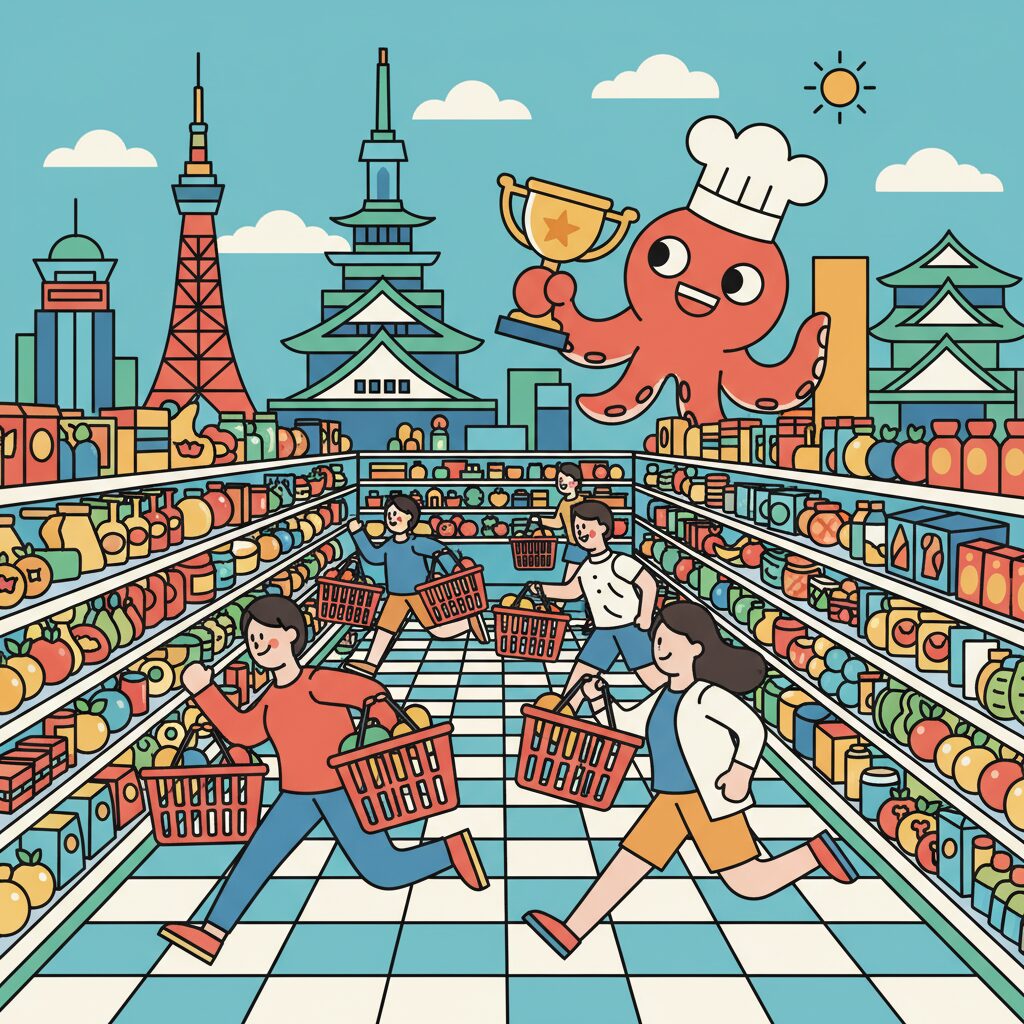
I remember my first Saturday morning in a proper Osaka supermarket. It wasn’t in the slick, curated basement of a Namba department store, but a sprawling, aggressively lit Mandai in a quiet residential neighborhood. I was just there for some milk and eggs, a simple weekend errand. What I found was something else entirely. A palpable energy hummed in the air, a low-frequency thrum of focused intent. Women, mostly middle-aged and older, moved with a practiced efficiency, their eyes scanning, calculating. Carts weren’t just being pushed; they were being navigated like tactical vehicles. A sudden announcement crackled over the PA system, a torrent of rapid-fire Japanese I couldn’t fully parse, and a squadron of shoppers pivoted in unison, descending upon the tofu aisle with a speed that defied their age. I stood there, bewildered, holding my single carton of milk, feeling like I’d wandered onto the floor of the stock exchange moments after the opening bell. I wasn’t just in a grocery store. I was in an arena.
This is the reality of daily life in Osaka. Grocery shopping isn’t a chore; it’s a craft, a strategy game, a deeply ingrained cultural ritual. And at the heart of this ritual is a concept that goes far beyond a simple sale sticker: the ‘hansogahin’ (販促品). These are promotional items, often sold at a ridiculously low, attention-grabbing price, designed for the sole purpose of getting you through the door. But to an Osakan, they are more than a marketing gimmick. They are the prize, the objective, the validation of a shopping trip well-executed. Understanding the hunt for the ‘hansogahin’ is understanding the very soul of this city—a soul forged in commerce, tempered by practicality, and fueled by the undeniable thrill of a good deal. This isn’t about being cheap. Forget that notion entirely. This is about being smart, resourceful, and winning a small, daily victory in the complex, vibrant ecosystem of Osaka life. It’s a world away from the polite, orderly, and often more expensive shopping experiences of Tokyo. Here, the supermarket aisles are where the city’s true character is on full display.
This competitive, value-driven mindset is a direct reflection of Osaka’s deep-seated merchant spirit, which shapes attitudes far beyond the supermarket aisles.
The Supermarket as a Battlefield: Understanding the Osaka Mindset
To truly understand the intensity of an Osaka supermarket, you first need to unlearn certain assumptions. You must let go of the idea that shopping is a passive act of simply acquiring goods. Here, shopping is active, strategic, and deeply intertwined with the city’s identity as the ‘kitchen of the nation’ (天下の台所, tenka no daidokoro) and, more importantly, as a city of merchants (商人の町, shōnin no machi). For centuries, Osaka was Japan’s commercial center, a place where fortunes were won and lost on the margins, where sharp wit and a keen eye for value were the most prized qualities. This merchant spirit runs deep, passed down through generations, now evident in the aisles of Life, Tamade, and every local shotengai grocery store.
It’s Not About Being Cheap, It’s About Being Smart
The biggest misconception foreigners have is to link this deal-hunting passion to poverty or stinginess. Nothing could be further from the truth. The core principle is not about spending the least amount possible; it’s about getting the greatest value. There’s a well-known Osaka saying: ‘eedもん安う買う’ (eemon yasukau), meaning ‘buying good stuff cheap’. The focus is on ‘good stuff’. It’s an expression of savvy. Paying full price for something that will be discounted tomorrow isn’t indulgence; it’s viewed as poor judgment—a failure to play the game properly.
In Tokyo, convenience and presentation often justify higher prices. People may shop at the store nearest the station regardless of cost, simply to save a few minutes, or choose products for their attractive packaging or brand prestige. In Osaka, the story behind a purchase matters most. A chat between neighbors is not just, “I bought some apples.” It’s, “I got these Aomori apples from Mandai—they’re usually 150 yen each, but they were the morning special at 98 yen, limit three per customer, so I went right when they opened. Can you believe it?” The deal is the narrative. It’s a badge of cleverness and diligence. Bragging about how much you paid for an item is seen as gauche; bragging about paying little for high-quality goods is a celebrated social art.
The ‘Chirashi’ as the Weekly Bible
This strategic shopping begins well before you enter the supermarket—it starts at the mailbox. The primary weapon against high prices is the ‘chirashi’ (チラシ), the humble flyer. While such leaflets might be dismissed as junk mail in many places, in Osaka, they are revered texts. Delivered en masse a day or two before sales, they are studied with the intensity of a scholar poring over ancient manuscripts. My neighbor, a woman in her late sixties, lays them out on her dining table like a general plotting a campaign.
Learning to interpret a chirashi is your first step to becoming a true Osaka shopper. It’s a detailed tapestry of information. The front page shouts the biggest deals, the ‘hansogahin’: a pack of eggs for 99 yen, a head of cabbage for 78 yen, a tray of chicken breast for a price that looks like a typo. But the fine print matters. Tiny characters next to prices specify conditions: ‘お一人様一点限り’ (ohitori-sama itten kagiri), meaning ‘one per customer’. Sometimes the deals are time-limited: ‘朝市’ (asa-ichi), a morning market special from 9 AM to noon. Or conditional: ‘1000円以上お買い上げの方’ (sen-en ijō okaiage no kata), available only to customers spending over 1000 yen.
Inside, the flyer outlines the week’s strategy. Each day has a theme. Tuesday might be ‘100 Yen Day,’ where various produce and pantry items are sold at a uniform price. Wednesday could be ‘Frozen Foods Day,’ with deep discounts on gyoza, frozen udon, and more. The chirashi dictates the cooking rhythm for the week. You don’t decide to make curry then buy ingredients; you see carrots, potatoes, and beef on special Thursday, and Thursday becomes curry night. The flyer sets the menu.
Though paper chirashi still reign supreme, the battle has moved online. Supermarkets now bombard customers’ phones via official LINE accounts. Apps like Shufoo! and Tokubai collect flyers from local stores, enabling cross-referencing and strategic planning. The technology has evolved, but the obsession with this information remains timeless. Going to the supermarket without consulting the chirashi is walking in blind—and in Osaka, that’s a rookie error.
The Arsenal of an Osaka Shopper: Tactics and Strategies
Armed with the insights gained from the chirashi, the Osaka shopper enters the store not as a simple consumer, but as a seasoned hunter. They have a clear mission, specific goals, and a finely tuned set of tactics to accomplish them. Here, the theoretical knowledge of the deals collides with the practical hustle of the crowded aisle, revealing the true artistry of shopping in Osaka.
The ‘Hansogahin’ Hunt: Beyond Just a Discount
The ‘hansogahin’, the promotional loss-leader item, is the highlight of the shopping trip. It’s the product meant to spark a frenzy, and it succeeds every time. A classic example, and a cornerstone of Osaka supermarket legend, is the ultra-cheap egg pack. This isn’t a minor discount—prices are so low the store evidently loses money on every carton sold—99 yen, 88 yen, sometimes even less. The catch is that these deals are always strictly limited. “First 100 customers only.” “Starting from 9:00 AM sharp.”
To witness the ‘hansogahin’ hunt is to witness human determination at its purest. If the store opens at 9:00 AM, a line of shoppers, mostly the formidable ‘obachan’ (a respectful term for middle-aged and older women known for their shopping skill), will have already formed by 8:45 AM. They arrive well-prepared, with their personal shopping carts or insulated bags ready. There’s a quiet camaraderie in line, a shared sense of purpose. When the doors slide open, there’s no chaotic rush—just an orderly, brisk, and unstoppable procession toward the prized item. They take their allotted carton of eggs, place it carefully in their basket, and only then does the rest of their shopping begin. Securing the ‘hansogahin’ is the top priority. Everything else comes second.
The ‘Supermarket Hop’ (Super no Hashigo)
No single supermarket excels at everything. The savvy Osaka shopper understands this well. Mandai may have the cheapest eggs on Tuesday, but Life offers a two-for-one milk deal, and the local Gyomu Super has unbeatable prices on frozen Brazilian chicken. The answer isn’t compromise—it’s the ‘supermarket hop’, or ‘super no hashigo’—visiting several stores in one outing to cherry-pick the best bargains from each.
This approach is a cornerstone of Osaka’s shopping philosophy. Loyalty to a single store is unheard of. Loyalty belongs to the deal. It’s common in any residential area to see someone on their ‘mamachari’—the ubiquitous mother’s bicycle with a front basket and child seat in the back—balancing shopping bags from two, three, or even four different supermarkets. A yellow bag from Tamade, a green one from Mandai, a white one from Life. Each bag signifies a tactical victory. This is not viewed as a hassle; it’s routine. The time and effort spent traveling between stores is a worthwhile investment for the savings gained. My own neighborhood offers a perfect example: within a five-minute bike ride, I have access to Life, Mandai, and Gyomu Super. Shopping at only one would mean ignoring my training and disrespecting local customs. You learn to map out your route, planning your hop for maximum efficiency.
Timing is Everything: Mastering the ‘Time Service’ and ‘Mikirihin’
The final level of mastery in Osaka shopping involves an acute understanding of timing. Prices are not fixed; they fluctuate not only day by day but hour by hour. The expert shopper knows how to ride these waves, turning timing into a tool for savings.
The ‘Time Service’ Rush
The ‘Time Service’ (タイムサービス) is a flash sale announced theatrically over the store’s public address system. The familiar chime sounds, followed by a store employee’s announcement: “Tadaima yori, sankai no seisen uriba ni oite…” (“From now on, in the fresh food section on the third floor…”). The announcement details a sudden, steep, and short-lived discount on a particular item—it might be freshly fried croquettes, sashimi, or a case of vegetables that must be sold quickly.
What follows is a controlled burst of energy. Shoppers who were casually browsing suddenly abandon their carts and move purposefully toward the sale’s epicenter. It’s not chaos, but a quick, focused convergence. A moment of shared opportunity. If two people reach for the last discounted item simultaneously, it’s almost always resolved with a nod and a quiet “douzo” (please go ahead). There’s a feeling that everyone is on the same team, all aiming to make the most of these fleeting value moments. Missing a ‘Time Service’ on a needed item leads to a genuine, if minor, regret.
The Art of the ‘Mikirihin’ Sticker
Perhaps the most advanced and respected skill is mastering the ‘mikirihin’ (見切り品). These are products nearing their expiration date and marked down for quick sale, identified by brightly colored discount stickers on their packaging. Here is where the ultimate game of patience unfolds.
The stickers have a hierarchy. A modest 20% off (2割引) might appear early afternoon. Later, it could be replaced by a 30% off sticker. But the ultimate prize for the patient shopper is the ‘hangaku’ (半額) sticker—half price. This golden ticket transforms an expensive tray of domestic beef or a beautiful sashimi platter into an affordable feast.
Experienced shoppers know, or quickly learn, the approximate time when the staff member with the sticker gun makes the rounds—usually late afternoon or early evening as the store nears closing. An unspoken etiquette governs this process. It’s considered rude to hover like a vulture over the employee while they work. Instead, shoppers keep a respectful distance, pretending to browse the nearby soy sauce section while keeping a careful eye. Once the employee moves on, the items become fair game. This practice fundamentally changes meal planning. Instead of deciding what to eat and then shopping, many Osakans shop in the evening with an open mind, letting the ‘hangaku’ stickers dictate their menu. It’s a creative, spontaneous, and highly economical way to live and eat.
The Social Fabric of the Supermarket Aisle
What truly elevates Osaka’s supermarket culture beyond mere economics is its social aspect. In many places, supermarkets are anonymous, transactional spaces—you enter, pick up your items, and leave, often without speaking to anyone. In Osaka, however, the supermarket serves as a community hub, a social arena where relationships are strengthened and information flows freely. It’s lively, crowded, and deeply human.
The ‘Obachan’ Network: The Unofficial Intelligence Agency
The ‘obachan’ of Osaka are the undisputed rulers of this realm. They are more than shoppers; they are the keepers of information, the generals of the grocery aisles. They function as part of a highly effective, decentralized intelligence network. Standing in the produce section, it’s almost certain you’ll overhear bits of essential, up-to-the-minute market insights.
“Sawako-san, don’t buy the spinach here. It’s much fresher and ten yen cheaper at the yaoya-san down the street,” one might whisper conspiratorially over a cart loaded with daikon radish. “Ah, but did you see? They have our favorite brand of mirin on sale today. Better stock up.”
This is not mere gossip—it’s the community’s lifeblood. Sharing a tip about a good deal serves as social currency, strengthening bonds between people. If you’re a regular at your neighborhood store, you’ll soon find yourself welcomed into this circle. An obachan might notice you hesitating between two types of miso and offer her unsolicited, yet always expert, advice. She could point you toward the discounted ‘hangaku’ pork she just spotted. This openness and readiness to engage strangers with the shared goal of finding good value defines the Osaka spirit. It sharply contrasts with the more reserved and formal social interactions often found in Tokyo. In an Osaka supermarket, everyone can be a potential ally.
The Cashier Counter Conversation
The social dynamic continues right through to the checkout. Cashiers aren’t mere barcode scanners; they take an active role in the shopping experience. Often locals themselves, they’re well aware of the day’s deals and community happenings. It’s quite common for a cashier to comment on your purchases in a friendly, familiar manner.
“Ooh, you got the last of the sale-price mackerel! You’re lucky!” they might say while scanning your items. Or, “You’re buying a lot of vegetables today—making something healthy for dinner? Good for you!” This small talk lubricates daily life, acknowledging your efforts, validating your smart shopping choices, and turning what could be a mundane transaction into a moment of human connection. It reinforces the sense that you belong to a community that understands and values the art of the deal. This is the renowned Osaka friendliness people mention—not just an abstract idea but something made real through these small, everyday interactions.
The Osaka Supermarket Pantheon: Know Your Players
Like any ecosystem, the Osaka supermarket scene features a diverse array of players, each with a unique personality, reputation, and role in the overall strategy of the local shopper. Understanding this landscape is essential for anyone aiming to truly master the art of shopping here.
Super Tamade: The Neon Jungle of Deals
No conversation about Osaka supermarkets is complete without mentioning the legendary Super Tamade. Calling Tamade a grocery store is like calling a Las Vegas casino a community center. It is a full sensory overload. The storefronts are covered in a wild explosion of neon lights, blinking and flashing around the clock. Inside, the chaos continues with loud, upbeat J-pop or store jingles blasting from the speakers, and every surface plastered with bright, hand-drawn signs shouting about unbelievable prices.
Tamade’s fame rests on one thing: being shockingly, ridiculously cheap. It’s home to the infamous ‘1 Yen Sale,’ where, with a qualifying purchase, you can grab a variety of items—from canned coffee to packs of instant noodles—for just a single yen coin. The quality of its fresh produce and meat can sometimes be hit or miss, earning it a somewhat notorious reputation among discerning shoppers. But for sheer price-smashing spectacle and pantry basics, it’s an essential and iconic part of the Osaka experience. Shopping at Tamade isn’t just a chore; it’s a pilgrimage to the temple of thrift.
Mandai, Life, and the Everyday Champions
If Tamade is the flamboyant showman, chains like Mandai and Life are the dependable, workhorse champions for everyday shoppers. These are the primary battlegrounds for the weekly ‘chirashi’ wars. They strike a solid balance of quality, variety, and competitive pricing. With extensive private-label brands offering great value and point card systems that layer in extra savings, accumulating points for future discounts is a long-term strategy embraced by every local. Most Osaka residents pledge primary loyalty to either Mandai or Life based on location and store strengths but willingly switch allegiances if the weekly flyer favors the other.
Gyomu Super: The Bulk-Buy Specialist
‘Gyomu Super’ means ‘Business Supermarket,’ and while it caters to restaurant owners, it’s also a beloved institution for regular families. Gyomu is the bulk-buy master. Its strength lies in a vast selection of frozen foods, from huge bags of fried chicken to every imaginable vegetable. It’s also a treasure trove of imported goods offered at prices that put specialty stores to shame. You’ll find pasta from Italy, spices from Southeast Asia, and sauces from across the globe—all in no-frills packaging at rock-bottom prices. Gyomu Super is rarely a one-stop shop for daily needs but remains indispensable for the ‘supermarket hop’ to stock freezers and pantries.
Department Store Basements (‘Depachika’): The Other Side of the Coin
At the opposite end of the spectrum are the ‘depachika’—the glittering gourmet food halls hidden in the basements of high-end department stores like Hankyu, Hanshin, and Daimaru. Here, the emphasis is on premium quality, exquisite presentation, and artisanal products. This world boasts perfectly marbled wagyu beef, rare seasonal fruits priced like fine meals, and world-renowned patisseries. It may seem the exact opposite of the ‘hansogahin’ culture, yet the Osaka mindset shines through. Osakans appreciate luxury but still love a bargain. As closing time nears, ‘depachika’ turns into its own arena for ‘hangaku’ (half-price) stickers. The battle for half-off gourmet bento boxes, high-end sushi, and delicate cakes is intense. It’s a testament to the local ethos: whether it’s a 78-yen cabbage or a 2000-yen sashimi platter, scoring it at half price is always a win.
What Foreigners Misunderstand
It’s easy to observe this intense, almost obsessive behavior and come to the wrong conclusions. The most common misconception is that this is all driven by necessity, that Osakans are stingy because they must be. This fundamentally misinterprets the culture. It’s not about lacking money; it’s about having an abundance of common sense. This is a cultural expression of resourcefulness. The joy lies not just in saving money, but in successfully carrying out a plan. It’s the satisfaction of outsmarting the system, of maximizing your resources through cleverness and effort.
In Osaka, frugality is not shameful; wastefulness is. Paying 500 yen for a bento that you could get for 250 yen an hour later is not a sign of wealth; it’s a sign of poor planning, of being ‘ahō’, a traditional Osaka word for a fool or idiot. Being called ‘kashikoi’ (clever, savvy) is one of the highest compliments. This value system runs so deep it cuts across social classes. You’ll see impeccably dressed women stepping out of luxury cars to line up for 99-yen eggs alongside everyone else. The game serves as the great equalizer.
For a foreigner, trying to live in Osaka without adopting at least some of this mindset means you’ll always be an outsider. You’ll overpay for everything and miss out on a central part of the local culture. Passivity is not the Osaka way. You have to engage, take part, and join the hunt.
How to Shop Like an Osakan: A Practical Guide
Ready to swap casual browsing for strategic shopping? Becoming a savvy Osaka shopper is a journey that begins with a few essential steps. Embrace the process, and you’ll not only save money but also develop a deeper connection with the city.
Step 1: Do Your Reconnaissance
Your mission starts before you even leave home. Grab the chirashi flyers—whether from your mailbox or by downloading an app like Shufoo! to browse them digitally. Identify the key ‘hansogahin’ for the day and week. Make a plan. Know your targets and the locations you need to visit. This is your battle strategy.
Step 2: Choose Your Time of Attack
Timing is crucial. Need a limited-quantity promotional item? Then arrive early and be ready to queue. Want to get the best deals on fresh fish or meat and are flexible with dinner plans? A late-evening hunt for ‘hangaku’ stickers is your goal. Learn your local stores’ unique rhythms. Is the ‘time service’ for baked goods always around 3 PM? Does the sticker-wielding staff make their first pass through the deli at 5 PM? This insider knowledge is your greatest advantage.
Step 3: Embrace the ‘Hashigo’
Forget the idea of one-stop shopping. Get a bicycle with a large basket; it’s the official vehicle of the Osaka shopper. Plan a route that lets you efficiently visit two or three key spots. Pick up 99-yen eggs from Mandai, stop by Gyomu for frozen edamame, and grab half-price tonkatsu from Life on your way home. It may feel like extra effort at first, but soon it becomes a satisfying and efficient routine. Both your wallet and your taste buds will thank you.
Step 4: Engage and Observe
Don’t be a silent ghost in the aisles. Listen carefully—ambient chatter offers valuable, real-time intelligence. Notice where veteran shoppers gather; they’re likely onto a deal you haven’t found yet. Make eye contact with the cashier. Share a laugh over an absurd price. Ask the fishmongers what’s freshest that day. Be an active participant, not just an observer. This is how you integrate, learn, and turn a simple errand into a meaningful part of your Osaka life.
Conclusion: The Soul of the City in a Shopping Cart

A shopping cart in Osaka is never simply a shopping cart. It serves as a moving testament to a way of life. It holds not only groceries but also the fruits of careful planning, keen observation, and a spirited competitive drive. The daily pursuit of value in the supermarket aisles perfectly reflects Osaka itself: practical, lively, modest, and deeply connected.
To shop like an Osakan is to grasp the city’s rhythm. It means realizing that value goes beyond price, encompassing the intelligence and effort required to obtain it. It means seeing that community can form over a shared enthusiasm for a good deal on daikon radish. It means finding happiness in small, everyday wins. The first time I successfully organized my day around a ‘time service,’ secured a ‘hangaku’ sticker on a beautiful piece of tuna, and received a warm nod from an obachan at the checkout, I knew I had become more than a visitor. I was beginning to understand what it means to live here. I was finally part of the game.