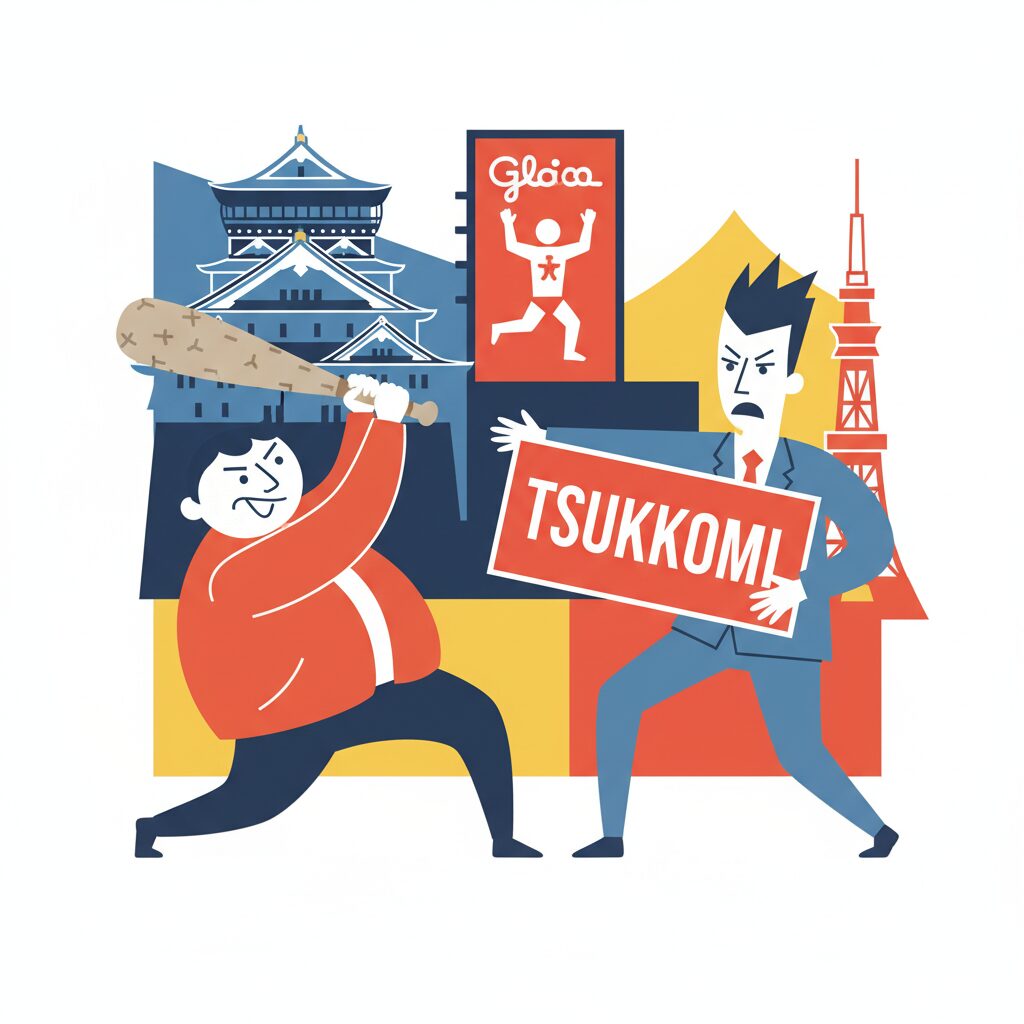
The first time it happened, I was genuinely concerned. I was standing in line for takoyaki in Tenjinbashisuji Shotengai, the longest covered shopping arcade in Japan. The air was thick with the savory smell of grilled octopus and dashi, the sizzle of batter hitting hot iron, and the rhythmic chatter of a city that never seems to take a breath. An elderly woman, probably in her late seventies, was paying for her order. When the shop owner, a man with a towel tied around his head, handed her the change, she peered into her palm and exclaimed, loud enough for half the line to hear, “Eh? That’s it? You’re robbing me blind!” The shop owner didn’t miss a beat. He shot back with a grin, “Gotta pay for my new sports car somehow, Obaasan!” He then gave her shoulder a light, friendly pat. She cackled, waving him off, and went on her way. Nobody else blinked. In fact, the people around me seemed to be enjoying the show. I was frozen. In many cultures, this would be an insult, a confrontation. But here, in the heart of Osaka, it was just another Tuesday. It was my first raw lesson in the city’s most fundamental social lubricant: the conversational duet of boke and tsukkomi.
To live in Osaka is to be a perpetual audience member—and potential participant—in a city-wide improv show. Conversations aren’t just exchanges of information; they are performances, tiny skits played out between shopkeepers and customers, friends at a bar, even colleagues in an office. This dynamic, a constant dance of absurdity and correction, is the lifeblood of Osakan communication. It feels worlds away from the careful, layered politeness of Tokyo, where conversations often prioritize harmony through indirectness. Here, harmony is achieved through laughter, through a shared rhythm of joke and response. For any foreigner trying to truly understand the pulse of this city, deciphering this code is not just a fun cultural quirk. It’s essential. It’s the key to understanding why Osakans seem so direct, so loud, and so incredibly engaging. It’s the difference between seeing a heated argument and recognizing an act of friendship. So, let’s pull back the curtain on this daily performance and learn the steps to the Osakan social tango.
Understanding these unspoken rules is as crucial for navigating the city’s social landscape as staying informed about the latest developments in the region, such as the significant international investment fueling Kansai’s luxury hotel boom.
The Manzai Mindset: Comedy as a Second Language
To truly understand the Osakan way of speaking, you first need to get familiar with manzai. This style of stand-up comedy, traditionally performed by a duo, is to Osaka what deep-dish pizza is to Chicago. The entire comedy industry in Japan, led by the Osaka-based entertainment giant Yoshimoto Kogyo, is grounded in this two-person act. Its structure is simple yet ingenious: one person is the boke (ボケ), and the other is the tsukkomi (ツッコミ). The boke plays the fool, misunderstanding, forgetting, or saying something absurd, while the tsukkomi acts as the straight man, correcting the boke, highlighting the absurdity, and steering the conversation back to reality—often with a sharp retort or a light, theatrical slap.
From Stage to Street
What’s remarkable about Osaka is how this theatrical format escaped the Namba Grand Kagetsu theater and became the default mode of everyday conversation. People here have internalized these roles, effortlessly switching between boke and tsukkomi with friends, family, and even strangers. It’s a shared script everyone knows by heart. An Osakan doesn’t need a stage or microphone to perform; a supermarket checkout or a platform on the Midosuji subway line works perfectly. It’s not about delivering structured jokes with punchlines, but about weaving a comedic rhythm into routine interactions. The aim isn’t always a loud laugh; often, it’s just a shared smile, a moment of connection that says, “We speak the same language. We’re on the same wavelength.” It’s a verbal and non-verbal confirmation of social bonds, enacted in real time.
Why Osaka? A Culture of Connection
This phenomenon gives Osaka a distinct vibe compared to other Japanese cities, especially Tokyo. In Tokyo, social interactions often revolve around a careful balance of tatemae (public face) and honne (true feelings), with communication that is more reserved, polite, and indirect to avoid conflict. In Osaka, the aim is to spark a connection. The city’s centuries-old history as Japan’s commercial hub plays a major role. Its people were merchants and traders who needed to build rapport quickly, haggle effectively, and be memorable. Witty, direct, and humorous exchanges broke down barriers more efficiently than stiff formality. Banter was a tool of the trade, and this merchant DNA is still very much alive. Osakans value directness and efficiency but soften it with humor to avoid abrasiveness. They use laughter to bridge gaps between people, saying, “Let’s skip the formalities and be friends.” While a Tokyoite may show respect by keeping polite distance, an Osakan shows respect by inviting you into the joke, trusting that you’ll know how to play along.
Anatomy of a Boke-Tsukkomi Exchange
A proper boke-tsukkomi exchange is a work of art—a rapid-fire interaction grounded in timing and mutual understanding. Although it may appear spontaneous, it follows a set of unwritten rules and expectations. When examined closely, it reveals a sophisticated communication technique masked as simple foolishness. This conversational dynamic requires both participants to work together; without one, the other falls flat into awkward silence.
The Boke’s Role: The Art of Absurdity
Being the boke doesn’t mean being truly unintelligent. In fact, it often demands quick wit and keen observation to spot the absurd in everyday situations. The boke intentionally steps away from reality to create a comedic opening. Their role is to toss out a verbal volleyball, perfectly positioned for the tsukkomi to spike. A skilled boke is a master of non-sequiturs, exaggeration, and deliberate misunderstandings. It’s a subtle, creative act. For example, if you point at the Tsutenkaku Tower and say, “Look, it’s Tokyo Tower!” you’re performing a classic and simple boke. You know it’s not Tokyo Tower. Your friend knows it’s not Tokyo Tower. The point isn’t to spread false information but to launch a comedic routine. Other common boke techniques include taking figurative expressions literally. If someone says, “My hands are full,” the boke might inspect their hands and say, “They look empty to me.” It’s a playful disruption of conversational norms—a spark of chaos tossed into the mix, waiting for a response that restores order.
The Tsukkomi’s Response: The Anchor of Reality
The tsukkomi is the essential counterpart. Without a tsukkomi, a boke is just someone uttering odd statements. The tsukkomi’s job is to acknowledge and highlight the joke by correcting it. Their reply is the punchline. It grounds the boke’s flight of fancy in humor. The most iconic tsukkomi phrase in the Osaka dialect is “Nande ya nen!” (なんでやねん!), which roughly translates as “Why the heck?!” or “What are you talking about?!” but carries more nuance. It’s an exclamation of playful frustration, saying, “I see what absurd thing you just did, and I’m pointing it out.” It closes the comedic loop and gives everyone permission to laugh. Another vital aspect is the physical tsukkomi, often surprising to outsiders. This could be a light tap on the back of the head with an open palm, a gentle push on the shoulder, or a swat on the arm. It’s crucial to understand this is not an act of violence but rather a theatrical gesture—a physical punctuation mark. The light touch combined with a smile expresses deep familiarity and affection, meaning, “You’re being ridiculous, and I love you for it.”
Reading the Room: When and How to Tsukkomi
Mastering tsukkomi depends entirely on context. The sharpness of the comeback, word choice, and physical contact all vary depending on the relationship between the two people and the social environment. A quick “Nande ya nen!” paired with a head tap is reserved for close friends. With a colleague, the tsukkomi might be a gentler, verbal nudge like, “Sato-san, you’re thinking of a different tower,” delivered with a wry smile. With a stranger, such as the shopkeeper in my takoyaki story, it becomes a battle of wits, kept light and verbal. Tsukkomi is never intended to be cruel or humiliating. A good tsukkomi makes the boke the star of the moment. The laughter targets the shared situation, not the boke personally. The boke actively wants the tsukkomi; they’re ready for it. It’s the confirmation that their joke landed well. The entire exchange is a joint effort to create a moment of shared joy.
Boke & Tsukkomi in the Wild: Real-Life Scenarios
Grasping the theory is one thing, but witnessing these roles unfold in real life is where the real magic occurs. The boke-tsukkomi dynamic is omnipresent in Osaka, effortlessly woven into the most ordinary activities. Once you learn to spot it, you’ll begin noticing these little performances throughout the city, from crowded trains to quiet neighborhood bars.
At the Izakaya (Pub)
The lively, raucous environment of an izakaya is the ideal natural setting for boke-tsukkomi. Picture yourself out with a group of Osakan friends. The table is laden with plates of karaage, edamame, and sashimi. Someone raises their beer and seriously declares, “Alright, tonight, we’ll solve all the world’s problems!” This is a classic boke setup—an absurdly grand statement for a casual night out. A non-Osakan might simply nod or ignore it, but the tsukkomi in the group will instantly jump in. “Let’s see if you can solve the problem of walking home straight first!” they might reply, pointing to the nearly empty beer jug. The table bursts into laughter. The original speaker, the boke, laughs the loudest. The workweek’s tension fades, and the group feels more connected. This exchange fulfilled its purpose: strengthening the group’s bond through shared humor.
Shopping in a Shotengai (Shopping Arcade)
Osaka’s shotengai are stages of commerce, where shop owners are experienced performers. This is where the merchant spirit truly shines. Imagine you’re at a vegetable stand in Kuromon Market. You pick up a particularly large daikon radish and ask the vendor, an energetic woman in her sixties, “How much is this one?” She might glance at you, then at the radish, and reply with a perfectly straight face, “For that beauty? Ten thousand yen.” She has just created the tsukkomi moment—she’s thrown you the ball. A serious response like, “That’s too expensive,” would kill the interaction. The Osakan way is to play along. You might say, “Does it grant wishes at that price?” or “I’ll have to take out a loan!” This is your tsukkomi. The vendor will burst out laughing, playfully slap your arm, and say, “Just kidding, it’s 200 yen. I’ll even give you a discount for being so funny!” You haven’t simply bought a radish; you’ve engaged in a successful social exchange. You’ve shown you understand the local banter, and for that, you’re rewarded.
In the Office (with Caution)
Even in the more formal environment of a Japanese office, Osaka’s comedic spirit manages to surface, though in a subtler way. The boke-tsukkomi dynamic here is less about loud snapbacks and more about gentle teasing and self-deprecation among trusted coworkers. For instance, a colleague struggling with a complex Excel formula might sigh dramatically, “My brain has officially stopped working. I am now just a handsome decoration.” This self-deprecating boke invites a lighthearted tsukkomi. A nearby coworker might respond without looking up from their screen, “We’ll be the judge of the ‘handsome’ part later. Did you try the VLOOKUP function?” It’s a soft correction that acknowledges the joke, offers assistance, and keeps a positive, collaborative atmosphere. It helps manage minor frustrations and foster team camaraderie, turning a stressful moment into a shared laugh.
The Foreigner’s Dilemma: To Boke or Not to Boke?
For a non-Japanese resident, navigating this landscape of constant banter can be both thrilling and intimidating. Misunderstanding signals is easy, and the fear of saying or doing something wrong is very real. However, grasping this dynamic serves as your gateway to deeper connections in Osaka. It’s about learning to observe, listen, and eventually join in the local rhythm.
Common Misunderstandings
The biggest challenge for foreigners is perception. First, there’s the risk of mistaking a tsukkomi for genuine anger or aggression. Seeing a friend lightly bop another on the head can feel unsettling if you don’t understand the comedic context. It’s essential to look past the physical gesture and notice the smiles, laughter, and the overall friendly vibe of the interaction. Second, there’s a danger in taking a boke literally. If an Osakan says something utterly ridiculous with a straight face, your instinct might be to correct them with facts. This, in a way, is a form of tsukkomi, but if taken too seriously, it can kill the playful mood. The key is to recognize the absurdity as an invitation to play, not a call for a factual explanation. Finally, the bluntness of Osakan humor can sometimes be mistaken for rudeness, especially compared to the more roundabout speech in other parts of Japan. It isn’t meant to be impolite; it’s a cultural shortcut to intimacy.
Your Role in the Duet
So, how do you join the dance? You don’t have to become a manzai expert right away. The process happens in stages. The first and most important step is to be a good audience. When you witness a boke-tsukkomi exchange, smile. Laugh. Show that you understand. Your appreciation is a form of participation. As you grow more comfortable, you can try a mild, verbal tsukkomi. If a Japanese friend makes an obvious boke, you don’t need to shout “Nande ya nen!”. A simple, smiling “You’re crazy,” or “What are you talking about?” in English works just fine. Tone and smile matter—they show you’re in on the game. Attempting to be the boke yourself is the advanced level. It requires solid language skills and a feel for the local humor. But don’t hesitate to try it with close friends. Even if your joke falls flat, the effort is often appreciated. Osakans value those who try to engage with their culture on its own terms.
The Payoff: Cracking the Social Code
The moment an Osakan starts using boke-tsukkomi with you is a milestone. It signals acceptance. It means they feel comfortable enough with you to drop formal guest-host and foreigner-native barriers. They’re treating you as an insider, a friend. They’re testing you, inviting you into their world. When you respond with a witty tsukkomi or even just a knowing laugh, you’re cementing a real connection. You’re no longer merely observing Osaka life—you’re an active participant. This is the true reward: moving beyond surface-level politeness into the warm, chaotic, and hilarious core of the city’s social life.
Beyond the Laughs: What Boke & Tsukkomi Reveals About Osaka
This distinctive style of communication is more than merely a habit of telling jokes. It offers a glimpse into the soul of Osaka, revealing a set of cultural values that define the city and distinguish it from the rest of Japan. It represents a philosophy of life, expressed through millions of small conversations every day.
A Rejection of Formality
At its essence, the boke-tsukkomi culture stands as a challenge to the stiff hierarchies and strict formality that often characterize Japanese society. In a country where language frequently signals status—through intricate honorifics (keigo) and rigid conversational rules—the humor of Osaka serves as a great equalizer. In the moment of a joke, the boss and the employee, the shopkeeper and the customer, become simply two people sharing a laugh. It puts human connection above social rank. This fosters an environment that many find more relaxed and approachable. It’s a culture that says, “Let’s not take ourselves too seriously. Let’s be people first.”
The Importance of ‘Aun no Kokyu’
The smooth back-and-forth of a skilled boke-tsukkomi duo perfectly illustrates a treasured Japanese concept: Aun no Kokyu (阿吽の呼吸). This phrase, meaning roughly “the breathing of A and Un,” refers to the statues with open and closed mouths guarding temple gates. It signifies a state of flawless, unspoken harmony between two people. They can anticipate each other’s thoughts and actions without needing words. A boke intuitively understands the kind of joke their partner can handle, while the tsukkomi masters the precise timing and tone to make it land just right. This demonstrates that the banter, though it appears spontaneous, is often founded on deep friendship and mutual understanding. It celebrates interpersonal chemistry.
Resilience Through Humor
Ultimately, the prevalence of humor in Osaka reflects the city’s character: its resilience, optimism, and pragmatism. Osaka has faced many setbacks throughout its history—fires, wars, economic struggles. A culture that can find humor in life’s little absurdities, that can turn mistakes or misunderstandings into shared laughter, is a culture that knows how to persevere. Humor serves as a coping strategy. It’s a means of keeping spirits high during tough times. It’s a proclamation that no matter what happens, the people of this city will find reasons to smile, to connect, and to move forward together. Living here, you come to understand that a well-timed joke isn’t just a joke; it’s an expression of the city’s indomitable spirit.