
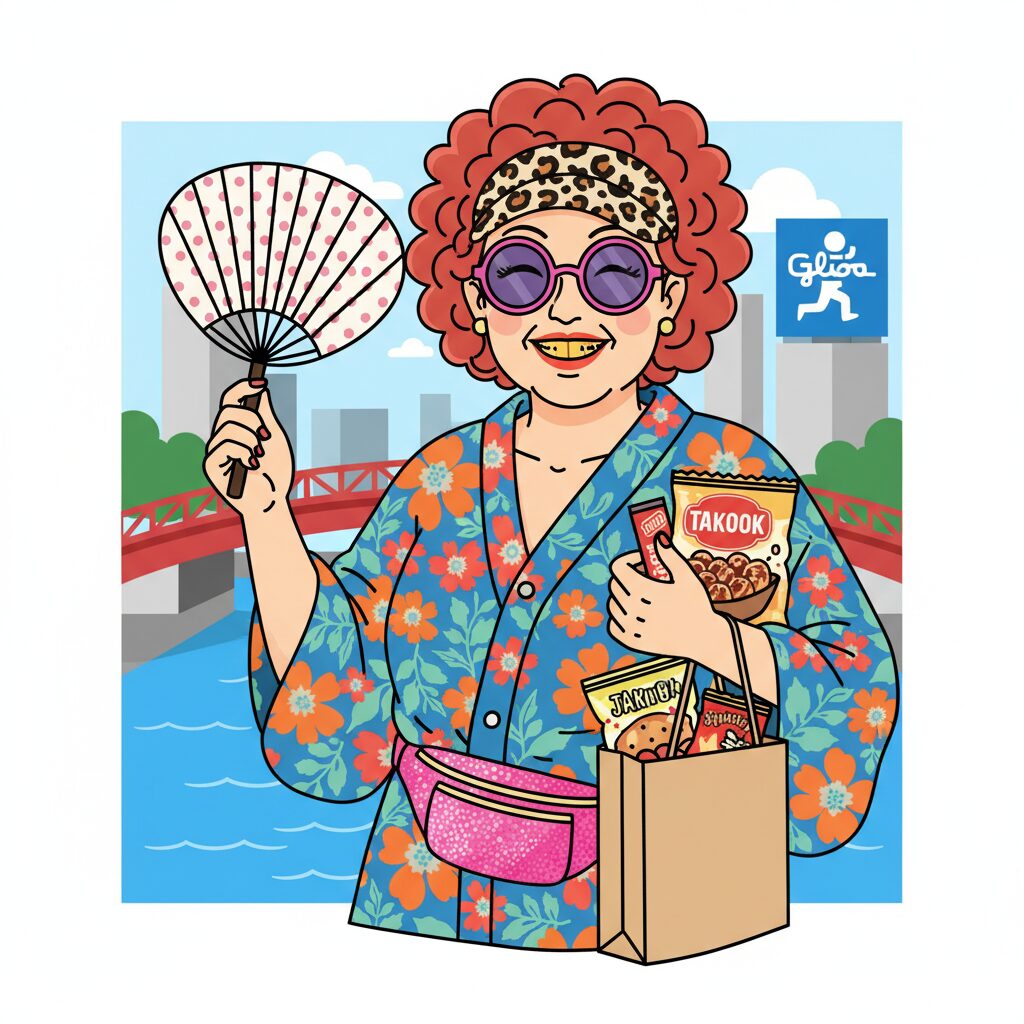
You see them everywhere in Osaka. A flash of leopard print cutting through the crowd on a mamachari bicycle, its front basket overflowing with daikon radish and green onions. A booming voice, thick with the local Kansai dialect, haggling with a fishmonger in a shotengai shopping arcade. A perfectly coiffed perm, impervious to the humid summer air, bobbing along as its owner dispenses unsolicited advice and hard candies to strangers. This is the Osaka Obachan, a figure as iconic to this city as the Glico Running Man or takoyaki. For many foreigners, the obachan is a walking, talking caricature, a source of amused confusion. They seem loud, sometimes nosy, and their fashion sense is a bold statement that defies the understated elegance often associated with Japan. But if you’re planning to live here, to truly understand the rhythm and pulse of daily life in Osaka, you need to look past the stereotype. The obachan is not a joke; she is a vital piece of social infrastructure. She is the keeper of neighborhood secrets, the enforcer of unwritten rules, and the glue that holds the local community together. In a city that prides itself on being different from Tokyo, the obachan is the living embodiment of that difference: pragmatic, direct, and deeply, fiercely human. Forget what you think you know. To understand Osaka, you must first understand her. She is the city’s heart, and her natural habitat, the bustling local shopping arcade, is where the real life of the city unfolds.
To truly appreciate her direct and humorous nature, it helps to understand the unspoken rules of Osakan humor.
Decoding the Obachan: Beyond the Leopard Print and Perm
To truly understand their role in the community, you first need to dissect the persona. The image of the Osaka Obachan is so iconic that it often conceals a more complex reality. It’s easy to notice the surface—the colorful attire, the boisterous chatter—and dismiss it as merely a cultural quirk. Yet every aspect of the obachan’s appearance is part of a larger framework, a practical adaptation to life in this busy merchant city. It serves as a uniform, a toolkit, and a philosophy all in one.
The Anatomy of an Osaka Obachan
The visual and auditory cues of an obachan are unmistakable. They assert presence in a city that values standing out rather than blending in, a sharp contrast to Tokyo’s social norms where harmony often means invisibility.
First, there’s the appearance. The leopard print is genuine, as are the bright purples, vivid pinks, and sparkling golds. But this isn’t about mimicking Milanese high fashion. It’s about functionality and self-expression. These colors ensure visibility in a crowded street and mask stains well. More importantly, they radiate energy and confidence. In a culture that can pressure women to become more subdued with age, the obachan’s style is a bold celebration of life. It declares, “I am here, I am visible, and I have responsibilities.” The signature visor, or `sanbaiza`, is another piece of practical design—a portable sun shield that enables them to ride their bicycles unimpeded under the relentless Japanese sun. It’s pure pragmatism.
Next is the sound. The Osaka dialect, or Kansai-ben, is known for being more direct and melodic than standard Japanese. When wielded by an obachan, it becomes a powerful tool. Their voices carry and cut through the hustle of markets or crowded trains. This volume is often misunderstood by outsiders, and even by people from other regions of Japan, as rude or aggressive. However, in Osaka, it’s a way to connect—an invitation to skip formalities and get straight to the point. A timid, quiet request often gets lost in the commotion, while a clear, confident statement from an obachan delivers results. This is the audible essence of the city’s merchant spirit: communication must be efficient and effective.
Finally, consider her gear. The `charinko`, or bicycle, serves as her urban vehicle. It almost always sports a large front basket and sometimes a rear one, capable of carrying a week’s worth of groceries. The rolling shopping cart is another familiar sight—a practical way to navigate markets without physical strain. But the most vital piece of equipment is the handbag. An obachan’s purse is a mobile command center, akin to a Mary Poppins bag for urban survival. It holds essentials like a wallet, keys, a foldable fan for summer, and a small towel. It also carries a miniature pharmacy with cough drops, bandages, and pain relievers. Most importantly, it contains `ame-chan`. This affectionate term for candy is the obachan’s universal currency of goodwill. A piece of candy can calm a fussy child on the bus, thank a helpful stranger, or spark a conversation with a new neighbor. It’s a small but powerful gesture that smooths social interactions.
The Obachan Mindset: Pragmatism Over Polish
Beneath the look, sound, and gear lies a core philosophy that embodies the Osaka spirit. It’s a mindset grounded in `kosupa` (cost-performance), common sense, and a healthy skepticism toward anything overly polished or pretentious. This approach was shaped by centuries of commerce. Osaka has long been Japan’s kitchen and its main trading hub—a place where value reigns supreme and people possess a keen instinct for spotting a bad deal.
This is most evident in the art of bargaining. Although haggling is rare in much of modern Japan, it remains alive in many of Osaka’s shotengai. For an obachan, negotiating the price of spinach is not merely about saving a few yen; it’s a conversation, a performance, a ritual that deepens the relationship between customer and vendor. It’s a friendly contest of wits that reaffirms social bonds. This stands in sharp contrast to the quiet, impersonal transactions typical of Tokyo supermarkets, where prices are fixed, and interactions are minimal. The Osaka obachan seeks connection with her food and those who sell it.
This pragmatism also underpins their famed directness. If you’re a foreigner living in an Osaka neighborhood, you’ll likely experience this firsthand. An obachan might stop you on the street to tell you your shoelace is untied or loudly point out a missed spot while you sweep the sidewalk in front of your building. This can feel embarrassing, even like public shaming, but that’s not the intention. From her perspective, she’s simply addressing a problem efficiently. Why let you walk around with an untied shoelace when she can fix it in seconds? Why allow poor sweeping when a quick correction helps keep the neighborhood clean for everyone? This radical honesty springs from a sense of collective responsibility. She views the neighborhood as an extension of her home and expects everyone to contribute to its upkeep. While polish and politeness are appreciated, what truly matters are results.
The Obachan as a Social Infrastructure
The true strength of the Osaka Obachan lies not in her individual quirks but in their collective role. They are more than isolated figures; they create a sophisticated, decentralized network that acts as the neighborhood’s operating system. This network offers services that no government agency or tech company could ever replicate. They serve as the human-to-human API for community life.
The Human Information Network
Long before the internet, long before Facebook neighborhood groups or the LINE app, there was the obachan network. This original, analog social media remains the most reliable source of hyper-local information in many parts of Osaka. The obachan act as the nodes and routers of this network, gathering, processing, and sharing information with remarkable speed and efficiency.
Through their daily visits—to the market, the public bath, the clinic, the park—they constantly collect data. Mrs. Tanaka at the tofu shop mentioned her grandson is sick. The butcher down the street is having a sale on minced pork tomorrow. A new family from Kobe just moved into the third-floor apartment. A suspicious van was spotted slowly driving down the street yesterday afternoon. This isn’t idle gossip; it’s actionable intelligence that keeps the community safe, informed, and connected. If you want to know the best pediatrician for kids, don’t rely on Google. Ask the obachan at the local tobacco stand. Her knowledge will be more current and detailed than any online review.
For a foreigner settling into a new neighborhood, this network can be a powerful tool for integration. The first time you meet an obachan—perhaps at the designated garbage collection spot—you’ll undergo a friendly but thorough intake interview. Where are you from? What do you do? Are you married? Do you live alone? It may feel intensely personal, but it’s her way of creating a profile for you and adding you to the community database. This is how she knows to watch out for you. If she notices you struggling with the instructions on a Japanese appliance, she already has the context to help you. She’s not aiding a random stranger; she’s assisting “the young American programmer living in apartment 201.” This process may seem intrusive, but its purpose is to weave you into the neighborhood’s social fabric.
The Keepers of Unspoken Rules
Every community depends on a set of unwritten rules—social norms that govern how people share public spaces and maintain harmony. In many cities, these rules are enforced through passive aggression, subtle hints, or official notices. In Osaka, obachan are the frontline enforcers, and their methods are anything but subtle.
Garbage disposal is a classic battleground. Japan’s rules for sorting and discarding trash are complex and strict, with different days for burnables, plastics, cans, and bottles. Get it wrong, and you disrupt the system. In Tokyo, you might find a neatly printed anonymous note on your improperly sorted bag. In Osaka, it’s far more common that an obachan will be waiting for you at the collection point at 8 AM. She’ll catch you in the act, march you back to your apartment, and supervise as you re-sort your trash—while giving a loud, detailed lecture on the proper procedure. It’s a deeply humbling experience but incredibly effective. You’ll never make that mistake again. You have been personally trained by a master.
This enforcement extends throughout neighborhood life. Parking your bicycle blocking the sidewalk, letting your child make too much noise in the hallway, failing to greet neighbors—these are all infractions that may trigger an intervention. They are guardians of the social contract, ensuring that a densely populated urban environment remains livable and respectful for everyone. They don’t do it to be harsh; they do it because they believe strongly that everyone has a responsibility to the collective.
The Community’s First Responders
Beyond information sharing and rule enforcement, the obachan network acts as an informal social safety net. They are the eyes and ears of the community, often the first to notice if someone is in trouble—particularly important in Japan’s rapidly aging population.
They instinctively keep track of elderly residents living alone. They notice if Mrs. Sato hasn’t gone out to buy milk for days. They see Mr. Suzuki’s mail piling up in his mailbox. A quick knock on the door or a call to a relative can be a lifesaver. This informal wellness check system is something official government services struggle to achieve. The obachan can manage it because they operate based on personal relationships and daily observation.
They also play a vital role in child safety. They know the neighborhood children by name and know their routes to and from school. While they might appear strict—scolding kids for being careless when crossing the street—they are fiercely protective. If a child scrapes a knee, an obachan will be there instantly with a bandage, kind words, and probably an `ame-chan`. They form a protective circle around the community’s most vulnerable members, creating a tangible sense of security that makes Osaka neighborhoods feel like true communities rather than just collections of anonymous apartment buildings.
Navigating Your Relationship with the Local Obachan

For a non-Japanese resident, the Osaka Obachan can seem like an intimidating figure. Her straightforwardness may feel jarring, and her social customs might be difficult to understand. However, she can also become your greatest ally, your entry point into the local community, and an invaluable resource for navigating everyday life. Building a positive relationship with the neighborhood obachan is one of the most important steps to feeling at home in Osaka.
How to Earn Their Respect (and Avoid Their Wrath)
Gaining the favor of the local obachan isn’t about grand gestures. It’s about consistently showing that you are a thoughtful and engaged part of the community. It means demonstrating that you recognize and respect their role.
First and foremost, learn the art of `aisatsu`, or greetings. A simple, cheerful “Ohayo gozaimasu” (Good morning) or “Konnichiwa” (Good day) whenever you see them on the street is incredibly powerful. It’s a basic acknowledgment of their presence. It shows that you see them not just as background, but as a fellow human and neighbor. In a culture that prizes community harmony, this small act is the foundation of all positive relationships.
Show that you’re making an effort. Your Japanese doesn’t need to be perfect. In fact, they’re often more charmed by enthusiastic, halting Japanese than by perfectly robotic textbook phrases. What counts is the effort. When an obachan offers advice, listen carefully. Ask questions. Show that you appreciate their wisdom. This conveys humility and a willingness to learn local customs.
And whatever you do, always accept the `ame-chan` (candy). Refusing candy isn’t viewed as polite; it’s seen as rejecting their goodwill. That can create an awkward social distance. Simply take the candy, smile, and say “Arigato gozaimasu.” You don’t even have to eat it. Accepting it completes the social exchange.
Finally, adapt your communication style. While respect is essential, using overly formal, stiff `keigo` (honorific language) can sometimes create a barrier. Watch how they talk to other locals. Often, they are direct, familiar, and humorous. You can start to mirror this a bit by adopting a slightly more relaxed tone. It indicates you’re at ease and view them as a familiar, trusted figure rather than a formal authority.
What Foreigners Often Misunderstand
There are several cultural pitfalls that foreigners commonly encounter when dealing with obachan. Understanding the intention behind their behavior can prevent much confusion and anxiety.
The biggest challenge is their reputation for being “nosy.” Their questions about your salary, marital status, rent, or weekend plans can feel intrusive by Western standards. But it’s important to recognize that this is rarely, if ever, meant as an interrogation. It’s a form of social mapping. She’s trying to grasp your life to see how you fit into the community and how she can assist you. Knowing you’re single might prompt her to try setting you up with a friend’s granddaughter. Learning you work late might lead her to watch out for your apartment. It’s a data-gathering process aimed at building community.
Another common misunderstanding is the volume and directness of their speech, which can be mistaken for anger or aggression. It’s crucial to separate tone from content. She might be shouting, but she’s saying something like, “Your umbrella is about to get caught in the train door, you fool!” She raises her voice to be effective, not to be threatening. It’s the sound of urgent, practical care. In Osaka, energy and expressiveness are appreciated. It’s a culture that wears its heart on its sleeve, markedly different from the more reserved, subtle social cues of Tokyo.
Lastly, be prepared for some physical contact. An obachan might grab your arm to get your attention or give you a firm pat on the back after a shared laugh. In a country generally known for limited casual physical touch, this can be surprising. But again, it’s part of their familial, hands-on approach to community. They treat you not as a stranger, but like a surrogate nephew or granddaughter. It’s a sign of affection and acceptance into their circle.
The Obachan’s Domain: Where to Witness the Phenomenon
To truly understand the Osaka Obachan, you need to observe her in her natural setting, confidently ruling her domain. Certain spots in the city serve as vibrant stages for obachan culture, where you can witness their social interactions in vivid detail.
The Shotengai (Shopping Arcade)
This is the obachan’s realm. A covered shopping arcade, or `shotengai`, forms the lively center of any Osaka neighborhood. Renowned places like the Tenjinbashisuji Shopping Street (the longest in Japan) or the more tourist-oriented Kuromon Market are great examples, but the smaller, local shotengai are where the true magic unfolds. Here, the obachan is far more than a shopper; she is a performer, negotiator, and community leader. Watch her intricate social dance. Notice the warm exchanges she shares with the butcher she’s known for decades. Listen to her questioning the fishmonger about the freshness of the mackerel. Observe how she swaps news and neighborhood gossip with another obachan while selecting tomatoes. The shotengai functions as an ecosystem, where she reigns as both top predator and devoted caretaker.
The Sento (Public Bath)
The neighborhood public bath, or `sento`, is the community’s private sanctuary. It acts as a great equalizer. Without clothing or pretenses, social statuses disappear. Amid the steam of the hot baths, the obachan network reaches its most powerful and intimate stage. Here, sensitive information is exchanged, advice is sought and offered, and newcomers are thoroughly assessed. Building rapport at the sento is like earning a backstage pass to the neighborhood. If you can embrace both the social and literal nudity, becoming a regular at the local bathhouse is the quickest path to genuine acceptance in the community’s heart.
The Local Supermarket (Especially during Timed Sales)
If the shotengai is a theater, the supermarket during a `taimu seru` (timed sale) is a high-stakes competition, and the obachan are seasoned contenders. Watching a group of obachan converge on a half-price sale of eggs or beef is a masterclass in focus, strategy, and determination. They move with a purpose and efficiency that is both daunting and impressive. Their uncanny skill lets them navigate crowded aisles, secure the best goods, and check out with no wasted motion. This is the ultimate showcase of their core philosophy: maximizing value through skill and assertiveness. It offers a raw, candid glimpse into the pragmatic spirit of Osaka.
The Future of the Osaka Obachan
In a rapidly modernizing Japan, it’s reasonable to question whether the classic Osaka Obachan is becoming a dying breed. Is this vibrant cultural archetype destined to disappear, replaced by online shopping and social media communities? The answer is nuanced. The world that shaped the obachan is undoubtedly changing.
A Fading Archetype?
The traditional obachan emerged from a distinct socio-economic era. She belongs to a generation where women were mainly homemakers, the undisputed managers of both household and local community. Neighborhoods were more stable, with families residing in the same place for generations. Daily life unfolded face-to-face, in the local market and on the street corner. Today, that world looks different. More women now work full-time, leaving less time for managing the neighborhood. Communities have become more transient, and social interactions have shifted online. The younger generation of Osaka women, while still carrying the region’s hallmark frankness and humor, may not be assuming the exact same community-management role.
The Enduring Spirit
Yet, to predict the obachan’s disappearance is to underestimate the resilience of Osaka’s culture. The leopard print and the perm may transform, but the core spirit of the obachan remains steadfast. That spirit—a potent mix of pragmatism, directness, fierce loyalty to one’s community, and a firm refusal to be a bystander in life—is woven into the very fabric of this city.
This enduring spirit is exactly what keeps Osaka feeling profoundly distinct from Tokyo’s sleek, orderly efficiency. Osaka is a city that still thrives on the power of human relationships. It’s a place where loud conversations with strangers are more common than quiet, anonymous commutes. It’s a city that values a good deal and a hearty laugh over polished appearances and formal protocols.
So, if you decide to build your life in Osaka, pay attention to the obachan. See her not as a mere colorful stereotype, but as your teacher. She will show you how to find the best food, how to sort your garbage, how to speak your mind, and how to be a good neighbor. She is the gatekeeper to the real Osaka. She can be intimidating, loud, and will certainly have opinions about how you live your life. But if you earn her respect, you will gain more than a neighbor. You will find a fierce, candy-dispensing guardian angel and discover a true home in the heart of this wonderfully chaotic and brilliantly human city.








