You think you know Osaka. You’ve seen the photos, you’ve walked the arcades. It’s the glowing Glico sign running its endless race over Dotonbori. It’s the clatter of pachinko parlors and the sizzle of takoyaki stands in Namba. It’s the sheer vertical ambition of Umeda’s department stores, a universe of consumerism stacked to the sky. And for many, that’s where the story ends. The city presents itself as a frantic, neon-soaked playground, a place of commerce and comedy, a caricature that’s loud, proud, and easy to digest. But what if that’s just the opening act? What happens when you follow the train lines south, away from the concrete heart, to where the city frays and finally meets the sea?
This isn’t a guide to a weekend getaway. This is an answer to a question that nags at anyone who lives here long enough: where does the real Osaka reside? Not the one packaged for tourists, but the one that powers the city’s unpretentious, unrelenting spirit. The answer, I’ve found, lies along the southern coast, in the string of working port towns collectively known as Senshu. This is Osaka with its sleeves rolled up. It’s a landscape shaped by salt and tides, not by marketing teams. It’s where the city’s famous directness isn’t a performance for the cameras but a fundamental tool for survival and community. A trip down here isn’t about escaping Osaka; it’s about finding its source code, written in the language of fishermen, factory workers, and families who’ve measured their lives by the rhythm of the waves for generations. Forget what you think you know. Let’s go south, where the air gets briny and the conversations get real.
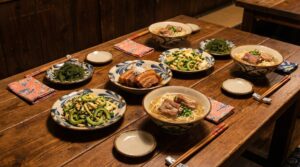
To truly understand the diverse culinary landscape that defines Osaka beyond its famous central districts, consider exploring the unique flavors found in Osaka’s Little Okinawa.
The Morning Roar: A Fish Market Without the Filters
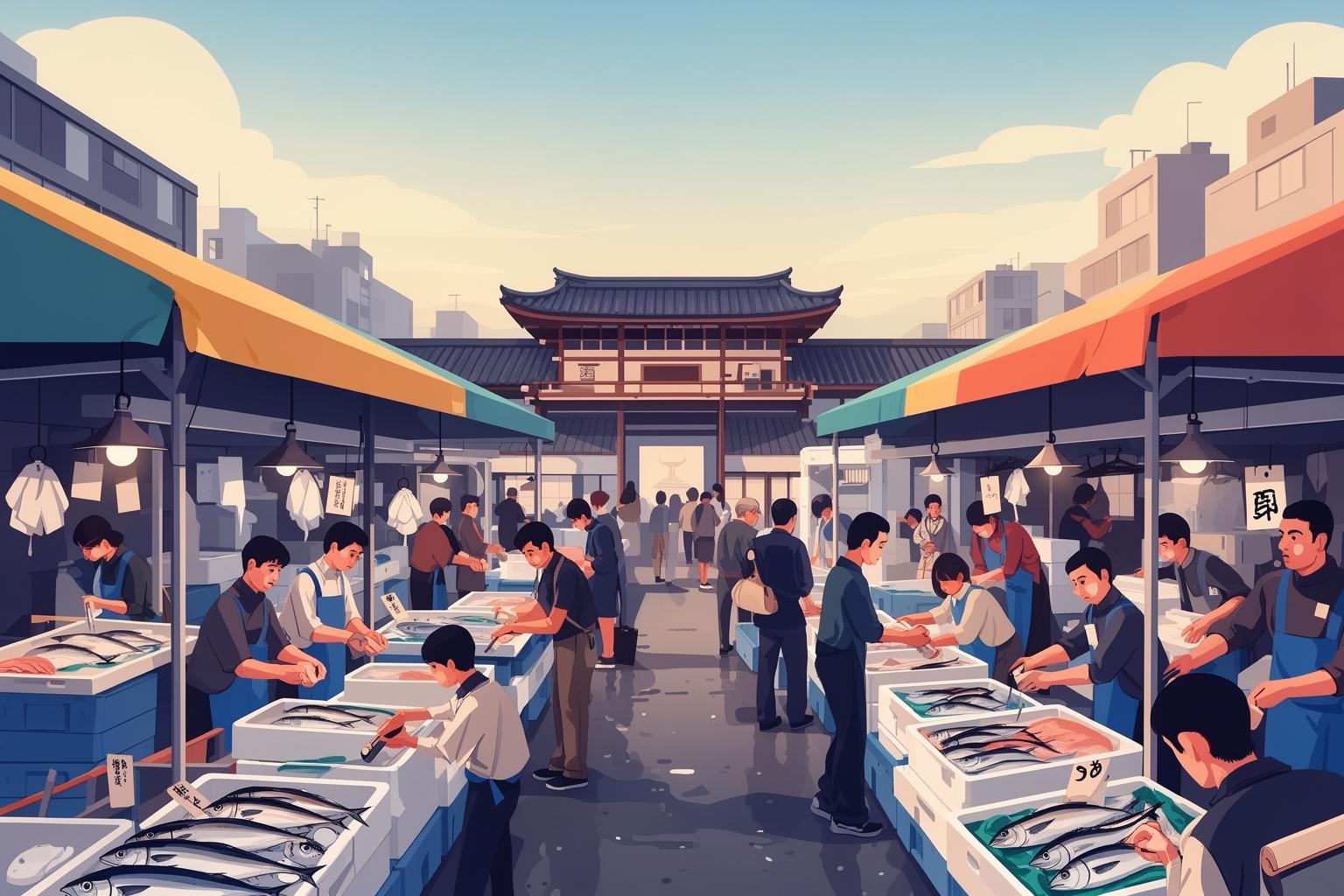
Before the sun has the chance to burn off the coastal haze, the real Osaka is already wide awake. You can sense it at the Tajiri Port Sunday Morning Market. Your first error would be to compare this to Kuromon Ichiba, the famed “Kitchen of Osaka” in Namba. Kuromon is a culinary spectacle. It’s clean, curated, and tailored for tourists. Scallops are grilled on the spot, fatty tuna is showcased like precious gems, and prices reflect the premium nature of the experience. It’s a fantastic food theme park, but it’s not where the city really gets its hands dirty.
Here at Tajiri, the experience is raw, not performative. The air is heavy with the metallic tang of the ocean, the sharp scent of diesel from the fishing boats, and the unmistakable aroma of raw, unapologetic fish. There are no polite sample sticks. No carefully arranged displays. Instead, styrofoam boxes are stacked high, bursting with the day’s catch—silver-skinned horse mackerel, glistening squid, fierce-looking scorpionfish, and octopuses whose limbs still twitch as if recalling the sea. This is a workplace above all else. The performance here isn’t for visitors; it’s the high-stakes ballet of commerce.
Watch the auction. It’s a whirlwind of motion and sound. A man with a weathered face and booming voice rattles off a rapid stream of rhythmic, guttural sounds—a language only the surrounding buyers understand. They don’t raise paddles; a subtle nod, a finger twitch, or a flick of an eye is enough to finalize a deal for hundreds of kilos of fish. This is Osaka’s shobai spirit in its purest form. It’s about speed, instinct, and a deep, unspoken trust built over years. There’s no room for hesitation or pleasantries. This isn’t the patient, deferential customer service of a Tokyo department store. This is a transaction stripped to its essence: product, price, and a swift, decisive agreement.
Interactions with vendors are just as direct. An elderly woman, her hands stained and wrinkled from a lifetime of handling fish, might scold you for standing in her way. But then, catching you eyeing a pile of prawns, she’ll silently drop a few extras into your bag after you’ve paid. This is omake—the little something extra, the bonus. It’s not a calculated marketing tactic. It’s a gesture that says, “I see you. You’re part of this world now.” Osaka friendliness isn’t about polite smiles; it’s about this practical, straightforward generosity. It’s a gruff acknowledgment of a shared reality, a world where everyone is simply trying to make a living. You don’t come here to be pampered; you come to witness the engine room of Osaka’s culinary life, and if you’re lucky, to leave with the freshest meal of your life and the lingering scent of the sea that stays with you all day.
The Language of the Coast: Speaking in Senshu-ben
As you travel through these port towns, from Izumisano to Kaizuka, you’ll notice the city’s sound shifts. The typical Osaka-ben, already quite distinct from Tokyo’s measured rhythm, gives way to something even more raw and powerful: Senshu-ben. To outsiders, it can come across as aggressive, almost confrontational. Sentences often end with a sharp, clipped tone, and the intonation is choppy and forceful. It’s a dialect shaped by the noise of fishing boats and factories, where subtlety is lost in the wind.
Foreigners often find the nuances of Japanese politeness—the delicate art of keigo (honorific language)—challenging. Senshu-ben largely tosses that rulebook aside. This is at the core of a common misconception about Osaka people. A Tokyoite might layer polite expressions to soften a request or refusal, emphasizing group harmony (wa) above all else. In Senshu, clarity is the priority. A fisherman won’t say, “It might be preferable if you considered another option.” Instead, he’ll meet your gaze and say, “Ah, sore akan. Kotchi ni shi.” (No, that one won’t do. Choose this one.)
Is it rude? Only if you equate politeness with indirectness. In the port context, this directness is a form of respect. It assumes you’re not fragile and in need of coddling. It treats you as an equal, capable of handling the unvarnished truth. The logic is straightforward: wasting time with ambiguity is inefficient and, in a sense, dishonest. This mindset permeates daily life. Ask for directions, and you won’t receive a vague gesture; instead, you’ll get a rapid-fire, precise series of instructions: “Go straight, turn at that signal, it’s the third building, the one with the blue roof. Understand?”
This verbal shorthand creates a unique intimacy. When formal language is stripped away, you reach the core of both the matter and the person much more quickly. It can be jarring at first. The absence of buffer words might feel like constant orders. But once you adjust, you find it liberating. You never have to guess what someone means. The communication is clear, efficient, and brutally honest. It reflects a mindset of, “Let’s not waste each other’s time with fluff. We have work to do, lives to live.” It’s a world of honne (true feelings) over tatemae (public facade), and in a country often impenetrable to outsiders, the striking clarity of Senshu-ben is a revelation.
Port Town Time: A Rhythm Set by Tides, Not Trains
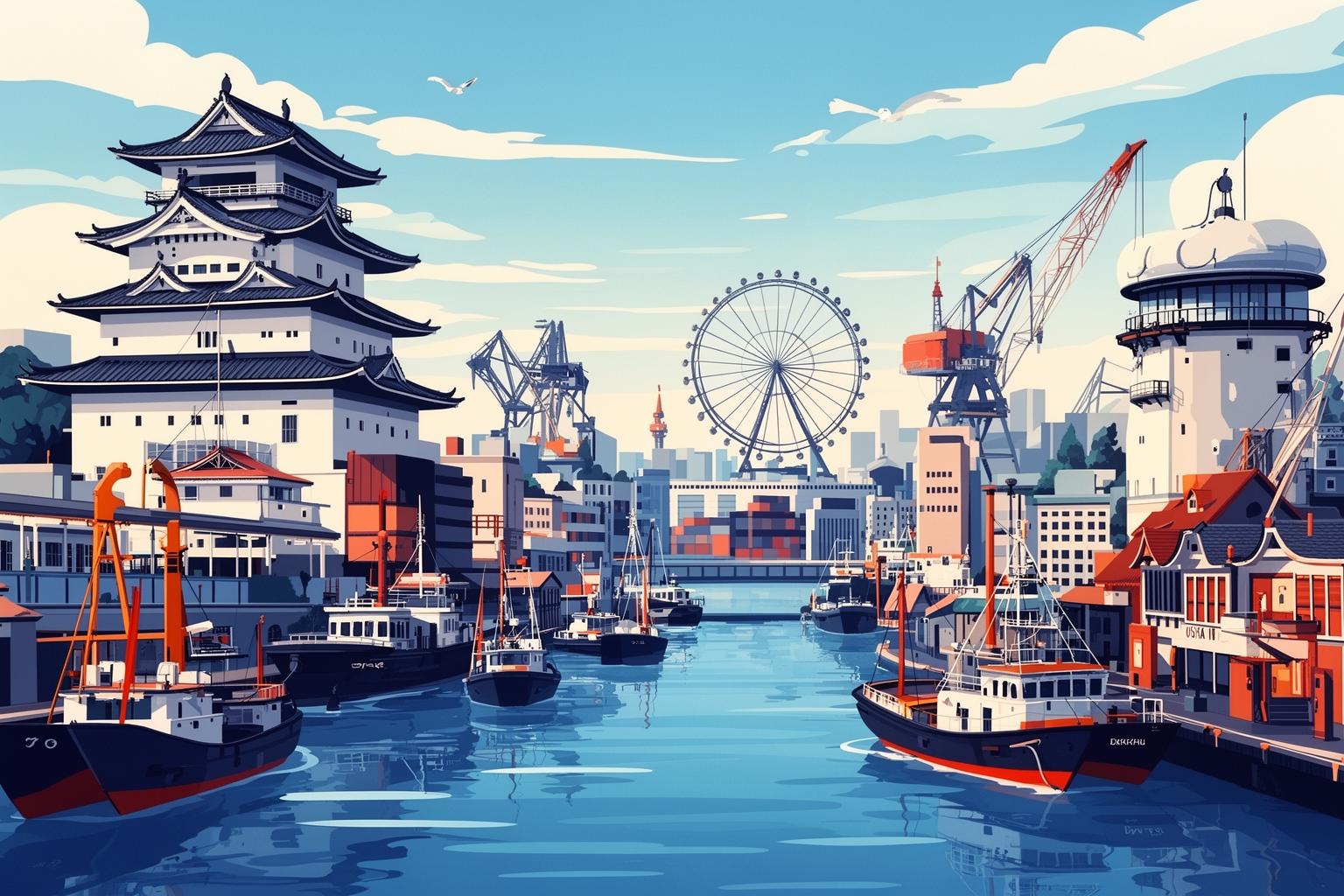
Central Osaka follows an unrelenting, unforgiving pace. The JR Loop Line and the Midosuji subway line act as veins, pumping life through the city at a breakneck speed. Every minute is meticulously accounted for. People walk quickly, eat hurriedly, and live by the ticking seconds of the clock. This is the rhythm that most residents, both foreign and Japanese, adopt. To be late is a grave offense. Efficiency is the supreme authority.
Yet, here on the Senshu coast, time flows differently. It expands and breathes. The prevailing rhythm isn’t the punctual arrival of the next Nankai Line express train; rather, it’s the timeless, unhurried cycle of the tides. After the morning rush of the fish market subsides, profound calm envelops the towns. The pace slows to a gentle stroll. Shopkeepers step out from their shops, not to rush after customers, but to sweep the sidewalks or converse with neighbors. Old fishermen sit on overturned crates, their hands moving with the slow, measured skill of decades as they repair their weathered, green nets. Their movements are deliberate and unhurried—a sharp contrast to the caffeinated bustle of the city center.
This highlights a fundamental duality in Osaka that many overlook. It is not a single, uniform entity. Rather, it is a vast mosaic of villages woven together into a metropolis. While the center thrums with global commerce, these coastal communities preserve a tempo from another time. A foreigner might see shuttered shops during the afternoon and mistake it for economic decline or lack of ambition. But that’s viewing it through a hyper-capitalist, city-focused lens. This isn’t laziness; it’s a different set of values. Life here isn’t about squeezing every commercial opportunity. It’s about balance. It’s about conserving energy for the pre-dawn work at the docks. It’s about making room for family, community, and simply sitting to watch the water.
Living in Osaka can feel like being on a constantly moving walkway, always needing to keep pace. A weekend in Senshu reminds you that there are other ways to exist within the same city boundaries. It resets your internal clock. You begin to notice the small details: the way the light shifts over the water, the distinct cry of the black kites circling the harbor, the slow emptying and filling of the streets. It’s a lesson in what daily life can be when it isn’t governed by a train timetable. It’s a reminder that beneath the surface of modern, fast-moving Osaka, there is a deeper, more natural rhythm, one that has been beating steadily for centuries.
Community as Currency: The Unspoken Seaside Network
In a megacity like Osaka or Tokyo, it’s easy to feel anonymous. You can live in a huge apartment complex and never learn your neighbors’ names. Privacy is the default. The social contract revolves around mutual, polite ignorance. That’s not how things work in the port towns of Senshu. Here, community isn’t just a vague, feel-good idea; it’s a concrete, essential part of everyday life. Anonymity simply isn’t an option.
Step into a small, family-run izakaya near the harbor in the evening. The air is thick with the scent of grilled fish and filled with boisterous laughter. Regulars sit at the counter while the owner, a woman with a sharp wit and a permanent apron, moves among them, pouring sake and exchanging jokes. She knows their orders without being asked. She knows whose son just passed his exams and whose boat is in need of repairs. This is more than a business; it’s a community hub, an exchange of information, and a social safety net all rolled into one.
Here, you come to understand the true nature of Osaka’s renowned friendliness. It’s not an indiscriminate, welcoming-arms-to-all-strangers attitude. It’s an invitation to be involved. If you’re a tourist passing through, you’ll receive professional courtesy. But if you’re a resident—a foreigner living down the street—the dynamic shifts. Your place in the community is earned through being present and participating. You buy your vegetables from the same grocer every few days. You get your morning coffee from the same tiny kissaten. You become a familiar face. Soon, gruff nods turn into brief greetings. Greetings evolve into short conversations. One day, the izakaya owner will ask you a personal question, and just like that, you’ve crossed a threshold. You’re no longer just a customer; you’re part of the local fabric.
This close-knit structure can feel intense to those used to urban anonymity. Everyone knows your business. Your comings and goings are noticed. But the trade-off is profound. This is a world where neighbors look out for each other, not out of obligation, but because their lives are genuinely connected. It’s a form of social currency more valuable than money. This deeply rooted communitarianism stands in stark contrast to the individualism typical of many Western cultures and even the more reserved, privacy-focused culture of Tokyo. In Senshu, you are not an island. You are a knot in a much larger net, and the strength of that net is what holds the community together.
The Danjiri Spirit: Pride, Passion, and Controlled Chaos
You can’t fully grasp the Senshu mindset without experiencing the Kishiwada Danjiri Matsuri. On the surface, it’s a festival. But in reality, it’s the soul of the region given form. Every September, teams of men from various neighborhoods pull massive, intricately carved wooden floats, or danjiri, at frightening speeds through narrow city streets. The most thrilling and dangerous move is the yarimawashi, a full-speed, 90-degree turn at an intersection that defies physics and common sense. Men stand atop the swaying floats, dancing and hopping, their lives dependent on the team’s skill below.
To outsiders, it looks like pure madness—reckless, dangerous, and chaotic. But this festival reveals the essence of the Senshu character. It is a vivid display of local pride. Your identity is tied to your neighborhood’s danjiri. Loyalty is absolute and lifelong. It demands teamwork pushed to its limits, requiring immense physical courage, split-second coordination, and total trust among comrades.
This “Danjiri spirit” is not confined to the festival alone. It permeates everyday life. It explains the fierce local pride and the slight chip on the shoulder Senshu people carry toward more cosmopolitan central Osakans. It clarifies their direct, no-nonsense approach to challenges. There’s no endless deliberation or committees; you confront the obstacle head-on and pull with all your strength. It accounts for the passionate, all-or-nothing approach to work and relationships. There is a raw, explosive energy here that is simultaneously intimidating and magnetic.
This contrasts deeply with the more restrained, orderly festivals seen elsewhere in Japan. The Danjiri is not about calm reverence; it’s about catharsis. It’s a celebration of strength, community, and a shared history of being a bit rough around the edges. It’s the physical expression of a people who have been self-reliant, carving out their existence from sea and land, and who take immense pride in managing anything—including a five-ton wooden float careening around a corner. This controlled chaos is the ultimate symbol of Senshu identity: passionate, powerful, and fiercely loyal to their own.
Leaving the Coast, Finding the Core
A weekend on Osaka’s southern coast leaves you with more than just photos of fishing boats and old temples. It gives you a new understanding of the city you call home. You return to the roaring traffic of the Hanshin Expressway and the crowded platforms of Namba Station, but you see them differently now. You realize that the city’s brash energy, famous entrepreneurial spirit, and candid humor are not just abstract cultural traits. They are extensions of the practical, hardworking, deeply communal spirit so evident in the port towns of Senshu.
This is the Osaka that doesn’t appear in travel brochures. It’s not sleek or polished. It can be gruff and intimidating. It won’t bend over backward to make you feel comfortable. But it will show you something authentic. It reveals a city still profoundly connected to its roots as a place of merchants, artisans, and fishermen. A trip to the Senshu coast is an essential lesson for any foreigner trying to understand this place. It teaches you that to truly know Osaka, you have to look beyond the neon glow. You must listen for the quieter, saltier rhythms. You must understand that the heart of this city isn’t in a skyscraper in Umeda, but in the calloused hands of a fisherman, the sharp tongue of a market vendor, and the unwavering pride of a community that knows exactly who it is.