
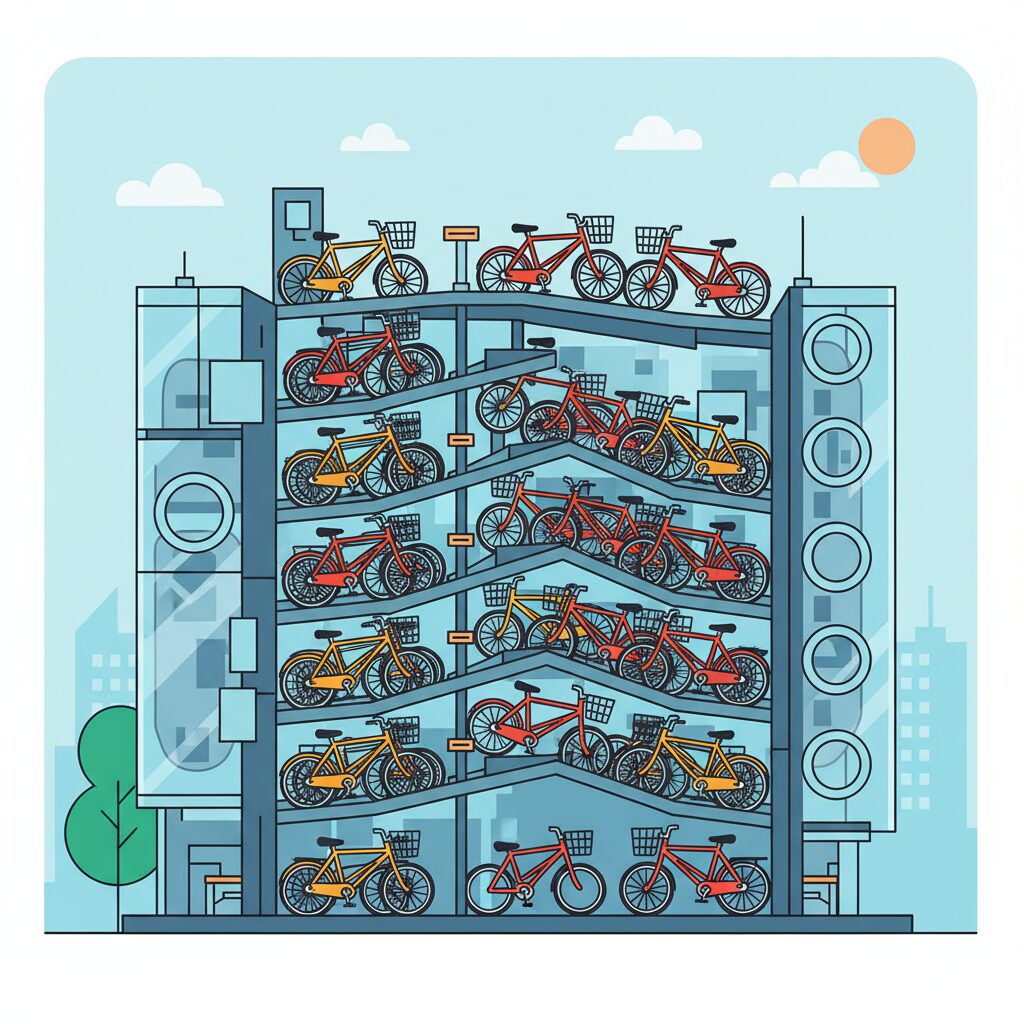
Step off the train in Osaka, at almost any station outside the gleaming commercial core of Umeda or Namba, and you are immediately confronted by a magnificent, sprawling chaos: the bicycle sea. It crashes against the station walls, floods into designated lots, and spills onto side streets in shimmering waves of steel and rubber. For the newcomer, especially one accustomed to the meticulously curated order of Tokyo, the sight can be bewildering. It appears messy, a bit haphazard, and fundamentally informal. There are no sleek, subterranean automated vaults whisking your bicycle into the earth, no silent, antiseptic rows governed by tapping a transit card. Instead, you find vast, open-air lots, often little more than fenced-off parcels of land, staffed by elderly men in simple uniforms who collect coins and hand out small, numbered plastic tags. The initial impression is one of charming, perhaps inefficient, antiquity. But to dismiss this system as merely old-fashioned is to miss the point entirely. This sprawling, human-powered network of bicycle parking is not a relic; it is a living, breathing testament to Osaka’s core philosophies of pragmatism, community economics, and a deeply ingrained financial savvy that shapes the daily life of its residents. It is, in fact, one of the city’s most effective, if unglamorous, social and economic engines, providing a hidden subsidy that makes life in this metropolis significantly more affordable. To understand this system is to begin to understand the very rhythm of Osaka itself.
This pragmatic approach to daily life, which extends far beyond just parking, is a key part of the broader economic boom in Kansai that is reshaping the region.
The Aesthetics of Pragmatism: Deciphering the Bicycle Sea
Step into one of these parking areas, perhaps near a lively residential center like Tennoji or Kyobashi, and the sensory experience hits you immediately. You behold a dense thicket of handlebars and frames. There are the ever-present mamachari, or “mommy bikes,” equipped with child seats and baskets, dependable workhorses of everyday family life. Beside them sit rusted, single-speed relics that seem to have been in use since the Shōwa era, parked next to the occasional sleek, modern road bike. The air resonates with the metallic click of kickstands and the soft clatter of bicycle chains. Overseeing this domain is the oji-san, the elderly attendant, who rests in a small, weathered shed, a simple cash box before him. The transaction is delightfully analog. You hand over a 150-yen coin, and he hands you a small, worn token attached by a loop of elastic, which you then fasten to your handlebars or key ring. There is no machine, no digital interface, no beep of a card reader. It is a moment of direct human connection, a quiet, repetitive ritual performed thousands of times daily throughout the city.
This system is not born from a rejection of technology. Rather, it is a deliberate choice, rooted in a deeply Osakan form of pragmatism. The management of these lots is often overseen by the Silver Jinzai Center (Silver Human Resources Center), a nationwide network of community organizations offering part-time jobs to senior citizens. In Osaka, this network is especially strong and visible. The city identifies one problem—seniors needing supplemental income and a sense of purpose—and another—commuters requiring affordable, accessible bicycle parking—and combines them into a single, elegant solution. The result is a system that values function over form and community benefit over corporate efficiency. While Tokyo might invest millions in a high-tech, space-saving automated garage that presents a sleek, orderly face to the public, Osaka simply fences off a patch of unused land, hires local retirees to manage it, and addresses the issue at a fraction of the cost. The aesthetic is not sleek modernism but lived-in practicality. It conveys a clear message: we will not spend money on what isn’t necessary, and we will find a way to make the solution serve the community directly.
The Economics of Community: A Deep Dive into the 150-Yen Transaction
That 150-yen coin carries far more weight than its face value implies. It acts as the key that unlocks a chain of savings, deeply affecting where and how people can afford to live. Take, for example, the daily commuter’s calculation. A monthly pass for one of these spots usually costs between 2,000 and 3,000 yen. This small expense makes the “last mile” trip—the distance between the train station and home—easily affordable. In Tokyo, where property near stations is prohibitively expensive and hyper-local bike parking can be costlier or scarce, there is intense pressure to live within a short walking distance to the station. This convenience commands a high premium, reflected in some of the world’s highest rental prices.
Osaka’s system breaks free from this limitation. Residents can comfortably rent apartments a ten- or fifteen-minute bike ride from their preferred station. This wider radius offers a large selection of more affordable housing in quieter, roomier neighborhoods. The financial impact is significant. The savings on rent by living slightly further from the station can easily total tens of thousands of yen each month. Deduct the modest 2,500 yen for the bike pass, and a family’s net savings can reach or exceed 100,000 yen annually. This is not just a minor lifestyle benefit; it forms a core pillar of household finances in the city.
This method reflects the Osaka mindset, which outsiders often misinterpret. Locals are sometimes stereotyped as kechi, or stingy. Yet a better description is shimarisu, meaning resourceful, thrifty, and economically savvy. Kechi means simply refusing to spend; shimarisu means finding the smartest way to spend, extracting maximum value at every step. The community-run bike lot is a perfect example of shimarisu. You’re not just saving money for yourself; your 150 yen supports the wages of a local senior, who likely spends that income at nearby shops. It is a closed-loop system of practical, grassroots economic stimulus. An Osakan doesn’t see a rundown bike lot; they see a clever, efficient system that lowers living costs while supporting neighbors. It’s a daily endorsement of a community-first economic model over an impersonal corporate one.
A System Built on Trust and Unspoken Rules
For such a seemingly low-tech system to work on this scale, it relies on a powerful, invisible currency: social trust. Security at these lots is minimal—a simple fence or perhaps a chain across the entrance at night. Yet, bicycle thefts from these managed lots are not as widespread as one might expect. This is partly due to the constant presence of attendants who serve as a natural deterrent, but it also arises from a shared understanding among users. The system feels personal, and that personalization fosters a collective sense of responsibility.
The attendants, the oji-san, often build a familiar rapport with daily commuters. They recognize faces, bicycles, and routines. If you forget your claim ticket, a frantic search is rarely necessary. More often, a nod of recognition suffices. There is an inherent flexibility that machines could never match. This human element extends to the physical management of the space. During the morning rush, the attendant might direct you to a specific spot or even take your bike to park it himself, expertly playing a game of Tetris to maximize capacity. He may later move your bike to accommodate another, and no one complains. This is one of the unspoken rules: you accept some degree of organized chaos in exchange for speed, low cost, and convenience. You trust the attendant to manage the space efficiently and treat your property with basic respect.
This sharply contrasts with the rigid, anonymous systems common in Tokyo. There, you interact with a machine. If your transit card has an error, if you lose your payment slip, or if the automated rack malfunctions, you are at the mercy of a faceless corporation, waiting on a call to a remote service center. The process is governed by explicit, inflexible rules. In Osaka, the rules are more fluid and navigated through human interaction. A foreigner might initially be surprised by an attendant gesturing brusquely or even shouting instructions. This isn’t aggression; it’s the sound of a human-powered system running at peak efficiency. It is the language of a community in motion, a shared dance of practiced routines that everyone understands.
The Hyper-Local Ecosystem: Beyond the Parking Lot
These bicycle parking lots are not isolated structures; they serve as essential hubs—key arteries linking the regional train network to the intimately connected neighborhood ecosystem. They are almost always strategically positioned at the entrance of a shotengai, the traditional covered shopping arcades that form the lifeblood of many Osaka neighborhoods. Consequently, the daily commute is far from a mere A-to-B trip; it is a multi-stage ritual deeply woven into the fabric of everyday life.
Picture the evening routine of a typical Osaka resident: they exit the train station, retrieve their bicycle from the lot for 150 yen, and instead of heading straight home, they slowly ride through the nearby shotengai. They stop by the local butcher for some mince, the greengrocer for vegetables, and perhaps pick up a hot korokke (croquette) from a street vendor as a snack. Their bicycle basket, a staple on the mamachari, serves as their shopping cart. This smooth blend of commuting and shopping sustains these small, independent businesses. Low-cost bike parking effectively acts as a subsidy for the entire local economy, promoting a lifestyle centered on the precinct, where everyday needs are fulfilled within a few hundred meters of the station.
This helps clarify why many Osaka neighborhoods feel so self-contained and maintain such a strong, distinctive identity. They function almost like urban villages, with the station-front area—anchored by the bike lot and the shotengai—serving as the village square, where commerce, transit, and community life converge. This stands in stark contrast to many modern urban developments, where high-speed transit moves people swiftly between sterile residential zones and massive commercial centers, bypassing the small-scale community layer altogether. Osaka’s model, enabled by the modest bicycle, keeps life grounded, local, and interconnected.
What This Teaches Us About Osaka
Ultimately, the modest, community-managed bicycle lot stands as a powerful metaphor for the city of Osaka itself. It represents a microcosm of the civic and social values that distinguish this city from its eastern rival, Tokyo, and indeed from many other global megacities. Observing this system in action offers insight into the core principles of the Osakan worldview.
First is the victory of pragmatism over polish. Osaka is a city built by merchants, and the merchant ethos permeates everything: is it practical? Is it cost-effective? Does it offer good value? An expensive, visually appealing solution that fails to provide significant functional improvement over a simpler, cheaper alternative is regarded not as sophisticated, but as foolish. Why build a palace when a sturdy warehouse suffices? This philosophy is evident in the chain-link fences and hand-painted signs of the city’s bike lots.
Second is a strong preference for human-scale solutions. While Tokyo often relies on large corporations and centralized government for top-down, standardized answers, Osaka places its trust in local communities to address their own challenges. The Silver Jinzai Center’s management of the parking is a perfect example—a decentralized, grassroots approach that is more flexible, more resilient, and more socially beneficial than a monolithic corporate contract. It reflects a belief that the best systems are those that prioritize people over machines.
Finally, it reveals a distinct interpretation of modernity. Osaka is not a city trapped in the past, but a dynamic, forward-looking metropolis. However, its vision of the future does not necessarily involve seamless automation and frictionless anonymity. Instead, Osaka embraces a modernity that values social cohesion, mutual support, and economic practicality. It recognizes that a truly advanced city is not simply one with gleaming infrastructure, but one where the cost of living remains manageable, where seniors find purpose, and where local communities flourish. The inexpensive, chaotic, and wonderfully human bicycle parking lot is not a sign that Osaka is behind the times; it is a sign that it is confidently and wisely forging its own path.








