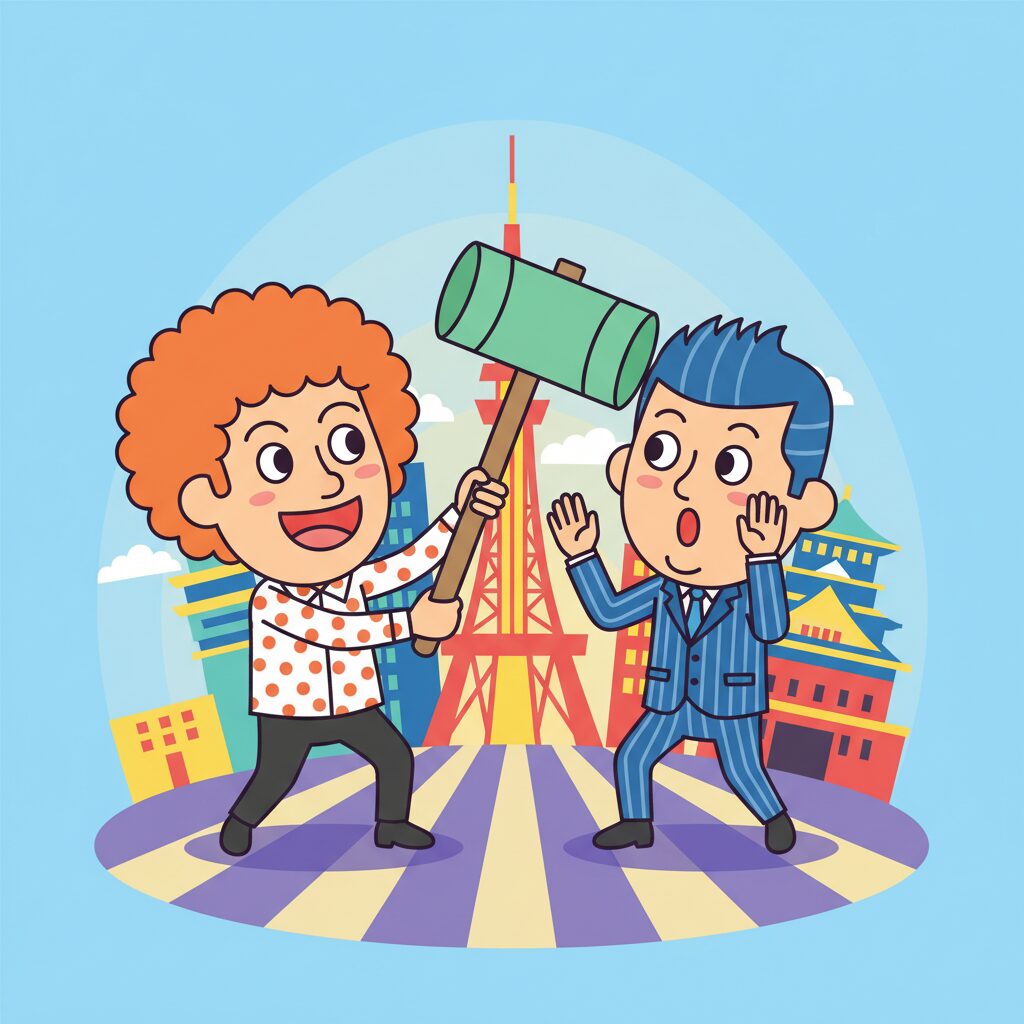
Ever been in a conversation in Osaka and felt like you missed a beat? One moment you’re chatting, the next your friend is dramatically pointing out a tiny flaw in your story, or a shopkeeper is heckling you with a grin. It’s fast, it’s sharp, and if you’re not used to it, it can feel like a mild, confusing attack. You might be wondering, “Are they making fun of me? Is this an argument?” Relax. You’ve just had your first real encounter with tsukkomi, the backbone of daily communication in Osaka. This isn’t about comedy routines or stage performances; this is the real, unfiltered rhythm of life in Kansai. It’s a linguistic and cultural signature that sets this city apart from the more reserved cadence of Tokyo and the rest of Japan. Forget what you think you know about polite, indirect Japanese conversation. Here in Osaka, the rules are different. The game is faster, the connections are forged in playful jabs, and the silence you might mistake for politeness elsewhere is often seen as a lack of interest. To truly understand and thrive in Osaka, you need to understand the art of the retort. This guide is your key to unlocking that code, to see tsukkomi not as conflict, but as the ultimate sign of acceptance and affection in Japan’s most vibrant city.
To truly immerse yourself in the daily rhythm of Osaka, consider how its unique social interactions extend into its spaces, like the dynamic environments found in Osaka’s traditional kissaten and modern coworking spaces in the shotengai.
What is Tsukkomi, Really? Beyond the Slapstick
On the surface, tsukkomi appears straightforward. It’s the “straight man” role in a comedy duo, responsible for correcting the silly “funny man,” or boke. You’ve likely seen it on TV: the boke makes a ridiculous remark, and the tsukkomi answers with a sharp, clever comeback, sometimes adding a playful tap with a paper fan. But in everyday Osaka, this dynamic drops its theatrical guise and becomes an essential tool for social interaction. It’s a verbal dance, a fast-paced game of catch where one person throws out a silly comment (boke), fully expecting—and wanting—the other to slam it back with a quick tsukkomi.
The Basic Mechanics: Boke and Tsukkomi
Let’s break down the parts. The boke sets things up. It’s an intentional, often subtle absurdity—maybe a slight exaggeration, a nonsensical remark, or a comically incorrect observation. For instance, pointing at a tiny, fluffy poodle and saying, “Wow, that’s a terrifying lion.” The one playing the boke creates a small, deliberate crack in normal conversation, inviting a response. The tsukkomi is the corrective force—the punchline that restores order by highlighting the absurdity. But it’s not a dry, literal correction like, “No, that’s a canis lupus familiaris.” That would kill the vibe. The skill of the tsukkomi is to match the boke’s energy and amplify the humor. A fitting tsukkomi for the poodle-lion comment might be, “A lion? Better run before it licks you to death!” or the classic, all-purpose, “Nande ya nen!” (“Why?!” or “What the heck?!”). The retort acknowledges the joke, validates it through reaction, and closes the comedic circle. It’s a collaborative effort to create a shared moment of fun.
It’s Not an Argument, It’s a Dance
This is crucial for foreigners to grasp. In many Western cultures, directly pointing out someone’s mistake or interrupting can come across as rude, aggressive, or condescending. We’re often taught to agree, soften disagreements, and overlook small errors to maintain social harmony. In Osaka, the opposite holds. A well-timed tsukkomi signals engagement. It says, “I’m listening so closely that I caught your joke, and I care enough to join in.” The worst response to a boke is silence or a noncommittal nod. That’s the real insult. It signals disinterest, a failure to connect, or being too formal and distant to play along. The boke’s conversational offering is left hanging. An Osakan would prefer a sharp, witty tsukkomi over polite but empty agreement. This style is a constant give-and-take, a rhythmic exchange that builds energy and rapport. It’s less like a debate and more like jazz improvisation. One plays a riff (boke), and you respond immediately with a complementary one (tsukkomi), creating something richer than if you both just played the melody straight.
Tsukkomi in the Wild: Everyday Examples
This might sound somewhat abstract, so let’s anchor it in the real, everyday situations you will inevitably encounter while living in Osaka. You’ll see this dynamic everywhere, from the lively shotengai shopping arcades to quiet neighborhood chats. It’s the city’s unofficial language.
At the Supermarket Checkout
You’re at the register in a local supermarket in Tenma, with a basket full of groceries. As the cashier scans your items, you realize your reusable bag is still folded at the bottom, and you start fumbling to open it. The cashier, a middle-aged woman with a constant sparkle in her eye, pauses scanning, looks at you, and says with a perfectly straight face, “Planning to stay the night? No rush, take your time.” This is a classic, gentle boke. She’s not actually irritated; she’s creating an opening for a little human interaction. A typical Tokyo reaction might be a flustered apology: “Sumimasen!” But here, you’re invited to join the play. The perfect tsukkomi would be to look up, laugh, and respond with something like, “Might as well, looks comfy back there!” or the simple, effective “Nande ya nen!” with a grin. Instantly, the tension disappears. You’re no longer just a customer but a fellow participant in life’s daily comedy. You share a laugh, and the exchange feels less like a transactional chore and more like a moment of connection.
Ordering at an Izakaya
Picture yourself out with friends at a noisy izakaya in Namba. Everyone’s ordered their drinks, but one friend is still staring intently at the food menu, lost in thoughts of yakitori and karaage. Five minutes go by. In many places, friends might wait patiently or gently ask, “Have you decided?” In Osaka, this waiting is an opportunity. A friend leans over and delivers a tsukkomi: “Trying to order everything on the menu? Just point at something before the chef retires!” or “Did you forget how to read? Want us to get you the picture book version?” It sounds harsh on paper, but delivery is key. It’s said with laughter, with warmth. It’s a loving nudge, saying, “We’re all in this together, and your indecision is part of the fun.” The friend being teased is expected to laugh and either fire back a witty reply (“I have to make a strategic decision!”) or finally place their order. The tsukkomi breaks the stalemate and brings everyone back into the group’s shared rhythm.
Casual Conversations in Your Neighborhood
Imagine living in a quiet neighborhood like Showa-cho. You’re chatting over the fence with your neighbor, Tanaka-san, mentioning that you spent the weekend hiking Mt. Ikoma. Trying to join the local culture, you throw out a little boke yourself: “Yeah, it was so easy I barely broke a sweat. I think I’ll try Everest next week.” Without missing a beat, Tanaka-san sizes you up and delivers the tsukkomi: “Everest? You were complaining about carrying groceries up the stairs yesterday! Maybe climb your apartment stairs five times first, then we’ll talk about mountains.” This isn’t an insult but a sign of affection. It shows Tanaka-san listens, recalls previous conversations (like your groans about stairs), and feels comfortable teasing you. It’s an intimacy that goes beyond polite small talk—you’ve successfully engaged in the local language of friendship.
Why Osaka? The Cultural Roots of Tsukkomi
This distinctive conversational style is no coincidence. It is deeply embedded in the city’s history and identity, shaped over centuries by a culture that prized speed, wit, and direct human connection rather than formal, hierarchical communication.
The Merchant City Mentality
For much of its history, Tokyo (then Edo) was the city of samurai and government—a place defined by strict social hierarchies, formality, and protocol. Osaka, by contrast, was Japan’s kitchen, the bustling commercial center where merchants (shonin) held sway. In the merchant world, time equates to money. Establishing rapport quickly with a customer was crucial to closing a sale. There was no time for lengthy, polite, indirect conversations. You had to break the ice, make a connection, and get down to business swiftly. Humor served as an ideal tool. A quick, clever exchange, a playful boke paired with a sharp tsukkomi, could forge a friendly bond in seconds. It demonstrated cleverness, approachability, and shared understanding. This fast-paced, pragmatic, and highly social mode of communication became deeply ingrained in the city’s character. It functions as conversational efficiency—a social lubricant that instantly bridges the gap between people.
Tokyo vs. Osaka: The Conversational Divide
The difference with Tokyo is striking and offers insight into Japan’s internal diversity. Tokyo communication often emphasizes wa (和), or group harmony. The aim is to keep interactions smooth and frictionless. This is achieved through kuuki wo yomu (空気を読む), or “reading the air”—sensing the group’s mood and unspoken needs, then adapting accordingly. Direct contradictions tend to be avoided, and opinions are expressed gently. In Osaka, the style is different. People are more inclined to kuuki wo tsukuru (空気を作る), or “create the air.” The purpose is not only to sustain harmony but to generate energy, or nori (ノリ). Nori represents the shared rhythm and vibe of a conversation, with tsukkomi acting as its driving force. By engaging actively—even through playful challenges—you contribute to the group’s energy. What might be perceived as disrupting wa in Tokyo is considered energizing nori in Osaka. This distinction often causes misunderstandings. A foreigner used to Tokyo’s style may find Osakans brusque, while an Osakan might regard Tokyo’s manner as cold, distant, or dull.
How to Navigate (and Maybe Even Participate in) Tsukkomi Culture
So, you’re living in Osaka, surrounded by this rapid-fire verbal exchange. How do you join in? The good news is, nobody expects you to become a comedy expert overnight. But picking up a few basic moves can greatly enhance your social life and help you feel more at ease.
You Don’t Have to Be a Comedian
First, relax. You’re not expected to deliver perfect, side-splitting comebacks. The key is simply to show you understand the game at play. The ultimate beginner’s phrase is “Nande ya nen!” (なんでやねん!). It’s your all-purpose tsukkomi tool. Someone tells you an outrageous story? “Nande ya nen!” A shopkeeper suggests a winter coat in August? “Nande ya nen!” Your friend boasts they can eat 50 takoyaki? “Nande ya nen!” The secret lies in the delivery. It should be quick, slightly incredulous, and always accompanied by a smile or laugh. It signals, “I get it, and I’m playing along.” Often, that’s all that’s needed to close the loop.
Reading the Room: When to Tsukkomi and When Not To
As with any cultural nuance, context is everything. Tsukkomi is for casual, relaxed occasions. It’s ideal for playful banter with friends, friendly shopkeepers, close colleagues, or staff at your local izakaya. However, avoid using it in formal or serious situations. Don’t use tsukkomi during high-stakes business negotiations, genuine apologies, solemn ceremonies, or sensitive discussions. The cue to watch for is the boke. If someone speaks with a playful tone, a sparkle in their eye, or a slight smile, they’re inviting you to join the game. If they remain serious and formal, it’s best to stick to polite, standard Japanese. It’s a dance—you just need to learn how to hear the music.
The Art of Receiving a Tsukkomi
Arguably more important than knowing how to give a tsukkomi is learning how to receive one. If someone throws a tsukkomi your way, congratulations. It’s a great sign—they’re comfortable with you and see you not as a fragile outsider (gaijin), but as an insider who can take friendly teasing. The worst response is to take it literally and get defensive. If you say, “I’m so tired; I ran 5 kilometers today,” and your friend replies, “Only 5k? I thought you were training for a marathon!” don’t counter with, “Well, actually, 5k is a respectable morning run…” That just kills the vibe. Instead, laugh it off. Play along. Say, “Yeah, a marathon of napping!” or simply chuckle and say, “Urusai!” (“You’re noisy!” or “Be quiet!”—a common playful comeback). By accepting the tsukkomi with humor and grace, you show you understand the unspoken rules and signal you’re part of the club.
The Takeaway: Tsukkomi as a Sign of Affection
When you peel back the layers of slang and comedic timing, tsukkomi is essentially about one thing: connection. It serves as the audible, interactive proof that someone is truly paying attention to you. In a world dominated by passive scrolling and polite yet distant interactions, the tsukkomi is a burst of genuine, unfiltered engagement. It’s a verbal tap on the shoulder that says, “I’m here with you,” “I hear what you’re saying,” and “We’re sharing this moment.” It’s what turns a simple exchange into a memorable interaction and an acquaintance into a friend. So next time a butcher in Kuromon Market teases you about your shaky Japanese, or your friend in Kyobashi points out your shirt is on backwards, don’t shy away. Smile, laugh, and maybe even try a tentative “Nande ya nen!” of your own. You’re not just uttering words; you’re speaking the language of Osaka, tapping into the city’s lively, warm, and wonderfully human heartbeat.