So you’ve done it. You’ve squeezed through the Shinsaibashi crowds, you’ve posed with the Glico Man, you’ve eaten takoyaki until you swore you’d never touch octopus again. You’ve experienced the Osaka that blasts its way into travel blogs and guidebooks—a city of neon, noise, and non-stop energy. And maybe, just maybe, you’re standing in your apartment, listening to the distant wail of a siren, and wondering, “Is this all there is? Is this where people actually live their lives?” It’s a fair question. The image of Osaka sold to the world is a caricature, a brilliant and exciting one, but a caricature nonetheless. It’s the city’s public face, its performance. But to understand Osaka’s heart, you have to find its lungs. And in this sprawling metropolis, the lungs are the vast, green, and unapologetically functional parks that line the Yodogawa River.
For many who move here, especially from the meticulously curated urban landscapes of Tokyo, the Yodogawa is a revelation. It’s not a manicured garden. It’s not a polished waterfront promenade designed for tourists. It is a sprawling, semi-wild, and intensely practical ribbon of green that slices the city in two. It’s where Osaka comes to breathe, to unwind, and, without even trying, to reveal its true character. Forget the tour buses and the shopping arcades. If you want to understand the rhythm of daily life here, the unspoken rules of its people, and why Osaka feels so fundamentally different from the rest of Japan, you need a bicycle, a weekend, and a willingness to just pedal. This is a guide to that journey—a ride not to a destination, but into the soul of a city that lives and breathes along its river.
Beyond the energized urban pulse and scenic parklands, you might find that exploring a local sentō retreat offers the perfect counterbalance to Osaka’s dynamic rhythm.
Day One: Downstream, Where the City Exhales
Setting Off into the Open Void
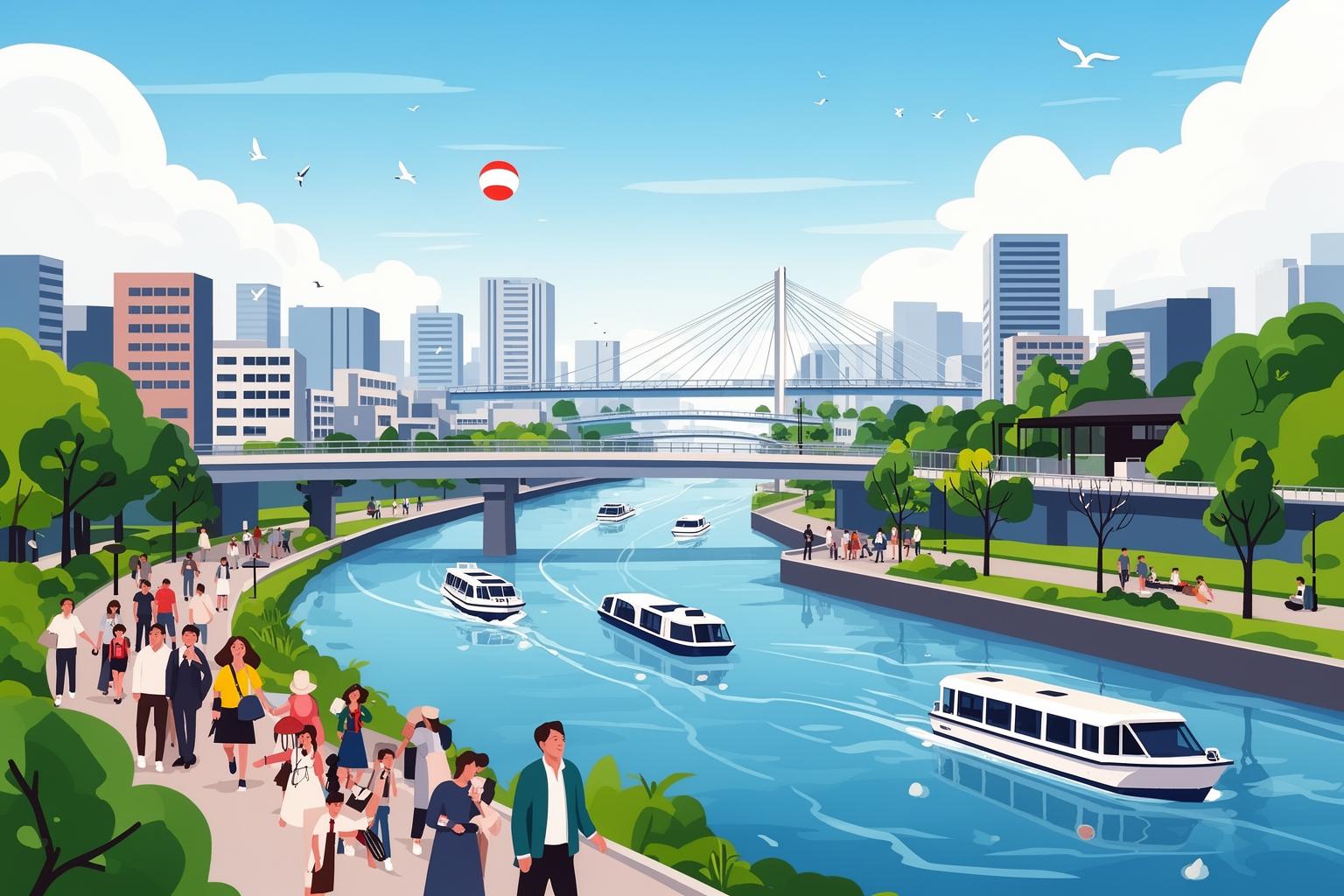
Your journey starts near the bustling urban heart, perhaps under the shadow of the Umeda Sky Building. You weave through a few crowded streets, cross a bridge edged by grumbling traffic, and then—it happens. The city slips away. The concrete maze gives way to an immense, almost startling expanse of green floodplain, muddy water, and an endless sky. This marks your first introduction to Osaka’s mindset: a deep need for and appreciation of open space. In a city built on reclaimed land, characterized by tight-knit neighborhoods and narrow shotengai, this river path acts as a pressure-release valve. It’s not delicate or ornamental like a traditional Japanese garden. It’s vast and utilitarian. The levees stand tall and grassy, designed to hold back floods. The paths are broad and paved, meant for cyclists, runners, and commuters. This isn’t nature as decoration; it’s nature as function, and Osakans engage with it comfortably and casually.
As you pedal westward toward Osaka Bay, the sounds of the city change. The sharp honks and electronic chimes of crosswalks fade into a muted, distant hum. In their place rises the soundscape of local life at leisure. You catch the rhythmic thwack of a baseball bat, followed by an encouraging shout from a middle-aged coach. You hear the soft whir of your tires on asphalt. Nearby, a group of mothers chat animatedly as they watch their toddlers wobble through the grass. High above, a Hankyu train, clad in its signature maroon, rumbles over a steel bridge—a steady, reassuring reminder of the city’s circulatory system. This is the soundtrack of a typical Osaka weekend: a symphony of small, personal moments unfolding simultaneously, in a shared public space that feels like a collective backyard.
The Unspoken Rules of Shared Space
One immediate observation, sharply contrasting with Tokyo, is how people inhabit this space. In a Tokyo park like Yoyogi, there is a performative aspect to leisure. Groups arrange themselves neatly on tarps, and their activities—whether dancing or playing instruments—feel like public rehearsals. There is a consciousness of being seen. Here on the Yodogawa, that awareness is replaced by a profound sense of what the Japanese call “my pace.” An elderly man sits alone on a folding chair, neither fishing nor reading, just gazing at the slow-moving water for hours. A family has set up a small, smoky barbecue, technically forbidden, yet no one objects. A group of teenagers idly kick a soccer ball, their conversation taking precedence over the game itself. No one is trying to impress anyone.
This exemplifies the Osakan approach to public life: pragmatic individualism within the collective. The unspoken rule isn’t about maintaining perfect harmony. It’s simply about not disturbing those around you. As long as you aren’t causing a major disruption, you’re free to do your own thing. Outsiders might mistake this as rough or unrefined. Why hasn’t that family cleaned up their barbecue smoke? Why does that man occupy so much space with his fishing gear? In Osaka, public space is for all, in all its messy, imperfect glory. It is a subtle but vital distinction. In Tokyo, group harmony often governs individual behavior. In Osaka, individual freedom is allowed as long as it doesn’t fracture the group. This creates a profound sense of ease. There is no pressure to perform leisure correctly. You simply exist.
A Brief Encounter and the Art of “Osekkai”
You pause for a break under a bridge, seeking refuge from the surprisingly strong sun. A man in his late sixties, with a weathered face and wearing the ubiquitous Hanshin Tigers cap, is carefully setting up a complex arrangement of fishing rods. You nod politely. In Tokyo, that interaction would likely end there—an acknowledgment followed by a retreat to personal space. But here, the man looks up, squints at your bike, and asks in a thick Kansai dialect, “Going far?”
This moment introduces you to one of Osaka’s most misunderstood yet essential traits: osekkai. Often translated as “meddlesome” or “nosy,” it can initially feel intrusive to those used to privacy. But osekkai is better understood as unsolicited care. It’s a form of connection that bypasses formal niceties and goes straight to the point. Before long, the fisherman tells you that you’re heading the wrong way for the best sunset view, that the path soon gets bumpy, and that you should’ve brought a bigger water bottle. He’s not being rude but straightforwardly helpful. He sees a person, assesses the situation practically, and offers advice—no subtext.
This is the core of Osaka’s renowned friendliness. It’s not the polished, customer-service smile of a Tokyo department store clerk. Rather, it’s practical, grassroots friendliness rooted in shared humanity. People will chat with you at the bus stop, comment on your groceries at checkout, or offer candy on the train. This style of communication comes from a merchant culture where quick, direct, and sincere interactions were everyday currency. The fisherman isn’t trying to be your best friend—he’s just part of the low-level hum of community life that keeps the city moving. After about ten minutes, mostly spent listening, he turns back to his fishing rods, the encounter as brief as it was genuine. You leave feeling not intruded upon, but somehow truly seen.
Day Two: Upstream, Through the City’s Backyard
Where Public Park Meets Private Life
On your second day, you begin further east, perhaps near Moriguchi or Hirakata, and choose to cycle upstream, heading toward the mountains that cradle Kyoto. Immediately, the character of the river park shifts. The expansive, open fields of the lower reaches give way to a narrower, more intimate path. The cycling trail now runs closer to the residential neighborhoods lining the levee. Here, you observe another essential aspect of Osaka life: the porous boundary between public and private space.
The path meanders past the backyards of houses. Laundry hangs from balconies—a lively but disorganized mix of towels, shirts, and even the occasional fish drying in the sun. The savory scent of dashi and soy sauce drifts as someone prepares lunch. In one area, official park land blurs into small, unofficial vegetable patches where elderly residents tend to their daikon and green onions. A fence exists, but it feels more like a suggestion than a true barrier. This contrasts sharply with the Kanto region, where private property lines are often clearly, sometimes aggressively, marked by high walls and hedges.
This physical blurring mirrors a mindset. In Osaka, there’s a sense that life spills beyond boundaries. It’s not confined within the four walls of your home. Your life and your neighbors’ lives all form part of the same lively, intricate tapestry. You might spot a man in pajamas and sandals walking his dog or overhear a couple having a loud, passionate argument through an open window. Rather than being seen as an embarrassing privacy breach, it’s simply life. This contributes to the feeling that Osaka is more “human” or “grounded” than Tokyo. The city isn’t afraid to reveal its messy, domestic side. It lives openly, and the river path perfectly showcases this tendency.
The Pragmatic Soul of a Merchant City
As you ride on, the infrastructure catches your eye. Massive concrete floodgates stand ready to close off smaller tributaries. The levee itself is a monumental engineering achievement. The bridges are sturdy, utilitarian structures of steel and concrete, not refined architectural statements. This is Yodogawa’s true role. It’s not just a park; it’s a vital flood control system protecting millions of residents. This reflects the practical, no-nonsense spirit of Osaka.
Osaka has always been a city of merchants, engineers, and builders. It had to control the water to survive and then harness it to grow into Japan’s economic powerhouse, the “tenka no daidokoro” (the nation’s kitchen). This history has ingrained deep pragmatism in the local character. Osaka residents are often described as direct, rational, and somewhat obsessed with value for money (“genkin”). They have little patience for fluff or ceremony. Does it work? Is it efficient? Is it a good deal? These are the questions that count.
This attitude is evident in the river park’s design. The benches are simple concrete slabs. The signage is functional, not decorative. The emphasis is on utility. This mindset carries over into daily interactions. An Osaka shopkeeper won’t use overly polite, honorific language if a straightforward “Maido!” (Thanks for your business!) and a direct question suffice. This can be startling for those accustomed to Tokyo’s more formal, layered communication styles. But it’s not rudeness—it’s efficiency. It’s a mutual understanding that everyone is busy, so let’s get straight to the point. The river, with its vast and practical design, silently embodies this core value. It’s a beautiful place, yes, but its beauty arises from function rather than as a primary aim. And that, in a nutshell, captures a distinctly Osaka perspective.
The Community’s Living Room
Further upstream, near Hirakata perhaps, the park widens. The space buzzes with a cross-section of society—a perfect snapshot of local life. Beneath a large tree, a group of elderly men concentrate intensely on a game of shogi, their silence broken only by the sharp click of wooden pieces. Nearby, a high school brass band rehearses, their slightly off-key pop song echoing over the fields. They practice here because it’s free, open, and won’t disturb neighbors in their thin-walled homes. It’s a practical solution to a common challenge.
A younger group, maybe junior high students, use a concrete wall under a bridge as a tennis backboard. A dance crew has spread a piece of cardboard and practices their moves, their boombox competing softly with the brass band’s music. Mothers gather on benches, sharing snacks and gossip while their children roll down the grassy levee. This is the community’s living room—a shared space created not through organized events or formal clubs, but through organic, everyday use. Each group carves out its own niche, coexisting in a relaxed, low-pressure harmony.
This is often how community functions in Osaka. It’s less about formal neighborhood associations and more about loose, informal bonds formed in shared spaces. You might not know the name of the man walking his Shiba Inu every morning, but you nod in acknowledgment. You recognize members of the gateball team. You know that on Saturdays, the kids’ baseball league takes over the main diamond. It’s a community built on recognition and routine, not deep personal friendship. It offers a sense of belonging without the demands of intense social ties. For a foreigner finding their footing, this can be incredibly welcoming. No formal invitation is needed to be part of the scene—you just need to show up.
The Ride Home: A City in a New Light
As the sun sinks lower, casting long shadows across the grass, you turn your bike around and head back toward the city. The towers of Umeda, which once seemed imposing, now appear different. They no longer represent all of Osaka. They are just the city’s dense commercial heart, while the river is its sprawling, vibrant soul. You’ve spent a weekend doing nothing traditionally touristic. You haven’t visited a castle or temple. You haven’t bought souvenirs.
Instead, you’ve witnessed something far more meaningful. You’ve seen how Osaka residents relax without pretension. You’ve experienced their direct, practical, and caring style of communication. You’ve grasped how their history as merchants and engineers shaped their straightforward worldview. You’ve observed how public and private life intertwine, creating a city that feels less sterile and more vividly, wonderfully human. The Yodogawa isn’t a landmark to tick off a list—it’s a text to learn to read. And once you can read it, you’ll never see Osaka as just a loud, chaotic city again. You’ll see it as a place of vast space, quiet moments, and a million everyday lives flowing together like the river itself.