
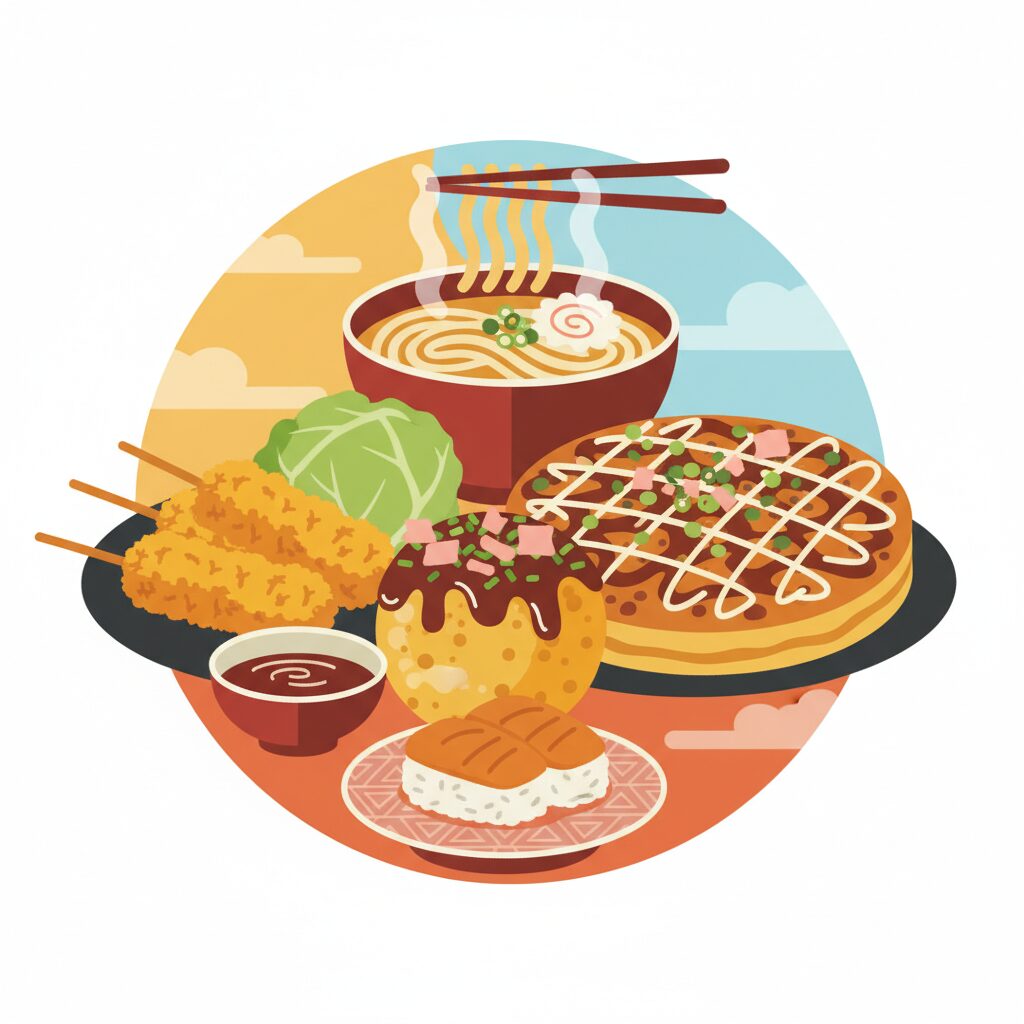
Walk through the electric canyons of Dotonbori, and you’ll inevitably meet him: a cheerful, drum-beating mechanical clown named Kuidaore Taro. His name, like the vibrant district he presides over, is a symbol of Osaka’s most famous philosophy: kuidaore. The standard translation is ‘to eat until you fall into ruin’ or ‘eat until you drop.’ It conjures images of endless buffets, gastronomic excess, and a city singularly obsessed with stuffing its face. For the tourist, this is an exciting, instagrammable invitation to indulge. But for someone living here, someone navigating the daily rhythms of the city, you quickly realize this translation is a profound, almost comical, misunderstanding of the Osakan soul. Kuidaore is not a command to binge. It’s a complex, unwritten social contract, an economic ideology, and a practical guide to life in Japan’s glorious, gritty merchant city. It dictates where people live, how they socialize, and why they will happily queue for an hour in the rain for a bowl of noodles that costs less than a cup of coffee in a Tokyo hotel. To truly live in Osaka, you must first understand that kuidaore is less about the quantity of food you consume and more about the quality of the judgment you exercise. It is a philosophy of value, a celebration of substance over style, and a key that unlocks the city’s unique, pragmatic, and deeply communal character. Forget the clown for a moment; the real kuidaore is found in the hushed, reverent silence after the first bite of a perfectly grilled skewer in a cramped alleyway, followed by a low, appreciative whistle and a muttered, “Unbelievable.”
Embracing Osaka’s vibrant way of life goes beyond savoring its culinary treasures, as mastering practicalities like navigating guarantor requirements is essential for a smooth transition into the city’s rhythm.
The Gospel of Cost Performance: Kuidaore as Economic Theory

The most common misconception about kuidaore is equating it with extravagance. Visitors from cultures where price often signifies quality might view a Michelin-starred kaiseki restaurant as the epitome of kuidaore. However, an Osakan would likely disagree. While they appreciate upscale dining, the true essence of kuidaore lies not in spending lavishly, but in value. The term that governs all transactions in Osaka, from groceries to real estate, is kosupa, short for ‘cost performance.’ This concept is the cornerstone of Osakan life.
The Calculation Behind Every Meal
In Tokyo, a beautifully arranged, minimalist dish served in a serene, architect-designed setting can justify a high price. The experience, brand, and ambiance all contribute to the product. In Osaka, however, this approach is met with skepticism. Here, the food itself must validate every yen on the bill. An Osakan evaluates a meal with the meticulousness of a stockbroker assessing a deal. Is the portion generous? Does the ingredient quality far exceed the price? Is there a cheaper spot nearby offering similar quality for half the cost? This isn’t about being stingy; it’s about being smart. It’s an intellectual challenge—a city-wide quest for the perfect balance of quality, quantity, and price. The greatest achievement isn’t dining at an expensive restaurant but discovering a 700-yen teishoku lunch that tastes like it should cost 2,000 yen. Such a find brings immense personal pride and becomes a tale to share and celebrate. A fancy interior, rather than being an asset, can sometimes raise suspicion that the owner is compensating for mediocre food with décor. The best eateries are often characterized by peeling paint, handwritten menus, and a line of patiently waiting customers outside.
The Merchant’s Legacy
This mindset stems from Osaka’s history as the nation’s kitchen (tenka no daidokoro) and, more importantly, its key commercial center. It was a city dominated by merchants (shōnin), not samurai or nobility. Their world revolved around pragmatism, cash flow, and savvy deal-making. A merchant’s reputation depended on offering honest goods at a fair price. This philosophy became part of the city’s DNA. Food was both a tangible pleasure—a reward for hard work—and a transaction. In Osaka, you never want to feel like you’ve lost out in a deal. This historical context explains why an Osakan’s praise often goes beyond just “Oishii!” (Delicious!) to something more precise: “Yasui noni, umai na!” (It’s cheap, but man, it’s good!). The “but” is crucial. It highlights the delightful surprise, the discovery of value, the thrill of winning the game.
The Unspoken Rules of the Counter Seat
Kuidaore is far from a solitary endeavor. It is a profoundly social and communal experience that has influenced how Osakans relate to each other. While Tokyo’s dining environment often feels formal and compartmentalized, with conversations kept quiet within individual groups, Osaka’s scene is a boisterous, engaging performance. The main stage is frequently a simple counter with a few stools.
Breaking the Fourth Wall
In a typical Osakan eatery—whether a standing-only bar (tachinomi), a kushikatsu spot, or a small ramen shop—the line between customer and staff is thin, almost nonexistent. The chef (taishō) is not a distant artist hidden away in the kitchen; they serve as the host, the conductor, and often the primary entertainer. Guests are encouraged to participate. Praising the food isn’t merely polite; it’s an essential part of the experience. A loud, genuine “Umai!” or “Meccha oishii!” becomes part of the restaurant’s soundtrack. It affirms the chef’s effort and fosters a shared connection among diners. This may feel startling to those used to a more reserved dining culture. Visitors might feel put on the spot, but for locals, it’s as natural as breathing. Silence from a customer can be read not as courtesy, but as a sign of displeasure.
Temporary Community
You might find yourself engaged in brief chats with the salaryman next to you about the Hanshin Tigers baseball team, or with the grandmother beside you discussing the best way to prepare eggplant. This isn’t about forging deep friendships. It’s a situational camaraderie born from a mutual appreciation of good, affordable food. The meal provides the common bond. This dynamic is what makes dining in Osaka feel so authentic and human. You are more than just a patron occupying a seat; you become a temporary member of a small community, united for an hour to enjoy something simple and well-crafted. This is why many of Osaka’s favorite establishments are remarkably small. A large, impersonal space would shatter this intimacy. The value lies not only in the food itself but in the lively, unpretentious atmosphere it nurtures.
Who Is Kuidaore Really For?

Grasping this philosophy is essential to deciding whether you’ll thrive in Osaka. The city’s character is a direct expression of its kuidaore mindset, which doesn’t appeal to everyone. It’s a culture that rewards a particular kind of person while puzzling others.
Those Who Will Thrive
Kuidaore is for the adventurer. It’s for those who find genuine excitement in uncovering a hidden gem within a worn-down shotengai arcade. It suits someone who values substance over appearance and trusts word-of-mouth recommendations rather than glossy magazine reviews. If you’re comfortable with a bit of grit and disorder, and can appreciate beauty in a place that prioritizes function over looks, you will love it here. It’s for the pragmatist who recognizes that a 500-yen bowl of kitsune udon, crafted with a sublime dashi broth perfected over generations, is a higher form of culinary art than a mediocre 5,000-yen steak served in a bland, corporate restaurant. If you appreciate straightforward, no-nonsense communication and can find warmth in a gruff yet generous welcome, Osaka will feel like home. It’s a city for those who want to engage, not just observe.
Those Who Might Misunderstand
On the other hand, those who associate quality with luxury and formality may find it challenging. If your idea of a good meal involves starched linen tablecloths, attentive service, and a calm, serene atmosphere, Osaka’s most authentic experiences may come across as harsh. The kuidaore mindset can be misunderstood as lacking refinement. The emphasis on price might be mistaken for “cheapness” rather than a sophisticated valuing of worth. The lively, interactive setting of many local eateries can feel intrusive to someone who prefers dining in a private cocoon. Someone who judges a book by its cover will pass right by Osaka’s best restaurants, which are often hidden in basements, down narrow stairways, or in buildings that seem untouched since the 1970s. For the kuidaore devotee, these aren’t drawbacks but promising signs that the owner is dedicating resources to what truly counts: the food.
How Kuidaore Shapes the Cityscape
The philosophy of kuidaore is not an abstract idea; it is embedded in the physical layout of Osaka. It has shaped a city filled with dense, highly specialized, and fiercely competitive food ecosystems that stand in stark contrast to the more curated commercial districts of Tokyo.
The Anatomy of a Food Neighborhood
Take an area like Tenma. By day, it features one of Osaka’s longest covered shopping arcades. By night, its network of side streets transforms into a confusing maze of hundreds of tiny bars and restaurants. There are no grand facades or famous chains. Instead, you find hyper-specialized spots: a place that focuses solely on smoked food, a bar boasting dozens of potato salad varieties, a stand offering one perfect type of gyoza. This is kuidaore manifested in urban form. The low overhead of these small spaces encourages experimentation and competitive pricing. Success hinges on excelling at one thing and pricing it fairly enough for locals. This creates an environment of constant discovery for residents. Life in Osaka becomes an endless treasure hunt, with the prize being a new favorite spot unknown to any guidebook.
Darwinian Dining
The incredible density of restaurants in Osaka generates intense, relentless competition. A new venue that opens with flashy decor but mediocre food at a high price will quickly be exposed by the city’s discerning diners. Word spreads fast, and a reputation for poor kosupa is fatal. This process of natural selection is harsh but ensures the city’s culinary standards remain extraordinarily high, especially at the affordable end of the spectrum. As a resident, you reap the rewards of this rigors. It means that on almost any night, on nearly any street, you can find a meal that is both excellent and affordable. Dining out is not a special occasion; it’s an extension of your own kitchen—a daily, accessible pleasure. This is the ultimate expression of the kuidaore spirit—not a single ruinous feast, but a lifetime of consistently smart, satisfying, and deeply enjoyable eating.








