
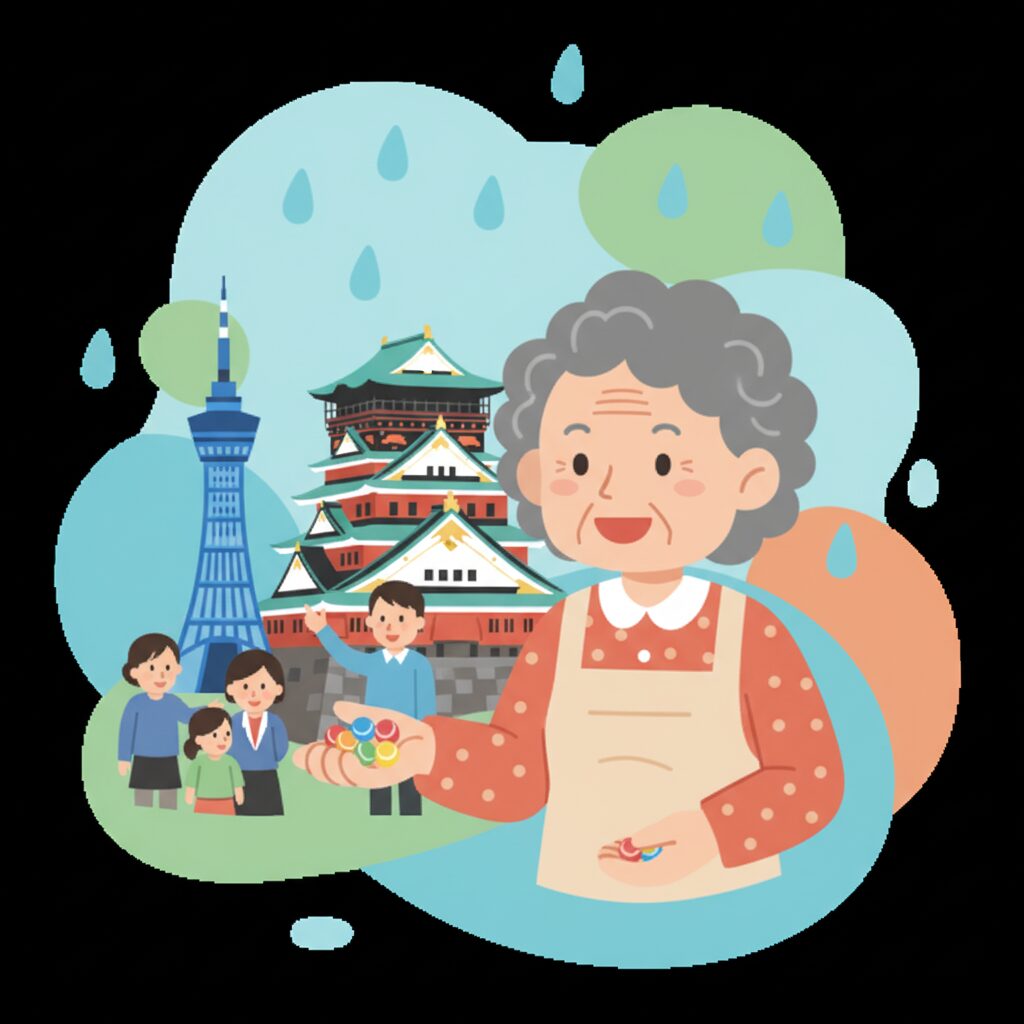
The first time it happens, you’re almost certainly caught off guard. You might be on a crowded Hankyu train heading to Umeda, maybe you’re waiting in line at a local supermarket in Tennoji, or perhaps you’re just resting your feet on a park bench. An older woman, an ‘obachan,’ as they’re known, with a perfectly coiffed perm and a twinkle in her eye, will catch your gaze. She’ll rummage through a cavernous purse, a universe of receipts, tissues, and mysteries. Then, with a swift, practiced motion, she’ll lean in, press a small, cellophane-wrapped candy into your hand, and say something like, “Atsui naa, kore taben.” It’s hot, huh? Eat this. And just like that, she’s broken a barrier. You’re holding a single piece of candy, a ‘kuro-ame’ (black sugar candy) or maybe a simple fruit drop, and you’re left wondering what just happened. This isn’t a random act of weirdness. This is your official, unceremonious welcome to the very heart of Osaka’s social fabric. You’ve just been initiated into the world of ‘ame-chan,’ the city’s most powerful, and sweetest, form of social currency. It’s a gesture that says more than a thousand polite bows ever could, a tiny transaction that oils the gears of daily life here. This little piece of sugar is your first clue that Osaka operates on a different frequency, a rhythm that’s warmer, more direct, and infinitely more personal than what you might find in the rest of Japan. Forget your phrasebook for a moment; understanding the ‘ame-chan’ is the real lesson in speaking Osakan.
Delving deeper into Osaka’s unique social fabric, our exploration of the obachan network reveals just how these lively local figures knit the city’s communities closer together.
More Than Just Candy: What ‘Ame-chan’ Really Means
Let’s break it down. ‘Ame’ is the Japanese word for candy, and ‘chan’ is an affectionate diminutive suffix, typically used for children or close friends. So, ‘ame-chan’ literally means ‘little candy’ or ‘dear candy.’ But that straightforward definition misses the whole point. In Osaka, ‘ame-chan’ isn’t just a noun; it’s a concept. It serves as an icebreaker, a way to de-escalate tension, a small gift, a conversation starter, and a gesture of solidarity all rolled into one. The candy itself is almost incidental. Usually, it’s a simple hard candy that lasts a while. You might see classics like Kasugai’s Kuro-ame, pineapple-flavored Pine Ame, or a variety of plain fruit drops. Sometimes, it’s a throat lozenge, handed over with a knowing look that says, “I hear that cough, take care of yourself.”
The economic value is laughably small, maybe just a few yen at most. But its social significance is immense. Giving ‘ame-chan’ instantly shrinks the vast, impersonal expanse of a modern city into a small, familiar neighborhood. It’s a micro-interaction that acknowledges shared humanity. You’re both standing in the same line, waiting for the same bus, enduring the same humid summer day. The candy acts as a tangible token of that shared experience. It’s a way of saying, “Hey, we’re in this together.” It’s a deeply human gesture in a society that can often feel, at least on the surface, quite formal and reserved. It’s a small piece of warmth you can hold in your hand.
The Keepers of the Custom: The Mighty Osaka ‘Obachan’
While anyone can offer ‘ame-chan,’ the undisputed masters of this tradition are the Osaka ‘obachan’—the middle-aged and elderly women of the city. Often stereotyped for their loud voices, bold fashion choices (leopard print is practically their uniform), and no-nonsense demeanor, the obachan are truly the city’s social backbone. They are the matriarchs of the metropolis, the self-appointed guardians of public welfare, and they are always, without fail, armed with candy.
Their handbags are legendary. They are far more than simple accessories; they serve as mobile command centers, personal convenience stores from which anything can be summoned at a moment’s notice. Tissues, a small sewing kit, a foldable fan, and most importantly, the ‘ame-chan pouch.’ This is a special small bag or container stocked with an assortment of candies for any occasion. An obachan without her ‘ame-chan’ is like a knight without a sword—unprepared for the daily challenges of urban life.
They deploy their sweet arsenal with tactical precision. A child starts crying on the train? An ‘ame-chan’ is offered to the mother with a reassuring smile. A tourist looks hopelessly lost studying a map? An ‘ame-chan’ appears, often accompanied by a rapid-fire flurry of well-meaning directions in thick Osaka dialect. You helped her pick up a dropped orange at the supermarket? You’re rewarded with an ‘ame-chan.’ The beauty lies in its spontaneity. There’s no formal occasion required—only a shared moment in time and space.
The Unspoken Rules of Sweet Exchange
Like any cultural ritual, the ‘ame-chan’ exchange has its own unstated etiquette. It’s simple but crucial if you want to navigate life here smoothly.
The Art of Giving
Giving is casual, almost brisk. It’s not presented as a precious gift. It’s a quick, low-key offering. The giver makes eye contact, smiles, and says a few words. It’s a bridge, not a performance. The intent is to create a brief, positive connection, not to place any obligation on the receiver. It’s a simple, fleeting moment of goodwill, offered without expectation of grand reciprocation. It’s a social spark designed to kindle a small fire of communication.
The Grace of Receiving
If offered an ‘ame-chan,’ the appropriate response is straightforward: accept it with a slight bow or nod, accompanied by a clear “Arigatou gozaimasu” (Thank you) or a slightly more casual “Sumimasen,” which can mean ‘excuse me’ but is often used as a light thank you. The most important part is the smile. Your warmth in receiving the gesture is the true reciprocation. Refusing can seem cold or distrustful. Unless you have a serious allergy or a compelling reason, it’s best to accept the candy. You don’t have to eat it right away—just put it in your pocket. The transaction is complete once you’ve accepted it graciously.
The Conversation After
The candy is often just the opening act. The main event is the brief conversation that follows. The obachan might ask where you’re from, comment on your Japanese skills, or talk about the weather. This is the whole point. The ‘ame-chan’ acts as a key unlocking the door to a small, friendly chat. It breaks down the usual urban anonymity. For a few moments, you are not a stranger—you become someone to share a word with. These small, daily interactions weave together the social fabric of Osaka, making it feel less like a sprawling city and more like a close-knit village.
A Tale of Two Cities: Why Osaka and Not Tokyo?

To fully appreciate the meaning of ‘ame-chan,’ you need to understand how distinct Osaka feels compared to Tokyo. In Tokyo, public spaces are governed by an unspoken code of politeness and invisible boundaries. On the subway, people remain silent, absorbed in their phones or books. Unsolicited interactions with strangers are uncommon and can even be met with suspicion. Offering a stranger a piece of candy on the Yamanote Line would be considered profoundly strange. People would likely feel puzzled, perhaps even alarmed.
Osaka follows a completely different social logic. This city was built by merchants (‘akindo’), not samurai or bureaucrats. Its identity is rooted in business, trade, and the art of negotiation. Historically, success in Osaka meant building relationships, engaging in banter, being personable, and offering a little extra—known as ‘omake’ (a small freebie included with a purchase). The ‘ame-chan’ represents a pocket-sized, non-commercial evolution of this spirit. It serves as a social ‘omake.’
This merchant DNA fosters a culture that is more pragmatic, direct, and less focused on strict formality. People value human connection and don’t hesitate to be a bit nosy. The prevailing attitude is, “Why be strangers when we’re standing right next to each other?” This mindset is evident everywhere, from the lively shopkeepers in the Shinsaibashi-suji shopping arcade who are eager to chat, to taxi drivers who share their life stories during a short ride. The psychological distance between individuals is simply shorter here. The ‘ame-chan’ is both a cause and reflection of this. It is a tool for bridging that gap, and its widespread use reinforces the notion that closing that distance is normal and positive.
Navigating the Candy Culture as a Foreigner
For a non-Japanese resident, the ‘ame-chan’ custom can initially feel a bit confusing. In many Western cultures, we’re taught from childhood to avoid accepting candy from strangers. So, your first reaction might be suspicion. Is it safe? What do they want from me? In 99.9% of cases, the answer is that it’s completely safe, and all they want is to share a small moment of kindness.
This is neither a scam nor a trick. It is a sincere, culturally rooted gesture of goodwill. Recognizing it for what it truly is—a symbol of Osaka’s distinctive brand of open-heartedness—is a significant step toward understanding the city. It’s an invitation to engage with the local culture on its own terms.
So, should you carry your own supply of ‘ame-chan’? You absolutely don’t need to. No one will be offended if you don’t offer a candy in return. But… if you want to elevate your Osaka experience, it can be a wonderfully enjoyable thing to do. Keeping a few small candies from your home country in your bag can be a secret weapon. The next time an obachan offers you an ‘ame-chan,’ you can smile, thank her, and then offer one of yours. The look of surprise and delight on her face will be priceless. In that moment, you stop being just another foreigner; you become someone who truly understands. You’ve shown that you not only recognize their culture but appreciate it enough to join in. It’s a small gesture that creates a surprisingly strong bridge.
The Sweetest Social Glue
Ultimately, the modest ‘ame-chan’ is far more than just a sweet treat. It serves as the unseen link that binds people together in this lively, chaotic, and profoundly human city. It represents a culture that values connection over formality, and community over isolation. Each small candy acts as a reminder that even in a city of millions, moments of genuine warmth and recognition can be found. It stands as a rejection of the coldness often found in modern urban life.
Living in Osaka means learning to interpret these subtle social signals. It means realizing that the loud, straightforward person beside you on the bus isn’t being impolite; they’re simply being Osakan. They operate on a social frequency where engaging with others is a natural and positive instinct. The ‘ame-chan’ embodies this spirit most clearly. It offers a small, sweet, and powerful lesson: in Osaka, a little sugar can go a long way in making a vast city feel like home.








