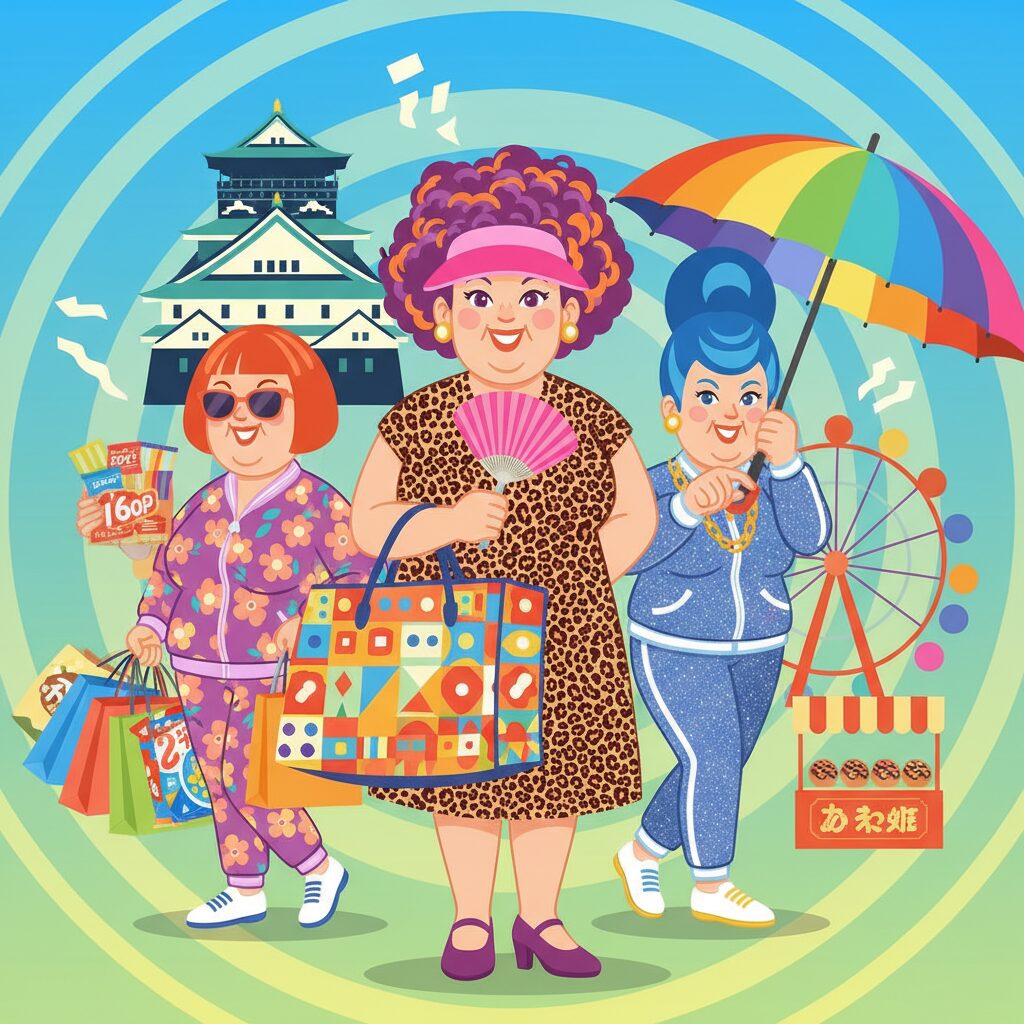
You’ve seen them. Of course, you have. You can’t live in Osaka for more than a week without an encounter. A flash of tiger stripe on the Midosuji Line. A booming, gravelly laugh that cuts through the sterile announcements at Umeda Station. A bicycle, piloted with unnerving precision through a crowded shotengai, its basket overflowing with daikon radish and its rider crowned with a sun visor the size of a satellite dish. This is the Osaka Obachan, the city’s unofficial mascot, a figure as iconic as the Glico Running Man and as misunderstood as the concept of a quiet Sunday.
For many foreigners, and even for many Japanese from outside Kansai, the Obachan is a caricature. She’s loud. She’s pushy. Her fashion sense is a glorious, unapologetic assault on muted tones and minimalist aesthetics. She’s the lady who will offer you a piece of hard candy, a throat lozenge of indeterminate age pulled from the depths of her handbag, for no apparent reason. It’s easy to file these encounters under “weird Osaka quirks” and move on. But that’s a mistake. To dismiss the Obachan is to misunderstand the very engine of this city’s social life. She isn’t an anomaly; she is the system. She is the walking, talking, laughing embodiment of Osaka’s history, its values, and its fundamental difference from the polished, reserved world of Tokyo. She is the social glue, the neighborhood watch, and the keeper of a communal flame that has been extinguished in many other modern cities. So, let’s peel back the layers of leopard print, look past the permed hair, and decode the vital social role of these formidable women. This isn’t just about understanding them; it’s about understanding the heart of daily life in Osaka itself.
Osaka’s quirky social fabric gains even more significance against the backdrop of Japan’s energy challenges that quietly influence the region’s industrial pulse.
The Archetype: Decoding the ‘Obachan’ Uniform
Before we can grasp what the Obachan does, we first need to understand how she presents herself to the world. Her public image is a carefully, if unconsciously, curated statement of intent. It’s a uniform designed not to blend in, but to broadcast presence, confidence, and a hard-won pragmatism. Every detail, from the animal print to the candy in her purse, serves a purpose.
The Leopard Print and Beyond
The leopard print is the most iconic element, the visual shorthand for the entire phenomenon. To a Western eye, it might seem tacky or outdated, a fashion choice stuck somewhere in the 1980s. But that’s looking through the wrong lens. In Osaka, this isn’t about chasing trends. It’s about projecting power. Think of it less as high fashion and more as urban camouflage for someone with no intention of hiding.
This aesthetic is rooted in Osaka’s identity as a city of merchants, a place where you had to be a little loud and flashy to get noticed and make a sale. A quiet, unassuming merchant went broke. The Obachan is the inheritor of this tradition. Her clothing is a declaration: “I am here. I am confident. I have lived a life, and I have earned the right to be seen.” The bold patterns, the bright colors, the glint of gold jewelry—they’re all part of a visual language that communicates vitality and a refusal to fade into the background. This contrasts sharply with the prevailing aesthetic in Tokyo, where conformity and understated elegance are often the ideal. The Tokyo uniform signals you belong to the group; the Osaka Obachan uniform signals you are a force to be reckoned with within it.
But the uniform goes beyond just leopard print. It’s the tightly permed hair, often with a subtle purple or reddish tint, a style that is both practical and resilient. It’s the ubiquitous sun visor, a piece of utilitarian headwear that shields from the sun while cycling but has become a statement piece in its own right. It’s the practical, sturdy, yet often brightly colored handbag, a veritable mobile command center containing everything from her wallet and keys to snacks, tissues, and, of course, the legendary ame-chan.
The Candy in the Purse: An Act of Social Currency
This brings us to the famous candy, or ame-chan as it’s affectionately called in the Kansai dialect. A newcomer to Osaka might be puzzled when a total stranger, an older woman on the train, notices a child getting fussy and, without saying a word, offers a small, wrapped candy. In many cultures, this would be met with suspicion. But here, it’s a fundamental social transaction.
The ame-chan is not just sugar; it’s social lubricant. It’s a tool for bridging the gap between strangers, transforming an anonymous public space into a momentary community. It’s an icebreaker, a way to calm a noisy child, a small gesture of solidarity with a frazzled parent. It’s a way of saying, “I see you. We’re sharing this space. Let’s make it a little more pleasant.”
This simple act highlights a core difference in the social contract between Osaka and Tokyo. In Tokyo, the default mode is non-interference. You maintain a polite distance, avoid imposing, and respect the personal bubbles of those around you. In Osaka, boundaries are more permeable. The Obachan operates on the assumption that shared space implies shared responsibility, however brief. Offering an ame-chan is an assertion of this communal mindset. It’s a micro-dose of the city’s renowned friendliness, a small, tangible expression of the idea that we’re all in this together. To accept the candy is to accept this premise. To refuse it is a minor social faux pas, a subtle rejection of the unwritten rules of engagement.
The Social Function: More Than Just Noise
The Obachan’s loud voice and straightforward manner can be startling to those unfamiliar with her. It’s easy to misinterpret her style as rudeness. Yet her role within the community fulfills several essential, though unofficial, functions. She acts as the guardian of social norms, the enforcer of public etiquette, and the vibrant heart of local commerce. What might be perceived as “noise” is actually the sound of a community actively caring for itself.
Guardians of the Neighborhood (The Unofficial Security System)
Spend any time in a traditional Osaka shotengai (shopping arcade), and you’ll find the Obachan in her natural environment. She doesn’t merely shop there; she oversees the area. She knows the butcher’s name, inquires about the fishmonger’s grandchildren, and comments regularly on the tofu maker’s quality. This isn’t idle gossip. It is the daily practice of maintaining the community.
These women form an incredibly effective, informal neighborhood watch. They are the eyes and ears of the street. They notice when an elderly neighbor has gone unseen for a day or two. They spot unfamiliar people lingering near the school. They’re the first to help a child who has fallen and scraped a knee. This ongoing, low-key vigilance fosters a strong sense of public safety. Whereas Tokyo depends on formal systems, security cameras, and discreet anonymity, Osaka relies on a network of attentive, deeply involved older women who miss nothing.
Their enforcement is straightforward. If someone cuts in line, an Obachan will call them out. If a teenager is making too much noise on the bus, she’ll be the one to say, “Hey, quiet down a bit!” This is not vigilantism; it’s the open, unapologetic enforcement of shared community standards. For those unaccustomed to it, this system can feel intrusive, but it builds a reassuring sense that someone is always watching out for the collective well-being.
The Communication Style: Direct, Unfiltered, and Surprisingly Warm
Japanese communication is famously indirect, layered with politeness, hesitation, and unspoken cues. The Osaka Obachan missed that memo. Her communication style is a prime example of directness. She skips formal pleasantries (tatemae) and goes straight to the point (honne).
She might comment on your grocery choices while waiting in line. “Oh, you’re buying that brand of curry? The other one is on sale today, you know.” She might offer unsolicited advice to a young mother on the train. “Your baby looks a little cold; you should cover his feet.” To outsiders, this can feel intrusive. But in Osaka, it’s a form of engagement. It signals that she sees you not as a stranger but as a fellow participant in the city’s daily life.
This behavior stems from a culture that prioritizes connection over privacy. The Obachan operates from a place of assumed closeness. By commenting on your life, she is, in a way, inviting you into her world. The warmth lies in her intent. The advice, regardless of how awkwardly given, is almost always well-meaning. It’s a sharing of practical, lived experience. She’s not judging; she’s trying to help, drawing on decades of household management, child-rearing, and city navigating.
The Art of the Bargain: A Performance of Connection
Watch an Obachan in action with a shopkeeper in the Kuromon Market or Tenjinbashisuji Shotengai. Buying something is rarely a quiet, simple transaction. It is a performance, a ritual, a conversation disguised as commerce. Haggling or asking for a little extra (omake) isn’t just about saving money.
Saving 50 yen is nice, of course, but the true purpose of the exchange is human connection. It’s a playful dance of wit and charm. The Obachan playfully complains about the price, the shopkeeper theatrically defends the quality of his goods, and they meet somewhere in the middle, often sharing a laugh. This back-and-forth reinforces their long-standing relationship. It confirms their roles within the community. It turns an ordinary purchase into a shared moment of humanity.
This contrasts sharply with the silent, efficient, and anonymous experience of a Tokyo convenience store. For foreigners living in Osaka, learning to join in this ritual, even with a few words and a smile, is a big step toward feeling like a local. It demonstrates an understanding that in Osaka, relationships often matter more than transactions.
The ‘Obachan’ Mindset: A Product of Osaka’s History
The Osaka Obachan did not appear out of nowhere. She embodies centuries of Osaka’s distinctive history and culture, serving as a living symbol of a city built on commerce, pragmatism, and a healthy dose of anti-establishment spirit.
Merchant City DNA: Pragmatism Over Polish
Throughout most of its history, Osaka was Japan’s commercial hub, known as the “nation’s kitchen,” while Tokyo (then Edo) served as the seat of the samurai government. This fundamental distinction gave rise to two markedly different urban cultures. Tokyo’s culture was influenced by the strict hierarchy and formal etiquette of the samurai class, where procedure, propriety, and saving face were essential.
Osaka, in contrast, was a city of merchants (akindo). In business, what counts is the deal and the bottom line. Communication had to be clear, direct, and efficient to prevent costly misunderstandings. This pragmatic, outcome-focused approach permeated every aspect of social life. Why waste time on elegant but empty formalities when you can get straight to the point? The Obachan epitomizes this merchant DNA. Her straightforwardness, practical mindset, and occasional disregard for delicate social graces are a direct legacy of a culture that has always prioritized substance over style and a good deal over a pretty bow.
Resilience and Humor: Laughing Through Hardship
Osaka has a long history of falling and rising again. From feudal-era sieges to the devastating bombings of World War II, the city has been rebuilt from the ashes time and again. This has cultivated a culture of remarkable resilience, a tough, unsentimental spirit, and a profound appreciation for humor as a tool for survival.
The Obachan’s character is shaped by this crucible. Many belong to the generation that grew up during the lean post-war years, a time marked by scarcity and struggle. They learned to be resourceful, to make do, and to find joy in simple pleasures. Their loudness is the voice of survival. Their humor acts as a shield. Osaka is the birthplace of manzai comedy, a quick-witted, fast-paced style often featuring one person as the fool (boke) and the other delivering sharp retorts (tsukkomi). The Obachan is a natural at this comedic timing in everyday life, able to spot the absurdity in situations and defuse tension with self-deprecating humor.
This blend of toughness and humor is essential. She may seem pushy, but it is often a form of tough love—a refusal to let herself or others be crushed by minor setbacks. Having seen worse, she knows that sometimes the best way forward is to laugh, speak frankly, and keep moving.
Navigating Interactions: A Practical Guide for Residents
For a foreigner settling into life in Osaka, mastering how to interact with the Obachan is an essential skill. It’s not about becoming one yourself, but about understanding the unwritten rules of engagement and responding in a way that respects the local culture. This is your key to being recognized not just as a tourist, but as a part of the community.
When You’re the Center of Attention
It will happen. You’ll be on the train, and an Obachan will loudly comment on the size of your suitcase or ask where you’re from. The first rule is: don’t panic. This is not an attack. Most likely, it’s an opening move for a conversation. A response that might feel natural in another culture, such as ignoring the comment or giving a cold stare, will be seen here as distant or rude—the typical “Tokyo” reaction.
The best approach is to engage, even briefly. A smile and a simple, friendly reply is all that’s needed. “Yes, it’s a big suitcase! I’m going on a trip.” Or, “I’m from America. Nice to meet you.” This small act of acknowledgment completes the social exchange. You’ve shown that you are open and willing to take part. More often than not, this will conclude the interaction. But you’ve passed the test. You’ve shown you understand the unspoken rule: in Osaka, a stranger is just a friend you haven’t yet spoken to.
The Line Between Nosiness and Care
Questions that might be seen as highly intrusive in many Western cultures are common conversational tools for the Osaka Obachan. “Are you married?” “Do you have children?” “How much do you pay for rent?” It’s easy to feel as if you’re being interrogated. But it’s important to reinterpret the intent. In a community-focused culture, these personal questions are not just gossip fodder; they are the foundation of connection. They help her place you within her social map. She’s trying to understand your story, to find common ground.
Of course, you’re under no obligation to share your life story with a stranger on the bus. The skill lies in polite deflection. A laugh and a vague reply like, “Oh, who knows about marriage!” or “My rent is way too high, that’s for sure!” works wonders. The key is to respond with the same warmth and humor with which the question was probably asked. This shows you understand the game without feeling pressured to disclose more than you wish.
Accepting the ‘Ame-chan’
This is the simplest and most important rule of all: if an Obachan offers you candy, you take it. Thank her with a smile. It doesn’t matter if you don’t like candy or if you’re on a diet. The ame-chan is a symbol. It’s a peace offering, a welcoming gesture, a token of goodwill. To accept it is to accept her invitation into the temporary community of that train car or park bench. To refuse it breaks that connection. It’s a small gesture, but in the subtle social dance of Osaka, it’s a step that truly matters.
The Fading Roar? The Future of the Osaka ‘Obachan’
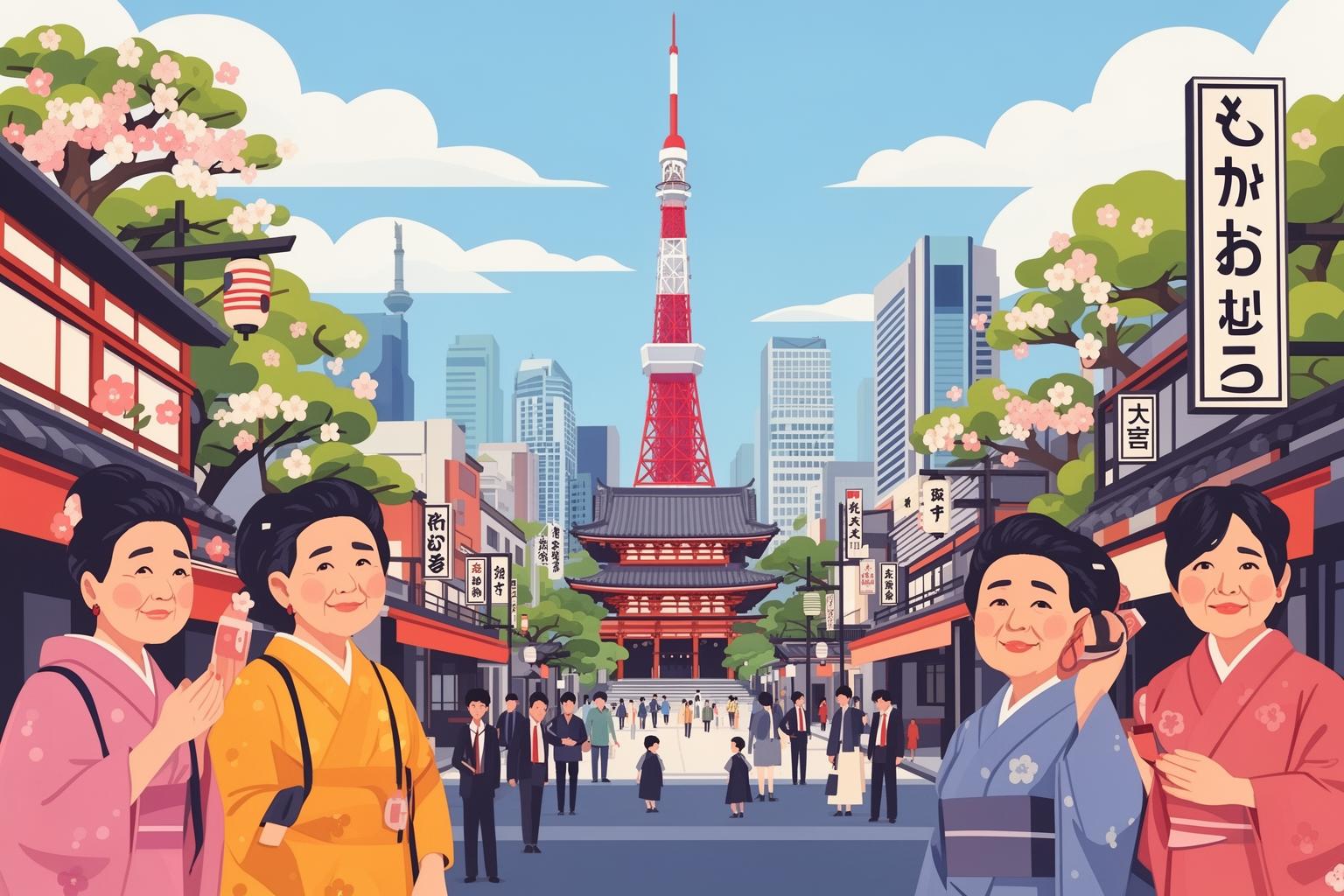
Is the classic Osaka Obachan a fading breed? It’s a valid question. The women who perfectly embody this archetype are now mostly in their 60s, 70s, and beyond. They were shaped by the unique economic and social conditions of Japan’s post-war boom, an era of rapid growth, neighborhood-focused life, and a more uniform national experience.
Younger generations of Osakan women are different. They grew up in a more globalized, internet-connected world. They are more influenced by the national, Tokyo-centric media that promotes a more standardized, less regionalized version of Japanese femininity. Leopard print is less common; the direct, unfiltered communication style is often softened. The forces of homogenization are strong.
However, it would be a mistake to say the spirit of the Obachan is dead. That spirit—the pragmatism, the humor, the focus on human connection over formal etiquette, the warmth beneath a tough exterior—is not merely a generational quirk. It is the cultural foundation of Osaka. It may take new forms. The new generation’s “leopard print” might be a cleverly worded social media post. Their “ame-chan” could be a shared meme or a helpful online recommendation. But the core values remain.
The true legacy of the Osaka Obachan is the permission she gives everyone in the city to be a little more human, a little less perfect, and a lot more direct. She keeps Osaka from becoming just another anonymous megalopolis. So next time you see her, roaring with laughter in the street or holding court at the local market, don’t just see the stereotype. See her for what she is: the vibrant, unapologetic, and fiercely beating heart of a city that refuses to be boring.