Step off the train at Kyobashi Station, and you’re not just stepping into another part of Osaka; you’re diving headfirst into its circulatory system. This is a place that thrums with an unpretentious, raw energy, a hub where the veins of the JR Loop Line, the Katamachi Line, and the Keihan Main Line converge. As dusk settles, the air grows thick with the clatter of departing trains, the neon sizzle of countless signs, and the irresistible aromas of grilled meats and savory broths. Kyobashi isn’t polished for tourists. It’s a living, breathing testament to the city’s working soul, a place where Osaka’s residents come to unwind, connect, and, most importantly, eat. And at the very heart of this vibrant ecosystem lies one of Japan’s most cherished culinary traditions: tachigui-sushi, the art of the standing sushi bar. This is more than a meal; it’s a cultural ritual, a ballet of speed, skill, and freshness performed on a stage of polished wood and steam. Here, in the narrow, labyrinthine alleys branching off the main station, the true flavor of Osaka awaits—not in quiet, reverent temples of gastronomy, but in boisterous, shoulder-to-shoulder bars where the city’s pulse is most keenly felt. Prepare to explore a world where sushi is stripped of all pretense, leaving only the pure, exhilarating taste of the ocean and the vibrant spirit of a city that has perfected the art of living well.
After experiencing the fast-paced world of tachigui-sushi, you can continue your exploration of Kyobashi’s unique standing culture by diving into its vibrant standing bar scene.
The Echo of Edo: Understanding the Tachigui Tradition
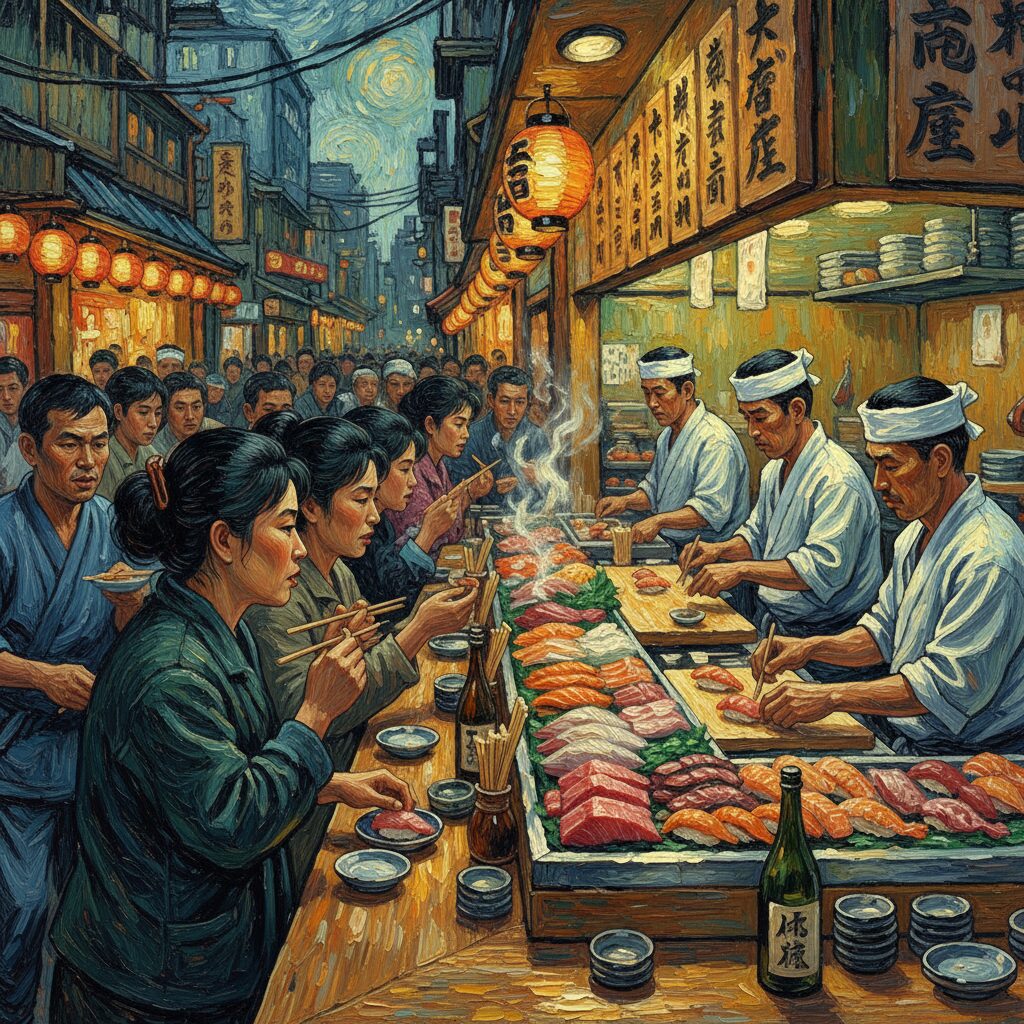
To truly appreciate a standing sushi bar in Kyobashi, you first need to recognize that you are engaging in a tradition with deep historical roots. The practice of eating while standing, known as ‘tachigui,’ is not a modern invention driven by a fast-paced lifestyle, but rather a continuation of the vibrant urban culture from Edo-period Japan. In the 18th and 19th centuries, the streets of Edo—today’s Tokyo—were filled with artisans, merchants, and samurai, all seeking a quick and nutritious meal. This demand gave rise to the ‘yatai,’ or street food stalls, offering everything from soba noodles to tempura. It was within this environment that sushi, in a form recognizable to us now, emerged as the ultimate fast food, served from carts and meant to be eaten with the hands in just a few bites before returning to one’s day. There was no ceremony or quiet reflection—only the immediate satisfaction of fresh fish and vinegared rice.
This pragmatic spirit endured through the centuries, adapting during the rapid industrialization of the Meiji era and the reconstruction following World War II. In post-war Osaka, a city famed for its industriousness and the motto ‘kuidaore’ (‘to eat oneself into ruin’), tachigui and its drinking counterpart, ‘tachinomi,’ thrived. These standing establishments became essential social hubs, affordable and democratic places where workers from various backgrounds could gather for a quick beer and some sushi after a long day, sharing stories and rebuilding community ties. Kyobashi, as a major transportation hub, was the ideal setting for this culture to flourish. The steady flow of commuters provided a ready audience for venues delivering high-quality food at speed. The standing sushi bars that now line its alleys are more than just eateries; they are living museums, preserving a dining style intimately connected to the history of urban Japan and the resilient, pragmatic spirit of Osaka itself.
The Kyobashi Experience: Atmosphere and Etiquette
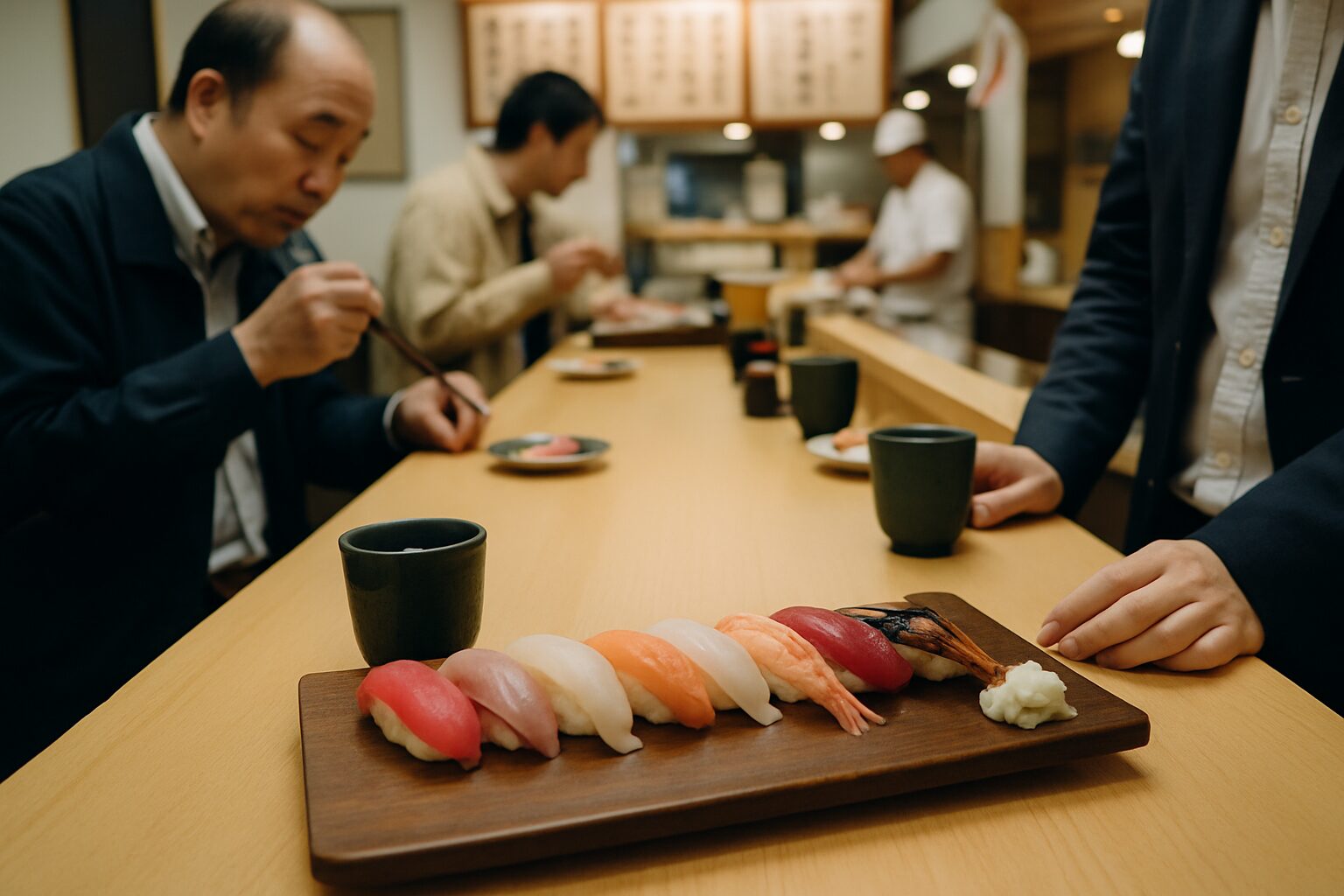
Entering a Kyobashi tachigui-sushi bar for the first time is an immersive experience, a delightful sensory rush that can feel both daunting and thrilling. The outside world fades away, replaced by warm, humid air scented with the sharp tang of rice vinegar and the clean, salty aroma of the sea. These establishments are typically small, focused more on function than aesthetics. A long, often beautifully worn wooden counter commands the room, behind which the ‘taisho’ (sushi chef) and assistants move with precise, almost theatrical motions. The atmosphere is a distinctly Japanese symphony: the low murmur of conversation, the sharp tap of a knife on a cutting board, the rhythmic exchange of calls and responses (‘Irasshaimase!’ greeting you, ‘Omatase!’ as a plate is placed before you), all layered beneath the distant, rhythmic rumble of trains overhead. The patrons represent a cross-section of the city—on one side, a group of salarymen with loosened ties laughing over sake; on the other, an elderly couple quietly enjoying their regular evening ritual. It’s a place where social boundaries dissolve, and everyone shares a common goal: savoring delicious sushi.
The Unwritten Rules: A Guide for the First-Time Visitor
Navigating this setting may seem intimidating, but the rules are straightforward and rooted in respect—for the food, the chef, and fellow diners. Ordering is your first task. Don’t worry about memorizing all the Japanese fish names. Menus are often displayed on wooden plaques (‘neta-kire’) on the wall, and pointing is perfectly fine. A simple ‘Kore, kudasai’ (‘This one, please’) will do just fine. It’s customary to order in small batches rather than all at once, allowing you to pace your meal and ensuring each piece is freshly prepared just before you eat it.
The counter is the chef’s stage; treat it with respect. There is usually a lower shelf or hooks for bags and coats. Keep your phone and personal items away from the main eating surface—your attention should be on the interaction and the food. When your sushi arrives, you’ll find pickled ginger (‘gari’) in a shared container; use your chopsticks to take a small amount for your plate. This is meant as a palate cleanser, eaten between different types of fish, not as a topping.
Applying soy sauce (‘shoyu’) is an art. Many traditional places have the chef brush a special, often slightly sweet soy sauce glaze (‘nikiri-shoyu’) onto your sushi. If that’s the case, no additional dipping is needed. If you do dip, lightly touch the fish side—never the rice side—into the soy sauce. Dipping the rice causes it to soak up too much shoyu, overwhelming the subtle flavor of the fish and causing the rice to fall apart. Regarding payment, systems differ: some keep track of your order on a small slip, others use a dish for tokens, or simply rely on your honesty. When finished, signal the staff, who will tally your bill. The guiding principle is to eat, enjoy, and make room for the next guest. It’s a smooth, efficient dance, and once you know the steps, you’ll feel like one of the locals.
The Stars of the Show: What to Eat in Kyobashi

While you can easily find familiar favorites like tuna (‘maguro’) and salmon (‘sake’) at any sushi bar, the real pleasure of a Kyobashi tachigui experience comes from exploring beyond the basics and savoring the neta that locals treasure. The high turnover in these bustling spots ensures the fish is exceptionally fresh, making it an ideal place to be adventurous. Seek out the ‘hikari-mono,’ or silver-skinned fish. These oily, flavorful varieties are a true test of a sushi chef’s skill, as they require careful preparation, often involving curing with salt and vinegar to balance their strong flavors. ‘Aji’ (horse mackerel), served with a touch of grated ginger and scallion, is a summer favorite, while ‘iwashi’ (sardine) offers a rich, deep flavor that lingers in memory. ‘Kohada‘ (gizzard shad) is perhaps the connoisseur’s pick, a complex neta that highlights the chef’s expertise with the curing process.
Shellfish (‘kai’) is another specialty of tachigui bars. The satisfyingly crisp texture and subtle sweetness of ‘akagai’ (ark shell), the tender chew of ‘torigai’ (cockle), or the creamy richness of a fresh ‘hotate’ (scallop) are experiences not to be missed. Many establishments also take pride in their ‘aburi’ sushi, where the fish is lightly seared with a blowtorch just before serving. This technique is especially favored for oily fish like ‘saba’ (mackerel), as the flame melts the fats, intensifying flavor and adding a smoky aroma that is utterly addictive. Don’t hesitate to ask the chef for a recommendation (‘osusume wa nan desu ka?’). He knows what’s freshest and best that day, and his suggestion will likely lead you to something spectacular.
Shari and Shoyu: The Unsung Stars
An expert will tell you that the soul of sushi lies not in the fish but in the rice, or ‘shari.’ In tachigui-sushi, the rice is often seasoned more boldly with rice vinegar and salt than in high-end venues. This isn’t a flaw; it’s intentional. The stronger seasoning creates a robust base that can stand up to the powerful flavors of hikari-mono and other traditional neta. It also pairs perfectly with a cold beer or a cup of sake. The temperature of the rice is also crucial—it should be served at or near body temperature, producing a sublime contrast with the cool slice of fish on top. Pay attention to the shoyu as well. As mentioned, many of the best shops prepare their own ‘nikiri-shoyu,’ a carefully balanced blend of soy sauce, mirin, and sake that’s simmered down into a glaze. When the chef brushes this on for you, it’s a sign of confidence and tradition. It’s a complete package, seasoned to perfection, underscoring the idea that in sushi, every component matters.
Seasonal Delights: Dining with the Calendar
Japanese culinary philosophy deeply embraces ‘shun,’ the concept of enjoying foods at their seasonal peak. This is especially true for sushi, and a visit to a tachigui bar is a delicious way to engage with the calendar. In the crisp spring air, look for delicate, almost translucent ‘sayori’ (halfbeak) or the tiny, flavor-packed ‘hotaru ika’ (firefly squid). Summer heralds the prime season for the aforementioned ‘aji’ and the rich, tender ‘anago’ (saltwater eel), often simmered in a sweet broth before serving. Autumn brings fatty, flavorful fish like ‘sanma’ (Pacific saury), frequently served aburi-style, and the deep red ‘katsuo’ (bonito), fantastic when lightly seared (‘tataki’). Winter is the season for ‘buri’ (mature yellowtail), whose flesh becomes marbled with rich fat, and the clean, elegant taste of ‘hirame’ (flounder). Eating seasonally not only guarantees the best flavor but also connects you to the natural rhythms of land and sea, a core principle of Japanese cuisine.
Navigating the Kyobashi Labyrinth: Where to Go
Part of Kyobashi’s charm lies in the excitement of discovery. Rather than offering a fixed list of names that may soon become outdated, it’s more useful to understand the typical types of tachigui bars you’ll find while exploring the area’s shotengai (covered shopping arcades) and yokocho (side alleys). This knowledge allows you to uncover your own hidden gem, a spot that truly matches your personal style.
The Station-Side Classics
These represent the iconic standing sushi bars of Kyobashi. Usually situated directly beneath the elevated train tracks or along the main covered arcades, these venues are the area’s dependable staples. The vibe is loud, bright, and frenetic. You’ll constantly hear trains rumbling overhead and be immersed in the continuous flow of commuters grabbing a quick bite on their way home. The emphasis here is on speed, value, and reliability. The menu includes all the classic neta, expertly prepared with efficiency. This is an ideal place for a baptism by fire—a straightforward introduction to tachigui sushi, where you can experience its raw, dynamic spirit.
The Back-Alley Treasures
For those willing to stray a little farther from the main streets, the narrow, dimly lit side alleys conceal Kyobashi’s real gems. These bars tend to be smaller, cozier, and can feel somewhat daunting to enter. Often family-run, they have been serving loyal local customers for decades. The pace here is usually slower and the atmosphere more subdued. The taisho may have time to chat, and you might discover more unique or specialized dishes reflecting the chef’s personal touch. These are the places where you can build a genuine connection, and where a bit of bravery is rewarded with an unforgettable meal and insight into the local community’s heart.
The Contemporary Hybrids
In step with changing times, a new generation of standing bars has emerged in Kyobashi. These venues often combine the traditional tachigui style with a modern aesthetic. Interiors tend to be brighter and more design-focused, and they’re more likely to offer English menus or have staff familiar with foreign visitors. While upholding the core values of speed, freshness, and affordability, they provide a somewhat more refined and accessible experience. For newcomers feeling hesitant, these modern hybrids can be an excellent starting point, offering the authentic tachigui experience in a more comfortable and less intimidating environment.
Beyond the Sushi Counter: The Kyobashi Ecosystem
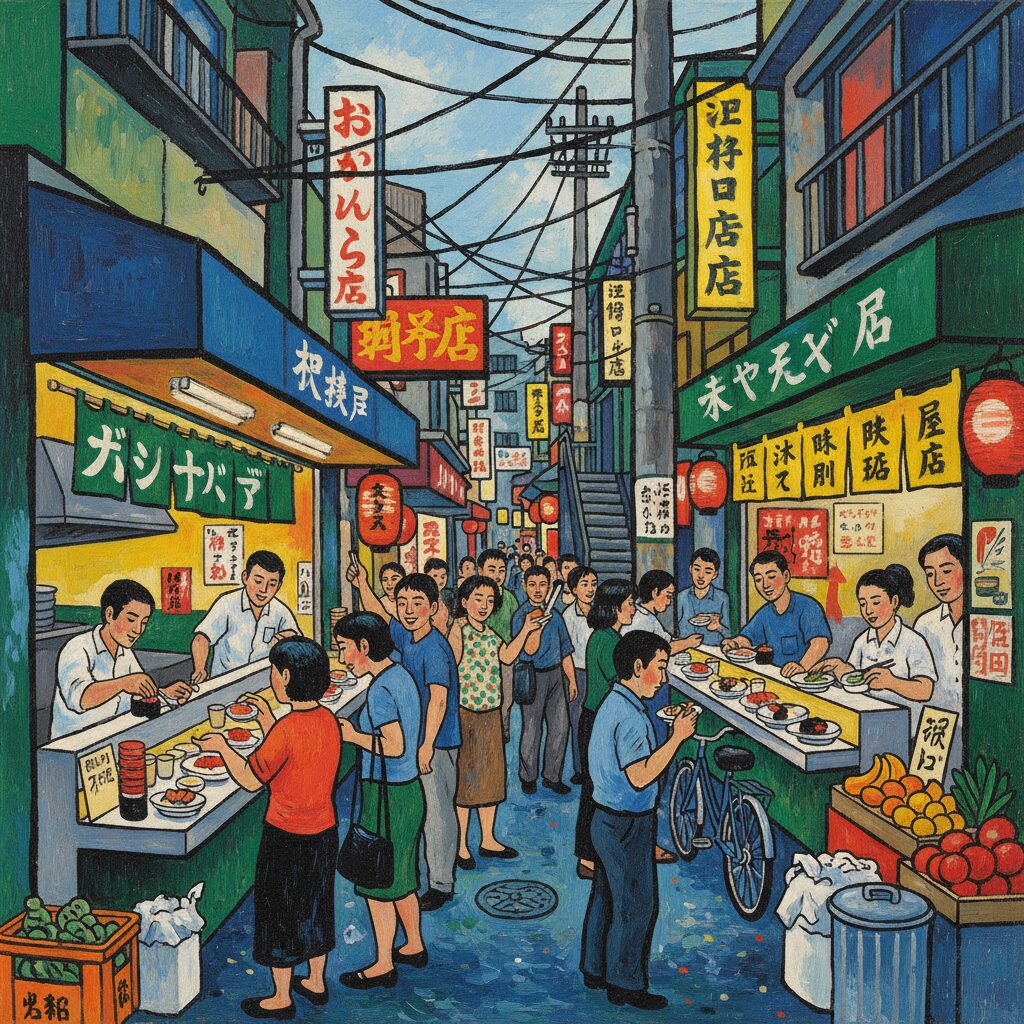
A visit to Kyobashi shouldn’t be limited to just sushi. The tachigui-sushi bar represents only one element of a broader, interconnected culinary ecosystem. To truly experience the area like a local is to partake in ‘hashigo-zake,’ the enjoyable custom of bar hopping. Kyobashi is perfectly suited for this pursuit. Its dense cluster of small, specialized eateries and bars beckons exploration. An ideal evening in Kyobashi might begin at a tachigui-sushi bar with a few carefully chosen pieces of fish to stimulate your appetite. From there, you could move next door to a lively ‘tachinomi,’ a standing bar focusing on drinks and small grilled dishes. Order a highball and some ‘yakitori’ (grilled chicken skewers). Then, perhaps, wander down an alley to discover a ‘kushikatsu’ shop, where you can savor deep-fried skewers of meat and vegetables, another Osaka specialty. This sequence allows you to taste a wide range of the city’s signature foods and drinks all in one evening. It’s a social, dynamic style of dining centered on movement, variety, and discovery. By embracing the hashigo-zake tradition, you shift from being a passive observer to an active participant in the nightly performance of Kyobashi life, fully immersing yourself in Osaka’s ‘kuidaore’ spirit.
Ultimately, the appeal of Kyobashi’s standing sushi bars goes beyond simply eating. It’s a deeply human experience. It’s about finding a fleeting sense of connection among strangers, all gathered around a single counter. It’s about the quiet communication and trust between you and the chef, who prepares each piece especially for you with years of honed skill. It’s the pure taste of the sea, served without show or pretense, in a setting that is unapologetically authentic and vibrant. In an increasingly homogenized world, Kyobashi’s tachigui-sushi bars stand as a powerful reminder of the beauty of tradition, community, and a meal that is both simple and perfect. So, on your next trip to Osaka, put aside any hesitation. Make your way to Kyobashi’s electric maze, step up to the counter, and let the city’s lively, unfiltered soul unfold before you, one delicious piece at a time.