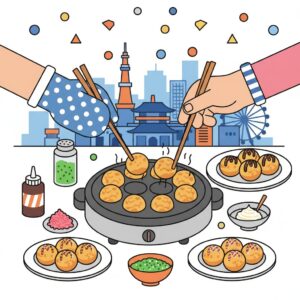
It’s 6:15 PM on a Tuesday. The fluorescent lights of the office hum their final, weary tune. You’ve closed your last spreadsheet, sent your final email, and your mind is already drifting towards the quiet comfort of your apartment, maybe a quick dinner from the konbini. Then, it happens. Your manager, a man who communicates in polite but impenetrable corporate-speak all day, claps a hand on your shoulder. He’s smiling, a real smile this time, not the tight one he uses in meetings. “Hey,” he says, his voice a full octave lower, relaxed. “A few of us are grabbing some takoyaki and a beer over in Tenma. You coming?” Your brain scrambles. Is this a test? A command? A genuine invitation? You’re tired. You want to go home. You say yes anyway. Congratulations. You’ve just stumbled into the most important meeting of your week, and it’s not on anyone’s calendar.
This is Osaka. This is where the real work begins after the official work ends. For many foreigners, especially those coming from Western work cultures where the line between professional and personal is a fortified wall, this can be baffling. You were hired for your skills, your experience, your ability to deliver results between 9 AM and 5 PM. But here, in the merchant capital of Japan, your career trajectory isn’t just defined by your performance reports. It’s forged in the noisy, cramped, steam-filled izakayas and takoyaki stands that line the city’s arteries. It’s built on a foundation of shared beers, mutual vulnerability, and the unspoken understanding that business isn’t just about transactions; it’s about relationships. Deep, resilient, human relationships. And in Osaka, those relationships are often seasoned with soy sauce, bonito flakes, and the glorious, gooey center of a perfectly cooked octopus ball. Forget your PowerPoint skills for a moment. Your ability to navigate these after-work rituals will define your success or stagnation in this city. This isn’t just a fun cultural quirk; it’s the unwritten operating system of Osaka’s professional world.
Mastering these social nuances is just as crucial as understanding the local customs of Temiyage and neighborly exchange in Osaka.
The Unspoken Contract: More Than Just a Drink
That casual invitation serves as a handshake, a test, and an opportunity all rolled into one. In the West, networking might happen at sterile conferences or through exchanging business cards over lukewarm coffee. In Osaka, alliances are built by proving you can hang out. It’s about seeing the person behind the job title and allowing them to see you. This ritual has a name, a well-known portmanteau you’ll hear everywhere: nominication. It combines nomu (to drink) and communication. While it exists throughout Japan, in Osaka, it takes on a distinct character—louder, more direct, and arguably more essential.
Deconstructing “Nominication” in the Osaka Dialect
To outsiders, nominication might seem like forced fun—an extension of the workday where you’re expected to drink with your boss. And sometimes, that’s how it feels. But that’s just a surface impression. The real aim of these gatherings is to systematically break down the rigid hierarchy that dominates the Japanese workplace during office hours. At work, your manager is bucho, an authority figure you address with formal language and respect. But over a shared pitcher of beer, that title might fall away. He becomes Tanaka-san—a guy who loves the Hanshin Tigers, worries about his daughter’s exams, and has an unexpectedly terrible singing voice.
This transformation is exactly the point. The drinking session creates a temporary, sanctioned space where the strict rules of seniority and formality soften. It’s your chance to be seen as more than just a subordinate, more than a cog in the machine. It’s an opportunity to reveal your personality, sense of humor, and humanity. It’s not about getting drunk—though that can happen—but about reaching a pleasant, alcohol-aided openness where honest opinions can be shared without fear of professional repercussions that would arise in the office’s formal setting. A project causing you trouble, an idea too hesitant to voice in a meeting, concerns about team dynamics—these issues surface during nominication. When your boss asks how you’re finding life in Osaka, he’s doing more than small talk; he’s checking your mood, assessing your morale, and opening a communication channel the formal workplace structure doesn’t permit. Overlooking this channel is like trying to use a computer without internet—you can complete basic tasks, but you’re disconnected from the network where crucial information is exchanged.
Why Takoyaki? The Symbolism of a Shared Plate
Why is takoyaki, the humble ball of fried batter and octopus, so central to this ritual? Because it’s the opposite of formal, hierarchical dining. There’s no complicated seating plan or elaborate multi-course meal to navigate. It’s simple, inexpensive, and fundamentally communal. Whether gathered around a tiny street-side stand or squeezed into a bustling specialty shop, everyone shares the same experience. You’re all drawing from the same “boat” of takoyaki, picking from the same pile with your chopsticks. Sharing food from a common plate is a powerful, primal bonding act. It breaks down barriers. You’re not individuals at a long table—you’re a group clustered together around a source of warmth and sustenance.
The process itself is a performance. Watching the vendor skillfully flick and turn the batter in the special cast-iron pan becomes a shared spectacle, an easy conversation starter. At a takopa (takoyaki party) at someone’s home, making the food together acts as the ultimate icebreaker. Who’s in charge of the batter? Who adds the octopus? Who has the best flipping technique? It’s a low-pressure, collaborative activity fostering teamwork far more effectively than any corporate retreat. The food is a tool and a reason to gather and lower your guard. In a culture often reserved and indirect, takoyaki offers a perfect, unpretentious setting for genuine connection. It says, “We’re not here for fancy business; we’re here to be people, together.”
The Osaka vs. Tokyo Divide: Business is Personal Here
Recognizing the importance of after-work gatherings is essential throughout Japan, but in Osaka, they are the very lifeblood of business. There is a noticeable difference in Osaka’s commercial ethos compared to Tokyo’s. While this is a generalization, it is deeply rooted in centuries of history. Tokyo represents the capital of samurai, bureaucrats, and government—it operates on rules, procedures, and established hierarchies. Osaka, by contrast, has always been the city of merchants, the akindo. It functions through wit, negotiation, relationships, and a healthy dose of street smarts.
Tokyo’s Logic vs. Osaka’s Emotion
In a typical Tokyo business environment, winning a contract often hinges on delivering a flawless presentation, comprehensive data, and a competitive price. The logic behind the proposal takes priority. Relationships tend to be professional and generally develop as a result of successful transactions. In Osaka, the order is often reversed. Relationships come first. An Osaka business owner is more likely to work with someone they like and personally trust, even if a competitor offers a slightly lower price. They are not merely purchasing a product or service; they are entering a relationship. They ask themselves: Can I trust this person? Can I share a beer with him? Does he understand?
Picture a foreign salesperson, Alex, operating in Tokyo. Alex spends weeks perfecting a 100-page proposal filled with detailed analytics. He presents it flawlessly in a formal meeting. The Japanese counterparts nod politely, thank him for his effort, and say they will review it internally. The decision will be based on a logical evaluation of the proposal. Now imagine another foreigner, Ben, in Osaka. Ben also has a solid proposal but senses it’s not resonating in the formal meetings. His boss suggests they take the potential clients out. They head to a lively izakaya in Namba. For the first two hours, they avoid business talk. Instead, they chat about baseball, their children, and the best ramen spots in the city. Ben recalls some advice and makes a self-deprecating joke about his poor Japanese. The clients laugh genuinely and heartily. The following day, the lead client calls Ben’s boss. “Your guy, Ben, he’s a good fellow. Let’s discuss that proposal seriously.” The deal is finalized not because of spreadsheets, but because Ben passed the personality test—proving he was someone they could collaborate with on a human level. In Osaka, emotional connections aren’t soft skills; they are hard currency.
“Hon’ne” and “Tatemae” in the Izakaya
The concepts of hon’ne (one’s true feelings) and tatemae (the public face or façade) are essential to understanding Japanese society. Tatemae is the polite, harmonious front maintained in formal settings like the office, while hon’ne represents what people really think, reserved for trusted circles. In Tokyo, the boundary between them can be blurred and difficult to penetrate. In Osaka, that boundary is vivid and clear, with the izakaya serving as the designated crossing point.
During the day, colleagues might say a project is “going well” (junchou desu) even when it’s failing miserably. They may describe an idea as “interesting” (kyoumi bukai) when they really mean “absolutely not.” This is tatemae, aimed at preserving group harmony. It is not lying; it is a social lubricant. But after a few highballs, hon’ne emerges. That’s when a senior colleague will lean over and whisper, “Listen, about that proposal… Section three is a disaster. The client will never accept it. We need to rethink our approach.” This is invaluable information—the insight you need to succeed. Skipping these after-hours sessions means operating solely in the realm of tatemae. You’re flying blind, relying on polite facades while the real negotiations and strategies unfold in a smoky bar somewhere without you. Missing out is more than losing a fun night; it’s a critical intelligence gap that will inevitably hinder your career.
The Art of “Tsukkomi”: Joking Your Way to Trust
Osaka is undisputedly Japan’s comedy capital. The city’s culture is steeped in the comedic duo style of manzai, which features a boke (the goofy, air-headed one) and a tsukkomi (the sharp, straight man who corrects the boke, often with a light slap or witty remark). This rhythm extends beyond the stage and forms the basic cadence of everyday conversation, playing a crucial role in building relationships, especially in informal settings.
At a drinking party, if a boss tells a long, rambling story that goes nowhere, a Tokyo subordinate might nod politely. An Osaka subordinate might grin and say, “Bucho, where’s the punchline? My beer’s getting warm!” This is a tsukkomi—a playful jab that paradoxically shows respect. It signals comfort with the other person by breaking down formal barriers with humor. It shows you are on the same wavelength. For a foreigner, this is advanced-level cultural navigation. A poorly timed or worded tsukkomi can be deeply offensive. But learning to sense the rhythm and eventually join in is a powerful tool. It’s the fastest way to shift from being “the foreigner” to being “one of us.” Begin by being a good audience, laughing at jokes, and observing who plays which role. A well-placed, gentle tsukkomi at a colleague’s minor slip can earn you more social capital than a month of flawless work. It demonstrates a high level of cultural and emotional intelligence—qualities valued far more than you might expect.
Practical Survival Guide: Navigating Your First Takoyaki Summit

Alright, so you’ve received an invitation. Your heart races. You don’t want to embarrass yourself. This isn’t just dinner; it’s a social minefield. But with a few basic guidelines, you can navigate it successfully and perhaps even enjoy it. Consider this your field guide to the concrete jungle of Osaka nightlife.
To Go or Not to Go: The Unspoken Invitation
Let’s be honest: do you really have to go? Technically, no one is forcing you. You can say you’re unwell or have other plans. But you should be aware of the consequences. Declining once is understandable. Declining repeatedly sends a clear signal: “I’m not interested in being part of the team on a personal level.” It can come across as distant or arrogant. You’re voluntarily removing yourself from the inner circle where trust is built and information is exchanged.
My advice is straightforward: always go, at least for the beginning. The evening usually unfolds in stages: the ichi-jikai (first party, usually dinner and drinks), the ni-jikai (second party, often a bar or karaoke), and sometimes a san-jikai (third party, like a ramen shop). You are under no obligation to stay for all. Just showing up for the ichi-jikai matters. Spend an hour or two, have a drink (it doesn’t have to be alcoholic), engage in conversation, then politely excuse yourself. Saying “I have an early start tomorrow, so I should probably head home” is perfectly acceptable. They won’t be offended. In fact, they’ll appreciate that you made the effort to attend. Participation is key. It shows your commitment to the team beyond the terms of your contract.
What to Talk About (and What to Avoid)
The aim of conversation is to build rapport. Keep it light, positive, and personal, but not too personal. This requires balance. Safe and effective topics include:
- Your Background: People will genuinely want to know where you’re from, what your hometown is like, and why you came to Japan.
- Hobbies: Sharing interests outside work—music, movies, sports, travel—is a great way to connect.
- Japanese Culture: Ask questions. Show admiration for things you enjoy about Japan. People value a sincere interest in their culture. Requesting recommendations on restaurants or places to visit is always a good tactic.
- Sports: This is a major topic in Osaka. The city passionately supports its baseball team, the Hanshin Tigers. Even if you don’t follow baseball, learning a few player names or commiserating about a recent loss makes you relatable. It’s an effective social lubricant.
- Food and Drink: You’re in Japan’s culinary heartland. Talking about food is a national pastime. Compliment the meal, inquire about ingredients, share stories about your homeland’s cuisine.
Equally important is knowing what to avoid. Stay away from:
- Direct Criticism: Never criticize the company or a colleague, especially a superior. Even if others do, as a foreigner you have less leeway. Just listen.
- Complaining: Griping about your workload or job difficulty will label you as negative and not a team player.
- Bragging: While openness is good, avoid boasting about achievements, salary, or past glories. Humility is valued.
- Heavy Politics and Religion: Like many cultures, these topics are best avoided unless you know your audience well.
The Financials: Who Pays?
This can be tricky for newcomers. The rules are unspoken but fairly consistent. If you’re out with direct superiors and it was their invitation, the senior person will almost always pay for the group. It’s seen as a leader’s responsibility to treat their team. However, it’s crucial that you make a genuine attempt to reach for your wallet when the bill arrives. This is an important social gesture. It shows you don’t take their generosity for granted. They will decline, saying “Ii yo, ii yo” (“It’s fine, it’s fine”). You should protest once or twice before accepting gracefully with a sincere “Gochisousama deshita!” (“Thank you for the wonderful meal!”).
If you’re with peers of similar rank, the default is wari-kan, or splitting the bill evenly. Usually, someone pulls out a calculator on their phone to announce the per-person cost. Have cash ready, as dividing by credit card can be inconvenient. Delaying payment is a major social faux pas.
A Note on Drinking
You’re not required to drink alcohol. Ordering Oolong tea or a Coke is perfectly acceptable. The important thing is to be present. However, if you do drink, there is one cardinal rule: never pour your own drink. Always watch the glasses around you, especially those of your superiors. If someone’s glass runs low, lift the beer bottle or sake carafe (with both hands if it’s formal) and offer to pour. Someone will pour for you in return. When receiving a pour, hold your glass with one hand and support the bottom with the other. This ongoing act of pouring for each other symbolizes mutual care and respect within the group. It’s a small but profoundly meaningful ritual that strengthens the collective bond. Master it, and you’ve grasped a key aspect of Japanese social dynamics.
Beyond the Office: How This Culture Shapes Osaka Life
This deeply personal, relationship-centered approach isn’t just a characteristic of the corporate world; it is the very essence of Osaka itself. The city was founded by merchants, and the spirit of akindo infuses everything. The boundaries between business and personal life, between customer and friend, are delightfully and chaotically blurred.
From Colleagues to a Community
Stroll through any shotengai (local shopping arcade) in Osaka, whether the sprawling Tenjinbashisuji or a small neighborhood one. The interactions differ from those in a more impersonal megacity. The butcher doesn’t merely sell you meat; he asks about your family. The woman at the tofu shop offers your child a small treat. The fruit stand owner sets aside the best strawberries because he knows you like them. This is omaido, a local greeting meaning something like “thanks for your continued patronage.” But it goes deeper—it’s a recognition of an ongoing relationship. Business here operates on a human scale. You’re not just a consumer; you are part of a local ecosystem.
The same principle holds true in your workplace. If you invest time in nominication, your colleagues become more than just people who share your office space. They turn into your support network. They’ll help you move apartments, invite you to family barbecues, and accompany you to the hospital if you’re ill. They become your “Osaka family.” Many foreigners in Tokyo’s more transient and anonymous environment find this difficult to experience. In Osaka, if you’re willing to nurture relationships, the community will reciprocate. It’s a powerful, reassuring feeling to know you truly belong to something.
The Misunderstanding: “They’re Unprofessional”
To outsiders, this may seem… unprofessional. Why should business decisions hinge on who’s the most fun at karaoke? Why does my boss need to know about my hobbies? Wouldn’t it be more efficient to focus strictly on work? This is a common and understandable misconception, stemming from a differing view of professionalism and efficiency.
In the Osaka mindset, building relationships is professionalism. It’s the most vital work you can do. It’s an investment in long-term efficiency. Teams with strong personal bonds communicate more openly, resolve conflicts more smoothly, and collaborate more effectively. When you ask for a favor or need someone to stay late, it’s not for an impersonal corporation; it’s for Tanaka-san, the person you shared laughs with over takoyaki last week. The trust and goodwill fostered in these informal moments yield huge dividends in the formal work environment. Problems get settled through brief conversations rather than long email chains because a foundation of mutual trust is already in place. Time spent socializing isn’t wasted company time; it’s the social infrastructure that enables the company to run smoothly. This is the wisdom of Osaka merchants: a strong relationship is your most valuable asset, more valuable than any contract or spreadsheet.
The Payoff: Why It’s Worth It
It can feel overwhelming. Learning the unspoken rules, navigating social etiquette, pushing through your fatigue to join the team for just one more drink—it all takes effort, patience, and a willingness to step well outside your cultural comfort zone. So, is it worth it?
Absolutely. The rewards are immense and extend far beyond your career. By engaging in this central part of Osaka life, you tap into the city’s true heart. You unlock a deeper level of communication, discovering what people really think and feel. You build a network not of empty LinkedIn connections, but of sincere human allies who will support you both professionally and personally. You begin to see your bosses and colleagues not as one-dimensional corporate workers, but as funny, flawed, and interesting individuals. You become part of a community.
I recall a young engineer from Germany at a company I knew. He was talented but quiet and reserved, always heading straight home after work. For months, he felt isolated, with his ideas overlooked. Eventually, a senior colleague practically dragged him out for takoyaki and beer. Awkward at first, he listened, asked questions, and gradually opened up. That one evening transformed everything. His colleagues saw him as a person, not just a quiet foreigner. They started including him socially and in important work discussions. His ideas, which had always been valuable, finally gained traction. He didn’t change who he was, but he opened the door for others to understand him. A year later, he was leading a major project. That promotion wasn’t won in a meeting room; it was earned on a Tuesday night over a cheap plate of takoyaki.
So when that invitation arrives, don’t hesitate. Recognize it for what it is: a golden opportunity. It’s your chance to move from the outside in. Embrace the noise, learn the customs, pour the beer, and laugh at the bad jokes. You’ll find that you’re not just building a career in Osaka—you’re building a rich, rewarding, and deeply human life.