When you tell people you live in Osaka, a certain picture forms in their minds. It’s a kaleidoscope of electric color and sound. It’s the Glico Running Man, arms raised in perpetual victory over Dotonbori’s murky canal. It’s the sizzle of oil hitting a griddle, the birth of another perfect disc of takoyaki. It’s a cacophony of vendors shouting `irasshaimase`, the clatter of pachinko parlors, and the rumbling bass of a thousand conversations happening all at once in thick, chewy Kansai-ben. Osaka is energy. It’s a city that grabs you by the lapels, shoves a hot octopus ball in your mouth, and asks what you’re laughing at, all in one breathless motion. It’s a concrete beast, a merchant’s paradise, a comedian’s proving ground. And for many, that’s where the story ends. But what if it’s not the whole story? What if the city’s true pulse isn’t found in the frantic rhythm of its commercial heart, but in the slow, steady beat of its periphery? I kept hearing whispers of a different Osaka, a place just a short train ride away, where the skyscrapers give way to persimmon trees and the soundtrack shifts from sirens to birdsong. This isn’t just about escaping the city for a weekend. It’s about understanding what makes the city tick by exploring its opposite. It’s a journey to the north, to the rural villages and satoyama landscapes cradled by the hills, all connected by a little train line with a funny name: the Nose Electric Railway, or as the locals call it, the Nose Dentetsu. This is the story of leaving the city to find the city.
To truly understand the city’s quieter rhythms, it’s also essential to navigate the social fabric of its neighborhoods, such as learning how to engage with a local chonaikai.
The Train Ride: A Decompression Chamber from Urban Chaos
The journey begins, as so many Osaka adventures do, in the vibrant, bewildering chaos of Umeda Station. It’s more than just a station; it’s an underground city, a human anthill beneath a vast, glass whale-shaped roof. Here, the rhythm is driven by the relentless demands of profit and punctuality. People move with a purpose that borders on aggression, a trait Osakans call `sekkachi`—impatient and always in a rush. You find your place in the human river streaming toward the Hankyu Railway platforms, a flood of dark suits, shopping bags, and determined faces of those who need to be somewhere, preferably five minutes earlier. The Hankyu train to Kawanishi-Noseguchi is sleek, modern, and fast. It slides out from the dense urban core, the windows presenting a flip-book of concrete, steel, and flickering signs, accompanied by a constant, muffled roar. It’s the quintessential symbol of Japanese urban efficiency, a finely tuned machine for moving crowds.
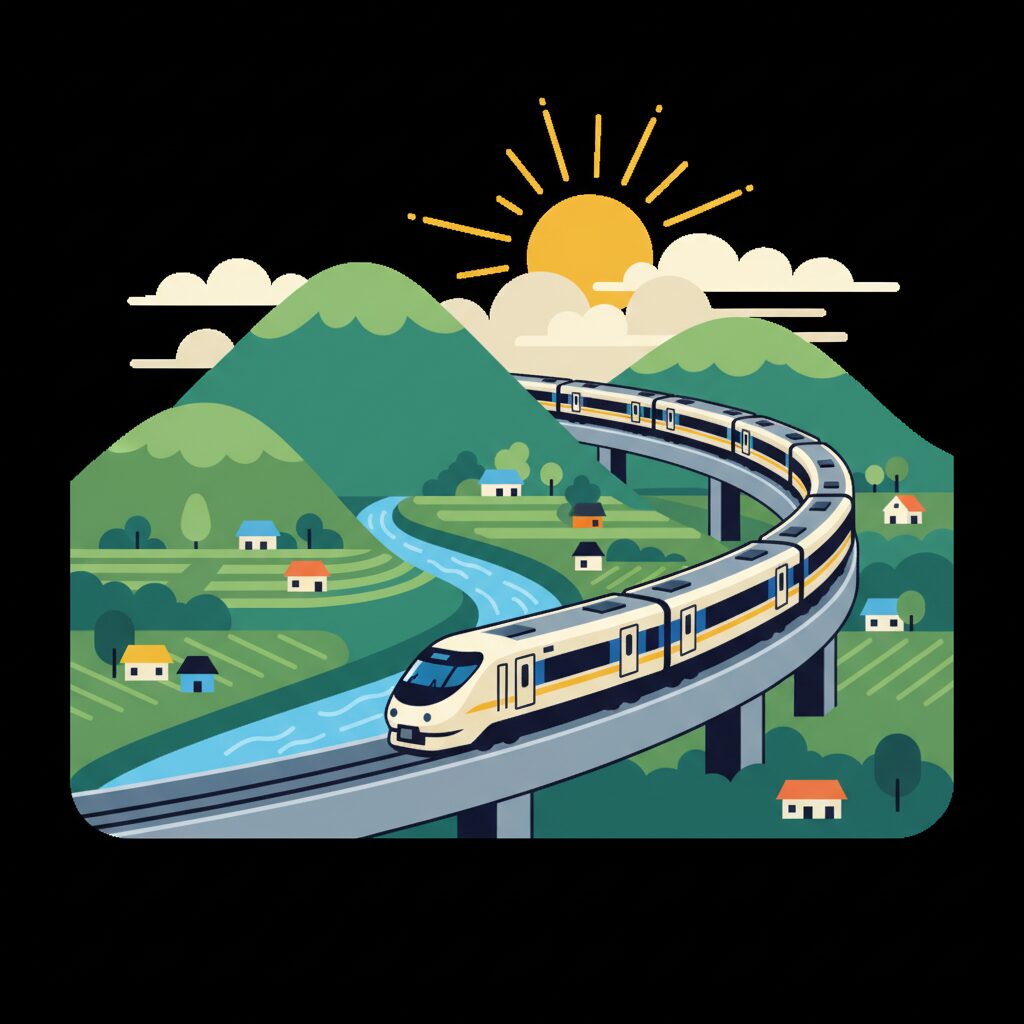
But at Kawanishi-Noseguchi, everything shifts. Stepping off the polished maroon Hankyu express and crossing the platform, you enter another world. The Nose Dentetsu train waits, feeling like a relic from a bygone era. Its cars are shorter, painted in a simpler, rustic green and cream. The interior favors functional durability over corporate sleekness. The engine hums lower, a gentle rumble rather than a high-tech rush. The change is sharp and tangible. The air on the platform seems to shift. The `sekkachi` energy fades, replaced by a collective sigh. You’ve crossed a threshold, an invisible line separating the city of work from the realm of home.
The passengers reflect this change as well. Sharp suits give way to comfortable jackets and worn denim. Schoolchildren with oversized backpacks chase each other through the aisles. Elderly couples, dressed for hiking, study paper maps with quiet focus. The conversations around you no longer center on quarterly reports or client meetings. Instead, two women talk about the price of daikon radishes at the local market. A grandfather points to a distant mountain and tells his granddaughter a story about the temple at its peak. The dialect remains Osaka-ben — direct and earthy — but the pace is slower, the topics grounded in the soil and the seasons. This transition is crucial to understanding the Osaka mindset. Unlike Tokyo’s endless, sprawling megalopolis where one neighborhood fades into the next for hours, Osaka has a distinct boundary. The city ends, and something else begins, often marked simply by a train platform. For many Osakans, this daily journey is more than a commute; it’s a ritual of transformation, a shedding of their urban skin to reveal a different self beneath. The train acts as a decompression chamber, gradually resetting the spirit from the city’s high pressure to the countryside’s gentle rhythm.
Satoyama Living: The Unspoken Contract Between People and Nature
Disembarking at Myokenguchi, the furthest stop on the line, feels like entering a different country. The air is heavy with the aromas of damp earth, woodsmoke, and flourishing greenery. The primary sounds are the chirping of insects and the whisper of wind through bamboo groves. This is the realm of `satoyama`, a term without a perfect English counterpart. It is neither wilderness nor farmland. It is a carefully managed environment—a patchwork of rice paddies, terraced vegetable gardens, small forests, and winding streams—that has coexisted delicately with human habitation for centuries. It is nature, but nature with intention, sculpted by generations who have tilled the earth, pruned trees, and maintained waterways.
Strolling through the cluster of homes and fields reveals the core philosophy here. There are no convenience stores, vending machines, or chain restaurants. Instead, you find something far more revealing: the `mujin hanbaijo`, or unattended vegetable stand. These are simple wooden racks or small tin-roofed huts beside the road, filled with the day’s produce. Perfectly knobby cucumbers, shiny eggplants, bunches of spinach still clinging to soil on their roots, and bags of freshly polished rice. Nearby sits a modest wooden or metal box with a slot in the top and a hand-painted sign showing the price, usually one hundred yen per item. There’s no shopkeeper, no security camera, no complicated system. Just produce and a place for the payment.
Here you witness the Osaka mindset in its purest form, stripped of urban bravado. A Tokyoite might admire the honesty, attributing it to naive, old-fashioned trust. But that’s a misinterpretation. This isn’t about blind faith in humanity. It’s about deeply rooted pragmatism and a strong sense of community. The unspoken rule is straightforward: we did the work to grow this food. You need food. Take what you need and pay the price we ask. It’s a direct, no-frills transaction, the rural counterpart to the Osaka merchant’s handshake deal. It’s founded on mutual benefit and shared understanding. There’s no need for a middleman or elaborate customer service rituals. The system functions because everyone knows their role. Having someone stand here all day is inefficient—poor value, or `kechi`. Cheating by not paying breaches the community contract, introducing needless and harmful complications into an otherwise smooth relationship.
This hyper-local, trust-based commerce contrasts sharply with the automated, impersonal efficiency of a Tokyo supermarket, where every exchange is governed by technology and corporate rules. In northern Osaka’s `satoyama`, the system is the community itself. It rests on the shared assumption that everyone is a neighbor, even passing strangers. It stands as a quiet affirmation that society works best not through strict rules and surveillance, but through a collective agreement to be practical and fair. This reveals a core truth about Osaka culture: it values human connection and tangible results over abstract ideals or polished façades.
The People of the North: A Different Flavor of Osaka Directness
Engaging with the residents of these northern villages is a learning experience in itself. The well-known Osaka friendliness is present, but it manifests in a different dialect of the same language. In the lively markets of Namba or Shinsaibashi, friendliness often feels like a performance—loud, theatrical, and a commercial tactic meant to put you at ease and open your wallet. It’s the shopkeeper who calls you `aniki` (big brother), jokes about your t-shirt, and hands you a free sample, all within thirty seconds. It’s charming, effective, and somewhat tiring. Here, in the quiet hills of Nose, the approach is less boisterous but equally direct.
While walking along a narrow path between rice fields, I encountered an old farmer tending his daikon radishes. He watched me approach, his expression a neutral curiosity. As I passed, he grunted a simple “Konnichiwa.” I replied in kind, and that was his opening. “You from around here?” he asked, not waiting for a reply. “No. Your shoes are wrong for these paths. Too clean. You’ll slip in the mud by the stream ahead. Where are you headed?” Before I could fully absorb his remarks and questions, he pointed with his soil-stained finger toward a trail I hadn’t noticed. “That way’s better. Fewer leeches after the rain.” Then he turned back to his radishes, ending the conversation. There was no pretense, no small talk, no `tatemae`—the polite, public facade so common in Japan. It was simply a flow of straightforward, practical information. He spotted a problem—a clueless outsider wearing unsuitable shoes—and offered a solution. Simple.
Later, at a tiny, family-run soba shop, the elderly woman who ran the place took my order then launched into a full-scale interview. “Where are you from? England? Oh, so far! Are you alone? Why? Don’t you have friends? What’s your job? Can you use chopsticks? Are you sure? You look like you might struggle.” The questions came like a rapid volley of arrows, sharp and fast. To an outsider, it might seem intrusive, even rude. But in the context of Osaka, it’s a way of connecting. It’s not nosiness; it’s about understanding you, about placing you on a mental map of the world. In many other rural parts of Japan, a stranger (`soto no hito`) is often met with polite, almost impenetrable reserve. You are a guest and treated with formal kindness, but a respectful distance is kept. In northern Osaka, that distance quickly disappears. The local mindset seems to be: if you’re here, you belong to this landscape, at least for the day. So let’s dispense with formalities and understand who we’re dealing with. This is a major misconception about Osaka. Its people aren’t “friendly” in the Western sense of being indiscriminately warm and smiley. Their friendliness stems from pragmatism and deep curiosity. They set aside social niceties to get right to the point—whether that point is the quickest route to the station, the quality of this year’s rice harvest, or who exactly this strange foreigner is and what brings them to their village.
Time, Efficiency, and the Rhythm of the Fields
In downtown Osaka, time is treated as a precious commodity. It is measured, traded, and above all, never squandered. The `sekkachi` culture is a point of local pride. Escalators are meant for walking, not standing (always on the right, naturally). Meals are ordered, served, and eaten with remarkable speed. The subways run on an exact schedule, timed to the second, and people move in harmony with this intense, human-made rhythm. This culture of efficiency has developed from centuries of commerce, where even a moment’s delay could mean a lost sale. It fuels Osaka’s economic strength with relentless forward drive.
Yet just thirty miles north, time follows an entirely different rhythm. The clock is replaced by the sun, and the calendar by the changing seasons. Walking through the `satoyama`, I observed people tending their fields, witnessing a different kind of efficiency. An elderly woman spent nearly an hour carefully weeding a small onion patch. Her movements were slow, intentional, and elegant. There was no rush or wasted motion. Every bend, pull, and step reflected a lifetime of experience. This was efficiency rooted in conservation, not speed. A young man repairing a terrace wall wasn’t rushing to finish; he was thoughtfully choosing each stone, testing its fit, ensuring the wall’s longevity. This wasn’t laziness, but a deep understanding of the task. Hastiness would lead to errors, and in farming, a mistake isn’t a missed deadline, but a ruined crop.
This duality is key to understanding those who live between these two worlds. The salaryman residing in Nose and commuting to Umeda is an expert at code-switching. He lives by the stopwatch during the workweek, navigating the city’s relentless pace. But on weekends, he swaps his leather shoes for rubber boots and tends his small vegetable garden, his internal clock slowing to the patient pace of tomato growth. This ability to function on two distinct temporal planes defines suburban Osakans. They embody both the impatience of the urban dweller and the patience of the farmer, applying each as the situation demands. This ties back to the central Osaka value of `kechi`. In the city, wasting time equates to wasting money, a cardinal sin. In the countryside, expending energy on rushed, careless work that must be redone is the greatest inefficiency. The aim remains the same—to maximize value and minimize waste—but the meaning of “waste” is beautifully and profoundly different. This contrasts sharply with Tokyo, where the urban buzz feels pervasive, an underlying anxiety present even in parks and residential areas. Tokyo is always switched on. The great advantage of northern Osaka is knowing when to turn off.
The Aesthetic of the Practical: No Room for Tokyo Polish
The visual landscape of the Nose region exemplifies the Osaka aesthetic, which can be summed up in two words: function over form. This is not an area carefully curated for tourists. It is a working environment, and it shows. A fence might be made from a jumble of weathered wood, bamboo poles, and a repurposed metal gate. A scarecrow could be an old flannel shirt stuffed with straw, topped with a faded baseball cap. Hand-painted signs, charming in their crooked lettering, point to a specific farm or a hidden shrine. Sheds are patched together with mismatched sheets of corrugated tin, their colors faded by sun and rain. Mud-caked farm equipment sits where it was last used, ready for the next day’s work.
For someone used to the polished perfection often found in tourist-heavy areas around Tokyo or Kyoto, this may appear messy or neglected. In places like Kamakura or Hakone, there is often a deliberate effort to preserve a certain historical or natural aesthetic. Every detail feels intentional, every view carefully framed. It is beautiful, but it can also feel like a museum display. The satoyama of Osaka is not a display; it is a workshop. The priority here isn’t to create a picturesque scene for visitors but to get the job done efficiently and economically. Why buy a new, uniform fence when a patchwork of available materials will keep the deer out just as effectively? Why spend money on a professionally printed sign when a can of paint and a piece of scrap wood will do? This is the honne—the true, unvarnished reality—of Osaka culture made visible in the landscape. It is raw, genuine, and refreshingly unpretentious.
This same principle explains much about the city itself. It’s why some of the best food in Osaka is served in tiny, cramped restaurants with greasy walls and sticky floors. The owner has invested everything in the quality of the ingredients and the perfection of the recipe, not in the interior design. It’s why Osaka fashion can seem louder, more eclectic, less concerned with fitting into a specific, cohesive “look” than in Tokyo’s stylish districts. It’s about individual expression and comfort, not conforming to a preconceived notion of elegance. This deeply ingrained pragmatism, this focus on substance over style, is often misunderstood by outsiders as a lack of refinement. But for Osakans, it is the ultimate refinement. It is the art of stripping away all that is non-essential and zeroing in on what truly matters. A beautiful view is nice, but a bountiful harvest is better. An elegant restaurant is pleasant, but a delicious, life-changing bowl of ramen is what you remember forever.
A Weekend of Quiet Reflection: What It All Means for Life in Osaka
Returning to the concrete canyons of Umeda after a weekend spent along the Nose Dentetsu is a startling experience. The noise, the crowds, the sheer pace of life feels overwhelming. Yet the city also appears different. It is no longer a monolith of urban intensity. I now see it as one half of a whole, a dynamic entity that draws energy not only from its commercial core but also from its deep roots in the productive soil to the north. The trip wasn’t an escape from Osaka; it was a deeper immersion into its complex identity.
For anyone thinking of making a life here, this is a crucial, often overlooked chapter of the Osaka story. Living in Osaka doesn’t have to mean a tiny apartment in a high-rise. The city’s excellent public transport network, exemplified by humble local lines like the Nose Dentetsu, makes a completely different lifestyle accessible. It offers a range of possibilities perhaps broader than that of any other major Japanese city. You can live in the heart of the action, with the entire city at your feet. Or you can reside in a quiet village surrounded by rice fields, where neighbors leave fresh vegetables on your porch, and still be at your downtown office in under an hour. This geographic and cultural flexibility is one of Osaka’s greatest strengths.
This journey showed that the well-known stereotypes of Osaka—the merchant’s pragmatism, the obsession with value, the straightforwardness, the humor—are not just products of the urban marketplace. They are deeply rooted in the land itself. The farmer calculating the yield of his field and the shopkeeper tallying his daily profit are playing the same game, just on a different board. The mujin hanbaijo operates on the same principles of trust and mutual benefit as a long-standing business relationship in the Senba merchant district. The Nose Electric Railway is more than just a train line. It is a link between the two poles of Osaka’s identity, connecting the frantic energy of its commercial heart to the slow, steady rhythm of its agricultural soul. To truly understand Osaka, you have to ride that train. You have to walk those muddy paths. You have to see that the city’s neon glow is fueled by the quiet, tireless, and profoundly practical work being done in its green and tranquil backyard.