The first time it happened, I was completely lost. Not just in the labyrinthine tunnels of Umeda Station, but conversationally. I had just moved from Tokyo, an event planner chasing a new vibe, a different rhythm. I asked an older woman, a classic Osaka oba-chan with a leopard-print scarf and an aura of unstoppable energy, for directions to a small coffee shop. She lit up, her eyes crinkling. She gave me a series of rapid-fire instructions involving a red sign, a shop selling takoyaki, and a slight incline I probably wouldn’t notice. Then, right at the end, after painting this vivid, confident picture, she hit me with it. A little shrug, a playful grin, and four simple syllables: “Shiran kedo.” I just stood there, blinking. “I don’t know, though.” What did she mean, she doesn’t know? She had just spent a full minute explaining it with the conviction of a seasoned general. Was this a test? A joke? Was I supposed to ignore everything she just said? In Tokyo, a statement is a statement. Information is delivered with a sense of responsibility. This felt like the conversational equivalent of a magician revealing the trick right after performing it, leaving you more confused than before. It took me months of living here, of being peppered with this phrase daily, to realize that “shiran kedo” isn’t a retraction. It’s not a sign of uncertainty. It’s a key. It’s the secret password that unlocks the entire operating system of Osaka, revealing how people here think, connect, and navigate the beautiful, chaotic, and deeply human landscape of their city. It’s the sound of Osaka itself.
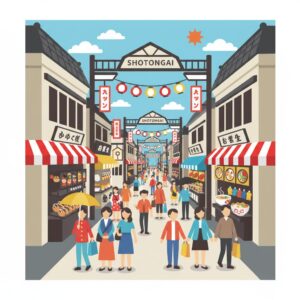
To truly grasp this unique conversational rhythm, you can experience it firsthand in the vibrant local atmosphere of an Osaka shotengai.
The Dictionary vs. The Street: What ‘Shiran Kedo’ Actually Means
To truly understand Osaka, you need to grasp this phrase. It drifts through the shotengai shopping arcades, reverberates in the izakayas of Namba, and is quietly exchanged among colleagues in the office kitchens of Yodoyabashi. It’s as much a part of the city’s auditory landscape as the clatter of train lines and the sizzle of okonomiyaki on a grill. But to really get it, you have to toss the dictionary aside and start listening with your intuition.
The Literal Translation: “I Don’t Know, Though”
Let’s first break it down to see why it’s so perplexing on paper. The phrase consists of two parts. “Shiran” is a casual, somewhat blunt Kansai-ben (regional dialect) form of “shiranai,” meaning “I don’t know.” It’s direct and informal. The second part, “kedo,” is the Japanese equivalent of “but” or “though.” So, literally, when someone says it, they mean, “I don’t know, but…” or more commonly at the end of a sentence, “…but I don’t know.” This structure confuses many outsiders, myself included. In standard Japanese, especially in the more formal Tokyo contexts, this phrasing suggests an immediate contradiction. It’s like saying, “The sky is blue, but I might be wrong.” It undercuts the previous statement, making the speaker sound unsure or unreliable. For foreigners learning Japanese from textbooks, it’s baffling. For Tokyoites used to a more measured, precise speech, it can seem irresponsible. Why offer information only to immediately disown it? This linguistic stumbling block often causes people to dismiss the phrase as a quirky local oddity or proof that you can’t trust what anyone says in Osaka. But that’s just the beginning.
The Real-World Nuances: A Swiss Army Knife of Communication
In reality, on Osaka’s streets, “shiran kedo” is a versatile, multi-functional tool. Its meaning shifts dramatically depending on context, tone, and the relationship between speakers. It’s less about the literal words and more about the social role it plays. Think of it as punctuation that adds color, emotion, and a distinctly Osaka flavor to a sentence. It can soften a statement, serve as a disclaimer, deliver a punchline, or act as a bridge. The first and perhaps most common use is as a softener. Osakans are known for their directness and expressiveness. They deliver opinions straightforwardly but add “shiran kedo” to prevent sounding arrogant or aggressive. It’s conversational padding, a cushion of humility. For example, a friend might say, “That movie was terrible, a complete waste of time… shiran kedo.” The central opinion is strong, but the phrase adds, “Hey, that’s just my perspective—you might see it differently.” It transforms a potentially confrontational opinion into a friendly offering, signaling openness to discussion. This is a huge part of local communication: expressing strong feelings without shutting down the conversation. Another key role, considered by many as its primary function, is the responsibility-dodger. This reveals Osaka’s pragmatic, merchant-city roots. For instance, “You should take the Sakaisuji Line; it’s much faster to get to Tennoji from here… shiran kedo.” Here, the speaker offers advice based on experience but subtly signals, “This is my best guess; schedules can change, so the final decision is yours.” It’s a verbal handshake that shifts responsibility onto the listener. It’s not laziness or evasion, but a reflection of a worldview where everyone is expected to be savvy and self-reliant. It says, “I’m helping you out, but you’re in charge of your own journey.” This is an efficient way to assist without taking liability for the outcome. Sometimes, it simply serves as a softer way to end a thought, like a conversational period gentler than a full stop. It can trail off a sentence, marking that you’ve made your point and are now passing the conversational baton. Lastly, it’s a masterstroke for humor. Osakans love to joke, and “shiran kedo” can be appended to the most obvious or absurd statements as a dry, witty punchline. For example, “Wow, it’s really hot today… shiran kedo.” Spoken on a scorching August afternoon, it’s a shared, ironic nod to the obvious. Understanding which of these functions is in play is the art of listening in Osaka.
Osaka vs. Tokyo: A Tale of Two Communication Styles
To fully grasp the brilliance of “shiran kedo,” it’s helpful to compare it with Tokyo’s communication culture. Having lived in Tokyo my entire life before moving here, the contrast feels like night and day. It’s not about one being superior; rather, each is tailored to entirely different objectives. Tokyo prioritizes precision, while Osaka emphasizes connection. This single difference explains nearly everything.
Tokyo’s Pursuit of Precision and Politeness
In Tokyo, conversation resembles a delicate dance. There is great value placed on delivering information that is completely accurate and verified. If you ask for directions in Shinjuku, people are more likely to check Google Maps on their phones and provide you with a precise, step-by-step route. If they are even a bit uncertain, they will apologize profusely and admit they don’t know. Offering well-meaning but possibly incorrect guesses is socially risky, as it may cause inconvenience, imply incompetence, and disrupt the efficient flow of society. The tendency is to err on the side of caution, with silence preferred over mistakes. This connects to larger cultural ideas like tatemae—the public face presented to others—and honne, one’s true feelings. In Tokyo, tatemae often means politeness, indirectness, and avoiding definitive statements that might be proven wrong or cause conflict. The aim is to preserve harmony, or wa, ensuring interactions run smoothly and predictably. There is a tangible responsibility attached to one’s words; people are expected to stand by them. This fosters a society that is highly reliable and efficient, though it can sometimes feel formal and distant.
Osaka’s Embrace of Connection and Banter
Osaka moves to a different rhythm. The main purpose of many casual conversations is not perfect data transmission but forming a human connection, even if brief. It’s about the back-and-forth, the nori, or the shared conversational rhythm. An Osakan would prefer to offer slightly inaccurate advice with a warm smile than leave you hanging with a polite but cold, “I’m sorry, I cannot help you.” The interaction itself is central. “Shiran kedo” serves as the engine enabling this. It lowers the stakes for everyone involved. For the speaker, it alleviates the pressure to be flawless. For the listener, it signals the information is a friendly gesture, not a sworn statement. It smooths social interactions, allowing for fluid, spontaneous, and ultimately more personal exchanges. This approach is deeply rooted in the city’s history as a merchant hub, akindo. In marketplaces, quick thinking, adaptability, and people skills are essential. Relationships are built through lively banter and negotiations, with an understanding that not everything is fixed. Conversations are a lively, fast-paced game of catch, and “shiran kedo” gently tosses the ball back. It keeps the dialogue moving, saying, “Here’s my move; now it’s your turn.” This creates a culture far more direct, open, and lively than Tokyo’s. People share opinions easily, laugh quickly, and engage with strangers readily because the social system permits greater imperfection and playfulness.
Living with ‘Shiran Kedo’: Practical Scenarios and How to Respond
So, here you are, living your life in Osaka. You’ll hear this phrase dozens of times a day. Learning to navigate it is an essential survival skill, but more importantly, it’s your gateway to feeling like a genuine local. The trick is to understand the context and respond not to the literal words, but to the speaker’s intent.
Getting Directions in Umeda
Picture yourself trying to locate a specific restaurant in the confusing underground city beneath Umeda Station. You stop a salaryman rushing by and ask for directions. He pauses, squints, and says, “Ah, I think I know that place! Go straight down this corridor until you see the big yellow sign for the pharmacy. Turn left there, walk for about two minutes, and it should be on your right, next to a bookstore. Shiran kedo.” Now, your Tokyo-trained brain might panic, fixating on the disclaimer. Does he really not know? Is he just leading me astray? The right reaction is to completely disregard the literal meaning of the last phrase. He’s offering his best, good-faith advice. He’s about 90% sure he’s correct but acknowledges that Umeda is a maze and might have confused the bookstore with a shoe store. Your reply should be a warm, grateful, “Arigatou gozaimasu! I’ll give it a try!” Smile and show appreciation for the effort. Take the guidance as a useful hint, not a precise GPS coordinate. Then follow his directions while keeping your own eyes open and trust your judgment. You’re collaborating; he gives you the starting point, and you’re responsible for finding the destination.
Recommendations at an Izakaya
You’re out with a new friend from Osaka at a bustling izakaya in Shinsaibashi. The menu is enormous, and you ask what’s good. Your friend’s eyes sparkle. “Oh, you absolutely have to try the kushi-katsu. They make it perfectly here—the batter is so light. It’s the best in the entire Minami area. Shiran kedo.” Here, the phrase doesn’t indicate doubt about the food’s quality. Quite the opposite. It’s a way to enthusiastically amplify the recommendation without sounding like a pompous food critic. It’s a performance of passion. He’s saying, “In my humble but very strong opinion, this is the best, but hey, taste is subjective, right?” It makes his confident recommendation feel inclusive and friendly rather than commanding. The only appropriate response is with equal enthusiasm: “Okay, you’ve convinced me! Let’s order a big plate!” By doing so, you’re not just ordering food; you’re joining in the shared excitement and playful banter that define Osaka’s social life.
Serious Conversations and Workplace Nuances
This is where it becomes crucial. Is “shiran kedo” ever a warning sign? Absolutely. While in casual settings it mostly serves as social lubrication, in more serious or professional conversations, its meaning becomes much sharper. It turns into a clear and deliberate disclaimer of responsibility. Suppose you’re discussing a project deadline with a colleague. They might say, “I think the final report is due on Friday, so you should probably submit your part by Thursday morning. Shiran kedo.” This is not a casual suggestion. It’s a bright, flashing caution signal. It means, “My understanding is that the deadline is Friday, but I haven’t checked the official email or project plan. It’s now your responsibility to confirm this.” Here, you should respond, “Thanks for the heads-up. I’ll double-check the official schedule right away.” You need to take the hint seriously. Osakans are fully capable of being precise and professional. When stating a confirmed fact, they will do so directly, without the trailing phrase. The presence of “shiran kedo” in a serious discussion is a purposeful signal that the information is unverified and should be treated accordingly. Ignoring this cue can cause real problems. Understanding this distinction is the final test in mastering the art of Osaka communication.
The Deeper Meaning: What ‘Shiran Kedo’ Reveals About Osaka’s Soul
After a while, you begin to hear “shiran kedo” not merely as a verbal tic, but as a subtle piece of philosophy repeated again and again. It offers a glimpse into the city’s collective mindset, revealing a worldview that is profoundly pragmatic, communal, and refreshingly grounded.
A Culture of Mutual Responsibility
The phrase sets a default expectation that everyone in the conversation is an active participant. It dismisses a passive communication model where one person holds all the knowledge and the other is merely a passive receiver. By inserting “shiran kedo,” the speaker is essentially saying, “Here’s my piece of the puzzle. Now it’s your turn.” It nurtures a sense of shared responsibility in figuring things out. It suggests that the listener is smart and capable enough to take the information, assess it, and respond accordingly. This fosters a more balanced conversational dynamic. It’s less hierarchical and more cooperative. It’s a culture where people support each other, but no one is expected to bear the full burden of another’s problems. It’s a community of resourceful individuals who trust one another’s ingenuity.
Embracing Imperfection and Spontaneity
At its heart, “shiran kedo” is a rejection of perfectionism. Life is messy. Information is often incomplete. Plans shift. This phrase verbally acknowledges that truth. It suggests that offering a good-enough solution and moving forward is better than being stuck in pursuit of absolute certainty. This philosophy is reflected throughout the city itself. Osaka is less polished and tightly controlled than Tokyo. It’s a bit more chaotic, more organic, with layers of history and commerce intertwined messily. The streets of Tenjinbashisuji Shotengai, the crowded, lively alleys of Shinsekai—all capture this spirit of celebrating a touch of beautiful imperfection. The people mirror this as well. They’re willing to improvise, to experiment, and to share a laugh when things don’t go exactly as planned. “Shiran kedo” is the motto of this spontaneous, resilient, and adaptive spirit.
The Foundation of Osaka ‘Friendliness’
Everyone says that people in Osaka are friendly. It’s the city’s most common cliché. But “shiran kedo” helps clarify why that friendliness is so widespread. Genuine friendliness isn’t just about politeness; it’s about a readiness to engage. The fear of being wrong or saying the wrong thing can be a significant barrier to conversation. In Tokyo, that fear sometimes results in polite but distant interactions. In Osaka, “shiran kedo” serves as a social safety net. It makes it easy and low-risk for anyone to jump into a conversation, offer help, share a joke, or voice an opinion. It eases the pressure and opens the door to sincere human connection. That oba-chan who gave me directions in Umeda wasn’t just providing information; she was creating a brief, meaningful connection. “Shiran kedo” was the lubricant that made that moment flow smoothly. It’s the tool that helps a city of millions feel like a network of approachable, helpful, and funny individuals.
When I first arrived, “shiran kedo” was a source of confusion. It was a verbal puzzle I couldn’t decipher—a sign that I was an outsider who just didn’t understand. But now, I hear it and smile. I realize it’s not a barrier; it’s an invitation. It invites a more relaxed, playful, and cooperative way of relating. It’s the city’s way of saying, “We don’t have all the answers, and that’s alright. Let’s figure it out together.” The next time you’re in Osaka and someone offers advice followed by that signature phrase, don’t hear uncertainty. Hear warmth. Hear trust. Hear humor. You’re not just receiving information; you’re being welcomed into an ongoing, imperfect, and wonderfully vibrant conversation that is life in this city. Now you’re in on the secret. And that makes all the difference.