The first time it happened, I was completely lost. It was my second week at a small design firm in Honmachi, Osaka. The clock hit six, and Tanaka-bucho, our section chief, stood up and declared, “Alright team, let’s go for a quick one!” A wave of relief and nervous energy washed over the office. This was it. My first real Japanese nomikai, the infamous after-work drinking party. We piled into a nearby izakaya, a wonderfully chaotic place buzzing with the energy of salarymen loosening their ties. The air was thick with the scent of grilled chicken and stale cigarette smoke, a perfume I’d come to associate with authentic, unpretentious fun. We squeezed into a booth, and a server appeared, ready to take our order. Before I could even open the sticky, laminated menu to find the highball section, a chorus erupted around me, led by the department chief: “Toriaezu biru!”
One after another, my colleagues nodded in agreement. “Biru.” “Same.” “Beer for me.” My Japanese was functional, but this was a new phrase. “Toriaezu… for now? Beer for now?” I thought. Does that mean they’ll have something else later? Does everyone really want the exact same thing? What if I wanted a lemon sour? Was I allowed to break the sacred beer pact? A mild panic set in. I felt the weight of ten pairs of eyes on me, the lone foreigner fumbling with the menu. In that moment of hesitation, my colleague Sato-san nudged me with a grin. “Just get the beer,” he whispered. “It’s easier. It’s faster. We can get to the ‘kanpai’ part.” And so, I mumbled my first “toriaezu biru,” and a frosty mug of Asahi Super Dry appeared before me moments later. It was more than just a drink order. It was my first lesson in the unspoken language of Osaka’s working culture, a social contract disguised as a beverage choice.
This single phrase is a key that unlocks so much about the Osakan mindset—its pragmatism, its impatience, its deep-seated need for communal rhythm, and its subtle departure from the more rigid formalities of Tokyo. For anyone trying to understand what daily life in Osaka is really like, forget the tourist guide to Osaka Castle for a moment. Pull up a seat at the izakaya, because the real education begins with that first, unified call for beer.
This pragmatic approach to social efficiency is also evident in Osaka’s unique cafe and coworking culture, where the merchant mindset prioritizes value and community.
The Unspoken Agreement: Why the First Drink is Almost Always Beer
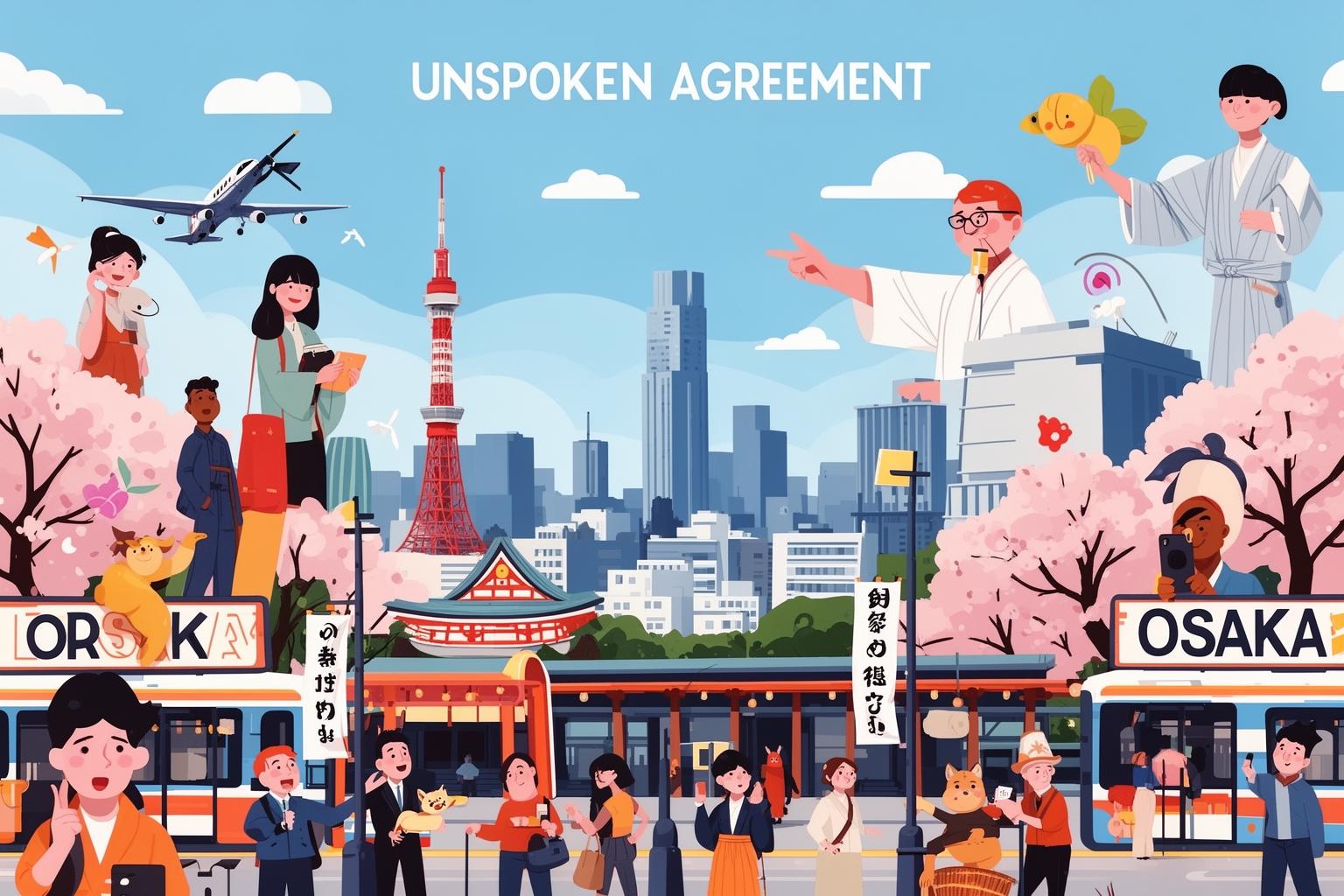
At its core, “toriaezu biru” is a testament to social efficiency, embodying the Osakan spirit defined by an unwavering pursuit of efficiency. This city was shaped by merchants rather than samurai. Time is money, and wasting it is considered the greatest transgression. This mindset clearly influences the first five minutes of any after-work gathering. The main objective isn’t to cater to individual tastes but to get a drink into everyone’s hand as quickly as possible, so the evening can officially begin with a collective “Kanpai!”
Speed and Efficiency: The Osakan Impatience
Picture the scenario from the server’s point of view. A group of twelve exhausted office workers just takes their seats. If each person carefully scans the menu, debates a gin and tonic versus a shochu highball, and then orders something different, the complexity skyrockets. The bartender must prepare a dozen distinct drinks. It’s slow, inefficient, and frankly frustrating. But an order of “Twelve beers, please!” is pure simplicity. The server grabs twelve identical mugs, pulls the tap twelve times, and delivers the whole round at once. Everyone is served simultaneously—a crucial factor for the communal toast. This isn’t merely about easing the staff’s workload; it reveals a core Osakan value known as sekkachi, a restless impatience. They aim to keep things moving. There’s a genuine desire to cut through delays and get straight to the point, whether in business deals or drinking sessions. Lingering over a drink menu for ten minutes while others wait is seen as stalling progress. Beer represents the easiest route to social interaction. It’s the starting signal for the night, and in Osaka, no one appreciates a false start.
The Ritual of the First ‘Kanpai’
The kanpai, or cheers, is far from a casual toast. It’s a meaningful cultural ritual signaling a clear division. On one side lies the world of work, with its hierarchies, deadlines, and professional facades. On the other side is the nomikai, a temporary space where those structures soften. It’s the moment the group collectively exhales. Until the first clink of glasses, the evening hasn’t truly begun. The “toriaezu biru” custom stems directly from the significance of this moment. By swiftly providing everyone the same simple drink, the group synchronizes. The beer functions as a placeholder, a temporary default that allows the critical first kanpai to happen smoothly. It’s a shared expression that says, “We’re all in this together, right now.” Delaying this for the sake of a picky drink choice feels, to Osakans, like missing the essence entirely. The content of the glass matters less than raising it in unison.
The Great Equalizer
There’s a subtle, beautiful democracy in the first round of beer. When the department chief, middle manager, ambitious newcomer, and quiet accountant all hold identical frosty mugs, a momentary equality emerges. For that brief instant, rank and seniority fade visually. It’s a powerful non-verbal signal that the rigid office hierarchy is set aside. This is especially evident in Osaka, where the boundaries between boss and subordinate feel more flexible and casual than in Tokyo. The shared beer symbolizes a shared identity as team members, not merely job titles. It conveys, “Tonight, we’re not just colleagues; we’re drinking buddies.” This initial act of uniformity ironically allows individuality and honest opinions to surface later in the evening. By starting on the same page with the same drink, everyone is permitted to relax and be themselves. It’s a unifying gesture that opens the door for real conversations, creating a level playing field where a junior employee might feel comfortable expressing a genuine view or even teasing the boss—something far more common, and expected, in Osaka.
From Formalities to Frankness: Navigating the Evening’s Arc
An Osaka nomikai is not a fixed event; it unfolds like a story with a clear beginning, middle, and end. It’s a carefully guided, though seemingly chaotic, transition from professional etiquette to sincere, unfiltered communication. Grasping this flow is key to understanding the significance of social drinking in Osaka’s workplace culture. The “toriaezu biru” is just the opening movement of a far more intricate symphony of food, drink, and conversation.
Act One: The ‘Toriaezu’ Overture and the Ritual of ‘O-shaku’
The first twenty minutes are a whirlwind of activity. The beers arrive. Before you even sip your own glass, you must observe the scene. This is when o-shaku, the custom of pouring drinks for others, takes place. You’ll see colleagues picking up beer bottles and making their rounds, starting with the highest-ranking person at the table. They approach the boss, hold the bottle with two hands (one on the bottle, the other supporting the bottom or the pouring hand), and carefully fill the glass without overfilling it. The recipient usually holds their glass and lifts it slightly to aid the pour. This gesture shows respect and attentiveness. Your turn will come. A senior colleague, or the person sitting next to you, will pour your glass. It’s essential that you never pour your own drink from a shared bottle, as that is viewed as somewhat anti-social, signaling detachment from the group’s mutual give-and-take. The conversation in this initial phase is typically light and safe—a warm-up. Topics might include the weather, a recent project, or a funny office incident from the day. The beer acts as a social lubricant, a prop to hold while navigating these first, slightly more formal exchanges. It’s the gentle hum of the engine before the car truly starts moving.
Act Two: The Food Arrives and Conversations Loosen Up
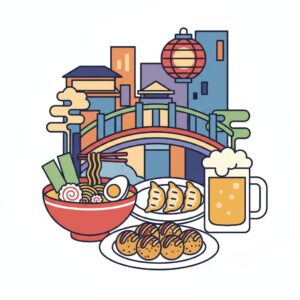
This is when the evening truly gains momentum, especially in Osaka, a city whose unofficial motto is kuidaore, or “eat until you drop.” A flow of shared plates begins to crowd the table: glistening skewers of yakitori, heaps of crispy karaage (fried chicken), bowls of vibrant green edamame, and perhaps a platter of sashimi. The food is not incidental; it’s central to the experience. Sharing dishes naturally fosters interaction. You’re passing plates, recommending a particularly good tempura piece, or playfully competing for the last grilled squid. This communal eating breaks down barriers. With the arrival of the food comes the second round of drink orders. The “toriaezu” phase is officially over. Now is the time to order that highball, a glass of sake, or whatever you truly prefer. Individual personalities begin to shine through their drink choices. Conversations deepen; work remains a common topic, but the tone shifts considerably. Polite small talk gives way to honne—one’s true feelings. Subordinates might voice frustrations about a project, often with humor, while managers might reveal their own worries about deadlines. This is where genuine team-building occurs—not in a sterile conference room with trust falls, but over shared gyoza and a third drink, where people feel safe enough to be candid. In Osaka, this openness often comes with loud laughter and playful teasing.
Act Three: The ‘Shime’ and the Crucial ‘Nijikai’ Question
As the evening winds down, someone will inevitably suggest ordering a shime dish. Shime, meaning “to tie up” or “to close,” is the culinary finale of the meal. It’s almost always a carb-heavy dish designed to soak up alcohol and provide a satisfying conclusion. Common choices include onigiri (rice balls), ochazuke (rice with tea poured over it), or a shared bowl of yakisoba. The arrival of the shime clearly signals that the main event is coming to an end. But the night often isn’t over. As the bill is settled, the most important question of the latter part of the evening arises: “Nijikai, iku?” (“Shall we go for a second round?”). The nijikai is the after-party, usually held at a different, typically smaller bar, or perhaps a karaoke box. This is a pivotal moment. Attendance is rarely mandatory, and Osakans, known for their practical nature, generally understand if someone needs to decline. The decision often depends on group dynamics and, crucially, the last train schedule. Those living farther away will cite their shuden (last train) as a perfectly valid, widely accepted reason to head home. For those who remain, the nijikai is where all filters come off. Conversations become even more personal, laughter louder, and bonds stronger. It’s an optional but frequently essential part of the full nomikai experience.
It’s Not Just an Accent: How Osaka Drinks Differently from Tokyo
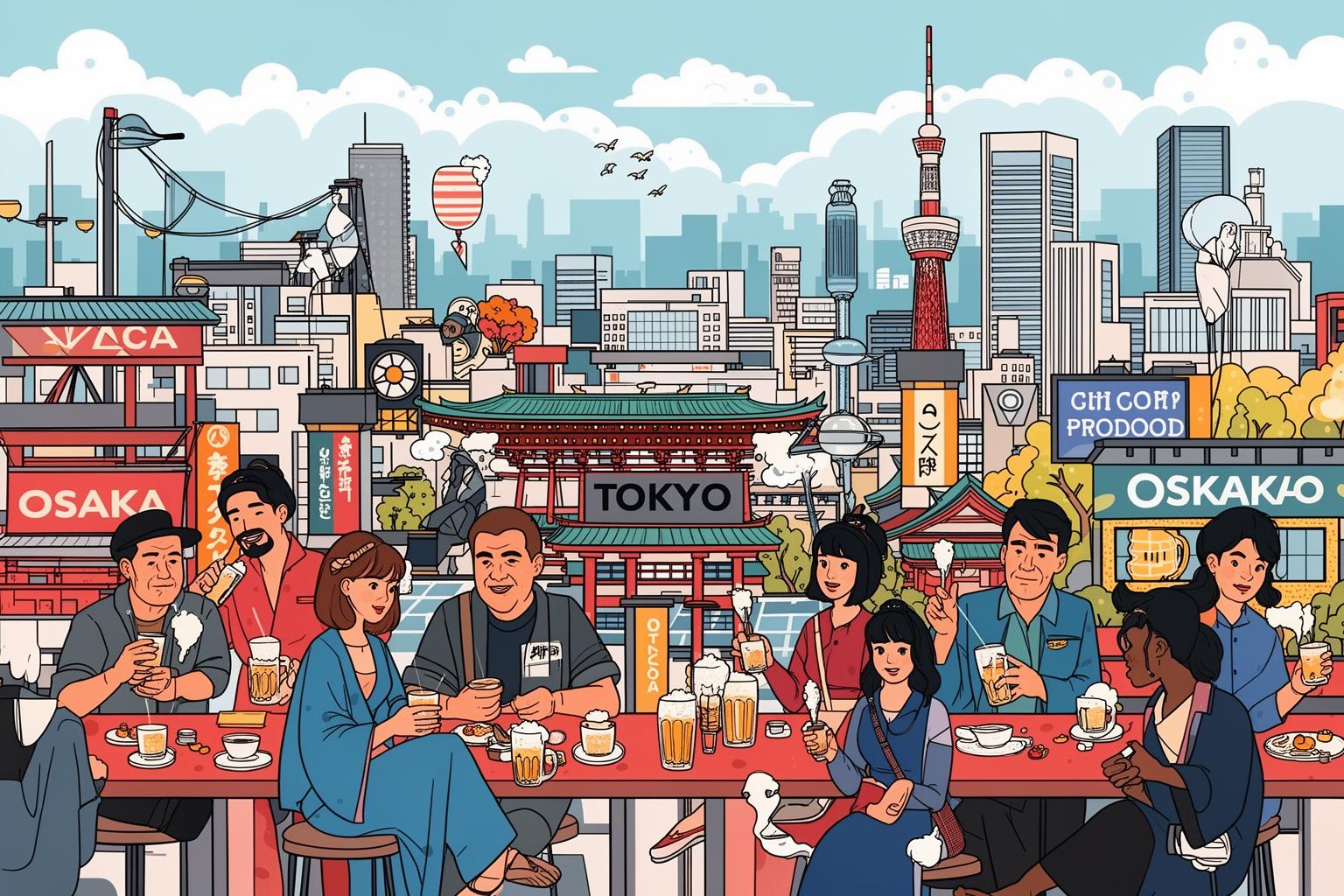
To those unfamiliar, a nomikai in Osaka might appear much like one in Tokyo: beer, food, and colleagues unwinding together. Yet living here reveals a profound difference in atmosphere, communication, and expectations. The contrast in how Japan’s two largest cities socialize after work reveals much about their core identities. It’s a story of two distinct urban cultures—one rooted in form and structure, the other in flow and feeling.
‘Nori’ vs. Formality: The Essential Vibe Check
While a Tokyo nomikai can sometimes feel like a continuation of the workday—a setting to demonstrate respect and uphold hierarchy—an Osaka nomikai represents a conscious break. The hallmark of an Osaka gathering is nori. Difficult to translate directly, nori captures the vibe, rhythm, and collective energy of the group. Good nori means everyone is on the same wavelength, helping create a fun, lively environment. In Tokyo, seating arrangements tend to follow rank (kamiza for the boss, shimoza for juniors), and a boss may start with a semi-formal speech appreciating everyone’s efforts. Conversely, an Osaka boss is more likely to open with a self-deprecating joke or begin teasing their closest lieutenant right away. In Osaka, the goal isn’t merely to fulfill a social obligation; it’s to genuinely enjoy the moment and share laughter. The energy is louder, gestures larger, and emotions expressed more openly. Because nori is so important, active participation is key. Sitting quietly in a corner is more socially awkward in Osaka than in Tokyo, where such reserve might be viewed as respectful. In Osaka, you’re expected to jump enthusiastically into the conversation.
The ‘Boke’ and ‘Tsukkomi’ Dynamic at the Table
This lively conversational exchange follows the rules of manzai, a form of Japanese stand-up comedy rooted in Osaka. The core of manzai lies in the interplay between the boke and the tsukkomi. The boke is the clown, making absurd, confused, or silly remarks, while the tsukkomi acts as the straight man, quickly correcting the boke with a sharp response or playful tap. This dynamic isn’t confined to comedians on stage; it’s woven into everyday Osaka communication and shines at a nomikai. Someone might exaggerate (boke): “This karaage is so delicious, I could eat a hundred pieces!” Instantly, a colleague fires back (tsukkomi): “You’d have a heart attack before you hit twenty! Don’t be ridiculous.” Outsiders might mistake this for an insult or argument, but in Osaka, it signals closeness and wit. It’s a verbal game, a joint effort to generate humor. Being adept at tsukkomi is a prized social skill, showing you’re attentive, quick-thinking, and engaged in the group’s nori. This interplay makes conversations vibrant, unpredictable, and full of laughter—far removed from the more cautious, measured style common at formal Tokyo gatherings.
Cost Performance and the Delight of ‘Tachinomi’
Osakans are known for their almost religious devotion to kosupa—cost performance. Rooted in a merchant tradition, they excel at spotting good deals and strongly dislike being overcharged. This mindset deeply influences the city’s drinking culture. While Tokyo boasts flashy, upscale cocktail bars in places like Ginza or Roppongi, Osaka’s after-work scene thrives on an array of affordable, welcoming establishments. At the heart of this culture is the tachinomi, or standing bar. These no-frills spots often consist of little more than a counter where patrons stand side-by-side. Drinks are inexpensive, food simple yet tasty, and service fast. For many Osakan office workers, a tachinomi is the ideal pressure valve. You can pop in for a single beer and a plate of doteyaki (beef sinew stew) en route to the station, with no need for the expense or commitment of a full meal. This exemplifies Osakan practicality. This stands in contrast to a certain Tokyo culture pressure to appear at the “right” venue. In Osaka, the best place is simply the one offering the greatest value and most fun, regardless of how it looks. The focus is on the substance of the experience—good food, cheap drinks, and lively company—not on the venue’s appearance.
A Foreigner’s Survival Guide to the Osaka Nomikai
Navigating your first few nomikai can feel like tackling a complex puzzle without any instructions. The rules are unwritten, the pace is natural for locals, and the fear of making a social mistake is genuine. However, the good news is that Osakans tend to be forgiving and welcoming, especially when they see you’re trying. The aim is not just to get through these evenings but to enjoy them fully, as they offer one of the best insights into local culture and a great opportunity to build genuine relationships with your colleagues.
Your ‘Toriaezu Biru’ Options: What If You Don’t Like Beer?
This is the main source of anxiety for many non-Japanese participants. What if you don’t drink alcohol? Or if you really dislike beer? Do you have to force yourself for the group’s sake? Absolutely not. Although “toriaezu biru” is the default, it isn’t a strict rule. The spirit of the custom is about speed and unity, not about the beer itself. If you don’t drink beer, you have plenty of easy alternatives. You can simply order something else, as long as it’s just as quick and easy for the staff to prepare. A highball, lemon sour, or oolong tea are all perfectly acceptable choices for the first round. When ordering, you can say with a small, apologetic smile, “Sumimasen, biru ga nigate nanode, hai-boru de onegaishimasu.” (“Excuse me, I’m not a big fan of beer, so I’ll have a highball, please.”) No one will mind. If you avoid alcohol altogether, the same approach applies. Just order a soft drink. Saying “Toriaezu uroncha de!” (“Oolong tea for now!”) works great. You’re still following the “toriaezu” spirit of a quick, decisive first order, allowing the kanpai to proceed on schedule. Your colleagues will appreciate your participation in the toast far more than what’s in your glass.
Reading the Room: Mastering the Graceful Exit
Japanese nomikai have a reputation as marathon events that are hard to leave. Although there may be social pressure to stay for the nijikai (second party) and even the sanjikai (third party), Osaka’s practical mindset gives you the perfect, unquestionable excuse: the last train. The shuden is your get-out-of-jail-free card. Before the nomikai begins, check the time of your last train home. As the night goes on and talk of a second round begins, you can politely and regretfully mention that you need to leave soon to catch your train. Saying, “Sorosoro shuden nanode, osaki ni shitsurei shimasu.” (“My last train is soon, so I’ll be leaving first.”) is universally understood and respected. Another acceptable reason is an early start the next day: “Ashita asa hayai node…” (“Since I have an early morning tomorrow…”). The crucial part is to be polite, thank everyone for the evening, and offer a slight bow when leaving. Trying to sneak out unnoticed (the “Irish goodbye”) is generally seen as rude. A clear, courteous farewell is always the better approach.
The Bill: Unraveling the Mysteries of ‘Warikan’
When the check arrives, what happens next can be puzzling. The Japanese method of splitting the bill, known as warikan, isn’t always a simple equal division. While casual get-togethers among friends of the same age often split the bill evenly, a work nomikai follows different conventions. There is nearly always a subtle payment hierarchy. The highest-ranking person, like the department chief, will almost certainly pay a much larger share than anyone else, reflecting their status and responsibility for the team. The rest of the bill is divided among the others, but often not equally. Senior employees (senpai) may contribute a bit more, while the youngest, most junior members (kohai) are asked to pay a smaller, rounded-down amount. For instance, if the per-person cost is 4,650 yen, seniors might pay 5,000 yen and juniors only 4,000 yen. The best strategy is to have cash ready in various denominations. When someone starts collecting money, just ask, “Ikura desu ka?” (“How much is it?”) and pay the amount you’re told without fuss. Insisting on paying your exact calculated share or raising issues with using a credit card can disrupt the smooth, efficient close of the evening. The Osakan approach is to settle the bill quickly and without drama so everyone can move on to the next spot or head home.
More Than a Drink, It’s a Language
The ritual of “toriaezu biru” perfectly encapsulates the essence of life in Osaka. On the surface, it appears simple, even rigid—a strict expectation for the first drink order. Yet, beneath that surface lies a complex and deeply human system aimed at fostering efficiency, breaking down hierarchies, and speeding the path toward genuine connection. It serves as a social shortcut, a practical tool that resonates with the city’s merchant spirit. It communicates, let’s skip the trivial choices so we can focus on what matters: the conversation, the laughter, the food, and the bonding.
Grasping this moment means understanding that communication in Osaka is often indirect, woven through shared actions and unspoken understandings. The first beer isn’t really about the beer; it’s about the community. The loud laughter and sharp teasing are not signs of conflict but expressions of affection and camaraderie. The focus on cost performance isn’t about frugality; it’s about being smart and straightforward. For any outsider living here, moments like these become the true language lessons. They teach you the city’s rhythm and the mindset of its people far better than any textbook could. The next time you find yourself in an Osaka izakaya with colleagues, and the familiar call of “toriaezu biru” rings out, you’ll know: you’re not just ordering a drink. You’re embracing an invitation to join the lively, chaotic, and wonderfully human dance of Osaka life.