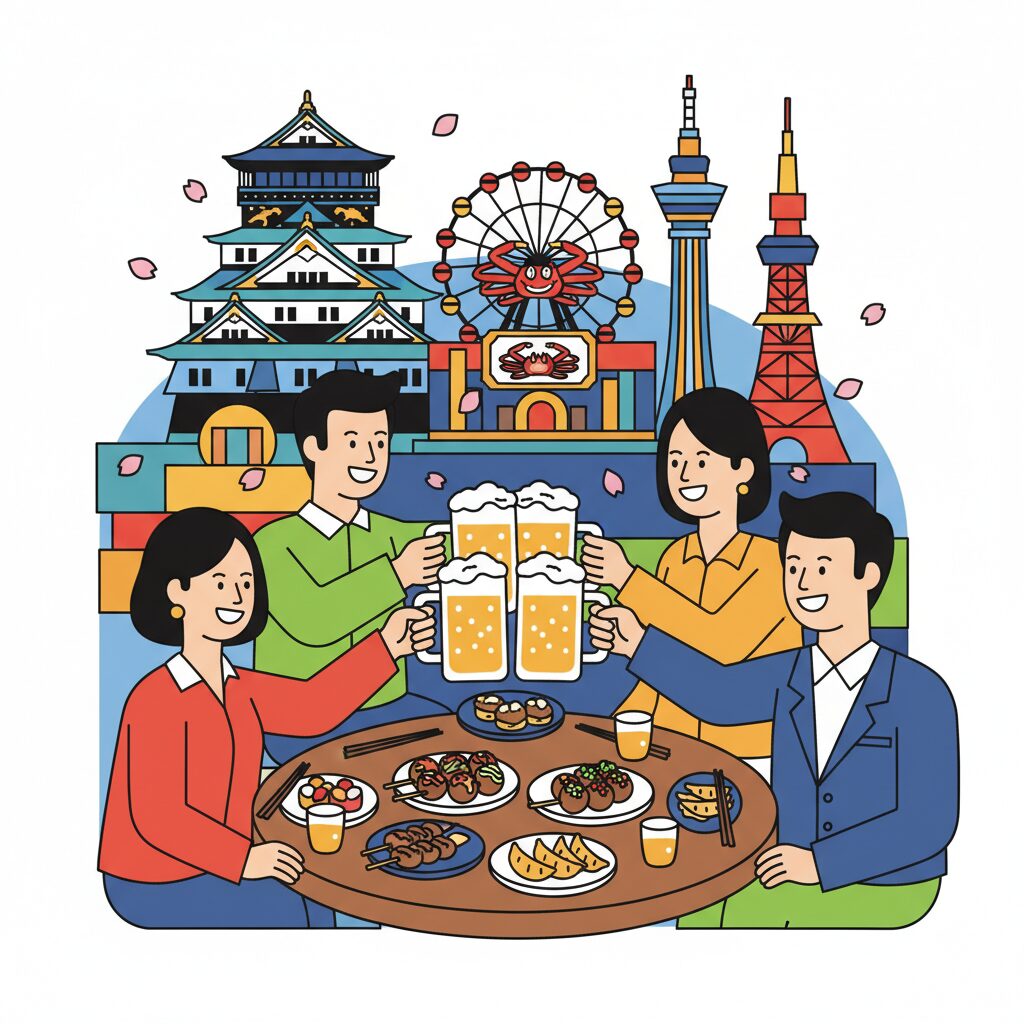
Hey there, it’s Megumi. As an event planner, my life revolves around bringing people together. I’m originally from Tokyo, where orchestrating a corporate gathering feels a bit like conducting a symphony—every instrument has its part, the tempo is set, and precision is key. But since I started working on projects in Osaka, I’ve realized that a company party here is less like a symphony and more like a free-form jazz session. It’s loud, it’s improvisational, and everyone’s trying to play their own hilarious solo. It’s a blast, but if you’re walking in with a dietary restriction—be it an allergy, a religious principle, or a lifestyle choice—that jazz session can feel like pure chaos. The invitation lands on your desk, a cheerful message from your boss: “Team Nomikai, Friday at 7! Let’s get lively!” For most, it’s a chance to unwind. For you, it’s the start of a low-grade, simmering anxiety. Your mind races. Will there be anything I can eat? How do I explain myself without being ‘that person’—the difficult, high-maintenance foreigner? Will they think I’m ungrateful or picky? These are valid fears, especially in a culture that places such a high value on group harmony and shared experiences. In Tokyo, you might solve this with a quiet, formal email to the organizer. In Osaka, that approach can feel cold, almost sterile. Osaka runs on a different social currency, one built on warmth, directness, and a healthy dose of good-natured ribbing. Surviving, and actually thriving, at an Osaka nomikai with dietary needs isn’t about having the perfect Japanese script; it’s about understanding the heart of Osaka communication. It’s about learning to ride the rhythm of the room, using humor as your shield and enthusiasm as your sword. It’s about showing them that even if you can’t share their plate of takoyaki, you can absolutely share their laughter. This guide is your backstage pass, your cheat sheet to navigating the beautiful, bewildering world of the Osaka company drinking party, ensuring you leave with your health intact and your professional relationships stronger than ever. Let’s dive into the noise.
Understanding these nuances is key to mastering the art of the Osaka nomikai, which is why it’s so important to learn why after-work gatherings are key to your career in Osaka.
Deconstructing the Osaka Nomikai: It’s Not What You Think

First and foremost, you need to understand what a nomikai truly is, especially within the Osaka context. From an outsider’s perspective, it might seem like a mandatory fun event—a forced trip to an izakaya to drink with coworkers you already spend eight hours a day with. While there’s a grain of truth in that, it completely misses the point. The nomikai serves as an essential pressure-release valve in the high-context, hierarchical environment of the Japanese workplace. It’s where unspoken thoughts come to light, where stiff formalities dissolve amid a splash of Suntory Highball, and where genuine team bonding occurs.
The Unspoken Agreement: Harmony, Honne, and Plenty of Highballs
In any Japanese office, there’s an ongoing performance known as tatemae—the public face, a polite and agreeable front maintained to preserve group harmony, or wa. You agree with the boss, use ultra-polite language (keigo), and keep your true feelings hidden. While efficient, it’s not entirely authentic. The nomikai is the designated space for honne—your real thoughts and emotions. It’s where your usually reserved section chief, Tanaka-kachou, might suddenly confess a love for 70s rock, or the formidable department head admits he’s nervous about his daughter’s new boyfriend. It’s where you stop being defined by your job title and start being yourself. Sharing food and drink around the same table is both a symbolic and literal ritual of unity; you’re reaffirming your place in the group. This is why someone’s reluctance to participate, especially in eating, can disrupt the group dynamic in subtle, unconscious ways. It’s not personal dislike; it’s that breaking the ritual interrupts the flow.
Osaka’s Twist: Where Business Mixes with Banter
Now, introduce the Osaka perspective. In Tokyo, a nomikai might still feel somewhat formal. Seating reflects hierarchy, conversation often loops back to work topics, and the atmosphere retains a planned sense of casualness. It’s a deliberate breaking down of barriers. In Osaka, it’s more like an explosive release. Boundaries are fuzzier, laughter louder, and the emphasis is less on respectfully airing honne and more on forging personal bonds through shared humor. Osaka businesspeople want to see if you can laugh with them, if you have personality, a sense of humor, a story to tell. They’re evaluating you not just as a colleague but as someone they might genuinely enjoy spending time with outside work. While the business deal matters, the relationship built over grilled squid and cheap beer forms its foundation. The nori—the vibe, rhythm, and collective energy—matters most. If you can catch the same wavelength, you’re accepted. This dynamic presents both a challenge and an opportunity for those with dietary restrictions; showing full engagement with the nori turns your inability to eat the okonomiyaki into a mere side note.
The “Nande ya nen!” Factor: Why Humor Is Your Secret Weapon
At the heart of this dynamic lies Osaka’s classic conversational style of boke and tsukkomi. The boke plays the fool, saying something absurd or silly; the tsukkomi is the straight man who quickly calls them out with a witty retort—often a sharp “Nande ya nen!” (“Why?!” or “What the heck!”). This isn’t just an act for comedians on TV; it’s the everyday rhythm of conversation. Your boss might say, “I’m thinking about buying a Ferrari this weekend,” and instead of a quiet nod, the expected reply is a quick tsukkomi like, “With what money, kachou? Didn’t you say yesterday you couldn’t even afford a new tie?” This exchange isn’t disrespectful; it’s a sign of closeness and affection, showing you’re paying attention and fully engaged. Understanding this is crucial. You can use this exact style to navigate your dietary restrictions. A simple, deadpan “No, thank you” might feel cold, but a playful tsukkomi-style comeback can transform an awkward moment into a chance to connect.
The Art of the Reveal: Timing is Everything
So, you understand the cultural context. Now, let’s discuss the practical strategy: how and when do you reveal that you can’t eat half the items on a typical izakaya menu? Revealing it at the wrong time can cast a shadow over the planning, while a well-timed disclosure makes it a non-issue. The key is to be proactive, casual, and present it as just a simple fact—not a problem for the group.
“Jitsu wa…” – The Subtle Art of Giving Advance Notice
The golden rule is to communicate your dietary needs ahead of time. Never wait until you’re seated at the restaurant, menus in hand, to mention your restrictions. Doing so puts the organizer, or kanji, in a very uncomfortable position. They’ve already picked the venue, likely based on a set course menu that offers good group value. A last-minute announcement forces them to scramble, negotiate with the restaurant staff in front of everyone, and disrupt the smooth start of the event. It shines an unwanted, awkward spotlight on you and your ‘problem.’ The correct approach is to get ahead of it. As soon as the nomikai is announced, find a quiet moment to speak with the kanji.
Choosing Your Messenger: The Kanji is Your Team Captain
The kanji is responsible for organizing the party—they book the venue, collect money, and generally manage the chaos. This person is your most important ally. Your whole approach depends on making their job easier, not harder. In Tokyo, the kanji role is often a formal, rotating duty. In Osaka, it’s usually someone naturally social who genuinely enjoys bringing people together—they’re the group’s social hub. Match your tone to their energy. Don’t send a formal, stiff email. Instead, catch them by the coffee machine or as the day wraps up. Start with enthusiasm: “Sato-san, I’m really looking forward to the nomikai on Friday! Thanks so much for organizing it!” Lead with something positive, then introduce the phrase “Jitsu wa…” which means “Actually…” or “The thing is…” This gentle opener signals you’re about to share a personal detail. You could say, “Jitsu wa, watashi, ebi arerugii ga arimashite…” (“Actually, I have a shrimp allergy…”) or “Jitsu wa, butaniku ga taberarenain desu.” (“Actually, I can’t eat pork.”) Keep it straightforward and factual. Smile. Your tone should express mild apology—not for having the restriction, but for any extra attention it might require. “Gomen ne, o-tesuu okake shimasu.” (“Sorry to trouble you.”) This small show of humility makes a big difference.
The Tokyo vs. Osaka Approach to Sharing Information
Here’s where my Tokyo background offers some insight. In a Tokyo office, this conversation tends to be quite transactional—you tell the kanji, they nod, make a note, and say “Wakarimashita” (“Understood”). The information is processed, and a logistical solution is found. In Osaka, however, the response is often more personal and, frankly, more emotional. Don’t be surprised if the kanji reacts with something like, “Eeeh, hontou ni?! Kawaisou ni!” (“Whaaat, really?! You poor thing!”) followed by a flood of questions: “You can’t eat shrimp? But it’s so tasty! What about crab? What happens if you accidentally eat it?” This isn’t nosiness or doubt; it’s their way of showing empathy and engaging personally with you as a colleague. Embrace it. Share a brief, light story if you have one. Laugh it off. By turning your restriction into a small personal anecdote, you transform it from a burden into a conversation starter, giving them a chance to show they care—which in Osaka, is social gold.
At the Izakaya: Navigating the Culinary Battlefield
You’ve given the heads-up, hopefully the kanji has passed the message along to the restaurant, and now you’ve arrived. The table is bustling, the beer is flowing, and huge plates of food are beginning to appear. This is where your real-time skills come into play. Most izakaya nomikai, especially with large groups, revolve around oosara ryori—big communal platters that everyone shares. This is the core of the challenge.
“Toribashi” Terror and the Dynamics of Shared Plates
In the center of the table, you’ll find various dishes: a sashimi platter, a bowl of edamame, a plate of karaage (fried chicken), a salad, maybe some grilled fish. Each dish will have its own serving chopsticks or tongs called toribashi. The rule is to use the toribashi to move food from the communal platters to your personal small plate (torizara). Never use the chopsticks you’ve used in your mouth to touch the shared food. The concern here is cross-contamination. The toribashi for the fried chicken might have touched the tempura shrimp nearby. Someone might accidentally use their own chopsticks. For those with severe allergies, this can be a minefield. For anyone with religious or lifestyle restrictions, it becomes a constant guessing game.
The “Sore, Nani Haitterun?” Tactic: Asking Questions Without Killing the Mood
At some point, you’ll need to ask what’s in a dish. How you ask matters. Pointing at a dish and bluntly asking “Does this contain meat?” can halt a lively conversation abruptly. It puts your needs front and center and makes everyone feel awkward. Instead, take a conversational, curious approach. Wait for a natural pause or turn to your neighbor as they take a bite. Use a phrase like, “Uwa, oishisou! Sore, nani haitterun desu ka?” (“Wow, that looks delicious! What’s in it?”) This frames your question with positive interest rather than negative scrutiny. Your colleague will probably be happy to explain. If they’re unsure, it becomes a fun group activity to find out. “Hey, Tanaka-san, is there pork in this? Megumi-chan wants to know.” The focus shifts from your ‘problem’ to a shared, light-hearted moment of discovery. You’re not the picky eater; you’re the curious foodie.
The Personal Plate Strategy: Your Safe Zone
Your small plate, your torizara, is your sanctuary. Aim to fill it with items you know are safe as soon as they arrive. When the giant salad bowl lands, be among the first to take a large portion before others get involved. When the edamame appears, grab a generous handful. Same goes for the sashimi, if it’s safe for you. By proactively filling your plate with trusted items, you create a buffer. You’ll have something to nibble on all evening, so it won’t be obvious if you avoid several other dishes. This visual cue matters. A full torizara signals that you’re participating, eating, and everything is fine. An empty plate, however, invites questions and concern, which you want to avoid.
Reading the Room: When to Speak Up and When to Let It Go
This is an advanced social skill in Japan, known as kuuki wo yomu, or “reading the air.” Sometimes a dish arrives that you suspect might contain a forbidden ingredient, but you’re not certain. Is it worth interrupting your boss’s funny story to question the waiter? Probably not. Group harmony and nori often take priority over your curiosity, unless it’s a life-threatening allergy. Sometimes the best move is to simply skip that dish and let it pass. No one is closely monitoring everything you eat. They care more about the conversation, the jokes, and the overall vibe. If you’re laughing, nodding, and your glass is full, you’re successfully taking part in the nomikai. In Osaka, disrupting a good story or ongoing joke is a bigger social faux pas than quietly passing on the grilled squid. Pick your battles. Protect your health but don’t feel you need to police every plate.
The Social Game: Eating is Only Half the Battle
This is the most crucial part of the entire strategy and where you can really stand out. Foreigners often focus so much on the food that they forget the main purpose of the nomikai: communication. If you can’t fully join in on the eating, you must overcompensate by engaging more in the social side. That’s how you succeed.
The Power of the Pour: O-shaku as a Social Tool
In Japan, you typically don’t pour your own drink. Instead, you pour for others, and they pour for you. This is known as o-shaku. It’s an ongoing, flowing ritual of mutual respect and care. Your glass should never be empty, and you should watch the glasses of your superiors and colleagues carefully. This is your secret advantage. Be the most attentive person at the table. Notice when your boss’s beer is about two-thirds gone. Pick up the bottle and, with both hands (a sign of respect), say “Kachou, douzo” (“Chief, please, allow me”) as you pour for him. Do this for everyone around you. By actively and enthusiastically pouring drinks, you show your engagement and respect in a powerful, non-verbal way. You become the one facilitating the group’s enjoyment. No one will mind if you skip the gyoza when you’re the one ensuring everyone’s glass is never empty. You’re supporting the nomikai’s main goal: to relax and cheer everyone up.
“Non-aru de!” – Embracing Non-Alcoholic Choices
What if you don’t drink alcohol? This used to be a tricky spot, but nowadays it’s completely acceptable. The important thing is to still join in the drinking ritual. Don’t just sit there with plain water. Order oolong tea, a Coke, or one of the many new non-alcoholic beers (“non-aru biiru”). When everyone raises their glass for the first “Kanpai!” (Cheers!), lift your tea glass alongside them. Clink glasses and take a sip. You’re part of the ceremony. What’s in the glass doesn’t matter; it’s the act of sharing the toast that counts. In Osaka, you can even joke about it. When ordering, wink and say, “Ocha de youchau BOKU!” (“I’m the guy who gets drunk on tea!”). A little self-deprecating humor shows you’re not judgmental or distant; you just don’t drink alcohol, and that’s perfectly fine.
The Art of Conversation: Be the Entertainer, Not the Patient
Shift all focus away from your plate and onto the people around you. Your goal is to be remembered as the fun, engaged colleague—not the one with the dietary restrictions. That means being actively involved in conversation. Ask about hobbies, families, weekend plans. Osakans especially love to talk and appreciate an interested audience.
Master the “Aizuchi” and the “Tsukkomi”
Two conversational tools will be your best allies here. The first is aizuchi, small verbal cues that show you’re listening and engaged while someone is speaking. In English, these are things like “uh-huh,” “yeah,” and “right.” In Japanese, they are a steady flow of “Un, un,” “Hai, hai,” “Sou desu ne,” and “Eeeh!” Mastering aizuchi makes you a great listener and delightful to talk to. The second tool, as mentioned, is the tsukkomi. You don’t need to be a comedy expert, but learning a couple of quick-witted comebacks can be a game-changer. If a colleague complains about being busy, you can playfully reply, “Sore, itsumo no koto ya n!” (“That’s your usual state!”). If someone tells an exaggerated story, a timely “Uso ya n!” (“No way! / You’re lying!”) will get a big laugh. This playful back-and-forth is the essence of Osaka social interaction. It shows you get the culture. Your value comes from your personality and involvement in the fun, making your dietary needs completely irrelevant.
When Things Get Tricky: Special Cases and Damage Control

Even with the best preparation, things can still take an unexpected turn. The spontaneous nature of Osaka nomikai means you need to be prepared for anything. The party often doesn’t end when you leave the first restaurant.
The Surprise Second Party (Nijikai)
The first party (ichijikai) comes to an end, and a senior colleague enthusiastically shouts, “Yosh, nijikai iku zo!” (“Alright, let’s head to the second party!”). This is the nijikai. Usually, it’s a spur-of-the-moment transition to a different kind of venue—a karaoke box, a ramen shop, or a tiny, smoky bar. This can present a new dietary challenge. Karaoke boxes serve plates of snacks, ramen often contains pork broth, and bars might only offer nuts (a major allergen for some). You have a few choices. First, it’s generally more acceptable to skip the nijikai than the ichijikai. You can politely mention you have an early start the next day. However, if you want to keep bonding, your best option is to go but watch your intake. At the ramen shop, simply don’t order ramen. Just have a drink and enjoy the conversation. At this point, the social flow is more important than everyone eating the same thing. The goal of the nijikai is pure, unfiltered enjoyment, so as long as you’re contributing to that, you’re good.
The Well-Meaning “Just One Bite” Colleague
This is a classic situation. A colleague, perhaps after a few drinks, pushes a piece of food towards you, saying, “C’mon, just try it! It’s delicious! You won’t even notice the [forbidden ingredient]!” They aren’t trying to harm you—they want to share an experience with you. It’s a clumsy but usually well-intentioned gesture of inclusion. A firm, cold “No” might be seen as rejecting their friendship. This is a perfect time to use Osaka-style humor. Wave your hands in mock panic and say, “Muri muri muri! Sore tabetara, ashita kaisha ikenaku naru!” (“No no no! If I eat that, I won’t be able to come to work tomorrow!”), or more dramatically, “Kyuukyuusha yobu koto ni naru de!” (“You’ll have to call an ambulance!”). Exaggerate the consequences with a big smile. This turns your refusal into a joke. You’re not rejecting them; you’re just sparing them the trouble of a medical emergency. They’ll laugh, you’ll laugh, and the moment will pass.
The “Gaman” Misconception: Are You Just Being a Picky Eater?
It’s important to understand the cultural concept of gaman, which means enduring hardship without complaint. It’s highly valued. As a result, some older Japanese colleagues might subconsciously interpret your dietary restrictions through this lens. They may not fully distinguish between a medical necessity and a simple preference (suki-kirai). They grew up in an era when you ate what was served and complaining wasn’t an option. That’s why it’s crucial to frame your issue correctly from the start. Using terms like arerugii (allergy) or explaining it’s for health (kenkou) or religious (shuukyou) reasons helps mark it in their minds as a non-negotiable matter, not just a taste preference. If you’re vegetarian or vegan for ethical reasons, it might be harder for them to understand. You may find it easier to say it’s for your health; this is a category they can accept without question.
Medical vs. Lifestyle: A Crucial Distinction
To be frank, a medically diagnosed allergy will always be taken more seriously than a lifestyle choice like veganism. Japan is improving in accommodating various diets, but in the context of a traditional office nomikai, the system is designed for the majority. If you have a severe allergy, you must be your own strongest advocate, using clear and simple language: “Watashi wa ピーナッツアレルギーです。食べると呼吸が困難になります。” (“I have a peanut allergy. If I eat it, I will have difficulty breathing.”). Be direct about the consequences. For lifestyle choices, a more flexible, low-key approach is better. You might not have a perfect vegan meal, but you can put together a plate of edamame, salad (ask for no dressing or just a simple soy sauce/vinegar), and grilled vegetables. Focus on what you can eat, not what you can’t.
The Long Game: Building Your Reputation
Successfully making it through one nomikai is an achievement. However, the true objective is to establish a lasting reputation within your team that makes the entire experience effortless in the future. You want to be remembered as “Megumi-chan, who’s a joy to hang out with and, by the way, doesn’t eat pork,” rather than “Megumi-chan, the one with the difficult dietary restriction.”
Gratitude is Golden: The Day-After Follow-Up
The following day at the office, be sure to visit the kanji and express your thanks. A simple, “Sato-san, kinou wa arigatou gozaimashita! O-kage-sama de, sugoku tanoshikatta desu.” (“Sato-san, thank you so much for yesterday! Thanks to you, I had a really wonderful time.”) works perfectly. If they went out of their way to accommodate your food needs, acknowledge that as well: “Also, thank you for being so considerate about my diet.” This expresses your gratitude and closes the loop. It makes the kanji feel appreciated for their extra effort and more than willing to help again next time. Additionally, thank senior colleagues who covered part of the bill or with whom you had a great conversation. These small gestures of social politeness build immense goodwill.
Own Your Narrative
You shape how your colleagues perceive you. If you come across as apologetic and uneasy about your diet, they’ll see it as an issue. But if you handle it matter-of-factly, confidently, and with humor, they’ll view it as just another interesting aspect of who you are, much like your taste in music or where you grew up. You can even turn it into a positive. Perhaps your quest for vegan options has made you an expert on the best tofu restaurants in Osaka. When someone needs to find a spot to take a vegetarian client, you become the go-to resource. You’ve transformed your restriction into an asset for the team.
The Osaka Payoff: From Outsider to Uchino-Hito
Here’s the wonderful thing about Osaka: while the initial social challenges may feel daunting, once you’re accepted, you’re genuinely in. Osakans are intensely loyal and protective of their own—their uchino-hito (insiders). Once you’ve proven yourself as a team player who makes an effort to connect with their culture, they’ll adopt you and your dietary needs as their own. The kanji will start checking with you proactively before choosing a venue. Your colleagues will point out dishes you can enjoy. “Ah, Megumi-chan, you can eat this! It’s just grilled fish!” They’ll watch out for you, sometimes even more attentively than you watch out for yourself. This is the reward. You’ll have navigated the lively, confusing, but ultimately warm-hearted world of the Osaka nomikai and emerged not as the ‘difficult foreigner,’ but as a beloved member of the team. And that, more than any meal, is the most fulfilling feeling of all.