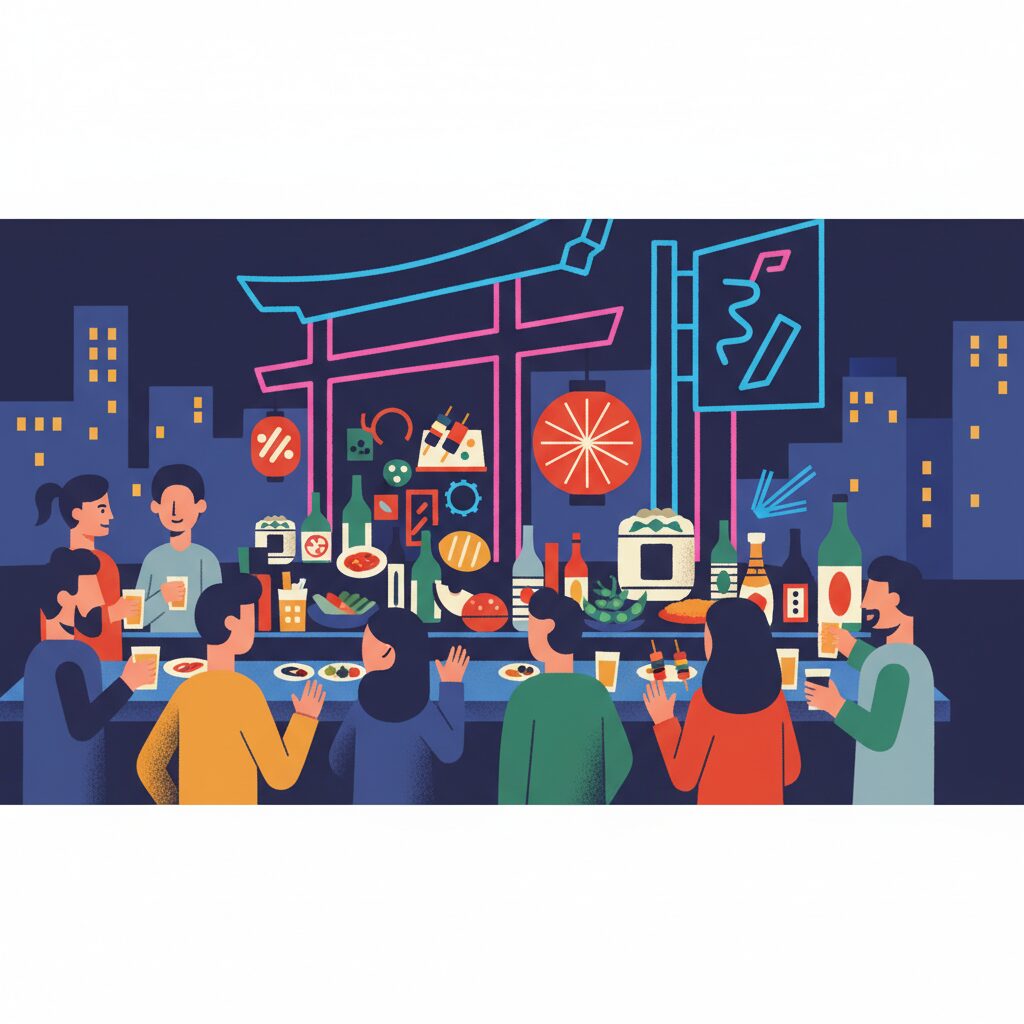
Walk through Osaka after five o’clock on a Tuesday, and you’ll feel it. It’s a low hum that builds into a crackle of electric energy, spilling out from beneath the train tracks in Kyobashi, leaking from the narrow alleyways of Tenma, and glowing under the paper lanterns of Ura-Namba. It’s not the polished sheen of a high-end cocktail bar or the manufactured bonhomie of a themed izakaya. It’s something far more raw, more fundamental to the city’s DNA. It’s the sound of the tachinomi, the standing bar. From the outside, it can look like chaos. A crowd of people, packed shoulder-to-shoulder, talking, laughing, eating, and drinking, all while on their feet. There are no chairs, no hostesses, no reservations. To the uninitiated, it might seem intimidating, a fortress of local custom that’s impossible to breach. You might wonder, what’s the appeal of paying to stand in a crowded room? But to dismiss the tachinomi is to fundamentally misunderstand Osaka. This isn’t just a place to grab a cheap drink. It’s a social lubricant, an economic barometer, and a living, breathing expression of the Osakan mindset. It’s a third space, a decompression chamber between the rigid formalities of the workplace and the quiet solitude of home. It’s where the city lets its hair down, one quick draft beer at a time. Forget the guidebooks for a moment. If you truly want to understand how Osaka thinks, acts, and connects, you need to learn the art of standing still. You need to step inside, find a spare patch of counter, and join the vertical ritual.
If you’re looking for another quintessential Osaka experience that blends daily life with local culture, consider exploring the city’s vibrant neighborhood shotengai for a perfect work-life-lunch balance.
The Philosophy of Standing: More Than Just No Chairs
The absence of chairs in an Osaka tachinomi is neither an oversight nor a design flaw; it’s a deliberate statement of purpose and the foundational principle on which the entire culture is built. In Tokyo, a standing bar might be a sleek, minimalist spot intended for a quick, stylish aperitif before a formal dinner—an aesthetic choice. In Osaka, however, it is a deeply practical one, rooted in the city’s history as Japan’s commercial hub. This is a city of merchants who have long understood that time is money and space is precious. A chair encourages lingering, settling in, and occupying valuable space for longer periods. Removing chairs transforms the venue into a place designed for high turnover and constant movement—a pit stop, not a destination. This philosophy influences every aspect of the experience, from pricing to social interaction.
A Culture of Speed and Efficiency
Watching an experienced tachinomi regular is like observing a masterclass in efficiency. They slide smoothly into an open space at the counter, then place their order in a clear, clipped tone: “Nama-chū to doteyaki.” (A medium draft beer and doteyaki). There’s no hesitation or menu perusal—they know what they want. Their beer arrives; they take a long, satisfying sip. Their food follows; they eat with purpose. They might exchange a few words with neighbors or the bartender, watch a bit of baseball on the small TV in the corner, and within twenty to thirty minutes, they’re finished. They place their money on the counter, give a nod, and disappear into the city flow. This isn’t rudeness; it’s an unspoken collective understanding of the tachinomi rhythm—get in, enjoy your social interaction and sustenance, and get out, making room for the next person. This transient flow is essential to the system, designed for salarymen heading to train stations, shoppers taking quick breaks, and friends grabbing a “zero-kai”—a pre-party drink.
The Economics of the Elbow-to-Elbow Experience
Why is everything so affordable? Many foreigners, used to paying premium prices for city drinks, ask this question. The answer lies in the absence of chairs. By eliminating seating, bar owners can accommodate significantly more patrons in a small space. More customers per hour mean greater volume, enabling them to keep prices remarkably low. This fuels the culture of senbero, a blend of sen-en (1,000 yen) and berobero (drunk or tipsy). The challenge—and the joy—for many Osakans is to see if they can enjoy a pleasant buzz on just 1,000 yen. That might mean three drinks or two drinks and a couple of small plates. This pursuit isn’t about cheap intoxication; it is about value. It reflects the Osakan obsession with being kenjitsu, meaning practical and savvy with money. Scoring a great deal is not just a pleasant surprise; it’s a triumph. People proudly share stories of amazing meals and drinks under a thousand yen. In this light, the tachinomi is the purest expression of Osakan economic philosophy: maximum satisfaction for minimal expense. You’re not paying for fancy decor, attentive service, or comfortable seating. You’re paying for the core essentials: good, honest food and drink served swiftly. The standing-only model embodies this no-frills, value-first mindset.
Cracking the Code: The Unwritten Rules of the Game
While a tachinomi might seem like a chaotic free-for-all, it actually runs on a strict, though unwritten, code of conduct. Breaking these rules won’t get you kicked out, but it will brand you as inexperienced and disrupt the delicate social rhythm. Learning this etiquette is essential to truly savoring the experience and feeling like part of the scene, rather than just a spectator. These guidelines exist to maximize efficiency and minimize friction in a cramped setting. They form the social contract that enables dozens of strangers to coexist peacefully in a space the size of a small bedroom.
The Art of Ordering
First, you need to grasp the payment system, which can differ. The classic Osaka style is cash-on-delivery, often called kyasshu on. You place your money in a small tray on the counter, and with each order, the staff takes the exact amount. It’s efficiency at its finest—no bill to tally, no waiting for a check. This simple transactional method works beautifully. Other establishments use a ticket machine (kenbaiki), where you buy tickets for your chosen items near the entrance and then hand them to the staff. Some, especially modern venues, allow tabs, but cash-on-delivery remains the most traditional method. Second, decisiveness is critical. The person behind the counter handles multiple orders simultaneously and doesn’t have time for hesitation. Scan the handwritten menus on the wall, observe what others are eating, and have your first order ready before claiming a spot. The universal first call is “Toriaezu biru“—”Beer for now.” It’s the Japanese way of buying a moment to settle in and start things off smoothly. Once your beer arrives, you can plan your food orders. Getting the staff’s attention is a subtle skill involving eye contact, a slight hand raise, and a clear, concise order—shouting or waving wildly is a sign of inexperience.
Personal Space is a Luxury
The Western notion of personal space doesn’t apply here. You’ll be in very close contact with the people next to you—elbows will brush, and you’ll overhear their conversations. This isn’t intrusive; it’s the essence of the environment. The key is to stake and defend your small corner at the counter. Once seated, place your drink and a small plate in front of you to mark your territory. Be conscious of your bag and coat, keeping them close and not sprawling into your neighbor’s space. Ironically, this enforced closeness is what makes the tachinomi special. It breaks down the invisible barriers that usually keep strangers apart in a Japanese city. In the tight crowd, usual social boundaries dissolve. You become part of a temporary collective, sharing the same steamy, enticing air. This proximity naturally encourages conversation, creating a fleeting sense of community rarely found elsewhere.
The Social Contract: Don’t Linger, Don’t Loiter
This may be the most vital and often misunderstood rule for newcomers. A tachinomi isn’t a place to settle in for the night. An ideal visit is a lively burst lasting 20 to 45 minutes; an hour is pushing it. The aim is to have one to three drinks, a few small plates, then move on. Staying after you’ve finished eating and drinking is a serious etiquette breach. You’re occupying a spot someone else, waiting patiently by the door, could be using. The entire business model and social flow depend on a steady turnover of customers. When you’re done, pay promptly and leave. This isn’t about the owner rushing you out; it’s your responsibility to the system and fellow patrons. It’s a shared understanding that keeps the tachinomi lively, accessible, and fair for everyone. This culture of transience ensures the bar stays dynamic, continuously refreshed with new faces and energy throughout the evening.
The Holy Trinity: What to Drink, What to Eat
Although social rules are paramount, the tachinomi experience is ultimately driven by its food and drink. The menus are neither extensive nor gourmet, but they are perfected. They feature a canon of dishes that are affordable, flavorful, and quick to prepare, designed to complement alcohol perfectly and be enjoyed while standing. Understanding this core menu is like learning the local dialect; it grants you fluency and an instant sense of belonging.
The Beverage Blueprint
Drinking at a tachinomi follows a familiar rhythm. The vast majority of patrons begin with a beer, often a medium bottle (chūbin) of one of the major Japanese lagers—Asahi, Kirin, or Sapporo—which you pour yourself into a small glass. Draft beer (nama) is equally popular. After the initial beer, customers usually switch to something stronger or lighter. The highball (haiboru), a simple mix of Japanese whisky and soda water, reigns supreme. It’s refreshing, endlessly drinkable, and inexpensive. Close behind are various chūhai, shochu-based highballs mixed with fruit-flavored sodas. The lemon chūhai is a timeless favorite. For the traditionalists, there is cheap, unpretentious sake served straight in a simple glass cup (koppu-zake). These drinks form the backbone of the tachinomi bar for a reason: they are quick to pour, easy to drink, and cost-effective, perfectly embodying the establishment’s core philosophy of speed and value.
The Canon of Tachinomi Cuisine
This is where the soul of Osaka truly shines. Tachinomi food is rustic, hearty, and deeply satisfying. It’s the kind of fare that makes you want another drink. Several dishes are so iconic that a tachinomi wouldn’t feel complete without them.
Doteyaki (どて焼き)
If there is one dish that defines the Osaka tachinomi, it is doteyaki. A humble yet sublime mix of beef sinew, konjac, and sometimes tofu, slow-cooked for hours in a rich, sweet, and savory miso-based broth. It often simmers in a large pot on the counter, filling the air with an irresistible aroma. Served in a small bowl with a sprinkle of green onions and a dab of mustard, doteyaki is the ultimate comfort food. The beef sinew becomes incredibly tender, melting in your mouth. It represents the Osakan spirit of taking inexpensive, tough cuts of meat and, through time and care, turning them into something truly delicious. It’s the heart and soul of the tachinomi in a bowl.
Kushikatsu (串カツ)
This is Osaka’s other great contribution to Japanese casual dining. Kushikatsu are skewers of various ingredients—meat, seafood, vegetables—breaded in panko and deep-fried to a perfect golden brown. They are served with a communal pot of thin, savory dipping sauce. Here, the most sacred rule of the tachinomi applies: NO DOUBLE DIPPING. You dip your skewer once, and only once, into the sauce pot. If you want more sauce, you use the provided slice of cabbage to scoop it onto your plate. This rule is not a mere suggestion; it is an ironclad law of hygiene and social consideration. It is a microcosm of Japanese society, where individual desire is balanced by the needs and comfort of the group. Breaking this rule is the ultimate sin, and you will be met with glares from staff and patrons alike. Mastering the art of the single dip is a rite of passage.
Oden (おでん)
Particularly in colder months, a simmering pot of oden is a welcome sight. This one-pot dish includes various ingredients simmered for a long time in a light, dashi-based broth. Classic items include daikon radish that has become translucent and soft, boiled eggs flavored by the broth, various types of fish cakes (nerimono), and blocks of tofu. You simply point to what you want, and the master plucks it from the broth, serving it with a touch of sharp Japanese mustard (karashi). Oden is simple, warming, and communal—the perfect food for a quick stop on a chilly evening.
Beyond the Counter: The People and the Places
A tachinomi is more than merely a collection of recipes and rules; it serves as a stage where the daily drama of Osaka life unfolds. It is defined by its unique cast of characters and the distinctive atmosphere of the neighborhoods that host them. These places are not tourist hotspots; they are essential elements of the local urban landscape.
The Cast of Characters
Each tachinomi features its own archetypes. Behind the counter stands the taishō (master), often a man of few words who acts as the silent conductor of the space. He moves with economical precision, taking orders, pouring drinks, and preparing food, all while keeping a vigilant eye on the entire room. He knows the regulars by name and their usual orders by heart. The jōren (regulars) form the establishment’s backbone—older men and women who have frequented the spot for years, each with a preferred seat and a familiar rhythm. Observing them is the best way to grasp the unspoken customs. Then there are the newcomers: office workers, young couples, and the occasional curious foreigner. The magic arises from the interactions between these groups. A regular might assist a newcomer in navigating the menu, or a salaryman might chat with the person beside him about the Hanshin Tigers’ latest game. These are not profound conversations but rather brief moments of connection—light interactions that bridge the gap between strangers and make the sprawling, anonymous city feel like a small village for a moment.
The Anatomy of a Tachinomi Neighborhood
The character of a tachinomi often mirrors that of its neighborhood. To appreciate the diversity of the scene, one must explore its main hubs.
Tenma (天満)
Just north of Osaka Station, Tenma is a vast, chaotic, and utterly charming maze of covered shopping arcades and narrow side streets. It presents a sensory overload in the best sense—a dense concentration of tachinomi ranging from decades-old, wonderfully gritty institutions to newer, slightly more polished standing bars focusing on wine or craft beer. Strolling through Tenma is like perusing a library of drinking venues. The sheer variety and competition keep prices low and standards high. It captures the boundless energy and culinary diversity of Osaka.
Kyobashi (京橋)
If Tenma is a sprawling library, Kyobashi is a well-worn paperback you can’t put down. Located at a major rail hub, Kyobashi is the quintessential salaryman district. The tachinomi here, especially those nestled in dark, atmospheric alleys beneath train tracks, are rough and unpretentious. Here, you’ll find some of the city’s most historic and character-rich standing bars. The air smells of grilled meat and cigarette smoke. The clientele tends to be older and more local. Kyobashi offers a glimpse into the post-war Showa-era soul of Osaka, worlds apart from the shiny shopping malls and tourist attractions.
Ura-Namba (裏なんば)
South of the neon-lit frenzy of Dotonbori lies Ura-Namba (literally “behind Namba”), a slightly more refined yet equally lively area. This neighborhood has undergone a renaissance in recent years, with a new generation of chefs and owners launching slightly more modern and specialized tachinomi. You might find a standing bar dedicated to Italian cuisine, another specializing in sake pairings, or one focusing on fresh seafood. It draws a younger, more diverse crowd and demonstrates how the traditional tachinomi format can be adapted and reinvented for a new era, while still embracing the core principles of speed, value, and casual social connection.
The Tachinomi as a Cultural Barometer
Ultimately, the tachinomi is far more than just a place to eat and drink while standing. It offers a clear view into the core values of Osaka culture. It acts as a cultural barometer, reflecting the city’s pulse.
The entire setup embodies Osakan pragmatism. Every aspect, from the absence of chairs to the cash-on-delivery system, is designed for efficiency and value. There is no pretense or unnecessary adornment. It is straightforward and honest, much like the people of Osaka.
More importantly, in a society that can often feel socially rigid and hierarchical, the tachinomi serves as a great equalizer. Within those four walls, job titles, income, and social status disappear. The CEO stands shoulder-to-shoulder with the construction worker, the university student beside the retiree. They are united by the same rules, sharing the same food and beer. This shared experience fosters a powerful, if brief, sense of community.
For many, the tachinomi offers relief from the pressures and potential loneliness of modern urban life. It provides a guaranteed space for low-stakes social interaction. No plans or reservations are needed. You can simply show up alone and, for thirty minutes, be part of something. You might share a brief conversation with a stranger, laugh over a baseball game, then fade back into the night feeling a little more connected, a little more human. This, right here, is the true Osaka. It’s not merely a city described as “friendly.” It’s a city that has mastered the art of fleeting community, the transient tribe, united by the simple, beautiful ritual of standing together at the counter.