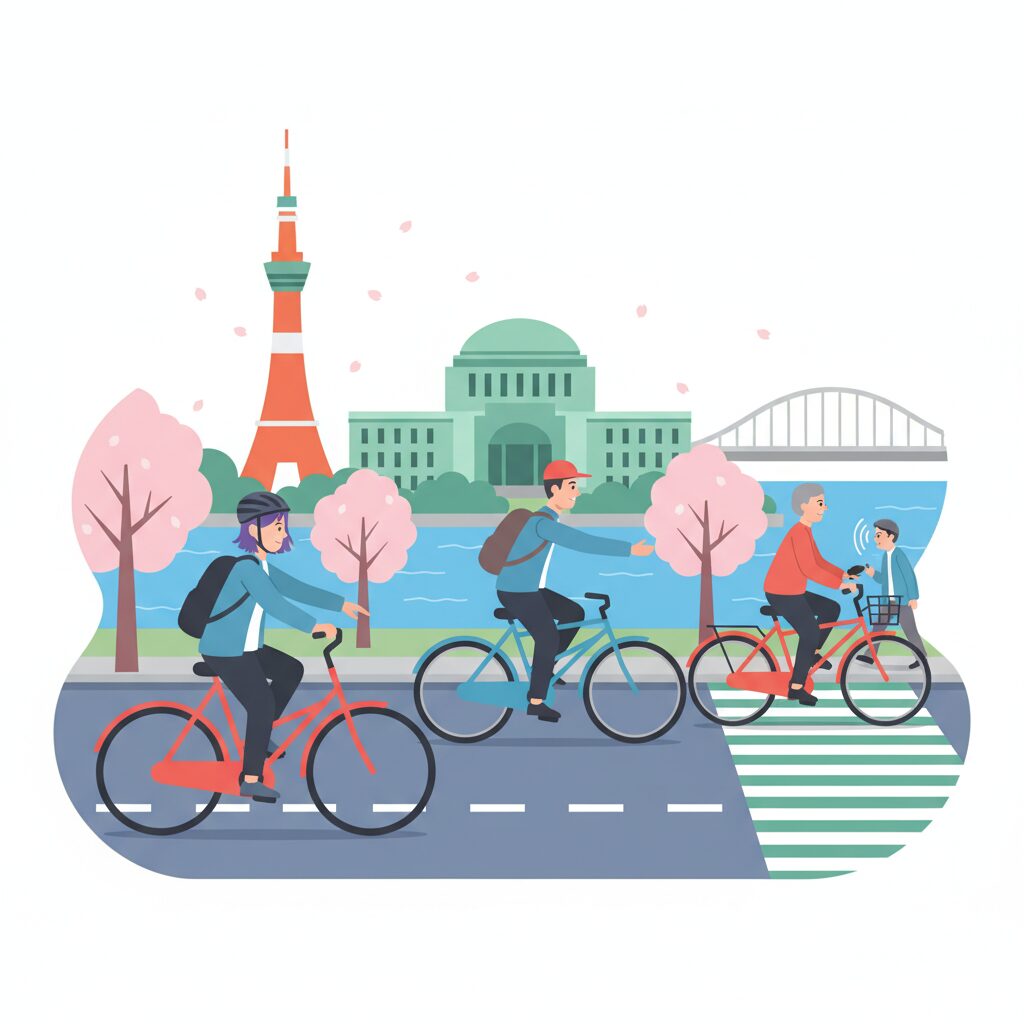
Step off the train at any station in Osaka, from the urban canyons of Umeda to the quiet residential lanes of Tennoji, and the first thing you’ll notice isn’t the architecture or the advertisements. It’s the bicycles. They’re everywhere, a sprawling, metallic ecosystem of transportation. They lean against shop fronts, cluster in designated parking lots like schools of fish, and flow through the streets in a current that seems both chaotic and mysteriously coordinated. For someone used to Tokyo’s meticulous, train-centric rhythm, where life is dictated by timetables and platform numbers, Osaka’s reliance on the humble bicycle feels like a fundamental shift in the city’s operating system. It’s a declaration of independence from the underground maze, a commitment to life at street level. This isn’t just about getting from point A to point B; it’s a core part of the city’s identity—pragmatic, a little bit defiant, and governed by a complex set of rules that you’ll never find written on a sign. To truly understand life in Osaka, you have to understand the way of the bicycle. This isn’t a guide to traffic laws. This is a guide to the unspoken symphony of the street, the rhythm and etiquette that keep this two-wheeled city moving. It’s about learning to read the air, not just the road signs, and finding your place in the flow.
Embracing Osaka’s unique bicycle culture often leads one to explore other hidden facets of the city, such as roadside stations that open up unexpected weekend adventures.
The Holy Trinity: Mamachari, Sidewalks, and Shopping Arcades

At the core of Osaka’s bicycle culture lie three interwoven elements that shape the everyday experience: the chosen vehicle, the terrain it traverses, and the final destination. This isn’t about sleek road bikes or high-performance equipment. It’s about the gritty, practical reality of urban life, where the bicycle functions less as a piece of sporting gear and more as a reliable workhorse. Grasping this triad is the first step to understanding the city’s dynamic energy.
The Mamachari: Osaka’s Urban SUV
Forget the image of a lightweight, carbon-fiber racing bike. The undisputed ruler of Osaka’s streets is the mamachari—the “mom’s chariot.” These bicycles serve as the city’s version of a family minivan or SUV, built for utility, not speed. They are sturdy, steel-framed machines, often single-geared, designed to endure the daily grind. The classic model sports a wide, deep basket upfront, ideal for groceries or a briefcase. A robust rack over the rear wheel frequently holds a child seat, sometimes two. You’ll often see mothers expertly steering these bikes with one child on the back and a smaller one secured to the handlebars. Add-ons are common: a spring-loaded clamp on the rear rack for securing bags, a clear plastic rain shield for the child seat, and the clever kasasuta, a handlebar clamp that holds an umbrella, freeing a hand for steering. The mamachari embodies Osaka’s practical mentality. It’s not stylish or fast, but it is incredibly effective. Watching a woman in her sixties, clad in an apron and sensible sandals, navigate a crowded street on a mamachari laden with leeks, tofu, and beer is a lesson in balance and calm confidence. The bike becomes an extension of the home—a tool for managing daily logistics efficiently and effortlessly.
Sidewalk or Street? The Great Osaka Debate
This is perhaps the greatest puzzle for newcomers. The law states that bicycles, as vehicles, should be ridden on the street’s left side, following traffic flow. Sidewalks are for pedestrians. In Tokyo, this rule is usually followed fairly strictly. In Osaka, however, the reality is far more flexible. The sidewalk isn’t sacred pedestrian-only ground but contested space shared through constant low-key negotiation. People of all ages ride on sidewalks, often at a brisk pace. The choice between street and sidewalk isn’t dictated by strict legal interpretation but by a fluid risk assessment. Is the road narrow and crowded with speeding cars? The sidewalk is safer. Is the sidewalk packed with pedestrians exiting a subway station? Then the street is preferable. The unspoken rule is to choose the path of least resistance and danger for everyone involved. This reflects Osaka’s deeper cultural trait: prioritizing the jitsujō—the actual situation on the ground—over abstract rules. The system works because riders skillfully weave through pedestrians, who in turn are used to sharing their space with bikes. Both develop a sixth sense, anticipating the silent approach of a two-wheeled vehicle without needing to look. It’s a dance of mutual awareness aimed at keeping things moving smoothly without incidents.
The Shopping Arcade Grand Prix
This delicate dance is most evident in Osaka’s famous shōtengai, the covered shopping arcades that serve as the city’s commercial lifeblood. Streets like Tenjinbashi-suji, Japan’s longest shopping street, or the bustling Shinsaibashi-suji, are not pedestrian-only zones. Instead, they are lively, chaotic rivers of humanity, with bicycles flowing as part of the current. Riding through a crowded shōtengai during peak hours is a quintessential Osaka experience: a slow, careful weave, an urban slalom. You don’t rush; you drift along, adjusting speed to the ebb and flow of foot traffic, anticipating when groups of students might suddenly stop at a shop window or when a merchant steps out with a delivery. Communication is through subtle cues: a glance, a slight body shift, a gentle brake tap. Bells are used sparingly, more as a polite “excuse me” than a loud demand to clear the way. This scene would be unthinkable in orderly Tokyo, where cycling through such dense crowds would be considered rude. In Osaka, it’s simply how shopping is done, reflecting a local tolerance for organized chaos and a shared belief that as long as everyone pays attention and makes small adjustments, the system runs smoothly without strict rules.
The Art of Parking: A Masterclass in Tetris
Once you reach your destination, a new challenge arises: parking. The sheer number of bicycles in Osaka far exceeds the capacity of official parking facilities. This shortage has led to unwritten rules and informal systems, turning bicycle parking into a strategic exercise in spatial reasoning and social awareness. It’s a daily puzzle every resident must navigate.
Official Parking vs. Guerrilla Parking
The city offers official bicycle parking lots, or chūrinjō. Some are large, multi-level underground structures, while others consist of simple rows of metal racks along the street. These are the authorized, legitimate options. Using them typically involves some technology: you slot your bike in, a metal clamp locks the front wheel, and you pay a modest fee—usually around 100 to 150 yen for several hours—when you retrieve it. These lots are safe and secure. The issue is that there are never enough spaces, especially near busy train stations or popular shopping areas. This shortage gives rise to “guerrilla parking,” the unofficial but widely accepted practice of parking wherever a small space is found. Bikes line up with military precision against office walls, are chained to guardrails, or cluster around utility poles. However, this is not a free-for-all; an unspoken etiquette governs it. The key rule is not to be a nuisance: don’t block store entrances, don’t obstruct tactile paving for the visually impaired, leave clear paths for pedestrians, and add your bike to the end of existing orderly rows. This is a communal space management system, a collective understanding to bend the rules in a considerate and minimally disruptive way.
The Impound Truck: The Final Boss
This tolerated rule-bending has limits, enforced by the silver municipal impound trucks. These vehicles are responsible for removing illegally parked bicycles, often operating in designated “no parking” zones—popular spots for guerrilla parking due to their convenience. City workers move efficiently, cutting cheap locks with bolt cutters and loading the bikes onto the truck. Encountering one of these trucks in action, or worse, returning to find your bike gone, is a rite of passage for Osaka cyclists. A notice is usually left behind directing you to the municipal impound lot. Retrieving your bike involves a bureaucratic process: a trip to a distant location, showing identification, and paying a fine of several thousand yen. The impound truck serves as a constant reminder that the unspoken rules exist within a larger framework. You can bend them, but not break them entirely. It prevents guerrilla parking from descending into chaos, enforcing a baseline order and reminding cyclists to be mindful of where they leave their bikes. The risk of being towed acts as a check and balance within the city’s flexible parking approach.
The Social Code of the Cycle Path

Cycling through Osaka is as much a social experience as it is a physical one. Because you’re constantly in close contact with pedestrians, other cyclists, and drivers, a rich, non-verbal language has evolved to keep everything running smoothly. This social code relies on small gestures, shared sounds, and mutual understanding, emphasizing flow and cooperation over strict adherence to right-of-way rules.
The Bell: To Ring or Not to Ring?
In Osaka, the bicycle bell serves as a nuanced form of communication. In many Western countries, and even in Tokyo, ringing a bell at pedestrians can come across as aggressive or impatient—a rude way of saying “move aside.” But in Osaka, its use is far more practical and less emotionally charged. A gentle chirin-chirin from a safe distance simply signals your presence. It acts as an audible “on your left,” a polite alert to a pedestrian who might be drifting into your path. It’s not a command but a piece of information to help avoid collisions. Of course, context matters: frantic, repeated ringing right behind someone is still considered rude. Yet, the casual, informative bell is an essential part of the city’s soundscape and a key tool for navigating shared spaces like sidewalks and shopping arcades. It’s a sign that you’re part of the same system, cooperating to reach your destination.
The “Sumimasen” Head-Nod
Much of the interaction between cyclists and pedestrians is non-verbal. The most common and important gesture is a slight head-nod, often paired with a murmured “sumimasen.” This wonderfully versatile Japanese word can mean “sorry,” “excuse me,” or “thank you,” depending on the context. When squeezing through a narrow gap or accidentally cutting someone off, a quick nod and a soft sumimasen serve as a universal social lubricant. It acknowledges the other person and apologizes for the minor inconvenience. It’s a gesture of mutual respect that eases potential tension and keeps the fluid, improvisational movement going. A pedestrian might signal you to pass with a small wave; you respond with a nod. If you get a bit too close, you offer the nod as an apology. This ongoing exchange of small, thoughtful gestures is the invisible glue holding the entire chaotic system together.
The Umbrella Samurai
Rainy season in Osaka brings a distinctive challenge, met with a unique local solution known as the Umbrella Samurai. This involves riding a bicycle with one hand while holding a full-sized umbrella in the other. Although technically illegal and undoubtedly risky, the streets fill with these skilled riders on any rainy day, gliding through the downpour with impressive finesse. Some use kasasuta holders, but most depend on sheer practiced skill. They tuck the umbrella handle against their shoulder, angle it against the wind, all while steering, braking, and navigating with their free hand. This practice exemplifies Osaka pragmatism at its best. Rain is part of life, but it won’t disrupt daily errands. Taking the train is a hassle, and wearing a rain poncho often feels too stifling. Thus, a risky yet effective method is widely embraced. It reflects the local “get it done” mindset and a balancing skill passed down through generations. While a Tokyoite might view it as dangerously reckless, an Osakan sees it as a perfectly sensible solution to a common problem.
Beyond the Rules: The Osaka Biker’s Mindset
To view Osaka’s bicycle culture simply as a collection of quirky habits misses the deeper meaning. It directly reflects the city’s essential character. How people ride their bikes here reveals their mindset, priorities, and interpersonal connections. It is a life philosophy expressed on two wheels.
Practicality Over Formality
The guiding principle behind nearly every unspoken rule is gōrisei—rationality and practicality. The focus isn’t “Is this technically correct according to the rulebook?” but “Is this the most efficient and sensible way to accomplish my goal right now?” This mindset explains why riders use sidewalks to avoid dangerous traffic, park their bikes in tidy but unofficial rows, and ride with umbrellas in the rain. There is a tacit understanding that official rules serve as a useful starting point, but must be adapted to the specific, immediate needs of each situation. This flexibility can be surprising to those from cultures that prioritize strict rule-following, but in Osaka, it’s simply common sense. It reflects a flexible, results-driven approach long rooted in the city’s merchant culture.
Reading the Air, Not the Sign
Being a successful cyclist in Osaka relies less on knowing the traffic laws and more on the ability to kūki o yomu, or “read the air.” This Japanese concept refers to sensing the mood and intentions of a situation and its people without explicit communication. You learn to anticipate the elderly man ahead wobbling slightly, sense a group of teenagers about to stop suddenly, or notice a delivery driver on a scooter preparing for a sharp turn. It’s a heightened state of awareness, constantly processing subtle environmental cues. You are not an isolated vehicle following fixed rules; you are a node in a dynamic, living network. This shared sensitivity keeps the system functioning despite its apparent disorder. Everyone, to some degree, reads the air and adjusts their behavior, creating a self-regulating flow that is more resilient and adaptable than any rigid law could provide.
A Different Kind of Politeness
A foreigner, especially from Tokyo, might initially interpret Osaka’s cycling habits as aggressive or self-centered. The sidewalk riding, close passes, and overall momentum can feel intimidating. But this is a misunderstanding of the local culture. Politeness in Osaka is not found in strict rule adherence but in the micro-interactions that enable smooth shared movement. It’s present in the sumimasen head nod, the readiness to yield a few inches of space, and the skillful weaving through crowds without collisions. The social contract is not “everyone will follow the rules exactly” but “everyone pays attention and acts to avoid seriously inconveniencing others.” This is a more robust, interactive form of consideration, based on the assumption that everyone is a competent, aware participant in the city’s controlled chaos.
To master cycling in Osaka is to absorb this mindset. It means understanding that the city moves to a rhythm of practical efficiency, upheld by a web of shared assumptions and constant small negotiations. When you find yourself gliding effortlessly through a crowded shopping arcade, ringing your bell with a gentle flick of your thumb, and nodding briefly to a pedestrian who yields, you’ll realize you’re no longer just visiting. You’re beginning to grasp the heart of this vibrant, pragmatic, and wonderfully human city. You’ve become part of its symphony.